


Quick Answer: The best way to compare business energy in the UK is to use a digital comparison platform that shows broker fees separately from supplier rates. Gather your MPAN/MPRN and annual usage, compare total annual costs (not just unit rates), and switch during your renewal window to avoid penalties. Businesses switching from deemed rates typically save 30-45% on their energy bills.
TL;DR: Key Takeaways
The Opportunity: UK businesses switching energy suppliers can save 30-45% by moving from deemed rates (~38p/kWh) to contracted rates (~22-24p/kWh). According to Ofgem’s Non-Domestic 2024 Research Report (opens in new tab), 33% of UK businesses switched supplier in 2024 - up from 26% in 2023 - with 53% citing price as their primary motivation.
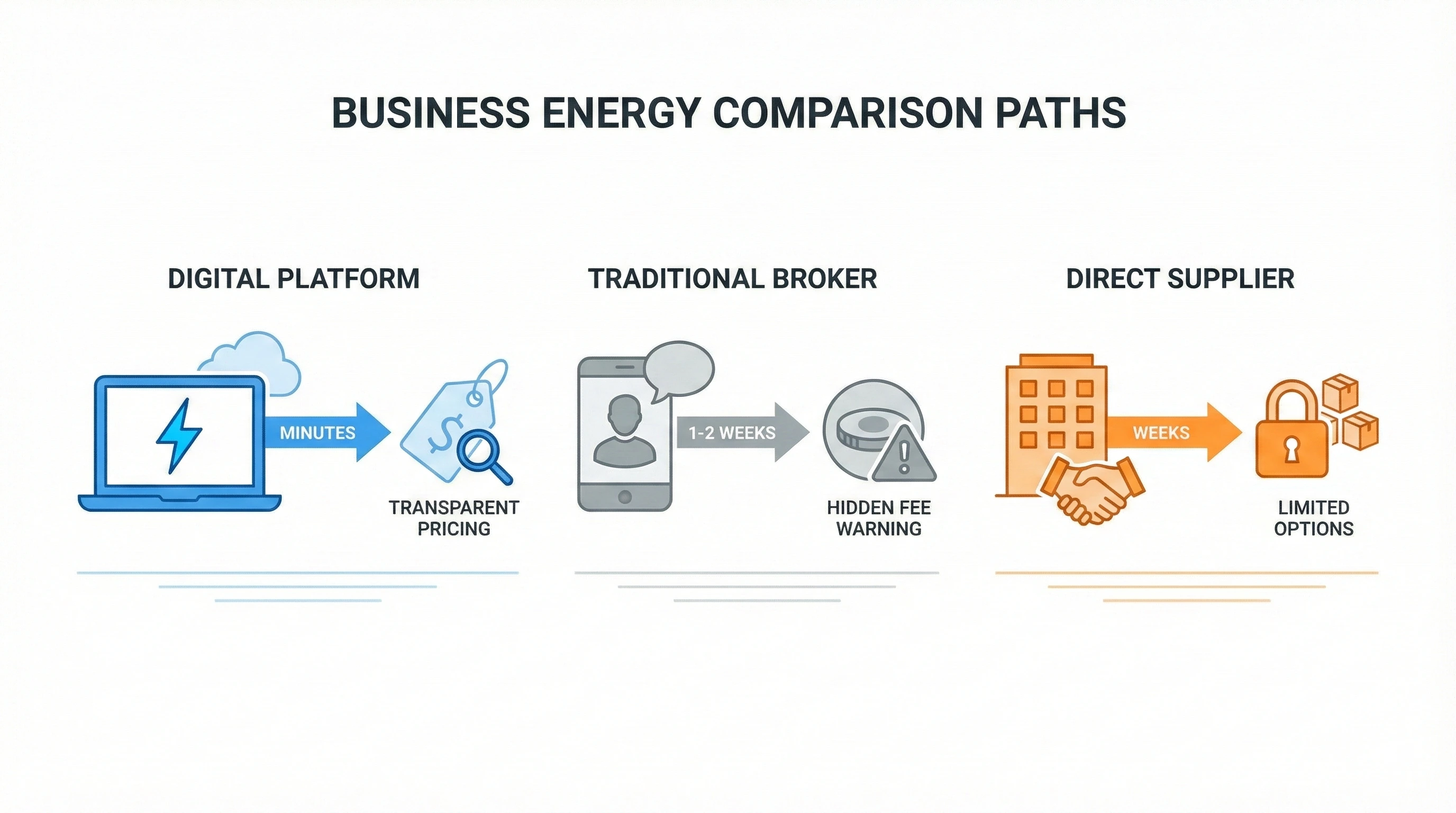
The Three Paths: You can compare business energy via digital platforms (fastest, most transparent), traditional brokers (better for complex sites), or direct supplier contact (slowest, limited options).
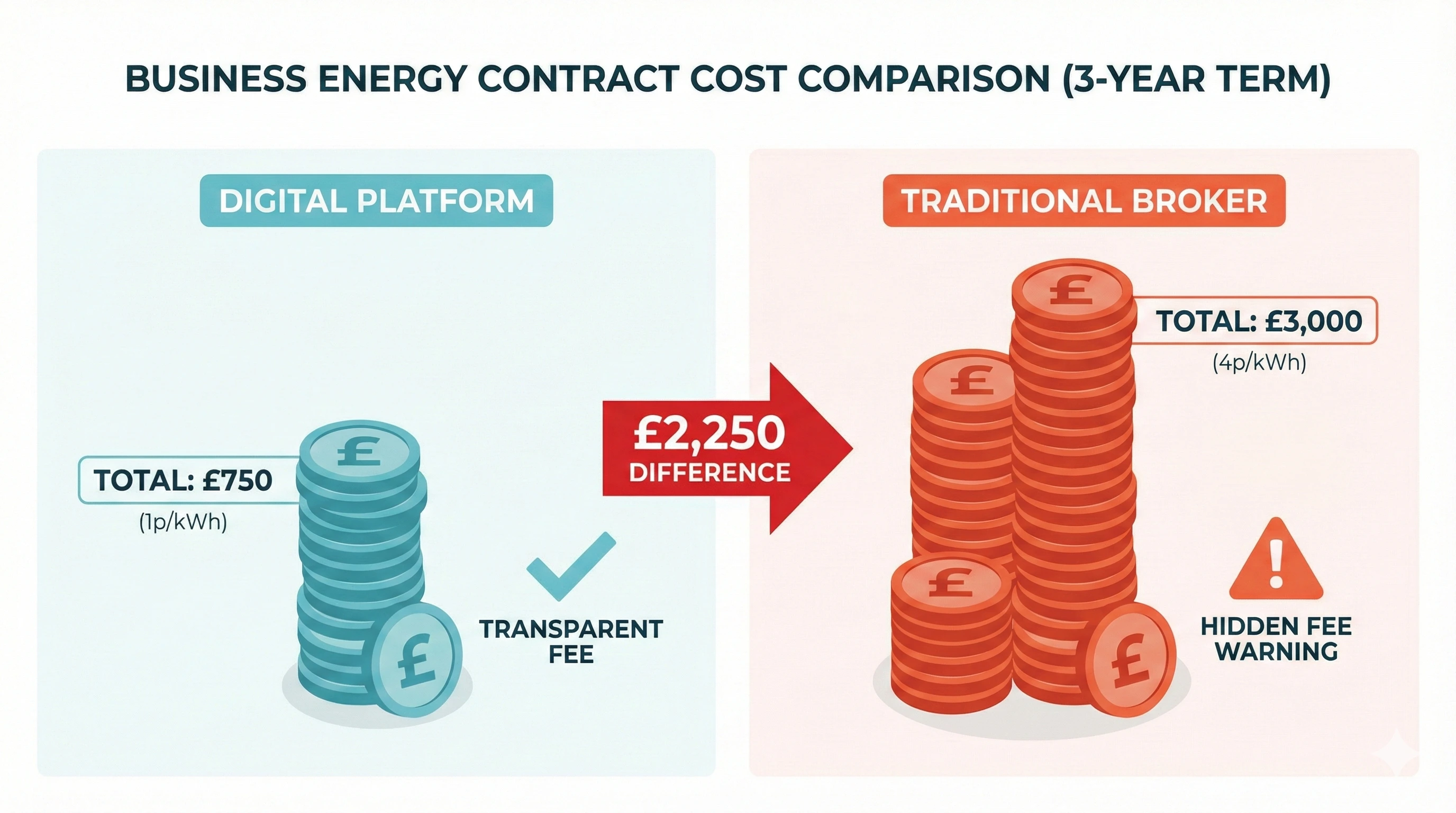
The Undisclosed Cost Problem: Traditional brokers build their commission into your unit rate. Ofgem’s data (opens in new tab) shows broker fees of about 3p/kWh were typical at some suppliers in 2022-23 - three times Meet George’s 1p - which is £750 a year for a business using 25,000 kWh. Since October 2024, Ofgem requires this to be disclosed, but legacy contracts remain opaque. Critically, Ofgem’s 2025 research shows 63% of businesses that used a broker thought they weren’t charged for it - despite commissions being embedded in virtually every contract. This is exactly why businesses think energy brokers are “free”.
The Data You Need: Your MPAN (electricity) or MPRN (gas), annual consumption in kWh, and contract end date. Without accurate data, quotes are unreliable.
The Meet George Difference: We compare a range of suppliers instantly, show our 1p/kWh fee separately from the supplier rate, and complete the entire process in 20 minutes. No undisclosed margins, no phone tag with brokers.
What Is Business Energy Comparison?
Business energy comparison is the process of evaluating electricity and gas tariffs from multiple suppliers to find the best rates, contract terms, and service for your commercial premises. Unlike residential switching, business energy comparison involves navigating wholesale market pricing, broker commissions, and contract clauses like volume tolerance that can add undisclosed costs if your usage varies from estimates. The comparison process also involves credit checks and supplier acceptance criteria - some suppliers won’t accept certain business types (such as pubs, clubs, or care homes) or businesses with poor credit history, which can limit your available options.
The UK business energy market includes 72 active non-domestic suppliers (opens in new tab) (compared to just 23 in the domestic market) and about 2,000 active brokers on the Energy Ombudsman’s register in October 2026 (Third Party Intermediaries or TPIs). Ofgem provides guidance on what businesses need to know about TPIs (opens in new tab). The market encompasses 3.3 million non-domestic meters consuming 144.6 TWh annually - with the average business meter using 44 times more electricity than a domestic meter (43,818 kWh vs ~1,000 kWh).
This guide explains how to compare business energy effectively in 2026, avoid the common traps, and secure the best rates for your business - whether you’re a sole trader using 5,000 kWh or an SME consuming 100,000 kWh or more annually.
UK Business Energy Broker Market Share
Exact broker market share data isn’t publicly available - most TPIs are private companies filing abbreviated accounts at Companies House, so revenue and customer numbers are largely hidden. But we can piece together a picture from Cornwall Insight rankings, Ofgem data, and the few public filings that exist.
Who dominates the broker market?
Cornwall Insight (opens in new tab) publishes periodic TPI rankings, though detailed data is behind a paywall. What is clear from public sources is that the market splits into three tiers:
- Large listed or PE-backed firms - A handful of companies dominate the top end. Inspired PLC (opens in new tab) (AIM: INSE) is the only publicly traded TPI, reporting £98.8m revenue in 2023 across procurement, ESG, optimisation, and software - not just brokerage. Other large players are private and don’t publish revenue figures.
- Mid-market brokerages - Regional or specialist firms with established supplier relationships, typically handling SME and mid-market contracts. Many operate through network affiliations to pool compliance costs.
- The long tail - The vast majority of registered brokers are small operations - sole traders, telephone sales desks, and local consultancies operating on thin margins.
The market is highly concentrated at the top and extremely fragmented at the bottom. For a deeper look at where this is heading, see our analysis of energy broker consolidation in the UK.
How many brokers are there?
The Energy Ombudsman’s broker register listed 1,999 active members in October 2026 (its downloadable register also keeps around 1,000 former members). The more meaningful numbers:
- 1,952 brokers were members of the Energy Ombudsman’s broker dispute scheme at the end of 2025, up from 1,812 at the start of the year (Energy Ombudsman, 2025 review (opens in new tab))
- Only 72 have signed the voluntary TPI Code of Practice (RECCo register (opens in new tab), checked 16 October 2026) - under 4% of the brokers in the Ombudsman’s scheme (our arithmetic)
- 37% of businesses used a broker to choose their current energy contract, according to Ofgem’s 2024 research (opens in new tab)
- Businesses that used a broker switched at 48% vs 23% for those that didn’t - brokers drive higher market engagement, but at a cost
Who dominates the supplier side?
While broker market share is opaque, supplier market share is better documented. In the non-domestic market:
- EDF Energy (opens in new tab) is the clear leader for large businesses - holding 27% of I&C meter points and 25% of volume according to Cornwall Insight. In the largest consumption band (>30 GWh), EDF holds 66% of meters.
- SmartestEnergy (opens in new tab) ranks 3rd largest C&I supplier by volume (11.5 TWh) and 4th overall in the non-domestic market - achieved through organic growth rather than acquisitions.
- Octopus Energy became the UK’s largest overall energy supplier in January 2025, managing 12.9 million meters across domestic and non-domestic. Their non-domestic share is growing but exact figures aren’t broken out separately.
The domestic “Big Six” still dominate the non-domestic market by volume, but the supplier landscape is more fragmented than the residential side - 72 active non-domestic suppliers versus just 23 domestic.
Why this matters for comparison
The broker market’s opacity is the problem. When 63% of businesses that used a broker thought they paid nothing for it (Ofgem, 2025 (opens in new tab)) and the largest brokers won’t disclose their revenue or commission structures publicly, the market is working against informed comparison. This is why Ofgem mandated commission disclosure in contract terms from October 2024 and why mandatory broker regulation is expected by 2027.
Who Are the Best Business Energy Brokers in the UK?
A commercial energy broker (the industry calls them third-party intermediaries, or TPIs) gets business gas and electricity quotes from suppliers on your behalf, and is usually paid by a fee built into the price you pay. There is no official ranking of the best business energy brokers in the UK. Ofgem does not yet license or rank brokers - it says it is “getting new powers” and “still need[s] to create the new rules” - so the best broker for your business is one that passes the checks Ofgem already expects (Ofgem, July 2026 (opens in new tab)).
Ofgem’s July 2026 good-practice guidance for brokers and comparison sites gives you the checklist. A good broker should:
- Say whether it searched the whole market. Ofgem expects brokers to “make it clear whether you searched all energy suppliers or only certain ones”.
- Tell you its fee before you sign. That means explaining “your commission or fee arrangements, including how much you’ll receive and how the customer pays”. Ask for it in pence per kWh and in pounds over the contract.
- Belong to a dispute scheme. Brokers with micro or small business customers “must sign up to a Qualifying Dispute Settlement Scheme”. You can check the Energy Ombudsman’s broker register (opens in new tab).
- Show you the principal terms: price, contract length, start date, renewal terms, termination conditions and early exit fees.
- Ideally, follow a code of practice. Ofgem points to the voluntary RECCo TPI code of practice (opens in new tab), whose register you can search, and the Utilities Intermediaries Association’s code.
Ofgem’s test for value is simple: “We would expect any commission or fees you get to reflect the services and benefits given to customers.” Size is no proxy for any of this - the market share picture above shows a few large firms and a long tail of small ones among the 1,952 brokers registered with the Energy Ombudsman’s scheme at the end of 2025. A broker you can check against all five points is a better bet than any ranking.
You don’t need a broker at all to compare: see the three ways to compare business energy below.
Why Business Energy Comparison Matters in 2026
The Cost of Not Comparing
A significant percentage of UK SMEs are currently on deemed rates - the expensive default tariff you roll onto when your contract expires without renewal. Deemed rates currently hover around 38-42p/kWh, compared to contracted rates of 22-26p/kWh.
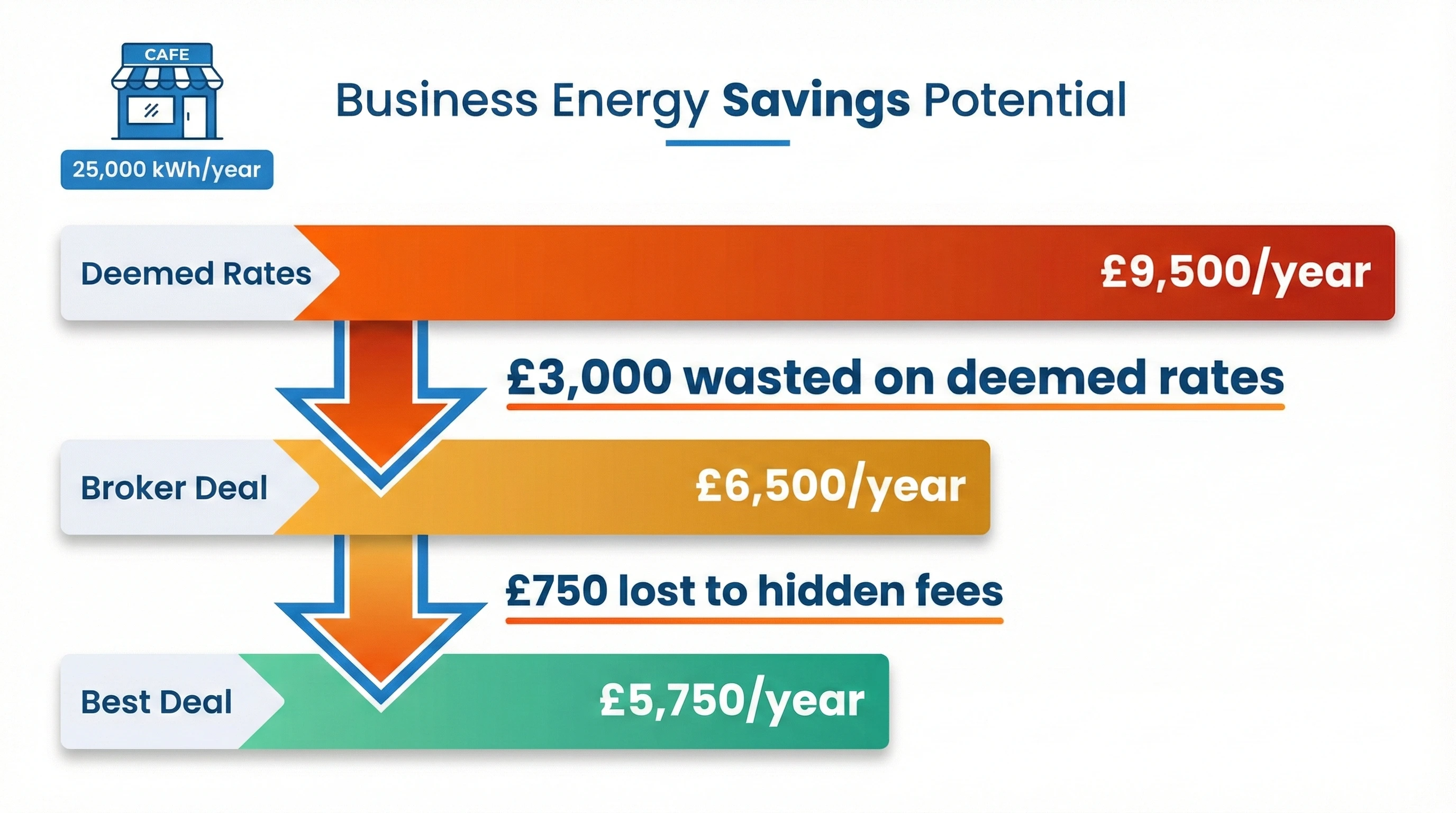
The maths for a typical SME using 25,000 kWh annually:
| Scenario | Rate | Annual Cost | vs. Best Deal |
|---|---|---|---|
| Deemed Rates | 38p/kWh | £9,500 | +£4,000 wasted |
| Average Broker Deal | 26p/kWh (inc. 4p undisclosed fee) | £6,500 | +£1,000 in fees |
| Meet George Deal | 23p/kWh (inc. 1p transparent fee) | £5,750 | Baseline |
The takeaway: Not comparing costs you thousands. Comparing badly (with undisclosed broker fees) still costs you hundreds.
Your own number depends entirely on where you are starting from. Our guide to how much you can save switching business energy puts a figure on all three starting positions - roughly 40.8% off deemed rates, 27.4% off a rolled-over contract, and 15% off a sub-optimal fixed deal - and gives you the DESNZ benchmark rate for your size band so you can sanity-check any quote you are given.
Market Volatility Makes Timing Critical
The 2022-2024 energy crisis demonstrated how quickly wholesale prices can spike. Businesses locked into contracts at the wrong time paid 2-3x market rates for years. Those who compared regularly and timed their switches strategically avoided the worst.
Wholesale prices have since stabilised but remain elevated. According to the Department for Energy Security and Net Zero’s Energy Trends data (opens in new tab), UK business electricity prices remain significantly above pre-2021 levels. The businesses that compare and switch proactively will continue to outperform those on auto-renewal or deemed rates.
Peak renewal periods: April and October are the busiest months for business energy switching, driven by the April 1st and October 1st contract year conventions. October 2024 saw 475,000 switches - the highest single month of the year. If your contract ends in these peak months, start comparing 90-120 days early to avoid last-minute pressure from brokers.
The structural shift: Beyond short-term volatility, UK electricity demand is growing for the first time in 19 years. The rollout of electric vehicles (projected to reach 25 million by 2035), heat pumps, and AI-driven data centres means demand is forecast to grow 50% by 2035. This creates long-term upward pressure on network charges - making it even more critical to secure competitive rates now. Learn how the £28bn grid upgrade affects your bills.
Regulatory Changes Are Reshaping the Market
Two major regulatory shifts affect how you should compare energy in 2026:
1. Ofgem Commission Disclosure (October 2024) All energy suppliers must now disclose broker commissions in business energy contracts. This means you can finally see what you’re paying brokers - if you know where to look. Learn how to spot undisclosed broker commissions.
2. Incoming TPI Regulation The government has confirmed mandatory regulation for energy brokers is coming. The Department for Energy Security and Net Zero (opens in new tab) announced plans to require broker registration, enforce conduct standards, and give businesses access to the Energy Ombudsman for disputes. Read more about the regulatory roadmap.
The Three Ways to Compare Business Energy
Option 1: Digital Comparison Platforms
What they are: Online platforms that aggregate quotes from multiple suppliers and allow you to compare, select, and switch entirely online.
How they work: You enter your meter details (or upload a bill), the platform retrieves your consumption data via industry databases, and displays live quotes from their supplier panel. You select a deal and sign electronically.
Pros:
- Fastest method (quotes in minutes, not days)
- Transparent fee disclosure (reputable platforms show their margin separately)
- No sales pressure or phone tag
- Compares a range of suppliers, not just commission-paying ones
Cons:
- Less suitable for complex multi-site or high-consumption (I&C) contracts
- Requires accurate data input (garbage in, garbage out)
- Quality varies significantly between platforms
Cost: Typically 1-2p/kWh (transparent platforms) or embedded in rates (less transparent ones)
Best for: SMEs with straightforward single-site contracts, businesses wanting speed and transparency
According to Ofgem’s 2024 research (opens in new tab), 78% of businesses found the switching process easy - up from 60% in 2023. However, this figure hides the fact that broker complaints to the Energy Ombudsman rose 112% in 2024 - suggesting the problems are concentrated in the broker channel. Digital platforms have helped drive this improvement by eliminating phone tag and paperwork delays.
Option 2: Traditional Energy Brokers
What they are: Human intermediaries who manage the comparison and switching process on your behalf, typically via phone and email.
How they work: You provide your details, sign a Letter of Authority (LOA), and the broker requests quotes from suppliers. They present options (usually via phone), help you select, and manage the paperwork.
Pros:
- Human advice for complex situations
- Can negotiate bespoke terms for large contracts
- Useful for multi-site portfolios requiring coordination
- May have relationships that unlock exclusive rates
Cons:
- Slow (1-2 weeks for quotes is standard)
- Commission built into your rate (about 3p/kWh was typical at some suppliers in 2022-23, per Ofgem; now disclosed in contracts)
- Limited supplier panel (many only show suppliers paying upfront commission)
- Incentives often misaligned (brokers may favour high-commission suppliers)
Cost: Embedded in your rate. Ofgem’s data shows about 3p/kWh was typical at some suppliers for micro businesses in 2022-23, while larger users averaged under 1p/kWh. Now disclosed, but not always prominent.
Best for: Large businesses with complex multi-site needs, I&C customers requiring negotiated terms
Important: Not all brokers are predatory. Some provide genuine value, especially for complex contracts. The key is understanding their fee structure and ensuring they show you the whole market. Learn how to distinguish good brokers from bad.
Option 3: Direct Supplier Contact
What they are: Contacting each energy supplier individually to request quotes.
How they work: You call or email suppliers directly, provide your meter details and usage, and each supplier sends a quote. You compare manually and contact your chosen supplier to proceed.
Pros:
- No broker fees
- Direct relationship with supplier
- Full control over the process
Cons:
- Extremely time-consuming (10+ calls/emails minimum)
- No standardised format makes comparison difficult
- Miss suppliers you don’t know about
- No expertise to spot unfavourable contract terms
Cost: No intermediary fees, but you pay with your time
Best for: Very large businesses with dedicated energy managers, businesses with existing supplier relationships they want to leverage
How to Compare Business Energy: Step-by-Step
Step 1: Gather Your Meter Details
Before comparing, collect:
Essential:
- MPAN (13-digit electricity meter number) - found on your bill
- MPRN (6-10 digit gas meter number) - found on your bill
- Postcode of your supply address
- Contract end date - critical for timing your switch
Helpful:
- Annual consumption in kWh - allows manual verification of quotes
- Current unit rate and standing charge - for baseline comparison
- Current supplier name - some platforms retrieve data faster with this
The Meet George shortcut: Simply upload a PDF of your latest bill. Our AI extracts all relevant data automatically - no manual entry required.
Step 2: Understand Your Current Contract Status
Your contract status determines when and how you can switch:
Out of Contract (Deemed Rates) If your contract has expired, you’re on deemed rates - expensive default pricing. You can switch immediately with no exit fees. This is the highest-priority situation. Citizens Advice confirms (opens in new tab) that deemed tariffs are usually the most expensive, and you typically won’t pay a fee to leave them.
In Renewal Window Typically 60-120 days before your contract ends, you enter the renewal window. You can sign a new contract now that starts the day your current one ends - locking in today’s rates without penalties.
Warning: Beware digital renewal traps. Some suppliers send emails with “confirm your renewal” buttons that lock you into unfavourable rates with a single click.
Mid-Contract If you’re within a fixed-term contract, switching early usually triggers termination fees. These can be substantial (£500+ per meter or percentage of remaining value). Calculate whether savings from switching outweigh the penalty. However, you can still compare and arrange a new contract while mid-contract - simply set the start date to align with your current contract end date, avoiding any termination fees while locking in today’s rates.
Learn more about cancelling business energy contracts.
Step 3: Choose Your Comparison Method
Based on your situation:
| Your Situation | Recommended Method | Why |
|---|---|---|
| Single site, under 500,000 kWh | Digital Platform | Fastest, most transparent |
| Multiple sites, coordinated renewal | Broker or Platform | Need portfolio management |
| Over 500,000 kWh (I&C) | Specialist Broker | Negotiated terms add value |
| Wanting maximum transparency | Digital Platform | Fees shown separately |
| Complex contract requirements | Broker | Human negotiation helps |
Step 4: Compare Like-for-Like
When reviewing quotes, ensure you’re comparing total cost, not just headline rates:
What to compare:
-
Unit Rate (p/kWh) - The per-unit cost. But don’t stop here.
-
Standing Charge (p/day) - The daily fixed fee. Can vary by 50p+ between suppliers.
-
Total Annual Cost (£) - Unit rate × usage + standing charge × 365. This is what actually hits your bank account.
-
Broker/Platform Fee - Since October 2024, this must be disclosed. Look for “Third Party Costs” or “Commission” in the contract. Understand how broker fees work.
-
Pass-Through vs Fixed Pricing - Check whether each quote is fully-fixed or pass-through. A fully-fixed rate locks all costs into one unit rate for the term. A pass-through (fixed) contract fixes only the wholesale element and passes network and policy costs (like pass-through charges) through at cost, so those can rise mid-contract. Two quotes are not like-for-like unless you know which type each one is.
-
Contract Length - Longer contracts may offer lower rates but reduce flexibility.
-
Volume Tolerance - Does the contract penalise you if usage varies from estimates? Understand this critical clause.
-
Exit/Termination Fees - What happens if you need to leave early?
-
Payment Terms - Monthly direct debit? Quarterly invoice? This affects cash flow and may impact pricing.
The calculation most people miss:
A quote showing 22p/kWh with a £1.50/day standing charge is more expensive than 23p/kWh with a 50p/day standing charge for most SMEs.
At 25,000 kWh annual usage:
- Quote A: (25,000 × £0.22) + (365 × £1.50) = £5,500 + £548 = £6,048
- Quote B: (25,000 × £0.23) + (365 × £0.50) = £5,750 + £183 = £5,933
The “cheaper” unit rate costs you £115 more per year.
Step 5: Check the Fine Print
Before signing, verify:
Volume Tolerance Clauses Many contracts include “take or pay” clauses penalising you if actual usage differs significantly from your Estimated Annual Consumption (EAC). Typical bands are 80-120% - meaning if you use less than 80% of estimated consumption, you pay for the shortfall anyway.
Auto-Renewal Terms Does the contract automatically renew? Microbusinesses have some protection here - Ofgem rules limit rollover contracts to 12 months maximum (opens in new tab) - but larger businesses may not. Ensure you know when to serve notice.
Security Deposit Requirements Some suppliers require security deposits from businesses without strong credit history. This ties up cash flow.
Green Claims If paying extra for a “green tariff,” verify what you’re actually getting. Some tariffs use REGOs purchased separately from actual generation - meaning your physical electricity may not be renewable.
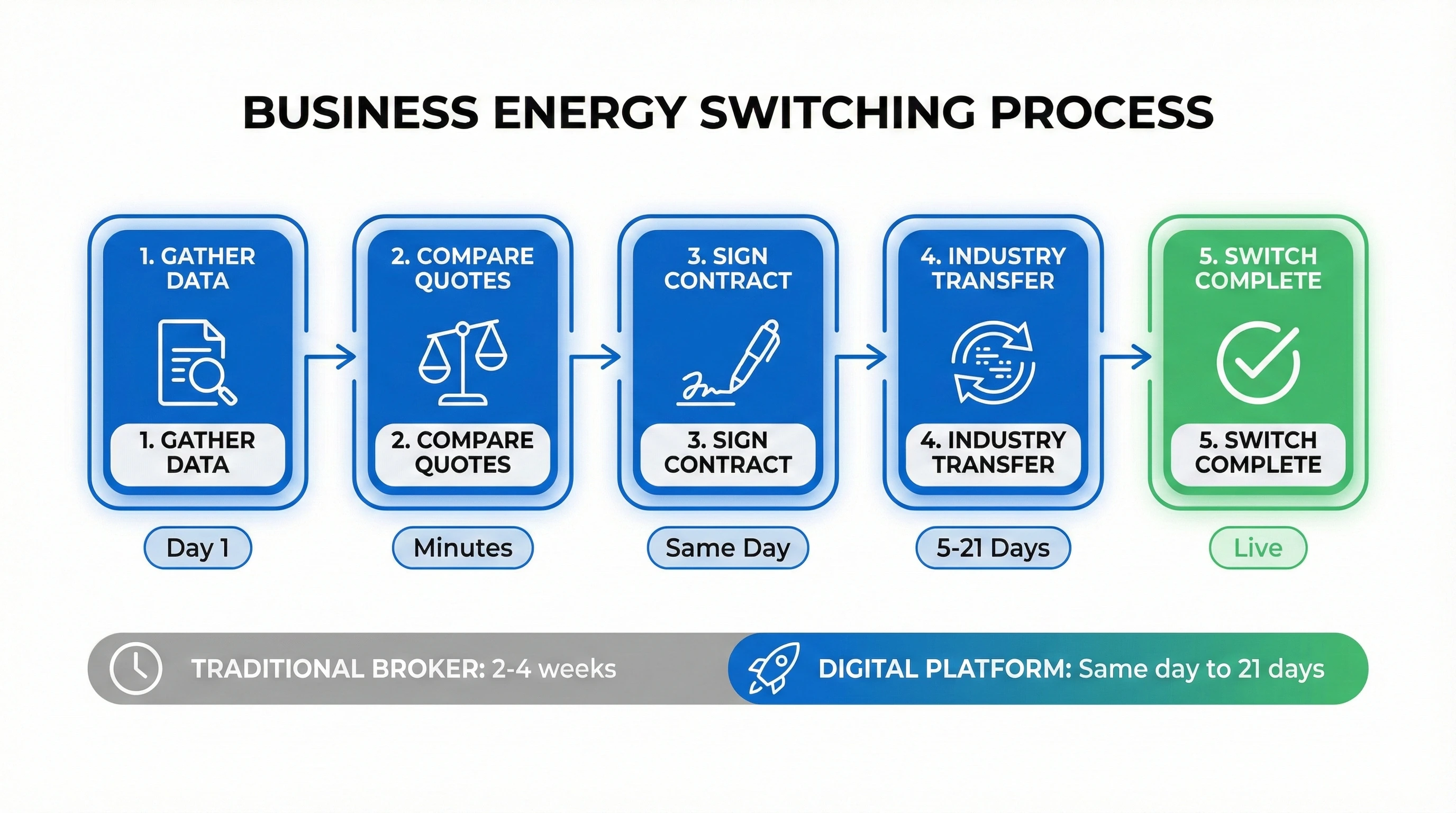
Step 6: Complete the Switch
Once you’ve selected a supplier:
-
Sign the Letter of Authority (LOA) - This authorises the platform or broker to act on your behalf. Ensure it’s a Level 1 LOA (data access only) not Level 2 (signing authority).
-
Review and sign the contract - Read it. There’s no cooling-off period for business energy contracts. Once signed, you’re committed.
-
Confirm the switch date - Ideally aligned with your current contract end to avoid overlap or gap charges.
-
Monitor the transfer - Industry transfers take 5-21 days. Your supply continues uninterrupted.
-
Check your first bill - Verify rates match what was quoted. Flag discrepancies immediately.
What Are the Best Business Energy Rates in the UK?
There is no single best business energy rate in the UK: suppliers price each business separately, by region, meter type and how much energy it uses, and their prices move with the wholesale market. The best rate for you is the quote with the lowest annual cost at your own usage - unit rate and standing charge together - on a contract you can live with.
To judge whether a rate is good, compare it with what other businesses your size actually pay. DESNZ’s latest figures put the all-in electricity price at 38.36p/kWh for the smallest business users (up to 20,000 kWh a year) and 24.51p/kWh across all businesses, including standing charges and the Climate Change Levy but not VAT (table 3.4.2, April to June 2026 - see the table below). A competitive fixed contract should come in under the average for your size, which includes businesses on expensive default rates.
Three things decide how close you get:
- Your contract status. Out-of-contract and deemed rates are usually far higher than a fixed deal - in October 2026 suppliers’ published deemed electricity rates ran from 37.22p to 66.36p/kWh on standard meters (what out-of-contract rates cost).
- Where you are. Network costs differ by region, so the same supplier can charge different rates in different postcodes (regional business energy prices).
- Your size. Smaller users pay more per kWh, so compare against your own size band, not the national average.
Want to know how your current rate compares? Upload your latest bill to Meet George’s free bill check: it compares your all-in electricity price with the DESNZ average for your size, in seconds.
How Do You Compare Business Gas and Electricity Rates?
Compare business gas and electricity rates one fuel at a time, on annual cost: the unit rate times your yearly kWh, plus the daily standing charge times 365, for each meter. Don’t compare gas with electricity per kWh - gas costs far less per unit, so judge each fuel against its own benchmark.
DESNZ’s latest averages show the gap. These are all-in prices, including standing charges and the Climate Change Levy but not VAT:
| Fuel | Smallest users | Next size band | All businesses |
|---|---|---|---|
| Electricity | 38.36p/kWh (up to 20,000 kWh a year) | 28.59p/kWh (20,000 - 499,000 kWh) | 24.51p/kWh |
| Gas | 9.31p/kWh (up to 278,000 kWh a year) | 4.86p/kWh (278,000 - 2,777,000 kWh) | 5.28p/kWh |
DESNZ table 3.4.2, April to June 2026, published 29 September 2026 (GOV.UK (opens in new tab)). The gas and electricity size bands are different.
To compare quotes for both fuels:
- Get each fuel’s annual use from a year of bills - electricity from the bills for your MPAN, gas from the bills for your MPRN.
- Ask for quotes for both with the same start date and term, so the prices reflect the same market.
- Work out the annual cost of each fuel separately, including standing charges and any broker or platform fee.
- Check each against its DESNZ average for your size band. A competitive fixed contract should come in below the average, which also includes businesses on expensive default rates.
- Treat a dual-fuel deal as two prices. A single supplier for both saves admin, but only take it if each fuel holds up on its own.
Remember VAT when you compare totals: a business using no more than 33 kWh of electricity or 145 kWh of gas a day on average pays VAT at a lower rate than 20% - here is how the VAT thresholds work. Want a quick read on where you stand? Upload your latest bill to Meet George’s free bill check, which compares your all-in electricity price with the DESNZ average for your size. If it is a dual-fuel bill, a person from our team picks it up.
Digital Platform vs Broker: The Complete Comparison
This is the strategic decision most businesses face. Here’s a detailed comparison - and if you want the long version, including the situations where a broker is genuinely the better call, read our honest comparison of self-service and broker-assisted switching.
| Factor | Digital Platforms | Traditional Brokers |
|---|---|---|
| Speed to quotes | Minutes | 1-2 weeks |
| Speed to switch | 5-21 days | 5-21 days (plus quote delay) |
| Typical fee | 1-2p/kWh (transparent) | Varies - about 3p/kWh typical at some suppliers (Ofgem, 2022-23) |
| Fee on 25,000 kWh (3yr) | £750-£1,500 | £2,250-£3,750 |
| Market access | A range of suppliers, not just commission-payers | Varies (often limited to upfront-paying suppliers) |
| Human advice | AI/chatbot support | Phone consultation |
| Best for | Single-site SMEs | Multi-site, I&C |
| Transparency | High (fees shown separately) | Improving (now disclosed) |
| Sales pressure | None | Often significant |
The financial reality:
A business using 25,000 kWh annually on a 3-year contract pays:
- Digital Platform (1p/kWh): £750 total commission
- Average Broker (4p/kWh): £3,000 total commission
- Difference: £2,250 saved by choosing the right comparison method
That’s money in your pocket, not a broker’s. Use our commission calculator to see the exact difference for your usage.
Common Comparison Mistakes to Avoid
Mistake 1: Comparing Unit Rates Alone
The unit rate (p/kWh) is only part of your cost. Standing charges, broker fees, and contract terms all affect total spend - here is how a business energy quote is actually put together. Always calculate total annual cost.
Mistake 2: Entering Inaccurate Usage Data
Quotes are only as accurate as the data behind them. If you estimate 20,000 kWh but actually use 30,000 kWh, your “cheap” quote becomes expensive - especially if volume tolerance clauses apply.
Solution: Use actual consumption from bills or let platforms retrieve data via your MPAN/MPRN.
Mistake 3: Ignoring Volume Tolerance
A supplier offering rock-bottom rates may include aggressive volume tolerance clauses. If your usage varies (which is normal for most businesses), you’ll pay penalties that wipe out any savings.
Mistake 4: Focusing on the Cheapest Option
The cheapest quote isn’t always the best deal. Consider:
- Supplier reputation and customer service
- Contract flexibility
- Exit fee terms
- Security deposit requirements
- Payment terms impact on cash flow
A slightly more expensive supplier with fair terms may cost less overall.
Mistake 5: Missing Your Renewal Window
Setting and forgetting leads to one of two bad outcomes:
- Auto-renewal onto whatever rate the supplier (or broker) chooses
- Rolling onto deemed rates at 30-50% premium
Solution: Calendar reminders 90-120 days before contract end. Compare and switch before the window closes.
Mistake 6: Signing a Level 2 LOA
Some brokers request Level 2 Letters of Authority giving them signing authority - the ability to sign contracts on your behalf. This creates risk of being locked into deals without your informed consent.
Solution: Only sign Level 1 LOAs (data access only). Review and sign contracts yourself. If you have a dispute with a broker, the Energy Ombudsman can help resolve complaints (opens in new tab) for eligible small businesses.
What Makes Meet George Different
We built Meet George because we experienced the broken market firsthand. Here’s our approach:
1. Transparent Pricing We charge a flat 1p/kWh - shown separately from the supplier’s rate. You see exactly what you pay us versus what you pay the supplier. See how we’re paid.
2. Digital Letter of Authority (LOA) Sign your LOA securely online in seconds. No printing, scanning, or posting documents. Our digital LOA gives us read-only access to retrieve your meter data - you remain in full control of any contract decisions.
3. Real Market Access We compare a range of suppliers, including ones that don’t pay upfront commissions. You see the best deals for your business, not the best deals for our commission.
4. Speed Without Sacrifice Upload your bill, get quotes in minutes, complete your switch in under 20 minutes. No phone tag, no chasing brokers, no waiting days for basic information.
5. Pound-Note Clarity We don’t just show unit rates. We show you: “You pay £X now. You’ll pay £Y with this switch. You save £Z per year.” Clear, actionable numbers.
6. AI Contract Analysis Before signing, use our AI Contract Assistant to ask unlimited questions about contract terms. “Does this have volume tolerance?” “What are the exit fees?” Get instant, unbiased answers.
7. Pro-Regulation We welcome incoming broker regulation because it will clean up the market and remove predatory operators. We believe transparency should be the default, not the exception.
UK Business Energy Comparison Platforms Compared
For transparency, here’s how the main UK business energy comparison options stack up in 2026:
Platform Types Compared
| Platform Type | Fee Model | Suppliers | Online Switch | Best For |
|---|---|---|---|---|
| AI-powered self-service (e.g. Meet George) | Fee shown separately (1p/kWh) | A range of suppliers | Yes | SMEs wanting transparency and speed |
| Hybrid broker (calls + online) | Embedded in rate | Broad panel | Partial | Businesses comfortable with phone calls |
| Comparison site (routes to broker) | Embedded in rate | Varies | Partial | Quick initial research |
| Phone-based broker | Embedded in rate | Limited panel | No | Those wanting human support |
Traditional Brokers
| Broker Type | Fee Model | Typical Commission | Best For |
|---|---|---|---|
| Independent Brokers | Embedded in rate | Varies | Relationship-based service |
| Tied Agents (exclusive relationship with specific suppliers) | Embedded in rate | Varies | Deep expertise on limited supplier panel |
| Consultancies | Fixed fee or embedded | Varies widely | Large I&C contracts |
Key Differences Explained
Fee transparency: Meet George is among the few UK platforms that show commission separately from the supplier rate. Other platforms embed their fee in your quoted unit rate - legal since October 2024 disclosure rules, but less visible.
Online completion: Many “comparison sites” still require phone calls to complete your switch. Fully digital platforms let you compare and switch without speaking to anyone.
Supplier access: Platforms with “embedded” fees may prioritise suppliers who pay higher upfront commissions. Transparent-fee platforms have less incentive to steer you toward specific suppliers.
Note: We have not independently audited competitor claims. This comparison is based on publicly available information as of mid-2026. Always verify current offerings directly with each provider.
The Bottom Line: How to Compare Business Energy Effectively
- Know your numbers - MPAN/MPRN, current usage, contract end date
- Choose the right method - Digital platforms for simplicity, brokers for complexity
- Compare total cost - Not just unit rates
- Check the fine print - Volume tolerance, exit fees, auto-renewal
- Understand what you’re paying - Ask for fee disclosure, look for transparency
- Time it right - Switch in your renewal window to avoid penalties
- Don’t accept the default - Deemed rates and auto-renewals are designed to extract money from passive customers
The businesses that compare proactively and switch strategically save thousands every year. The businesses that don’t subsidise everyone else.
Note on future changes: Market-wide Half-Hourly Settlement (MHHS) (opens in new tab) is rolling out through 2026-2027. This will change how electricity is priced based on when you use it. Businesses with smart meters and off-peak usage patterns may see lower costs, while peak-time users may pay more. Compare now to lock in rates before these changes take full effect.
Ready to compare business energy the transparent way? Start with your current contract: upload your latest bill and George tells you in seconds whether you’re in your switching window. When you compare quotes with Meet George, the supplier rate and our fee are shown separately. No undisclosed margins, no surprises.
Further Reading
Meet George Guides:
- How to Switch Business Energy: Complete Step-by-Step Guide
- Hidden Broker Commissions: How Uplift Actually Works
- What Are Deemed Rates? Why You’re Paying an 80% Premium
- Volume Tolerance: The Cheapest Contract Trap
- When Is a Broker Worth Paying?
- Letter of Authority: What It Is and Why It Matters
- Business Energy Glossary - All terms explained in plain English
External Resources:
- Ofgem: Guidance for Microbusinesses (opens in new tab) - Official regulator advice
- Citizens Advice: Business Energy Supply (opens in new tab) - Independent switching guidance
- Energy Ombudsman (opens in new tab) - Free dispute resolution for eligible businesses
- Federation of Small Businesses (opens in new tab) - UK small business advocacy and support


