

Quick Answer: Business electricity standing charges are fixed daily fees you pay whatever you use. They cover network infrastructure, metering and supplier costs. Business tariffs aren’t price-capped, so there’s no official typical figure, but suppliers’ published default (deemed and out-of-contract) standing charges for a standard small-business meter ran from about 153p to 300p a day in October 2026 - roughly £560 to £1,100 a year before you use any electricity. A negotiated fixed contract is usually lower; if you’re anywhere near that range, check whether you’re on deemed rates.
TL;DR: Key Takeaways
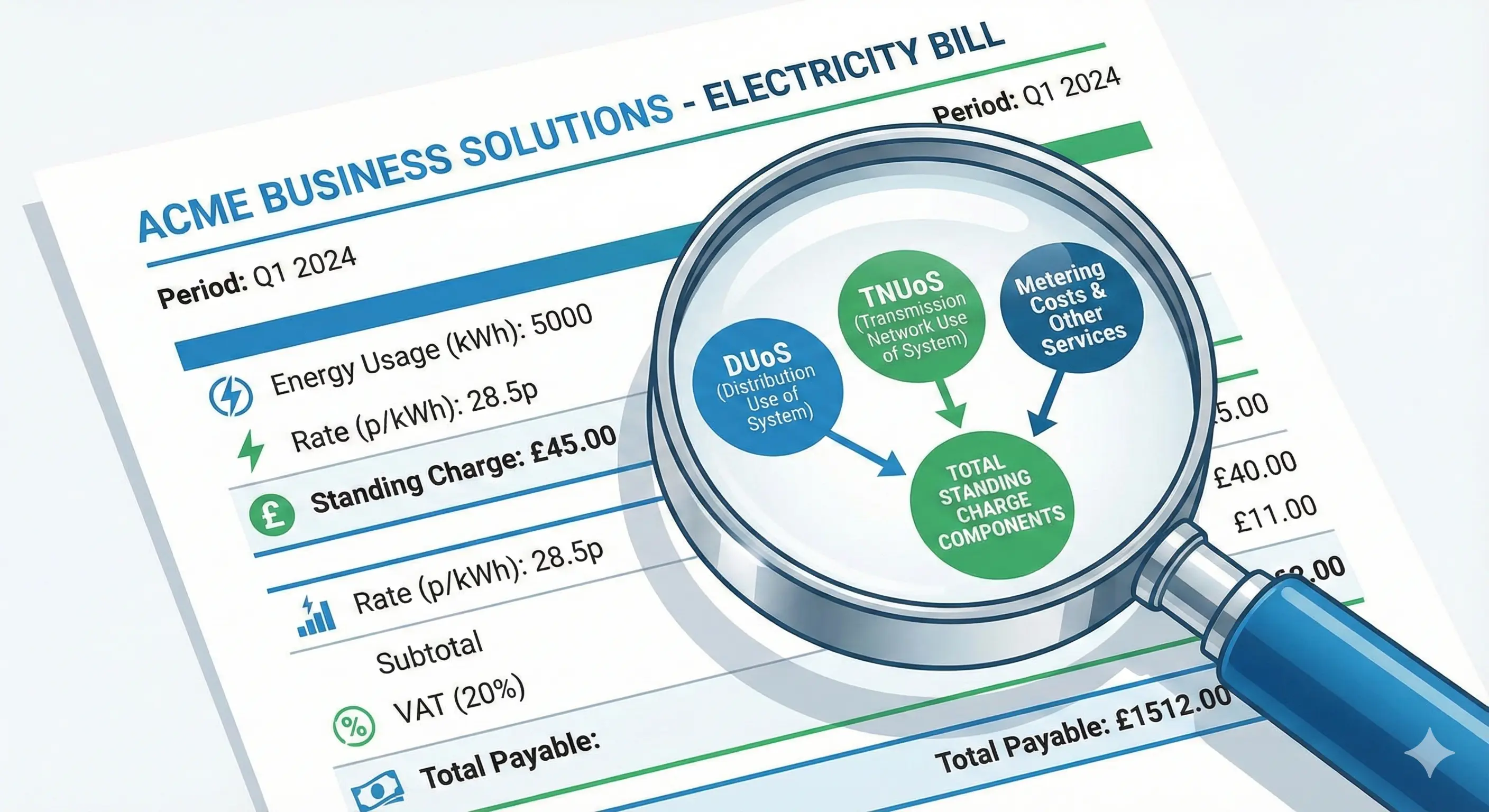
What Standing Charges Cover: Network costs (DUoS for local distribution, TNUoS for national transmission), metering and data collection, supplier costs, and some government policy costs.
What They Cost: There’s no official average. Suppliers’ published default standing charges for a small-business meter ran from about 153p to 300p a day in October 2026; a negotiated contract is usually lower. Half-hourly and CT-metered sites pay more, because they carry capacity charges and extra metering fees.
Broker Fees Can Sit Here Too: A broker’s fee is usually added to the unit rate, but some suppliers let it be added to the standing charge as well. Since October 2024, Ofgem has required broker fees to be shown in your contract’s principal terms.
Regional Variation: Each of the 14 network regions sets its own distribution charges. In 2026/27, UK Power Networks’ fixed daily distribution charge on the same tariff ranges from 0p in London to as much as 22.20p in the South East. See our analysis of regional business energy pricing across the UK.
The Meet George Approach: We show standing charges alongside unit rates, so you can compare total annual costs - not just headline p/kWh figures.
What Is a Business Electricity Standing Charge?
A business electricity standing charge is the fixed daily fee you pay simply to have a live electricity supply - before you use a single kWh. Think of it as the “membership fee” for being connected to the electricity network.
Unlike your unit rate (which varies with consumption), the standing charge is payable every day, whether your business uses 1,000 kWh or zero. This makes it particularly significant for:
- Seasonal businesses (tourism, events, agriculture)
- Multi-site operators with low-usage locations
- Landlords with vacant commercial properties
- Businesses that have downsized but kept their meter
Because business standing charges are not price-capped, there is no single official average, and the figure varies widely by supplier, meter type, DNO region and contract status. As a reference point, suppliers’ published default (deemed and out-of-contract) standing charges for a standard small-business meter ran from about 153p to 300p a day in October 2026 - see what deemed rates cost now. A negotiated fixed contract is usually lower.
What Your Standing Charge Actually Pays For
Your standing charge isn’t arbitrary - it recovers costs that exist whatever you use:
| Cost Component | What It Covers |
|---|---|
| DUoS (Distribution) | Your local electricity network - the poles, wires and substations that deliver power to your premises |
| TNUoS (Transmission) | The national high-voltage network that connects power stations to local networks |
| Metering & Data | Your meter, meter reads, data processing and (for smart meters) communications |
| MOP and DC/DA fees (HH sites only) | The Meter Operator (MOP) installs and maintains your meter; the Data Collector and Data Aggregator (DC/DA) read it and submit the data for settlement. These are separate fixed fees on half-hourly meters, usually bundled into the standing charge |
| Supplier costs | Billing, customer service and the supplier’s margin |
| Policy Costs | Some government scheme costs, including the cost of supplier failures |
How much each part contributes varies by supplier, region and meter, and suppliers don’t publish the split.
Important: Unlike household tariffs, business energy contracts are not covered by Ofgem’s price cap - Ofgem lists having “a business energy contract” among the cases where you are not protected by it (Ofgem: energy price cap explained (opens in new tab)). There is no regulatory limit on a business standing charge, so the protection you have is comparing quotes.
Standing Charges vs Capacity Charges: What’s the Difference?
You’ll often see capacity charges (measured in kVA) mentioned alongside standing charges. These are related but distinct:
Standing Charge: A fixed daily fee covering basic network access, metering, and administration. Every business with a meter pays this.
Capacity Charge: An additional fixed charge based on your Maximum Import Capacity (MIC) - the maximum power your premises can draw at any moment. Only applies to larger connections (typically half-hourly metered sites).
The Highway Lane Analogy:
Think of the electricity network like a motorway:
- Your standing charge is like paying for basic road access - everyone pays to use the road network
- Your capacity charge is like reserving dedicated lanes - if your business might need to use 3 lanes of traffic at peak times, you pay to have those 3 lanes available 24/7, even if you usually only use 1
A small shop might only need a standard connection (no reserved lanes). But a commercial kitchen that occasionally runs all equipment simultaneously needs significant capacity reserved - and pays for that privilege through capacity charges.
Real example: THIS Workspace, a flexible office provider, has a 40 kVA capacity allocation. This means they pay capacity charges to reserve 40 kVA of network capacity, ensuring the building can handle peak demand when all meeting rooms, kitchens, and workstations are running simultaneously.
For most SMEs on standard meters, capacity charges don’t apply - you just pay the standing charge. But if you have a half-hourly meter or high-capacity connection, capacity charges can be significant and are worth reviewing regularly.
Whole-Current vs CT Metering: Why Some Sites Pay More Fixed Fees
Your meter type also drives how many fixed charges you carry. Smaller supplies use a whole-current (direct) meter, where the current passes straight through the meter - these sites do not attract capacity charges and carry fewer fixed fees. Larger connections use a CT (current transformer) meter, which steps down high currents to measurable levels, has an agreed Maximum Import Capacity with the DNO, and attracts capacity/availability charges. CT and half-hourly sites also pay the separate MOP and DC/DA fixed fees described in the table above - fees a whole-current NHH site does not carry - which is a large part of why half-hourly standing charges are so much higher.
How Much Are Business Standing Charges in 2026?
There is no official figure for what UK businesses typically pay in standing charges. Ofgem doesn’t cap business tariffs, and DESNZ’s business price statistics fold standing charges into an all-in price per kWh. What you can check against:
- Published default rates: suppliers’ published default (deemed and out-of-contract) standing charges for a standard small-business meter ran from about 153p to 300p a day in October 2026, roughly £560 to £1,100 a year. A negotiated fixed contract is usually lower, so a standing charge in that range is a sign to compare (out-of-contract and deemed rates).
- Your network region’s charges: every DNO publishes its distribution charges each year, including the fixed daily charge for each tariff (see the regional example below).
- Your meter type: half-hourly and CT-metered sites carry capacity charges and MOP and DC/DA fees on top, so their fixed daily costs are much higher than a small-business meter’s.
The quickest way to know where you stand is to turn your own standing charge into a yearly cost: multiply the daily rate by 365, then compare it with the quotes you get on total annual cost.
Regional Variation by DNO Area
Your location affects your standing charge because each network region has its own distribution charges. Great Britain is divided into 14 Distribution Network Operator (DNO) regions, run by six operators.
Under Ofgem’s RIIO-ED2 price control (opens in new tab), each DNO’s allowed revenue is set separately, and it sets its own DUoS charges to recover it - so identical businesses in different regions pay different rates.
| DNO Region | Operator |
|---|---|
| London | UK Power Networks |
| South East | UK Power Networks |
| East of England | UK Power Networks |
| East Midlands | National Grid Electricity Distribution |
| West Midlands | National Grid Electricity Distribution |
| South West | National Grid Electricity Distribution |
| South Wales | National Grid Electricity Distribution |
| North West | Electricity North West |
| Yorkshire | Northern Powergrid |
| North East | Northern Powergrid |
| South Scotland | SP Energy Networks |
| Merseyside and North Wales | SP Energy Networks |
| Southern England | Scottish and Southern Electricity Networks |
| North Scotland | Scottish and Southern Electricity Networks |
Why we don’t rank the regions: DNO charges are not secret. Every DNO has to publish a Use of System charging statement under Standard Licence Condition 14 of its electricity distribution licence, each statement is updated annually, and they all use the same tariff names and the same table layout. The problem is comparability, not availability. What you actually pay depends on which of four residual charging bands your site is assigned to under industry rules, whether your meter is half-hourly, and how many hours a day your region treats as “red” peak time - and those hours differ from region to region. Two businesses on the same headline rate in different areas can end up paying very different amounts, and the region that looks dearest on one tariff is often among the cheapest on another.
What that looks like in practice: UK Power Networks runs three of the fourteen regions. For the 2026/27 charging year, its own charging statements set a different fixed daily charge in each one on the same tariff, “Non-Domestic Aggregated or CT”. Across the four charging bands, the fixed charge is 0.00p per day in London (opens in new tab), 9.65p to 13.03p per day in the Eastern region (opens in new tab), and 10.04p to 22.20p per day in the South East (opens in new tab) (all effective 1 April 2026). London recovers the money through peak-time unit rates instead, and it counts twice as many peak hours to do it: two “red” windows on weekdays, 11am-2pm and 4pm-7pm, against the single 4pm-7pm window used in the other two regions. Same owner, same year, same tariff name - and a very different bill depending on when you use the power. These are DUoS rates: one input into the standing charge your supplier bills you, not the standing charge itself.
Which Business Electricity Supplier Has the Cheapest Standing Charge?
No single supplier has the cheapest business electricity standing charge everywhere: standing charges are set supplier by supplier, region by region and meter by meter, and a low standing charge often comes with a higher unit rate. The cheapest electricity deal is the one with the lowest annual cost at your usage - the standing charge times 365, plus the unit rate times the kWh you use in a year.
For a sense of scale, suppliers’ published default standing charges for a standard small-business meter - the rates you pay out of contract or on a deemed contract - ran from about 153p to 300p a day in October 2026 (out-of-contract and deemed rates). A negotiated fixed contract is usually lower, so a standing charge in that range is a sign to compare.
Whether a lower standing charge saves you money depends on how much you use. Two illustrative quotes:
| Standing charge | Unit rate | Annual cost at 3,000 kWh | Annual cost at 10,000 kWh | |
|---|---|---|---|---|
| Quote A | 60p/day | 26p/kWh | £999 | £2,819 |
| Quote B | 30p/day | 28p/kWh | £950 | £2,910 |
Illustrative figures, before VAT and CCL: annual cost = standing charge × 365 + unit rate × annual kWh.
Quote B’s lower standing charge wins only below about 5,475 kWh a year - the point where the £109.50 a year it saves on the standing charge (30p × 365) is used up by its 2p/kWh higher unit rate. Above that, Quote A is cheaper despite the higher daily charge. So:
- Low-usage sites (a small office, a storage unit, a seasonal business) should weight the standing charge heavily - and may suit a no-standing-charge tariff.
- Most other businesses should judge quotes on annual cost, where the unit rate usually matters more.
- Every business should check the standing charge on its bill against its region and meter type (see the regional table above).
Not sure what you pay now, or what your annual cost is? Upload your latest bill to Meet George’s free bill check and see your standing charge, unit rate and all-in price in seconds.
The DUoS Reform: What Changed
The biggest change to how network costs reach your standing charge came from Ofgem’s Targeted Charging Review (opens in new tab). Network charges have two parts: forward-looking charges, which signal the cost of using the network at busy times, and “residual” charges, which recover the fixed cost of the existing pylons and cables. Ofgem decided that “residual charges will be levied in the form of fixed charges for all households and businesses”.
What this means for your business:
- More of your network costs are fixed: the residual part of DUoS and TNUoS is now a fixed charge, set by the band your site is placed in, rather than a charge per kWh
- Your band matters: non-domestic sites are placed in one of four residual charging bands, and a higher band usually carries a higher fixed charge
- Regions differ: each DNO decides how its fixed and peak-time charges recover its revenue - which is why, in 2026/27, London’s fixed distribution charge is 0p a day while the South East’s is up to 22.20p (see above)
- The headline “standing charge” can mislead: a lower standing charge doesn’t mean lower total fixed costs if capacity charges or peak-time unit rates are higher
A related review, Ofgem’s Access and Forward-Looking Charges Significant Code Review (opens in new tab), reduced the connection charges faced by those connecting to the distribution network and changed how access rights are defined; Ofgem continues to review DUoS charges separately.
Unified vs Itemised Standing Charges
When comparing quotes, you’ll encounter two different ways suppliers present standing charges:
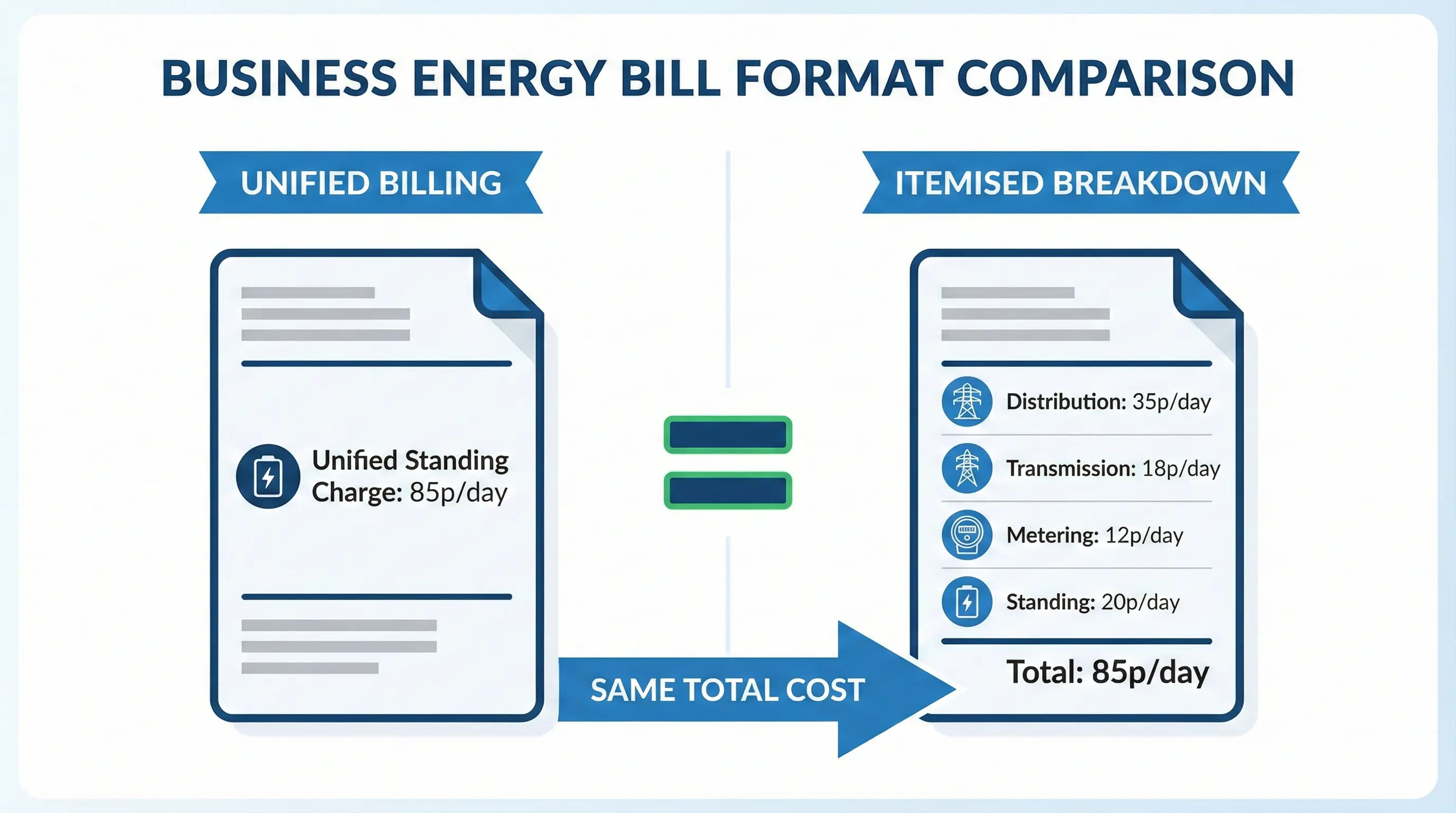
Unified Standing Charge
Most suppliers show a single “Standing Charge” figure that bundles all fixed costs together (illustrative figures):
Standing Charge: 85p/day
Unit Rate: 24.5p/kWh
Pros: Simple to understand and compare Cons: Less transparency about what you’re actually paying for
Itemised Charges
Some suppliers break out the components separately (the same illustrative total):
Distribution Charges (DUoS): 35p/day
Transmission Charges (TNUoS): 18p/day
Metering Charge: 12p/day
Standing Charge: 20p/day
---
Total Fixed Daily Cost: 85p/day
Unit Rate: 24.5p/kWh
Pros: Full transparency; easier to understand cost drivers Cons: Appears more complex; harder to compare quickly
The key point: When comparing quotes, always calculate total fixed daily cost regardless of how it’s presented. A “low standing charge” that excludes separately-listed DUoS charges isn’t actually cheaper.
Broker Fees in Your Standing Charge
Here’s something many businesses don’t know: a broker’s fee can be added to your standing charge as well as your unit rate.
We’ve written about how broker uplift on unit rates works, but the standing charge is another place a fee can sit.
How Standing Charge Uplift Works
Each supplier sets its own rules for brokers: whether a fee can be added to the standing charge at all, and how much. Where it is allowed, it works like this (illustrative figures):
- The supplier’s standing charge is 50p/day
- The broker adds 30p/day
- You see a standing charge of 80p/day
Over a 3-year contract, that 30p/day costs you an extra £328.50 (30p × 365 × 3) - on top of anything added to your unit rate.
Capacity Charges Come From Your DNO
Capacity (availability) charges are set by your Distribution Network Operator (DNO) in pence per kVA per day, applied to your agreed Maximum Import Capacity. Because every DNO publishes its rates in its annual charging statement, you can check the capacity rate on your bill against your DNO’s published figure for your tariff.
How to Protect Yourself
When getting quotes:
- Ask for the breakdown: Ask for the supplier’s standing charge separately from any broker fee
- Compare total fixed costs: Calculate the annual standing charge cost (daily rate × 365) for each quote
- Check the principal terms: Since 1 October 2024, Ofgem has required broker fees to be shown in your contract’s principal terms (Ofgem factsheet (opens in new tab))
- Use transparent platforms: Meet George shows our 1p/kWh fee separately - we don’t add anything to your standing charge
Why Are My Standing Charges So High?
If your standing charges seem excessive, here are the most common causes:
1. You’re on Deemed or Out-of-Contract Rates
The problem: Ofgem says deemed rates are “usually higher than negotiated contract rates”, and out-of-contract rates are “usually more expensive than fixed-term contracts” (Ofgem (opens in new tab)) - and that applies to standing charges too.
The solution: Switch to a new fixed contract. If your contract has ended, you can usually switch straight away.
2. You Have a Half-Hourly Meter with Excess Capacity
The problem: Half-hourly (HH) and CT-metered sites pay capacity charges based on their agreed Maximum Import Capacity (MIC). If your business has downsized but kept its original capacity, you’re paying for capacity you don’t use.
The solution: Compare your MIC with the most you actually draw (your half-hourly data shows it), and if there’s a big gap, ask your DNO about reducing it.
3. Regional Network Costs
The problem: Some regions simply have higher network charges due to infrastructure costs.
The solution: Unfortunately, you can’t change your location. Focus on optimising other elements and ensure you’re not overpaying through broker uplift.
4. Broker Uplift on Standing Charge
The problem: Your broker may have added their fee to your standing charge.
The solution: Check your contract’s principal terms for the broker fee, compare your standing charge against other quotes, and consider switching through a transparent platform.
5. Multiple Meters
The problem: Each meter carries its own standing charge. Multi-site businesses or premises with separate gas and electricity meters multiply these fixed costs.
The solution: Audit whether all meters are necessary. Consolidate where possible. For vacant sites, consider de-energising meters.
Are No-Standing-Charge Tariffs Worth It?
Some suppliers offer business tariffs with no standing charge - but don’t assume this means cheaper bills.
How No-Standing-Charge Tariffs Work
To make up for the missing fixed income, the supplier charges a higher unit rate. How much higher varies by supplier, so check the quote.
Example comparison (illustrative figures):
| Tariff Type | Standing Charge | Unit Rate |
|---|---|---|
| Standard tariff | 60p/day (£219/year) | 26p/kWh |
| No-standing-charge | £0/day | 31p/kWh |
The Break-Even Calculation
To find when a no-standing-charge tariff makes sense:
Break-even kWh = Annual standing charge ÷ Unit rate difference

Example: £219 ÷ £0.05 = 4,380 kWh/year
Below your break-even: the no-standing-charge tariff is cheaper Above your break-even: the standard tariff with a standing charge is cheaper
When No-Standing-Charge Makes Sense
- Storage units with minimal lighting
- Seasonal businesses closed for extended periods
- Vacant properties awaiting sale or development
- Any site that uses less than its break-even
When to Avoid No-Standing-Charge
- Any site that uses more than its break-even
- Sites with steady year-round usage
- Multi-site businesses (easier to manage standard contracts)
Will Standing Charges Keep Rising?
Network charges are reset every year, and the networks are investing heavily to connect more renewable generation and meet growing demand - from electric vehicles, heat pumps and new connections such as data centres. That investment is paid for through network charges, including the fixed parts that reach your standing charge. We explain the scale of it in the £28bn grid upgrade.
What This Means For Your Business
- Check what your contract fixes: Ofgem says fixed rate contracts “fix the price of unit rates and standing charges for the length of the contract” (Ofgem (opens in new tab)); on a pass-through contract, network charges can change during the contract
- Budget for changes at renewal: network charges change each April, so your next quote may differ even if wholesale prices haven’t moved
- Review capacity: make sure you’re not paying for capacity you don’t use
- Consider flexibility: businesses that can shift demand may benefit from time-of-use tariffs under MHHS
How to Reduce Your Business Standing Charges
1. Switch Away from Deemed Rates
If you’re out of contract, switching is usually the biggest saving, because deemed rate standing charges are usually higher than contracted ones.
Action: Check your contract end date. If it’s passed, switch now.
2. Review Your Capacity Allocation
For half-hourly metered sites, your Maximum Import Capacity (MIC) directly affects your fixed charges.
Action: Ask your supplier for your current MIC. Compare it against your actual maximum demand (available from half-hourly data). If there’s a significant gap, ask your DNO about a capacity reduction.
3. De-energise Unused Meters
Empty premises still incur standing charges on live meters.
Action: For long-term vacant sites, consider de-energisation. Ask your supplier what reconnection would cost before you do it, in case you need power again later.
4. Consolidate Multi-Site Contracts
Each meter carries its own standing charge. Managing multiple sites on separate contracts multiplies admin and may mean paying different (higher) rates on some sites.
Action: Ask suppliers to quote for a multi-site contract and compare its total cost with your current contracts.
5. Compare Total Annual Cost, Not Just Unit Rates
Many businesses focus on p/kWh and ignore standing charges.
Action: Always calculate: (Unit rate × Annual kWh) + (Standing charge × 365) = Total annual cost
6. Ask About Standing Charge Specifically
When getting quotes, explicitly ask:
- “What is the supplier’s own standing charge?”
- “Is any broker fee included in the standing charge?”
- “Is this a single charge, or are there separate DUoS/TNUoS elements?“
7. Use a Transparent Comparison Platform
Platforms that show fees separately from supplier rates make it easier to understand true costs.
Meet George shows our 1p/kWh fee separately - and we don’t add anything to your standing charge. You see what you’re paying the supplier and what you’re paying us.
Standing Charges for Different Business Types
Retail and Hospitality
Challenge: Often have multiple meters (main supply, kitchen, signage) multiplying standing charges.
Tip: Audit whether all meters are necessary, and whether a low-use supply could run from the main one.
Seasonal Businesses (Tourism, Events, Agriculture)
Challenge: Standing charges continue during closed seasons when consumption is zero.
Tip: Calculate whether no-standing-charge tariffs make sense for your usage pattern. For very seasonal operations, the break-even point may favour zero-standing-charge despite higher unit rates.
Multi-Site Operators
Challenge: Standing charges multiply across every location.
Tip: Ask suppliers to quote for the whole portfolio, and make sure low-usage sites aren’t on expensive deemed rates.
Landlords with Vacant Properties
Challenge: Paying standing charges on properties generating no income.
Tip: Consider de-energisation for long-term vacancies. For short-term vacancies, ensure you’re on a contracted rate rather than deemed.
Manufacturing and Industrial
Challenge: Half-hourly meters with high capacity allocations mean significant standing elements.
Tip: Regular capacity reviews are essential. Production changes, efficiency improvements, or shift pattern adjustments may mean your MIC is now oversized.
The Bottom Line: What to Do About Standing Charges
Standing charges are an unavoidable part of business electricity - but that doesn’t mean you should overpay.
Key actions:
- Know what you’re paying: Convert your daily standing charge to annual cost (×365)
- Check your contract status: Deemed and out-of-contract rates usually mean higher standing charges
- Understand the breakdown: Ask whether DUoS/TNUoS are included or separate
- Watch for broker fees: A broker’s fee can be added to the standing charge as well as the unit rate
- Compare total cost: Don’t be fooled by low unit rates with high standing charges
- Review capacity: Half-hourly sites may be paying for unused capacity
- Plan for change: Network charges reset every April
Standing charges may feel like “dead money” - a cost you pay without getting any energy in return. But understanding them and avoiding overpayment can save your business hundreds of pounds a year or more.
Want to see what your own standing charge costs? Upload your latest bill and Meet George shows it as a yearly cost in seconds, with your all-in price per kWh and whether you’re in your switching window. When you switch with Meet George, supplier rates and our fee are shown separately, so you can compare total annual costs without undisclosed margins.
Further Reading
Meet George Guides:
- Business Energy Comparison UK: Complete 2026 Guide
- Hidden Broker Commissions: How Uplift Actually Works
- Out-of-Contract Energy Rates: Why They Happen, How to Leave
- How to Switch Business Energy Suppliers: Complete Guide
- Volume Tolerance: The Cheapest Contract Trap
- Business Energy Glossary - All terms explained in plain English
External Resources:
- Ofgem: Get a business energy contract (opens in new tab) - Official regulator guidance
- Ofgem: Energy price cap and standing charges explained (opens in new tab) - Who the price cap does and doesn’t cover
- Ofgem: RIIO-ED2 Price Control (opens in new tab) - How distribution network costs are regulated
- Ofgem: Targeted Charging Review decision (opens in new tab) - Why residual network costs are now fixed charges
- Ofgem: Access and Forward-Looking Charges Significant Code Review (opens in new tab) - The reform of connection charges and access rights


