

TL;DR: Key Takeaways
- Volume tolerance is a contract clause that lets your supplier charge you if you use much more or much less energy than your contract was priced on - often 10% or 20% either side of your estimate.
- The charge is usually a price difference, not your full rate. Suppliers buy your energy in advance. If you use less, they resell the surplus, often for less than they paid; if you use more, they buy extra at short-term prices. The clause passes that loss on to you.
- Fixed and open volume: fixed (or closed) volume is energy already bought at a set price; open volume is still to be bought at future market prices.
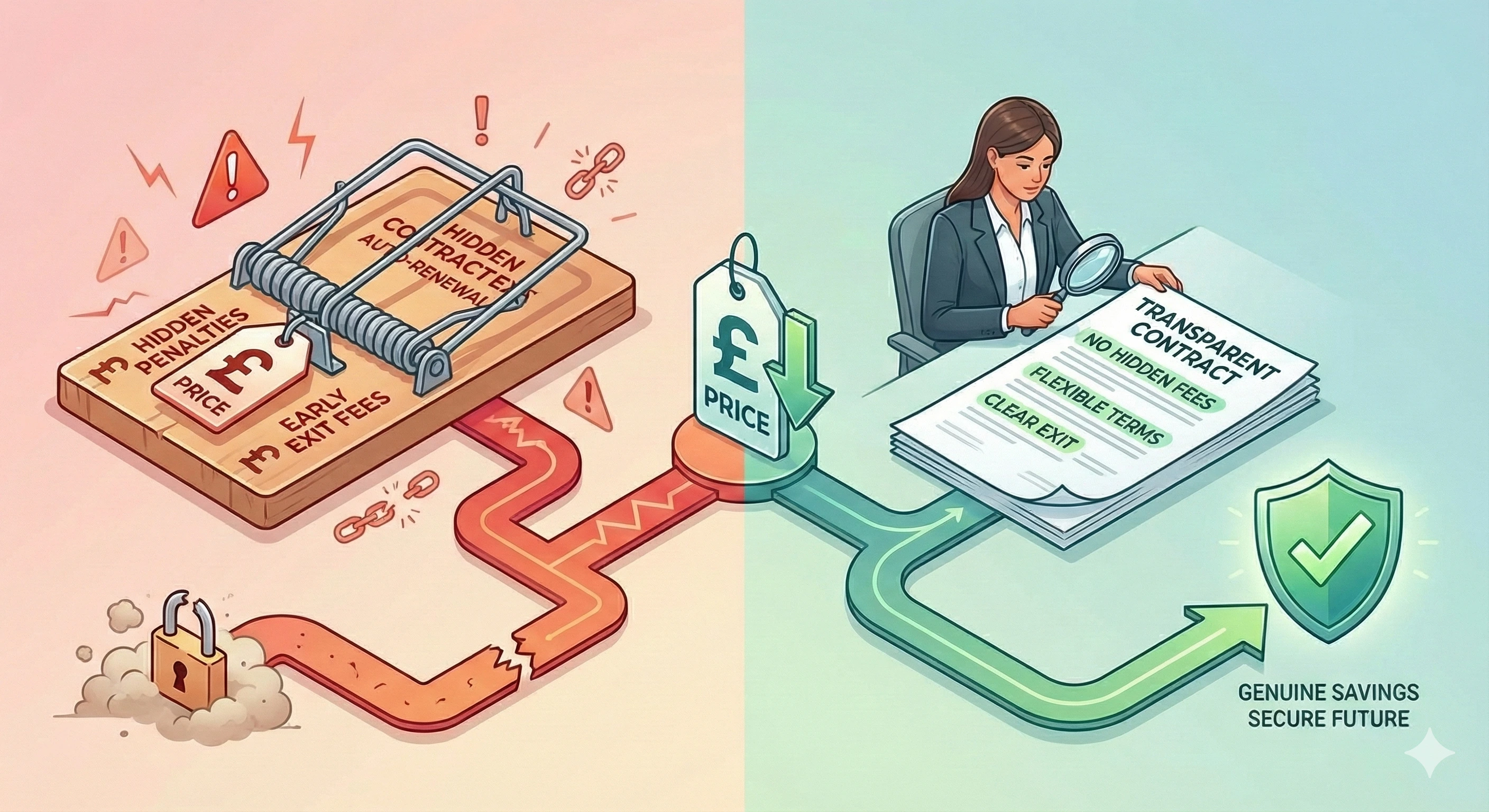
- A quote that looks too cheap often has a catch: a minimum-usage floor, tight tolerance, a high standing charge, or charges that aren’t fixed.
- Fit matters more than price. Read the terms, not just the unit rate.
What Is Volume Tolerance?
Volume tolerance is a clause in a fixed-price business energy contract that lets the supplier charge you if your usage moves too far from the estimate the price was based on. You agree a price per kWh for an expected amount of energy - your Estimated Annual Consumption (EAC) - and the clause sets how far above or below that you can go before extra charges apply.
It is sometimes called “take-or-pay”, and the allowed range is called the tolerance band. Here is how one supplier puts it. Drax’s SME terms (opens in new tab) (February 2024 version) say that if your actual consumption differs from your Estimated Annual Consumption “by a quantity in excess of or below the Volume Variation Tolerance (or, if none is specified, ten per cent.) then you shall reimburse us against all costs, losses and expenses associated with the difference in consumption”.
Bands vary by supplier and product. In EDF’s 2015 explainer (opens in new tab), its Fixed + Protect product allowed 20% variation without charge, Fixed + Reflective had a 10% threshold, and Fixed + Peace of Mind had no limit. Check the band in your own contract - it is usually in the contract schedule or terms, not on the quote.
Why Do Suppliers Use Volume Tolerance?
To give you a fixed price, a supplier buys most of your expected energy in advance on the wholesale market (called hedging). If your usage then changes a lot, it is left with the wrong amount:
- You use less: the supplier holds electricity it has paid for and has to sell the surplus back, often for less than it paid. Drax’s terms name “selling electricity for a lower price than that for which it was originally purchased” as one of the costs you can be asked to cover.
- You use more: the supplier has to buy the extra at short-term prices, which may be higher than the price it fixed for you.
In plain terms, the clause moves that risk from the supplier to you. Suppliers aren’t being difficult - it is a real cost - but it means the cheapest unit rate is only cheap if your usage stays inside the band.
How Are Volume Tolerance Charges Worked Out?
The charge is usually the price difference on the energy outside your band, not your full unit rate on it. Each supplier sets its own formula, so read yours. EDF’s Fixed - Peace of Mind terms for industrial and commercial customers (opens in new tab) set it out clearly:
- Under the band: tolerance charge = ((EC - (EC x T)) - AC) x (ER - SSP). In words: the kWh you fell short of the bottom of the band, times the gap between your contract energy rate and the System Sell Price (the imbalance price a supplier gets for surplus electricity in the national settlement system).
- Over the band: tolerance charge = (AC - (EC + (EC x T))) x (SBP - ER). In words: the kWh above the top of the band, times the gap between the System Buy Price and your contract energy rate.
In those terms, EC is the Estimated Annual Consumption, AC is your actual consumption, T is the tolerance (10%) and ER is your contract energy rate. The same terms say no tolerance charge applies if your consumption in the period is 50GWh or less, so a small business on that product would not pay one. Other suppliers’ terms, such as Drax’s, are written more broadly (“all costs, losses and expenses”).
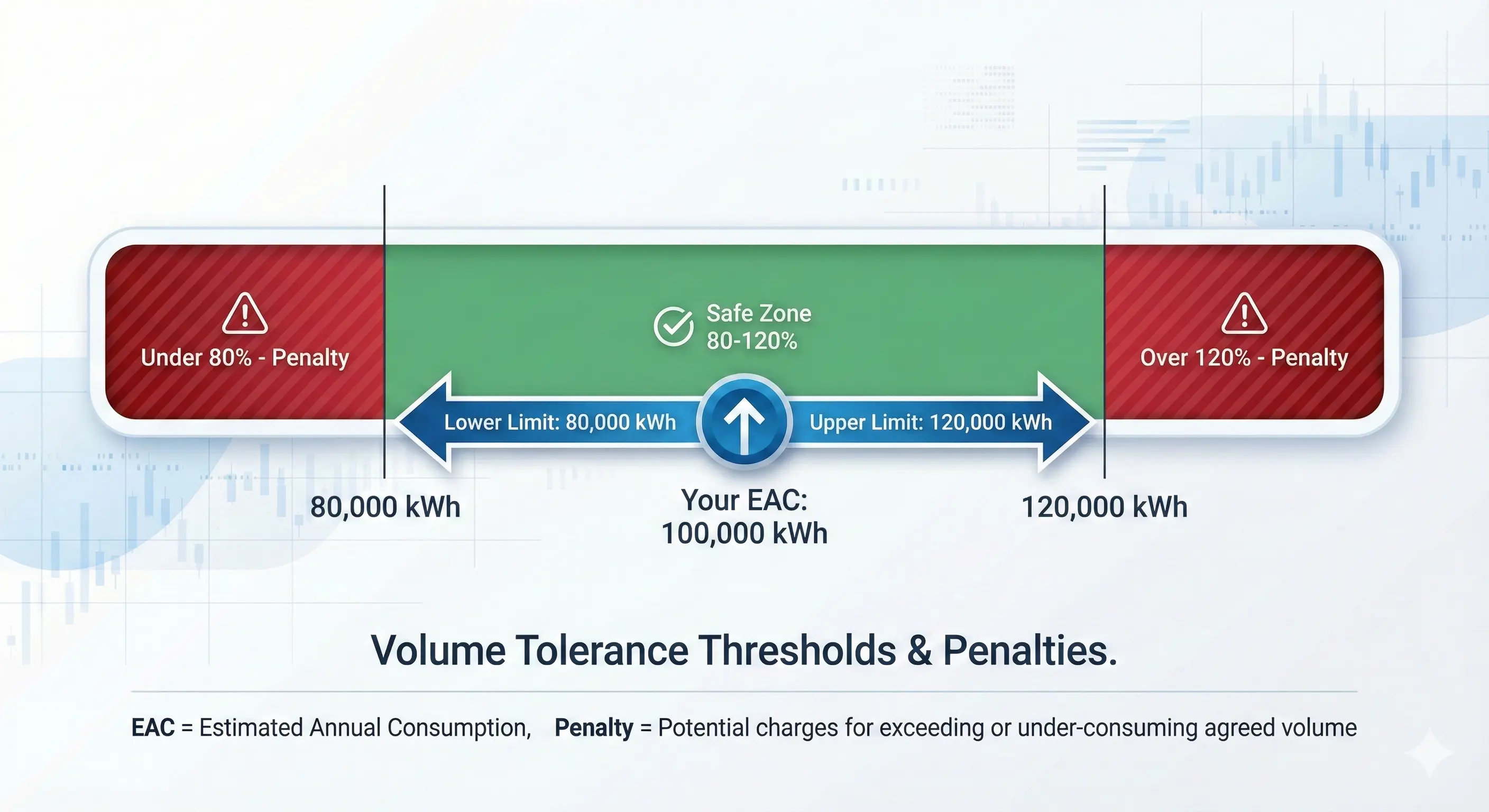
Worked example (our arithmetic, with illustrative prices - not market prices): your EAC is 20,000 kWh with a 10% band, so the bottom of the band is 18,000 kWh. You use 15,000 kWh - 3,000 kWh short. If your contract energy rate is 10p/kWh and the surplus sells back at 7p/kWh, the formula gives 3,000 x 3p = £90. If the resale price is 2p/kWh, it is 3,000 x 8p = £240. The wider the gap between what the supplier paid and what it can resell at, the bigger the charge.
Some contracts go further than a tolerance charge. Drax’s SME terms also say that if the level or pattern of your consumption “is materially different to (or materially changes from) the information provided then we may change the Charges” - in other words, re-price your contract.
What Do Fixed and Open Volume Mean?
Fixed (or “closed”) volume is energy that has already been bought at a set price; open volume is the part still to be bought later, at whatever the market price is then. The terms come from flexible energy buying, where large buyers purchase their energy in chunks over time instead of all at once.
A public sector buying framework’s information pack describes a reference price “based on the cost of all energy purchased prior to the supply period (the ‘closed volume’) and … forecast of costs to purchase the remaining energy within the supply period (the ‘open volume’)” (LASER Flexible Energy Frameworks 2016-2020 information pack, published by Southampton City Council (opens in new tab)).
For a small business, the practical point is this:
- Fixed-price contracts fix the price per kWh, but not how much you use. Your supplier has bought your expected volume in advance, which is why the volume tolerance clause exists.
- Flexible contracts leave some volume open, so part of your price moves with the market. You carry the price risk on that open volume yourself.
On a fixed-price contract, the question to ask is not “is my volume fixed?” but “what happens if I use more or less than the estimate?”
Why Does My Business Energy Quote Seem Too Cheap?
A quote that is much cheaper than the rest usually isn’t comparing like with like - the catch tends to be in the terms rather than the unit rate. Before you take it, check these five things:
- Minimum usage and volume tolerance. A low rate can come with a tight band or an absolute floor, such as a minimum kWh a month. If your usage is below it, you are outside the terms from day one (see the real example below).
- The standing charge. A low unit rate with a high standing charge can cost more in a year, especially for a small user. Compare the total annual cost at your usage.
- Fixed or pass-through. On a pass-through contract, some non-energy costs (such as network charges) aren’t fixed and can go up during the contract. A fully fixed contract includes them in the price, so it can look dearer on day one.
- Contract length and start date. Quotes for different terms (one year against three) or start dates aren’t directly comparable.
- The usage it is based on. A quote priced on the wrong annual usage will give the wrong annual cost, and can push you outside your tolerance band. Check the kWh figure on the quote matches your recent bills.
If you are not sure what your current price is, start there: upload your latest bill and Meet George’s free bill check lists every charge line by line and compares your all-in price per kWh with the DESNZ average for a business of your size. That tells you whether a “cheap” quote is really cheap for you.
Real Example: The “Cheapest” Quote That Wasn’t
We recently helped Dream Looks Boutique, a small beauty business using about 6,039 kWh per year.
On paper, one supplier looked like the winner. Their unit rate offered a 51% annual saving compared to the client’s current costs (they were on deemed rates). It was the lowest price on the table.
But then our AI scanned the full Terms & Conditions and flagged a clause in the small print. It was something along the lines of:
The supplier reserves the right to increase the charges if the customer uses less than 1,200 kWh of electricity per month.
Do the maths:
- Dream Looks Boutique uses 6,039 kWh per year
- That averages to ~503 kWh per month
- The contract set a minimum of 1,200 kWh per month
If the client had signed this “lowest price” contract, they would have been below the threshold from day one, and the supplier would have had the right to increase the charges.
It’s About “Fit,” Not “Quality”
The supplier in question is a good provider for businesses that use more energy. They have every right to protect their buying position with these thresholds. The problem wasn’t the supplier; the problem was the fit.
For a larger business, that contract could have been perfect. For a small boutique using about 500 kWh a month, it was a ticking time bomb. This mismatch is an example of why SMEs often overpay for broker services designed for industrial users - the “best” deal depends on your business.
The Better Choice
Instead of the “lowest price” deal, we recommended an alternative supplier:
- The rate: a 46% saving - slightly less than the cheapest quote
- The terms: crucially, no absolute 1,200 kWh floor
By paying a little more per unit, the client got a contract they could actually stick to - securing real savings rather than theoretical ones.
Who Is Most at Risk?
The risk depends less on the size of your business than on how predictable your usage is and how it compares with any minimums in the contract.
Lower risk:
- Stable, predictable usage that hasn’t changed much in two years or more
- A contract priced on actual meter reads
- Usage comfortably above any contract minimum
Higher risk:
- Seasonal businesses (hospitality, retail, tourism)
- Businesses that are growing or shrinking
- New premises without usage history
- Businesses changing how they operate (new equipment, different hours)
- Small users facing an absolute kWh floor set for bigger customers
- Businesses installing solar panels, batteries or EV chargers
Solar Panels and Batteries
On-site generation cuts the electricity you take from the grid, which can push you below your tolerance band. Drax’s SME terms say that where you intend to install equipment “(including but not limited to generation, electric vehicle charge points and batteries) that will materially change the level or pattern of your consumption then you must give us advance notice”. Before you install:
- Work out how much your grid usage will drop
- Tell your supplier before installation
- Ask for your EAC and tolerance terms to be updated
- Get the revised terms in writing
How Does MHHS Affect Volume Tolerance?
MHHS (Market-wide Half-Hourly Settlement) moves every electricity meter in Great Britain onto half-hourly settlement, so suppliers will work from your actual half-hourly usage instead of estimates. Elexon (opens in new tab), which runs the programme, says it will complete in May 2027 - see our guide to half-hourly charges and MHHS for the full timeline.
Until your meter moves, if you’re on a non-half-hourly meter your usage is settled using a standard profile class - the first two digits of your MPAN. Profile Class 03 is a standard non-domestic meter, 04 is a non-domestic Economy 7 (day/night) meter, and 00 is half-hourly. Your EAC is an estimate built from your meter reads, so if your reads are estimated too, the forecast your tolerance band is based on can drift.
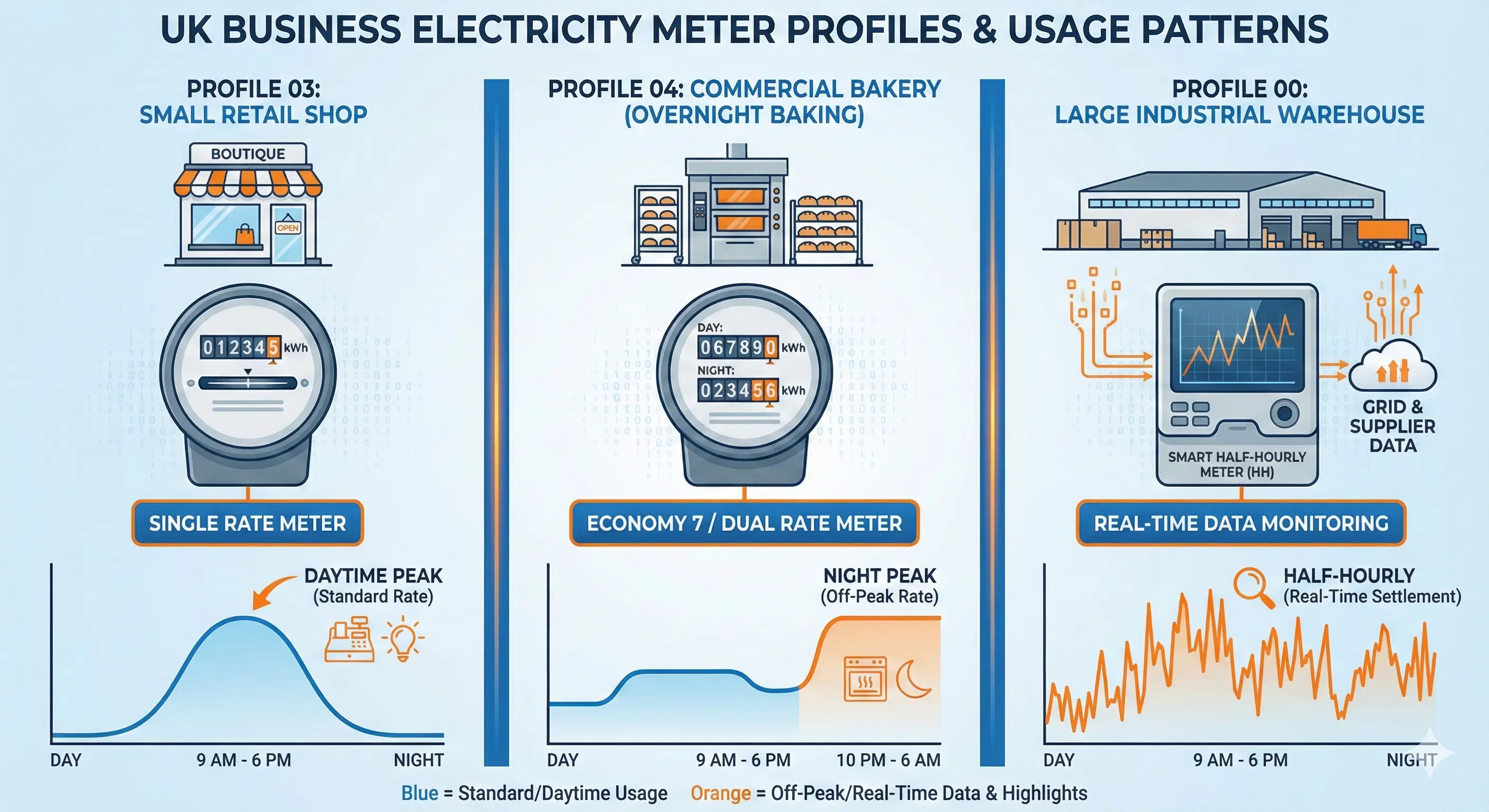
Half-hourly data should make EACs, and so tolerance bands, more accurate. It doesn’t remove the clause: your supplier still buys in advance, so if your usage changes a lot, the clause can still apply. In the meantime, submit regular meter reads (or make sure your smart meter is sending them) so your EAC reflects what you really use.
How to Protect Yourself
Before signing any energy contract:
1. Get the Full Terms & Conditions
Don’t just look at the quote summary. Request the complete terms and search for:
- “Volume tolerance” or “volume variation”
- “Take-or-pay”
- “Minimum consumption”
- “Estimated Annual Consumption”
- “Tolerance charge”
2. Check for Absolute Thresholds
Look for clauses setting a minimum kWh a month or a year. Check whether your business consistently meets the minimum. If your typical usage is below it, you are outside the terms from day one.
3. Use Actual Meter Reads
Make sure your EAC comes from actual meter reads, not estimates. Submit reads regularly if you don’t have a working smart meter.
4. Ask Direct Questions
Email the supplier (or your broker):
- “What is my volume tolerance band?”
- “How is the charge worked out if my usage falls outside it?”
- “Are there any absolute kWh minimums?”
Get the answers in writing.
5. Compare the Total Cost
Compare the annual cost at your real usage, including the standing charge and the tolerance terms, not just the unit rate. A contract you can stick to at a slightly higher rate can cost less than a cheaper one you can’t.
Why Meet George Is Different
In our experience, most comparison sites rank by price. They don’t read the PDF.
When we compare quotes, Meet George’s AI reads the terms as well as the unit rate, and flags clauses - like the minimum-usage floor in the Dream Looks example - that don’t fit how your business uses energy. We don’t just find you the cheapest rate. We find you the contract you won’t regret signing.
Check what you pay now: upload your latest bill and Meet George tells you in seconds whether you’re in your switching window.
Switching soon? Learn how to switch business energy step by step, see how business energy quotes work, or understand what happens when your contract ends and you roll onto deemed rates.
Worried about your current contract? Read our guide on whether you can cancel a business energy contract early.


