


What is MHHS?
MHHS (Market-wide Half-Hourly Settlement) is a major upgrade to the UK electricity grid that will require all business meters to send usage data every 30 minutes. This eliminates the current system of estimated billing and enables accurate, real-time settlement. The rollout began in October 2025, with full completion expected by 2027.
TL;DR: Key Takeaways
The Guessing Game: Your supplier estimates your usage based on outdated Profile Class data. You pay estimated bills for months, then get hit with massive reconciliation charges.
The Hidden Penalty: Volume Tolerance clauses (80/120 rule) penalise you for using significantly more OR less than your forecast. Large users (Profile Class 00) face the strictest enforcement.
The Solar Trap: Installing renewables without renegotiating your contract can trigger “Take or Pay” penalties for using less energy than predicted.
The Fix is Coming: MHHS (Market-wide Half-Hourly Settlement) is rolling out now. By 2027, all meters will send 30-minute data, eliminating estimates forever.
Protect Yourself Today: Submit monthly meter reads (if you don’t have a smart meter with automatic meter readings), check your Volume Tolerance terms, and ensure you have a working smart meter for accurate billing.
What Is the Problem with Business Energy Billing?
For decades, business energy billing has been a guessing game.
You pay an “Estimated Bill” for months, only to be hit with a massive “Reconciliation Bill” when you finally submit a meter reading. Worse, if your actual usage varies too much from your estimate, you might find yourself slapped with a hidden penalty called a Volume Tolerance Charge (often known as “Take or Pay”).
The system isn’t broken, but it is archaic.
However, a massive industry upgrade called MHHS (Market-wide Half-Hourly Settlement) is currently rolling out to fix it.
At Meet George, we believe you shouldn’t need a degree in grid mechanics to pay a fair price. Here is what MHHS means for your business, why “Profile Class 00” meters carry more risk, and how to avoid penalties right now.
Why “Estimated Billing” Exists: Understanding Profile Classes
To understand why bills are wrong, you have to look at your meter’s Profile Class. You can find this on your bill - it is the first two digits of your MPAN (the grid of numbers on the top left).
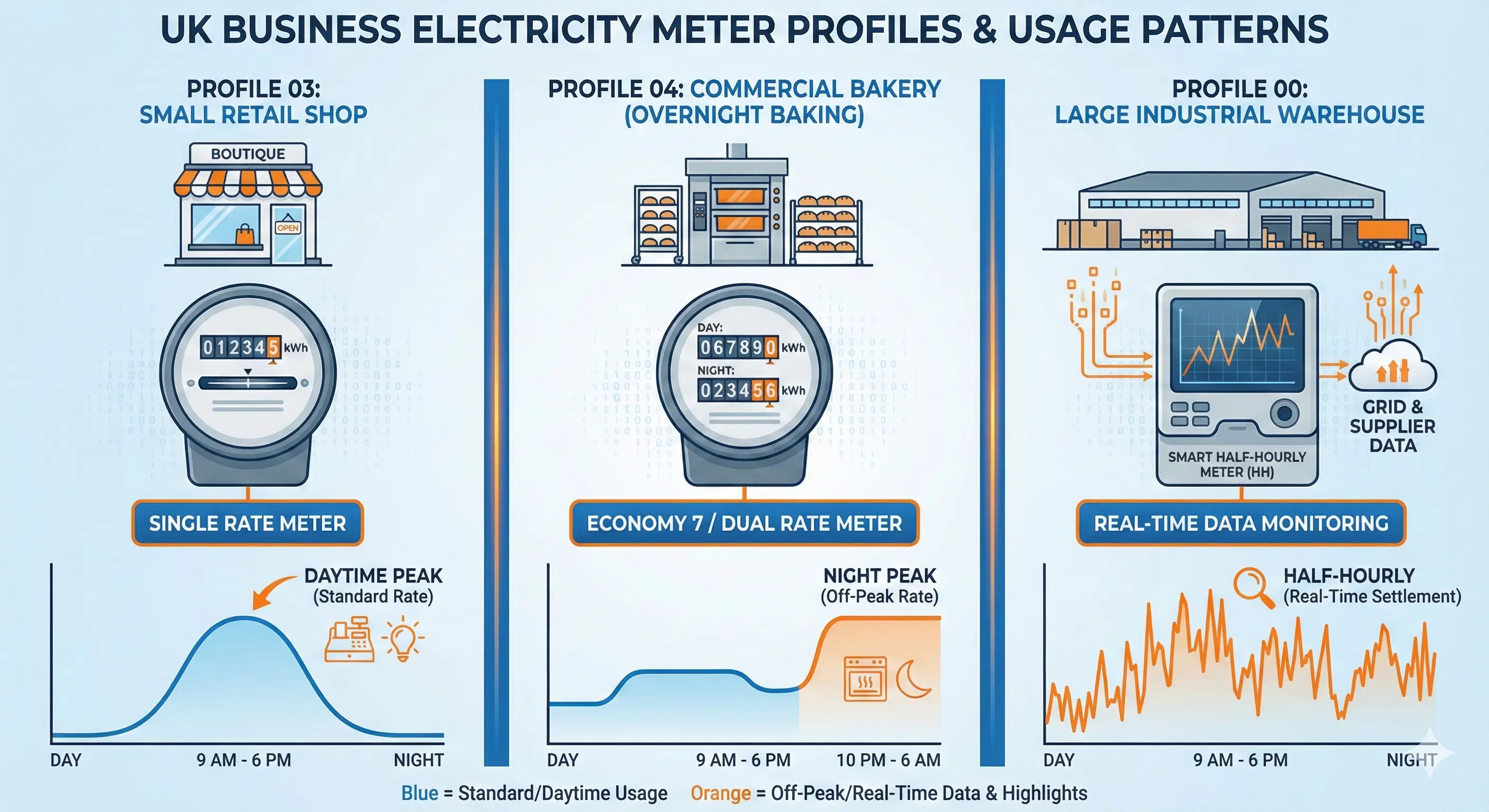
The Three Main Non-Domestic Profile Classes
| Profile Class | Name | Typical User | How It Works |
|---|---|---|---|
| 03 | Non-Domestic Standard | Small shops, offices | Single-rate meter with estimated billing |
| 04 | Non-Domestic Economy 7 | Businesses with overnight machinery/heaters | Dual-rate (Day/Night) with estimated billing |
| 00 | Half-Hourly | Large energy users (100kW+) | Records usage every 30 minutes |
The Core Issue with 03/04 Meters
Currently, even if you have a smart meter, Profile Class 03 and 04 meters are not settled on the grid in real-time. Suppliers have to guess your usage pattern based on your EAC (Estimated Annual Consumption).
If they overestimate: You overpay monthly and hurt your cash flow.
If they underestimate: You get a nasty “Catch Up” bill later.
But the biggest risk isn’t just a messy bill. It’s the penalty clause hiding in your contract.
The Hidden Trap: Volume Tolerance (Take or Pay)
Because suppliers buy your energy in advance (a process called hedging), they lose money if you use significantly more or less than predicted.
To protect themselves, they include a Volume Tolerance clause in your contract. We’ve written a detailed guide on how volume tolerance can turn the “cheapest” contract into a trap - the short version is that the lowest unit rate isn’t always the best deal.
How the 80/120 Rule Works
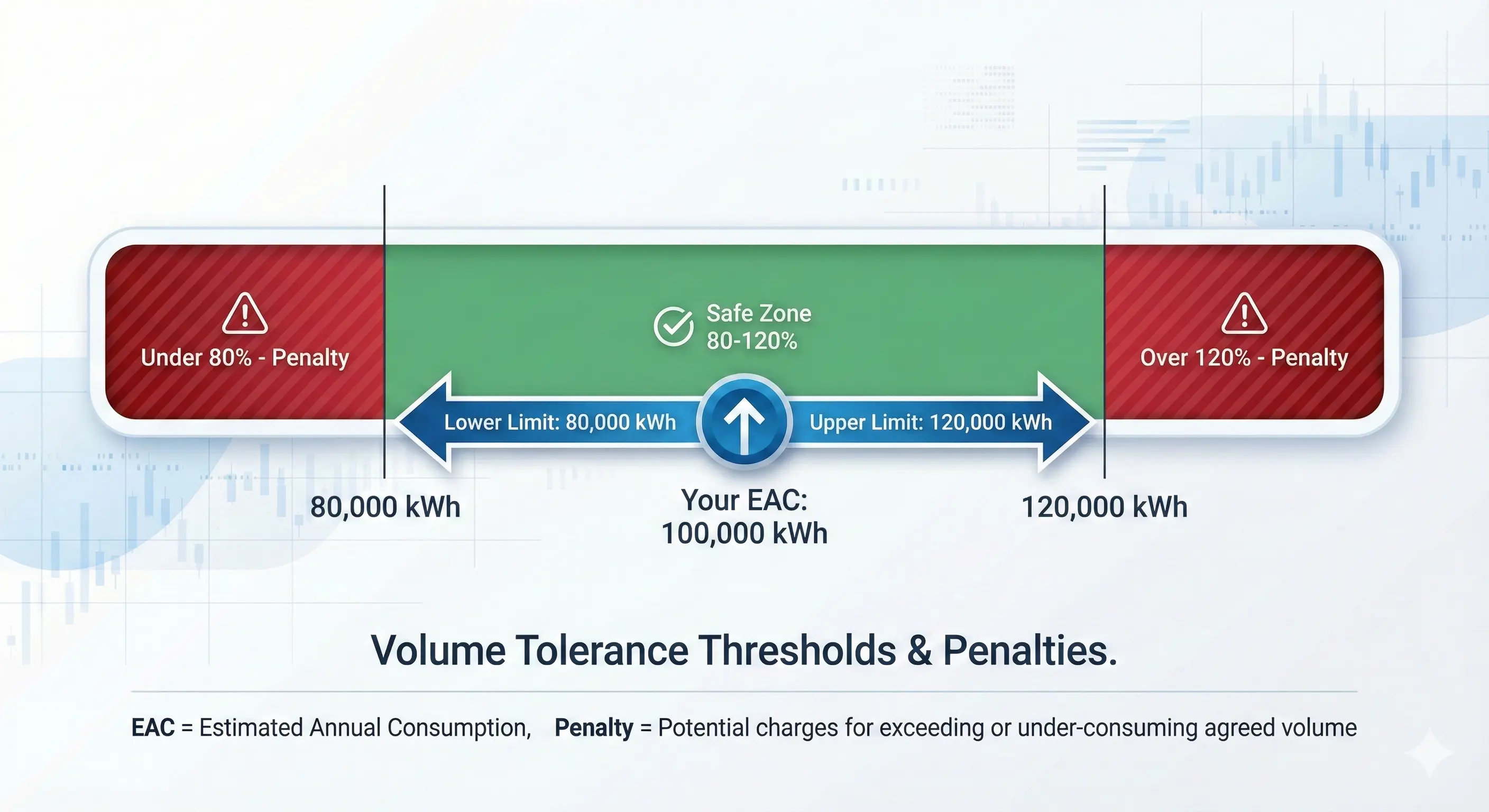
Most fixed contracts set a tolerance band - typically 80% to 120% of your estimated usage.
Example: If your EAC is 100,000 kWh:
| Zone | Usage Range | What Happens |
|---|---|---|
| Safe Zone | 80,000 - 120,000 kWh | No penalties |
| Over Tolerance | >120,000 kWh | Supplier buys extra at expensive “Day Ahead” rates. You pay a penalty for every extra unit. |
| Under Tolerance | <80,000 kWh | Supplier bought energy they can’t sell. You pay for the “unused” energy anyway (“Take or Pay”). |
How Penalties Are Calculated
There is no standardised UK-wide penalty formula - each supplier sets their own terms (opens in new tab). However, the typical calculation works like this:
Over-tolerance: Excess kWh are charged at the supplier’s deemed rate or Day-Ahead spot price (not your contracted rate). You effectively pay the difference between your contracted rate and the much higher penalty rate.
Under-tolerance: You pay for energy you didn’t use. The supplier charges you for the shortfall at your contracted rate - because they already bought that energy for you.
Example Penalty: A business with 100,000 kWh EAC that uses 112,000 kWh (12% over the 120% threshold = 2,000 kWh excess) could face penalties of £300-£700 (opens in new tab) on those excess units alone, depending on supplier terms. That’s on top of what you already paid for those units at your contracted rate.
Important: Tolerance bands vary by supplier. Some are stricter (85/115), others more lenient (75/125) (opens in new tab). Always check your specific contract terms.
The “Profile Class 00” Risk
While Volume Tolerance applies to everyone, the risk is higher for larger businesses on Profile Class 00 meters.
Why the Risk Differs by Profile Class
Small SMEs (Profile Class 03/04): Suppliers hedge these accounts in bulk portfolios. Small variances are often absorbed because the overages and underages across many customers tend to balance out.
Large Users (Profile Class 00): If you have a 00 meter, the supplier buys energy specifically for you based on your forecast. If you miss your prediction, the financial impact is direct and immediate. Therefore, Volume Tolerance penalties are enforced strictly for 00 customers.
The Renewable Energy Trap
Insider Warning: If you’re installing solar panels, batteries, or other on-site renewable assets, your consumption from the grid will drop significantly. If you don’t warn your supplier and renegotiate your Volume Tolerance, this drop could trigger a “Take or Pay” penalty for using less than 80% of your forecast. Always renegotiate your Volume Tolerance before going green.
The Solution: Market-wide Half-Hourly Settlement (MHHS)
The “guessing game” is ending. The UK energy grid is undergoing a massive digital migration.
What is MHHS?
Instead of relying on estimates or monthly reads, every meter (including Profile Class 03 and 04) will eventually send usage data to the grid every 30 minutes.
This means the industry will finally know exactly how much energy your business uses, when you use it, and can bill you accordingly.
The Benefits for Your Business
| Benefit | What It Means |
|---|---|
| Hyper-Accurate Billing | No more estimates. You pay exactly what you used that month. |
| Smarter Buying | Suppliers won’t need to add huge “risk premiums” to your rates because they won’t be guessing your usage anymore. |
| Time of Use Tariffs | Suppliers will be able to offer cheaper rates at specific times of day, optimised for your specific business patterns. |
| Reduced Reconciliation Shocks | No more massive catch-up bills months after the fact. |
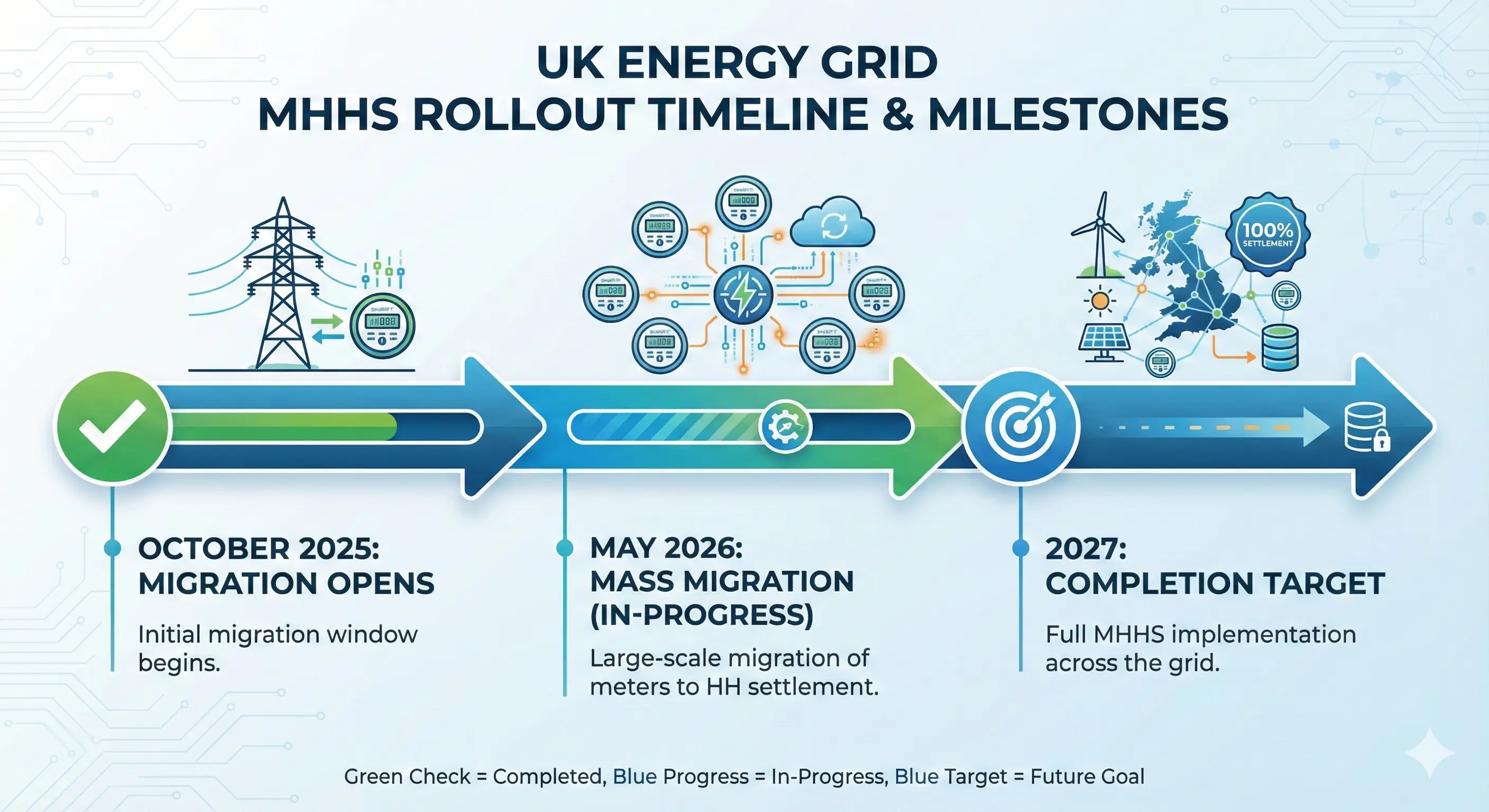
MHHS Implementation Timeline
| Date | Milestone |
|---|---|
| October 2025 | Migration window formally opens |
| 2026 | Mass migration ramps up |
| 2027 | Target completion for all non-domestic meters |
For the full business case and regulatory decision, see Ofgem’s MHHS Decision Document (opens in new tab).
How to Protect Yourself Today
You don’t have to wait for 2027 to stop the bill shocks. Here are five actions you can take right now.
1. Check Your Volume Tolerance
Read your contract carefully. Look for the tolerance clause and note the percentage band. Is it 80/120? Stricter? More lenient?
If you can’t find it, ask your supplier directly: “What is the Volume Tolerance band on my contract, and what are the penalty rates?“
2. Submit Meter Reads Monthly
Even if you don’t have a smart meter, submitting manual reads prevents the “drift” that leads to massive catch-up bills.
Pro tip: Set a calendar reminder for the same day each month. Take a photo of your meter and email it to your supplier.
3. Review Before Installing Renewables
If you’re planning solar panels, battery storage, or any on-site generation:
- Calculate how much your grid consumption will drop
- Contact your supplier before installation
- Renegotiate your EAC and Volume Tolerance to reflect the new lower usage
- Get the revised terms in writing
4. Verify Your EAC is Accurate
Your EAC (Estimated Annual Consumption) is the foundation of your contract and your Volume Tolerance calculation. If it’s wrong, everything built on it is wrong.
Ask your supplier for your official EAC from the central industry database (ElectraLink (opens in new tab)). This ensures your contract is based on accurate industry data, not a supplier’s guess.
5. Understand Your Meter Type
Profile Class 00 meters: Your supplier already has access to your exact half-hourly data, giving complete visibility into your consumption patterns. Volume Tolerance is enforced strictly.
Profile Class 03/04 meters: Your usage is estimated using industry profiles. Ensure your contract is based on your official industry EAC to reduce Volume Tolerance breach risk.
The Grid is Getting Smarter. Your Energy Buying Should Too.
MHHS represents the biggest change to UK business energy billing in decades. For the first time, the industry will have accurate, real-time data on exactly how much energy every business uses.
This means:
- End of estimated billing and reconciliation shocks
- Fairer pricing as suppliers can price risk accurately
- New tariff opportunities like Time of Use pricing
- Reduced Volume Tolerance risk as forecasts become more accurate
But the transition won’t happen overnight. During the 2025-2027 migration period, businesses still face the old risks: estimated bills, catch-up charges, and Volume Tolerance penalties.
Protect yourself now. Check your contract terms and submit regular meter reads if you don’t have a smart meter.
Ready to find a better energy deal? Learn the complete 5-step switching process or join the Meet George platform waitlist to switch in 20 minutes with full transparency - no undisclosed fees, no surprises.


