

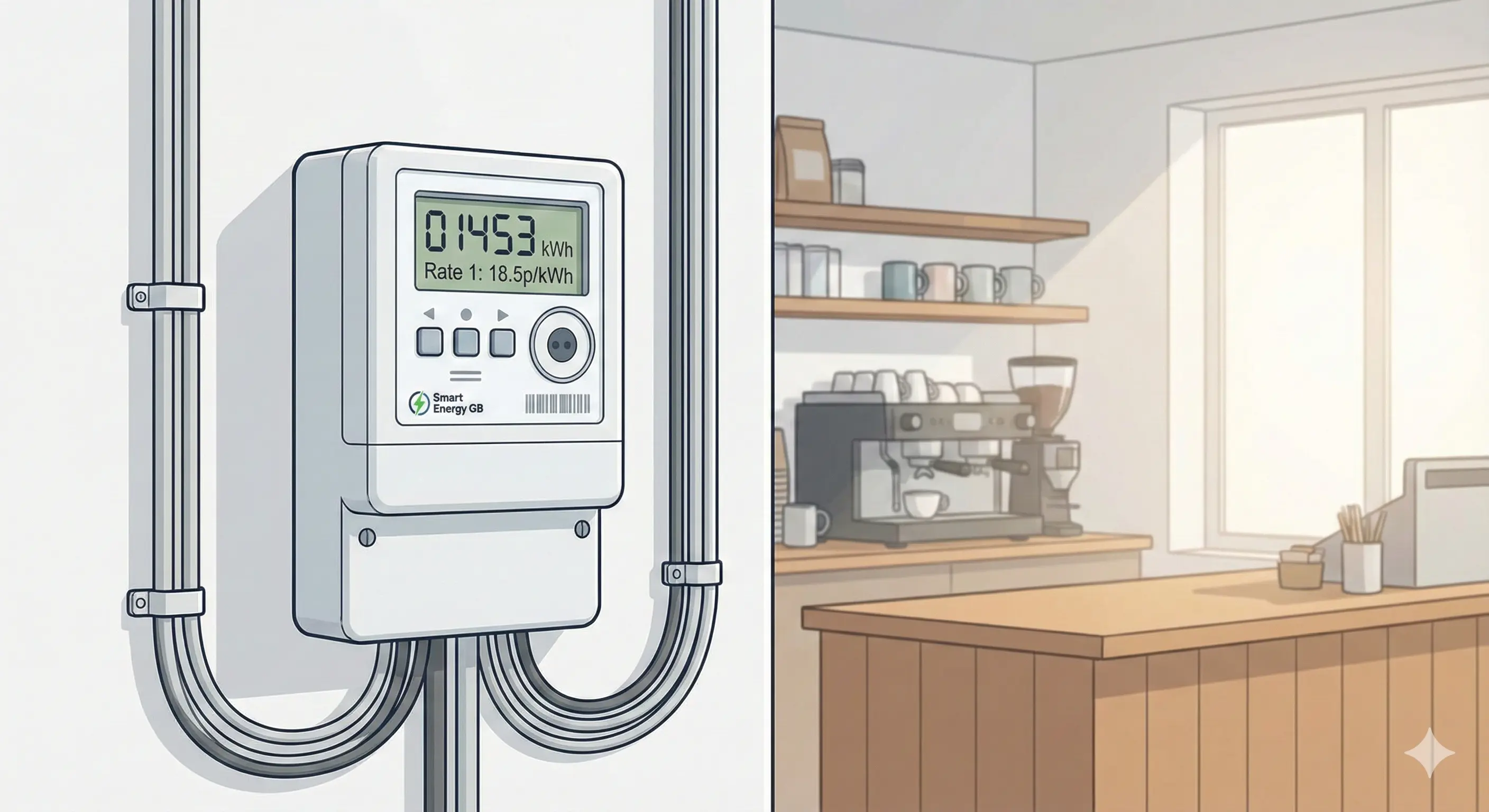
TL;DR: Smart meters in plain English
- One-sentence answer: If you want accurate bills, eligibility for “smart” tariffs, and the best chance of avoiding MHHS risk premiums, your UK business should get a working smart meter (ideally SMETS2).
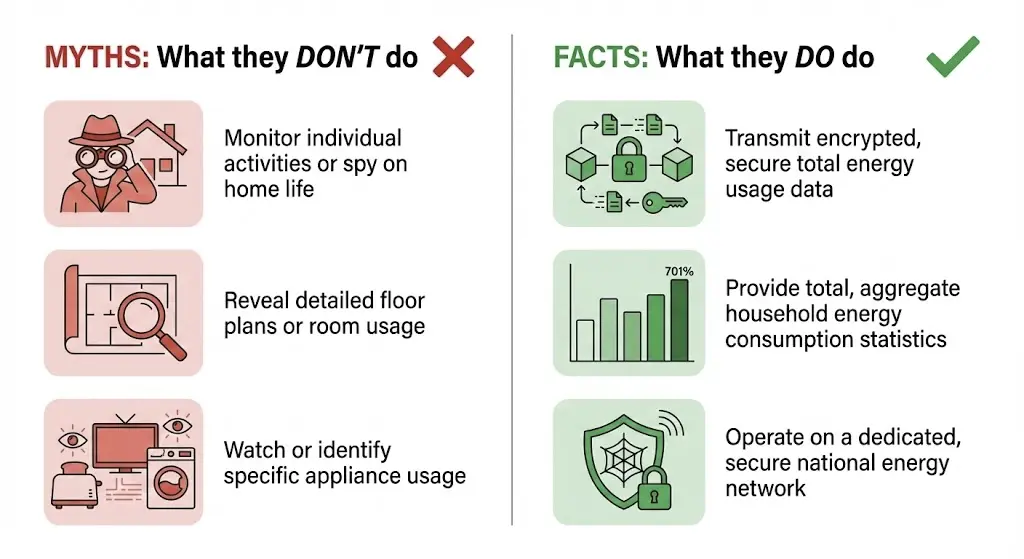
- Myth: Smart meters can’t see appliances - they measure total consumption at the meter, over time.
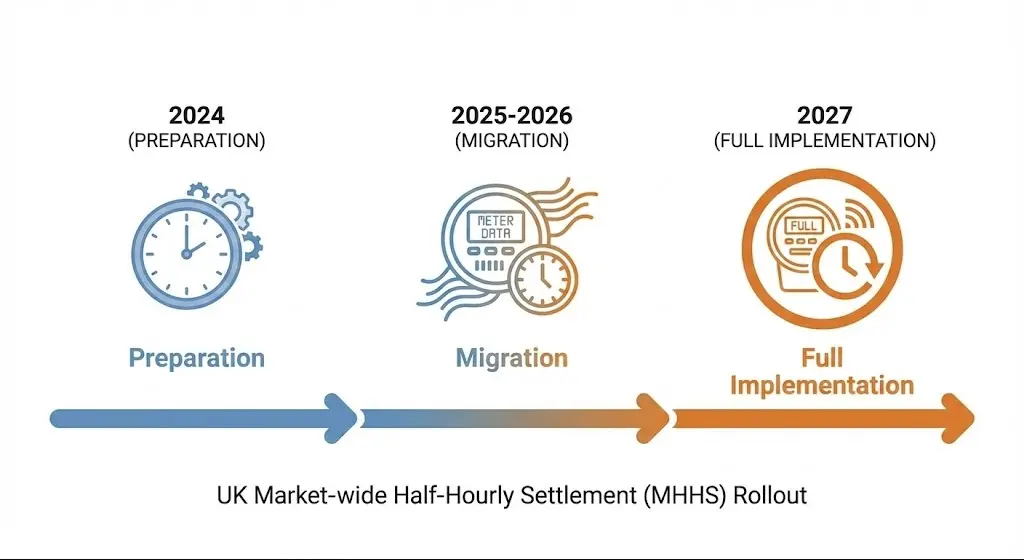
- MHHS: The UK electricity market is moving to Market-wide Half-Hourly Settlement (MHHS), which makes accurate half-hourly data more valuable for pricing and disputes.
- 2027 (confirmed): From 1 January 2027 suppliers must start telling business customers about the smart-contingent contract rule, and from 1 September 2027 new fixed-term contracts for small and medium sites must require a smart or advanced meter, or the customer’s agreement to have one (government response, September 2026 (opens in new tab)).
- Practical step: Ask your supplier for a free non-domestic smart meter installation/upgrade and confirm it’s sending automatic reads.
If you’re still sending manual meter reads in 2025, you’re running your energy billing on “best guesses”. As of end 2024, 61% of UK non-domestic meters now have smart meters (2.0 million of 3.3 million total meters), with the government targeting 68.7% coverage by end 2025 and universal coverage by 2030. The UK is now the fastest-growing European smart meter market, with 35.5% compound annual growth forecast through 2033. This guide explains what smart meters actually do, why MHHS changes the incentives, and what to do next if you want to reduce costs and avoid billing surprises.
Are smart meters “spying” on your business?
The “spying” fear is the most common reason SMEs delay smart meter installs.
Myth: “The supplier (or government) can see what appliances I’m using.”
Reality: A smart meter measures aggregate electricity flow through the meter, not the devices behind it. It can tell you when your site used more power, but it can’t identify what caused it.
- No “appliance fingerprinting” from the meter itself.
- Smart meters communicate via the UK’s smart metering infrastructure (not your business Wi-Fi) via the DCC (Data Communications Company), operated by Smart DCC (opens in new tab).
- You can ask your supplier what data frequency is enabled; half-hourly (HH) metering is the most useful for savings and disputes.
In short: Smart meters measure total consumption at the meter - they cannot see individual appliances or “spy” on your business operations.
What data does a smart meter collect (and how is it secured)?
In practical terms, a smart meter records:
- Total consumption (kWh) over time (often in 30-minute blocks if half-hourly is enabled)
- Standard meter identifiers (so bills are attributed correctly)
- Technical reads used for billing and network operations
Smart meters do not use your business broadband. In the UK, meters communicate via the DCC network (run by Smart DCC (opens in new tab)). For official policy direction and timelines, see the UK government’s non-domestic smart meter rollout consultation (opens in new tab).
If you’ve heard horror stories about early smart meters, most of it comes down to coverage, communications hubs, and the interoperability gap between SMETS1 and SMETS2 (which is being addressed via DCC-led programmes).
Which UK meter types matter for billing (and why Profile Class matters)?
Many businesses are “stuck” on older billing structures because they still have older meter setups or data settings.
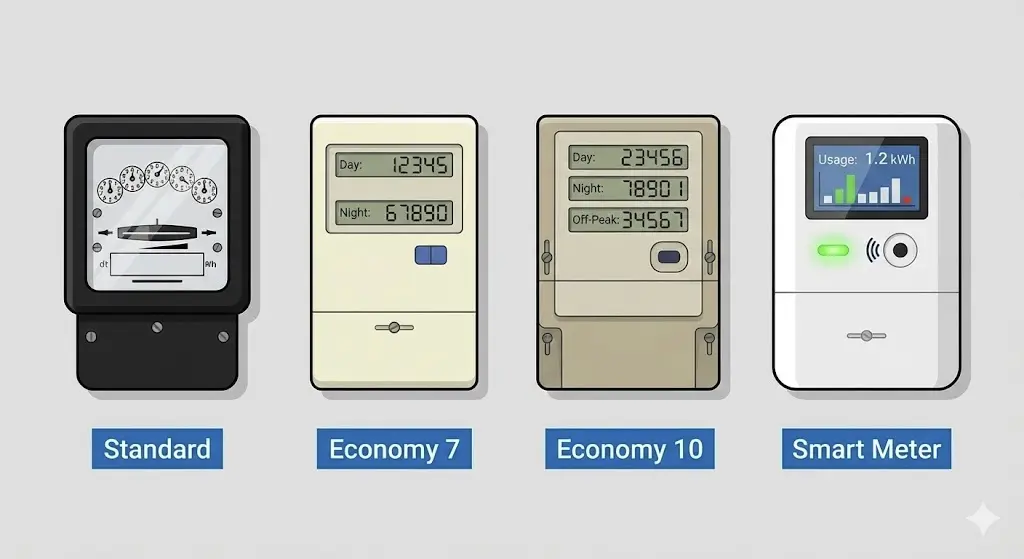
Here’s a simplified view of the common meter types you’ll see in UK SME electricity:
| Meter type | Profile class (typical) | How it works | Key limitation / risk |
|---|---|---|---|
| Standard (analogue / AMR) | 03 | One rate: you pay the same price (e.g. 25p/kWh) whether you use power at 2am or 2pm | You overpay if you operate outside peak hours, and bills can drift on estimates |
| Economy 7 | 04 | Two rates: you get ~7 hours of cheaper “night” electricity (often around midnight-7am) and a more expensive “day” rate | Great for storage heaters, bad if you work 9-5 (day rates are often inflated) |
| Economy 10 | 03/04 | Three windows: ~10 hours of cheaper rates split across night (5 hrs), afternoon (3 hrs), and evening (2 hrs) | Often confused with “weekend” tariffs, but E10 typically runs 7 days a week. It’s complex and can be hard to switch away from |
| Smart meter (SMETS1 / SMETS2) | 00 | Time of use (ToU) pricing: tracks usage every 30 minutes and can unlock tariffs that are cheaper when renewables are abundant (e.g. windy days) | The future: this is how you access smart/time-variable pricing and “smart-only” style commercial tariffs |
If you want one quick diagnostic: check your Profile Class on the MPAN line of your bill. If you’re on 03/04, you’re usually not getting the full benefit of half-hourly data yet (even if your meter hardware is “smart”).
SMETS1 vs SMETS2: which do you have and does it matter?
If your smart meter was installed before 2019, it’s likely a SMETS1 (first-generation) meter. These worked well with the original supplier, but some stopped sending reads after a switch - effectively becoming “dumb” meters that require manual reads.
SMETS2 meters (installed from 2019 onwards) communicate via the national DCC network, meaning they stay smart regardless of which supplier you’re with.
The good news: the DCC has been running a large-scale programme to bring SMETS1 meters back online. As at December 2025, almost 12 million SMETS1 meters have been migrated to the DCC network via over-the-air software updates (opens in new tab) - no engineer visit required. If you have a dormant SMETS1 meter, ask your supplier whether it’s eligible for remote migration. Many can be brought back online without any site visit.
Your rights if smart meter installation or repairs go wrong
From February 2026, Ofgem introduced new Guaranteed Standards of Performance (opens in new tab) for smart meters. They cover households and microbusinesses - not larger businesses, which Ofgem left out because they “typically have bespoke contractual protections” (Ofgem’s final decision, January 2026 (opens in new tab)). If you’re a microbusiness, your supplier must make an automatic payment (Ofgem puts it at £40) when:
- It can’t offer a first-time smart meter installation appointment within 12 weeks of you asking (the limit for households is 6 weeks)
- A smart meter installation fails due to a fault within the supplier’s control
- You report a smart meter problem and the supplier doesn’t give you a resolution plan within 5 working days
The payment is automatic - you should not need to claim it. If you don’t receive it when you’re entitled to, raise a formal complaint with your supplier. If you ask for an appointment date outside the 12 weeks yourself, no payment is due.
Still to come: Ofgem held back a decision on a fourth standard (GSOP 4), covering smart meters that stop working in smart mode for over 90 days, saying in January 2026 it would take it forward later in the year.
The bigger picture: Ofgem’s compliance engagement has already seen over 900,000 previously non-working smart meters repaired or replaced since 2024. These new rules add financial teeth to that pressure.
What is MHHS and why does it make smart meters more important?
Market-wide Half-Hourly Settlement (MHHS) is a UK market reform that moves electricity settlement toward half-hourly granularity. In plain terms: suppliers (and the system) increasingly care about when you use energy, not just how much.
If you have reliable half-hourly data, pricing and disputes can be based on your real usage pattern. If you don’t, suppliers have to model your site using generic assumptions, which can translate into added risk and less favourable tariff availability.
As at December 2025, the MHHS programme’s mass migration for non-domestic meters is expected to ramp up from April 2026 (timelines can move, so always sanity-check the latest programme updates).
If you want the full context, read our MHHS explainer: End of the “Average” Bill: MHHS Changes Everything.
For official policy direction on non-domestic rollout post-2025, start with the government response (opens in new tab) (September 2026) and the consultation’s Annexe A analytical evidence (opens in new tab).
The key point is: Under MHHS, suppliers increasingly price based on half-hourly data - if you don’t have it, you may face risk premiums or limited tariff options.
What if you don’t get a smart meter?
Today, you won’t be “cut off” or directly penalised for not having a smart meter. But the landscape is shifting:
- Market pricing: Suppliers increasingly offer better rates to sites with reliable half-hourly data. Without it, you may face risk premiums or fewer tariff options.
- Confirmed 2027 rule change: The government confirmed on 1 September 2026 (opens in new tab) that from 1 September 2027, every new fixed-term contract for a small or medium business site must include a term that the customer has, or agrees to have, a smart or advanced meter installed. Agreeing to an installation is enough to sign, and a binding consumer protection code stops you being penalised for installation delays outside your control.
- Weaker dispute evidence: Without granular meter data, it’s harder to challenge billing errors or prove what actually happened.
- Grid capacity pressure: UK electricity demand is growing for the first time in 19 years, driven by EVs (projected to reach 25 million by 2035) and heat pumps (scaling to 600,000 installations annually by 2028). The grid needs smart meter data to manage this demand - and businesses with smart meters can access flexibility payments for shifting usage away from peak times.
The rule is now confirmed (status: decided, applying from 1 September 2027). The direction of travel is clear: the market is making smart meters the default for business contracts.
Worked example: how estimated billing can hit SME cashflow
This is an illustrative example to show the mechanism (not a promise of savings).
Assumptions:
- Café uses 1,500 kWh/month (actual)
- Supplier estimates 2,100 kWh/month for billing
- Unit rate £0.28/kWh
- Standing charge £0.60/day (30 days/month)
| Item | Actual | Estimated | Difference |
|---|---|---|---|
| Energy (kWh/month) | 1,500 kWh | 2,100 kWh | 600 kWh |
| Energy cost (per month) | £420.00 | £588.00 | £168.00 |
| Standing charge (per month) | £18.00 | £18.00 | £0.00 |
| Total bill (per month) | £438.00 | £606.00 | £168.00 |
If this happens for three months before a reconciliation, the business can be £504 out of pocket temporarily - and that’s before any disputes about readings, contract terms, or standing charge changes.
Smart meters reduce this because reads are automatic and frequent, meaning fewer “best guess” bills and fewer end-of-contract surprises.
Common mistakes businesses make with smart meters
- Assuming a smart meter is “optional forever”. Under MHHS, the market is moving toward half-hourly granularity.
- Not checking if a SMETS1 meter went “dumb”. If it stopped sending reads after a supplier switch, ask about DCC migration. Smart DCC publishes the SMETS1 Enrolment and Adoption programme (opens in new tab) for how older meters are being brought onto the smart network.
- Leaving half-hourly data disabled. You may miss out on better analytics and pricing options.
- Focusing only on unit rate. Standing charges, uplifts, and contract terms can outweigh a “cheap” rate. Start with our guide to undisclosed broker commissions and uplifts and understand how volume tolerance clauses can turn the cheapest quote into a trap.
This means that: The biggest risk isn’t the smart meter itself - it’s leaving your meter in a state where it can’t send accurate reads or half-hourly data.
Landlord vs tenant: who can request a smart meter?
This is a common blocker for SMEs in rented premises. The short answer: in most cases, the bill payer (usually the tenant) can request a smart meter upgrade directly from the supplier. You don’t typically need landlord permission for a like-for-like meter swap.
However, if the installation requires changes to the meter board, wiring, or wall-mounted equipment, the supplier may need landlord sign-off. And if you’re on a landlord supply (where the landlord pays the supplier and recharges you), the landlord controls the meter - you’ll need to ask them to request the upgrade.
Practical tip: Check your lease and energy contract, but don’t assume you need permission. Most suppliers will handle the request directly with you as the bill payer.
How do I get a business electricity meter installed?
It depends on whether your premises already has a supply. For a brand-new connection, your local network operator installs the supply and gives you your MPAN (find yours on the Energy Networks Association’s postcode search (opens in new tab)), then a supplier installs the meter - E.ON, for example, says that “For new connections, meters are provided free of charge”, while the cost of the cable work “is agreed between you and the distribution company” (E.ON (opens in new tab)). If you already have a meter and want a smart one, ask your supplier: Smart Energy GB says “Many small businesses can get a smart meter at no extra cost”, though depending on your supplier and tariff “you may be charged for a part of the upgrade or for access to your energy usage data” (Smart Energy GB (opens in new tab)).
To get a smart meter on an existing supply:
- Ask your current supplier for a non-domestic smart meter installation (ideally SMETS2), and check whether there’s any charge.
- If you already have SMETS1, ask whether it’s enrolled and sending reads (and whether DCC migration applies).
- Confirm billing changes: you want automatic reads and fewer estimated bills.
- Request half-hourly data if you want the best pricing and insights under MHHS.
- Then compare contracts using your real usage pattern, not generic assumptions. From 1 September 2027, new fixed-term contracts will also include a smart meter term - see smart-contingent contracts.
For the regulator’s view on rollout performance, see Ofgem’s supplier smart metering installation targets (opens in new tab).
Can Meet George help if you don’t have a smart meter?
Yes.
Meet George helps UK SMEs audit bills, compare quotes, and switch online - even without a smart meter.
- Without a smart meter, you may see more estimated billing and less precise analysis.
- With a smart meter, it’s easier to prove what happened (and when), and to match your contract to your load shape.
Whether you have a smart meter or not, we can check what you’re actually paying - including any undisclosed uplifts or standing charge issues - before your next renewal. If you’re wondering how Meet George makes money, we explain the fee model clearly in How We’re Paid.
If you only do one thing
Request a free non-domestic smart meter upgrade from your current supplier and confirm it is sending automatic reads. It’s the simplest step that improves billing accuracy and unlocks better analysis under MHHS.
Switching soon? Learn how to switch business energy step-by-step and understand what happens when your contract ends.
Worried about your current contract? Read our guide on whether you can cancel a business energy contract early, or see how to spot undisclosed broker commissions and uplifts.


