


TL;DR: Key Takeaways
The five steps, in order: 1. Check your contract status - out of contract, mid-contract, or in your renewal window. 2. Sign a Letter of Authority so your consumption data can be pulled from the industry databases. 3. Compare quotes on total annual cost, not the headline unit rate. 4. Review and sign the contract - there is no cooling-off period, so read it before you commit. 5. Complete the switch - the meter transfer takes 5-21 days and your supply never goes off. The full detail of each step is directly below.
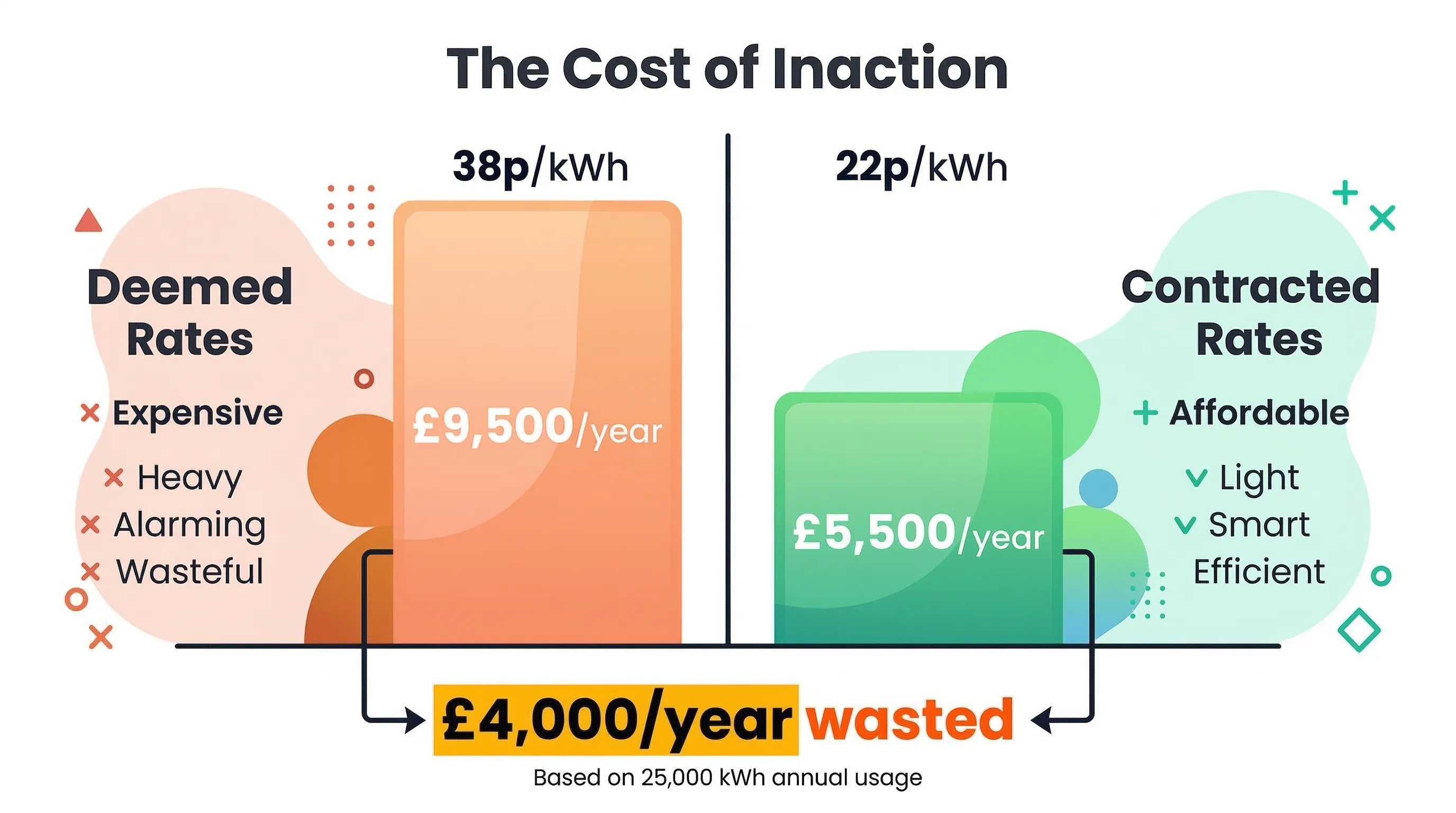
The Cost of Doing Nothing: Businesses on deemed rates (currently c. 38p/kWh) pay a massive premium. A typical small business stands to waste thousands this year by not switching to a contracted rate (c. 22p/kWh).
The 5-Day Reality: The logistical transfer of your supply takes just 5-21 days. The weeks of back and forth between your broker and you is due to the manual, fossilised process of traditional switching.
The Broker Trap: Traditional brokers embed their fees in your unit rate, often adding 2-4p per kWh - money hidden inside the way the quote is priced. They create anxiety with jargon and pressure you with false deadlines. See what different commission rates actually cost with our free calculator.
Crucial Warning: Unlike your home energy contract, business contracts have NO cooling-off period. The Energy Switch Guarantee doesn’t apply to businesses - once you sign, you are legally locked in.
The New Way: Meet George replaces the broker with AI. Upload a PDF of your bill, and our platform handles the data, the Letter of Authority, and the quote comparison instantly. It takes 20 minutes, and our fee is a transparent, flat 1p/kWh - typically 75% cheaper than a broker.
The 5-Step Business Energy Switching Process
These are the same five steps whether you use a broker, go direct to a supplier, or use a self-service platform. What changes is how long each step takes and how much of it lands on your desk.
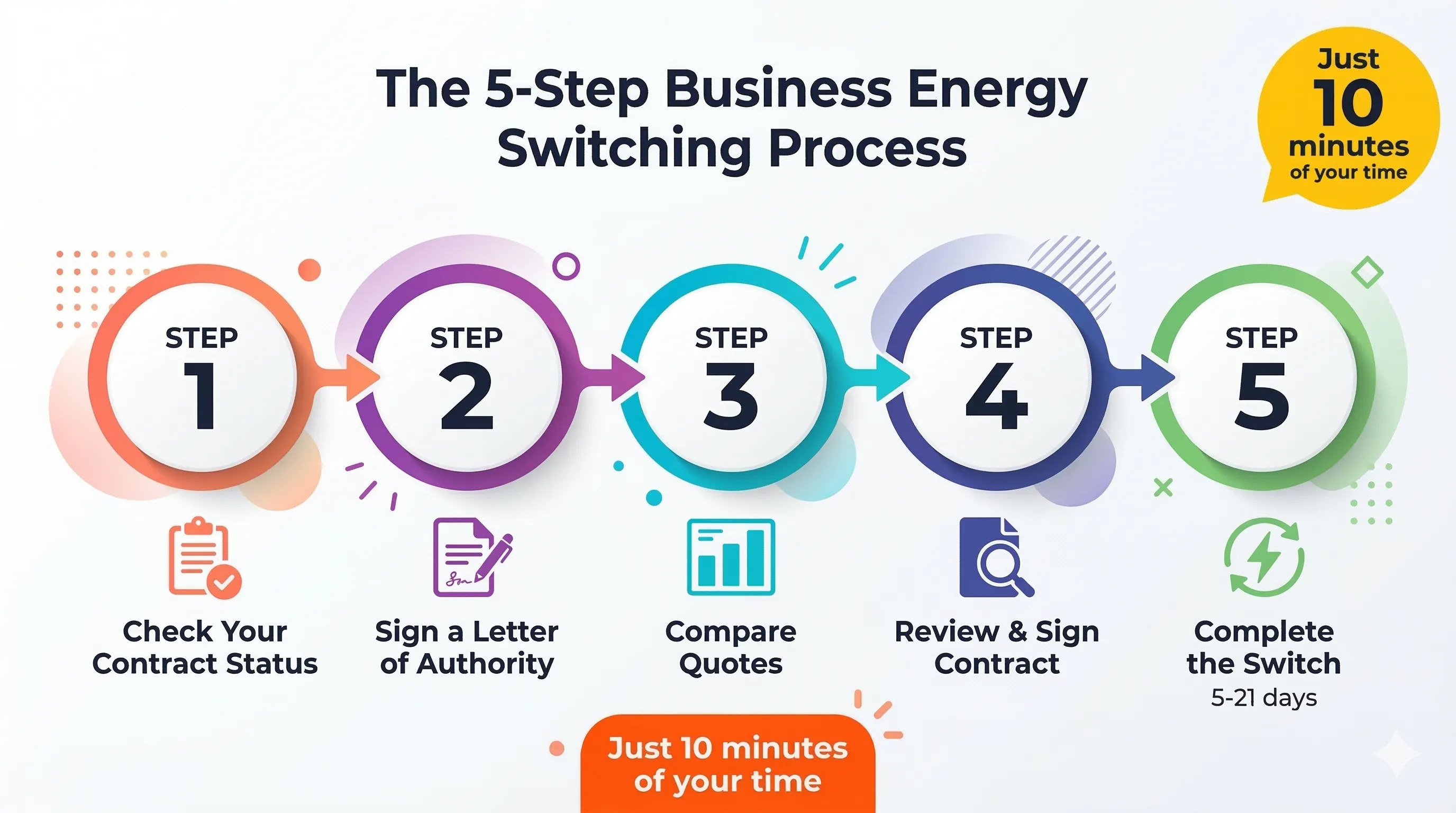
Step 1: Check Your Contract Status
Before you can switch, you must determine your status to avoid penalties.
Scenario A: Out of Contract (Deemed Rates) If your contract has expired, you are free to leave immediately. There are no exit fees. You should switch today to stop overpaying.
Scenario B: Mid-Contract If you have time remaining on your fixed-term contract, leaving early usually triggers a Termination Fee. Warning: Some contracts include “Mark to Market” clauses. This isn’t just a flat fine; it means you must pay the supplier for the energy they bought in advance for you, calculated on the difference between the wholesale price then and now. This can be substantial. We cover whether you can cancel your business energy contract in detail, including how to calculate potential exit costs.
Scenario C: Renewal Window (The “Sweet Spot”) Typically 1-6 months before your contract ends, you enter the renewal window. You can sign a contract now with a new supplier that will go live the day your current contract ends. This locks in today’s rates without incurring exit fees. Warning: Be careful of digital renewal traps - clicking a “confirm” link in a supplier email during this period could lock you into an expensive auto-renewal.
Peak Renewal Periods: April and October are the busiest months for business energy switching. October 2024 saw 475,000 switches - the highest single month of the year - driven by SME contract expiries. If your contract ends in these periods, start the process 60-90 days early to avoid the rush.
The reality of SME behaviour: Research shows the average SME owner only starts engaging with energy renewal approximately 65 days before contract expiry - despite best practice suggesting 90-120 days. This reactive behaviour leaves businesses vulnerable to pressure tactics and limits their negotiating options. Starting early gives you leverage; starting late means you’re at the mercy of whoever happens to call.
How to find your end date: Check your latest bill. If it’s not listed (some suppliers annoyingly omit this), check your original contract. As a last resort, call your supplier to ask.
Step 2: The Letter of Authority (LOA) & Data Gathering
In the traditional process, gathering data is a headache. You might think you need to hunt down your annual consumption (kWh), but you actually just need to grant access.
The Letter of Authority (LOA) is the key. This is a legal document authorising a broker or platform to speak to suppliers and retrieve your consumption data from the central industry database (Xoserve (opens in new tab) for gas, ElectraLink (opens in new tab) for electricity) on your behalf.
Important: Not all LOAs are the same. There are two types: Level 1 (information only) and Level 2 (full authority to sign contracts on your behalf). Level 2 LOAs are used by some brokers to lock you into contracts without your consent. Learn more about LOA types and how to protect yourself.
Traditional Way: The broker emails you a PDF form to print, sign, scan, and email back. Some modern brokers may send a DocuSign link, but they still then have to manually request your data (EAC or AQ).
Meet George Way: You simply upload a PDF of your latest bill. Our AI extracts your MPAN/MPRN and address, automatically generates a digital LOA, and you sign it on-screen. We then pull all your consumption data instantly in the background.
Step 3: Compare Quotes (The Danger Zone)
This is where the process splits into three very different paths - and where most businesses make costly mistakes. Research shows 53% of SMEs chose their supplier simply because it was the cheapest option (rising to 68% among recent switchers), yet only 4% selected based on customer service. This price-above-all mindset is understandable, but it creates a race to the bottom that rewards undisclosed fee structures over genuine value.
We’ve written a detailed comparison of self-service vs broker-assisted switching if you want the full picture. Here’s how they compare at a glance:
Quick Comparison: Your Switching Options
| Method | Time to Switch | Typical Fee | Fee Transparency | Market Access |
|---|---|---|---|---|
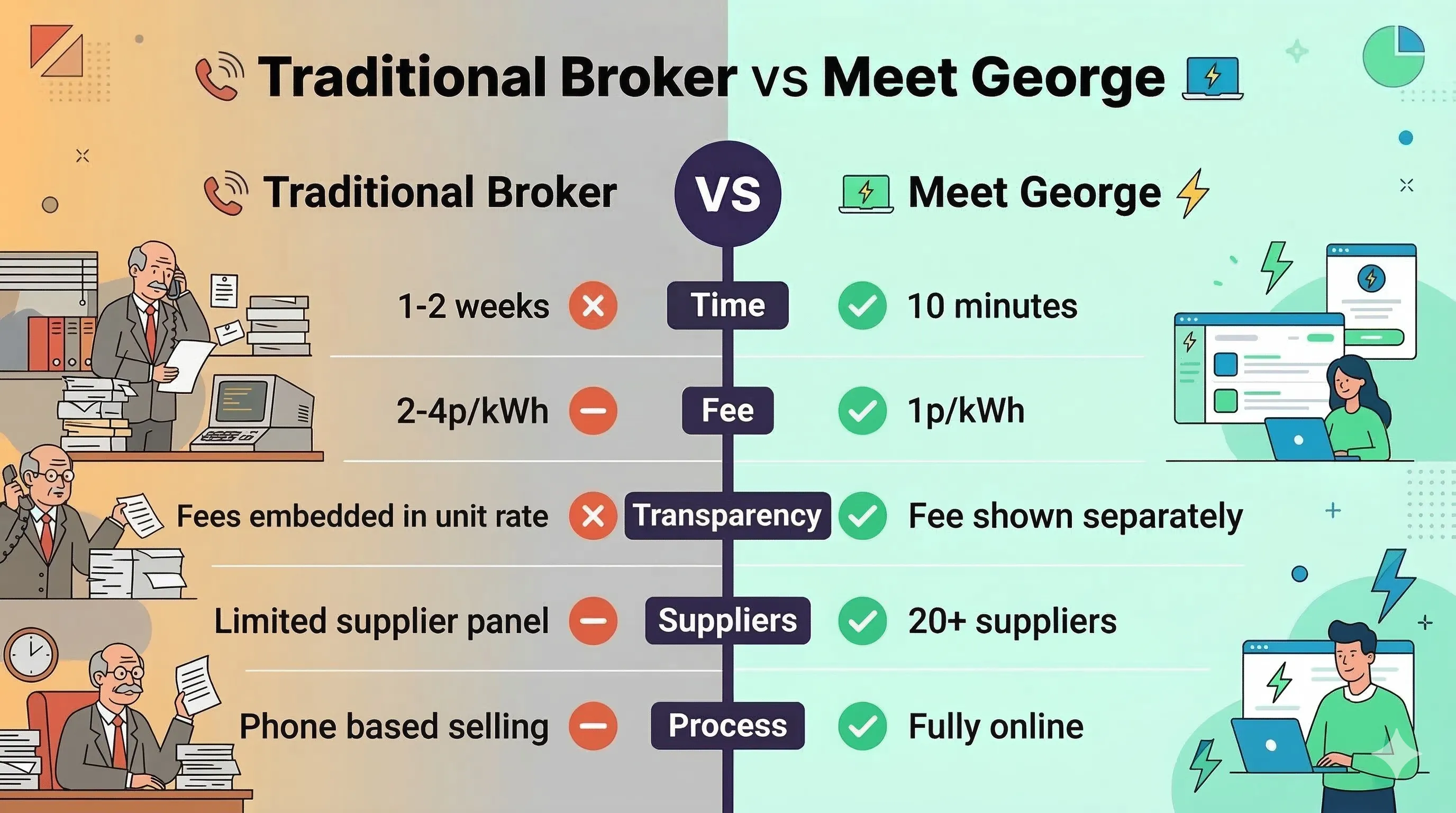
| Traditional Broker | 1-2 weeks | 2-4p/kWh | Embedded in contract | Limited (upfront commission-paying suppliers) |
| Comparison Sites | 1-2 weeks | Variable | Embedded in contract | Limited panel |
| Meet George | 20 minutes | 1p/kWh | Shown separately | A range of suppliers |
Path A: The Traditional Broker (Slow & Opaque)
- The Process: You speak to a human energy broker. They take your details, then manually go out to tender.
- The Limited Market: Brokers often favour suppliers who pay them upfront commissions. Commission structures commonly front-load payments, meaning brokers may receive the majority of their fee when you sign. This means you aren’t always seeing the whole market - just the suppliers that pay the broker the best.
- The “Uplift”: Brokers add their fee into your unit rate. While 2024 rules state this must be disclosed on the contract, it is often not made obvious. They might add 3p, 4p, or in extremely predatory scenarios, up to 10p per kWh to your rate. Learn how undisclosed broker commissions work and how to spot them.
- The Pressure: Expect calls claiming “rates expire today.” For SMEs, prices typically update weekly or monthly (unlike more frequent updates for larger energy users), so this is usually just a sales tactic.
Path B: Online Comparison Sites
- The Process: Faster than a broker, but often still requires a phone call to finalise the deal.
- The Limitation: Like brokers, they are limited to the panel of suppliers they have commercial relationships with. What many don’t realise is that most comparison sites use the same underlying broker - creating an illusion of choice. You are often still blocked from completing the full switch online without human intervention.
Path C: Meet George (Transparent & Automated)
- The Process: Instant comparison across a range of suppliers.
- The Cost Advantage: Because we use AI and automate the switching process, we are typically 75% to 80% cheaper than traditional brokers.
- Full Visibility: You see the base wholesale rate and our fee separately. No undisclosed charges.
Step 4: Review and Sign the Contract
Once you select a quote, the supplier generates a contract (usually via DocuSign or PDF).
Traditional Way: The broker sends you the document. If you have questions about complex terms like “take-or-pay clauses,” you have to rely on the broker to explain them.
Meet George Way: You view the contract digitally. Our platform features an AI Contract Assistant. You can ask it limitless questions: “Does this contract have a termination fee?”, “Explain the payment terms,” or “Is this a green tariff?” You get instant, unbiased answers before you sign.
Step 5: The Switch
WARNING: There is NO Cooling-Off Period. Unlike residential energy, business energy contracts do not have a 14-day cooling-off period. Once you sign, you are legally committed for the full term. Ensure you are happy with the rates before signing.
The Timeline: Once the contract is signed, it must be submitted to the supplier. Meet George handles this instantly via API (a secure digital connection to the supplier’s system), whereas traditional brokers may submit the contract paperwork manually.
Once submitted:
- Fast Track Switching: Can be completed in as little as 5 working days.
- Standard Switching: Typically takes 11 to 21 days.
During this time, your new supplier takes over the meter registration logistically. If you are in credit with your old supplier, they will refund the balance to you after the final bill is settled.
The Reality Check: Ofgem research shows 78% of businesses who switched in 2024 found the process easy (up from 60% in 2023). The challenge isn’t the switch itself - it’s making the decision to switch. The biggest barrier? 42% of businesses are locked into existing contracts and can’t switch until their renewal window opens.
What Is Business Energy Switching?
Business energy switching is the process of changing your commercial gas or electricity supplier to secure better rates, improved contract terms, or enhanced service. Unlike residential switching, business energy contracts have no cooling-off period, require a Letter of Authority (LOA) to access your consumption data, and involve negotiating with suppliers who set prices based on your business’s specific usage profile. The process typically involves checking your current contract status, authorising data access, comparing quotes from multiple suppliers, and signing a new contract that triggers an industry meter transfer.
Can You Switch Business Energy Without a Broker?
Yes. You can switch business energy without a broker - either by going direct to a single supplier, or by using a self-service switching platform that compares a range of suppliers for you. A broker is not required to switch; it is just one (often opaque) route.
Going direct means contacting suppliers yourself, requesting individual quotes, and comparing unit rates and standing charges by hand. It works, but you only see the suppliers you approach, and you carry all the admin.
The self-service path removes that legwork. A platform like Meet George pulls your consumption data, compares the market, and lets you complete the switch online - no sales calls, and the 1p/kWh fee is shown separately rather than buried in your unit rate. You stay in control of the decision at every step.
Business Energy Switching: Why It Takes Weeks
Switching business energy suppliers is often described as a “fossilised” process. We’ve written about why business energy switching is so difficult - the short version is that while the logistical transfer of your meter only takes between 5 and 21 days, the administrative nightmare leading up to that moment - dealing with brokers, chasing bills, and decoding complex quotes - can drag on for weeks.
Most SMEs avoid switching because of this friction. They fear the admin spiral of hunting down paperwork and navigating aggressive sales calls.
Meet George changes this. We automate the entire process using AI. Upload a PDF of your bill, and our platform extracts the data, handles the Letter of Authority (LOA) digitally, and lets you switch in 20 minutes.
The five steps above don’t change. What changes is how long each one takes, and how much of it you have to chase.
Why Most Businesses Don’t Switch (But Should)
1. The Cost of Inertia
The numbers are stark: only 33% of UK SMEs switched energy supplier in 2024 (up marginally from 26% in 2023), and a large share of SME owners have never switched at all. Industry data suggests the average SME saves over £1,700 annually by switching - meaning there are potentially billions in unrealised savings across the UK. Perhaps most tellingly, 43% of business owners believe there’s no real competition in the energy market (Ofgem Non-Domestic 2024 Research (opens in new tab)) - a perception problem that keeps businesses trapped on expensive rates.
A significant number of UK SMEs are currently on “deemed rates” or out-of-contract tariffs. Deemed rates are the default price you pay when your contract expires and you haven’t actively renewed. Learn more about deemed rates and why they cost you 80% more.
Deemed rates are currently hovering around 38p/kWh, but due to market volatility, they can spike as high as 50p/kWh or more. In contrast, a competitive contracted rate is currently closer to 22p/kWh.
Let’s look at the maths for a business using 25,000 kWh annually:
- On Deemed Rates (38p): £9,500 per year
- On Contracted Rates (22p): £5,500 per year
- The Loss: £4,000 per year wasted due to inaction
To run the same sums against your own consumption, see our breakdown of how much you can save switching business energy.
This isn’t hypothetical. Dream Looks Boutique in Marylebone had been on deemed rates for over two years without realising - they saved 46% when they switched. Red Clover Gardens in Cheltenham found their standing charge was 79% above market rate.
2. The “Jargon Friction”
The second reason businesses stay stuck is that the process is abstract and confusing.
SMEs are experts at what they do. If you run a barbershop, you are excellent at being a barber. If you run a nail salon, you are a specialist nail technician. You shouldn’t need to understand complex energy jargon like “standing charges,” “DUoS,” “TNUoS,” or “kVA allowances.”
Traditional brokers speak in “pence per kilowatt hour” - an abstract figure that makes it hard to visualise the impact on your bank balance. This creates anxiety, so business owners put it off.
Meet George removes the abstraction. While we show the unit rates for transparency, we focus on the pound note value: “You pay £500/month now. You will pay £350/month with this switch. You save £1,800/year.” That is concrete, clear, and actionable.
Energy Switching by Business Type
The five steps above work identically whether you run a pub, a salon, a gym or a portfolio of commercial units. What changes is your consumption profile, your peak usage times, and how willing suppliers are to quote for your sector.
Here is roughly what each sector uses, based on DESNZ ND-NEED data (opens in new tab) and industry benchmarks:
| Business type | Typical annual electricity | Worth knowing |
|---|---|---|
| Barber shop | c. 6,000 kWh | Less water heating than a salon |
| Trades premises (workshop, yard, unit) | Up to 15,000 kWh | Sits inside the DESNZ microbusiness band |
| Salon (1-3 chairs) | 10,000-24,000 kWh | 4-8 chairs: 24,000-54,000 kWh |
| Dog grooming salon (2-3 tables) | 18,000-24,000 kWh | Kennels and catteries far higher |
| Cafe or coffee shop | 20,000-40,000 kWh | Concentrated 6am-6pm |
| Pub or restaurant (200m²) | c. 22,000 kWh | Plus c. 48,000 kWh gas |
| Bakery | High refrigeration load | Plus 30,000-50,000 kWh gas for ovens |
| Hotel or B&B | c. 6,000 kWh per room | A 25-room hotel can exceed 150,000 kWh |
| Gym (dry-side) | 60,000-100,000 kWh | Add a pool and total energy can top 250,000 kWh |
Hospitality has the highest median energy intensity of any sector - 111 kWh/m² for electricity and 242 kWh/m² for gas. Below is the sector-specific detail worth checking before you switch.
Switching Energy for Pubs, Bars and Restaurants
Some suppliers avoid hospitality because of higher insolvency rates in the sector, which can thin out your quotes - though the ones you do get come from suppliers who understand your usage. If you have rolled onto deemed rates, the damage is severe: a pub using 22,000 kWh at 38p/kWh pays £8,360 a year against roughly £4,840 on a contracted rate. That is over £3,500 wasted on electricity alone, before you look at gas.
Tip: Check whether your meter is half-hourly settled. Larger pubs and restaurants usually are, which means your pricing reflects when you use energy, not just how much - and evening-heavy trade affects your rates.
Switching Energy for Salons and Beauty Therapists
Salon usage is predictable and daytime-focused, which makes you an attractive customer, so expect quotes from a wide panel. The risk is inertia: monthly bills feel manageable, so the overpayment never feels urgent. A small salon using 15,000 kWh on deemed rates at 38p rather than a contracted 22p is throwing away around £200 a month.
Tip: If you rent your premises, check whether energy is included in your lease. If it is billed separately, you have every right to switch - your landlord cannot prevent it.
Switching Energy for Barber Shops
Lower consumption means smaller absolute savings, but barber shops are more likely to be sitting on deemed rates, so the percentage saving is often higher. Twenty minutes now typically saves £500-£1,000 a year - worth it for a single-owner shop where admin gets pushed to the bottom of the list.
Tip: You need your MPAN (electricity) and MPRN (gas), both printed on your bill. No recent bill? The number on the meter itself is enough for your supplier to find your account.
Switching Energy for Gyms and Fitness Centres
Gym demand peaks early morning, lunchtime and evening. On a half-hourly meter that shape drives your cost, not just your total, and lots of equipment running at once can push you into higher capacity charges. DESNZ data (opens in new tab) shows wet-side leisure centres use up to ten times more energy per square metre than dry-side sites.
Tip: Larger facilities and converted buildings often have several meters, each a separate supply point. Compare all of them - it is common to find one on a decent contract and another on expensive deemed rates.
Switching Energy for Dog Groomers and Pet Businesses
Water heating for bathing, dryers, climate control and lighting are the main draws, and kennels or catteries run far higher because heating and ventilation never switch off. Pet businesses often operate from converted premises, so check your supply is registered as a commercial meter rather than a domestic one - that determines which suppliers and tariffs you can access.
Tip: If you run a mobile grooming business from a van, this guide doesn’t apply - you would be on domestic rates at your home base. A commercial shopfront or dedicated studio switches like any other business.
Switching Energy for Cafes and Coffee Shops
Cafes attract the same hospitality caution from some suppliers as pubs, but shorter trading hours and lower insolvency rates mean you should still see a decent spread of quotes. If you lease space in a shopping centre or food court, check whether the landlord controls supply through a sub-meter arrangement - if so, you may not be able to switch independently.
Tip: Treat gas and electricity as separate switches. The best electricity deal often comes from a different supplier than the best gas deal.
Switching Energy for Hotels and B&Bs
Hotel demand stays relatively flat across the day, unlike businesses that close overnight, which makes you attractive to most suppliers. Larger sites often have multiple meters and a half-hourly meter for electricity, plus heavy gas use for heating, hot water, laundry and kitchens. The risk is scale: every penny per kWh on deemed rates costs you far more in absolute terms.
Tip: If you are seasonal, compare annual costs rather than monthly snapshots. Signing during your low season makes the first few months look cheap, but your peak season is locked in at the same rate.
Switching Energy for Bricklayers and Trades with Premises
If you are a bricklayer, plumber, electrician or joiner with a workshop, yard or office unit, you can switch. Trades premises have the simplest energy needs but the lowest engagement with switching: inherit a premises, inherit the contract, and you roll onto deemed rates without noticing. Even at 10,000 kWh a year, the gap between 38p and 22p is £1,600.
Tip: If you mostly work on client sites and the premises is just storage, your savings will be modest - but it still only takes 20 minutes, so the return on your time is excellent.
Switching Energy for Florists and Garden Centres
Flower coolers and display refrigeration run 24/7, supplemental grow lighting adds real consumption through the darker months, and heated greenhouses or polytunnels push gas well above what the floor area suggests. That steady, round-the-clock demand is low risk, which prices well with suppliers.
Tip: Check whether exterior lighting and irrigation pumps sit on the main meter or a separate supply, and compare on annual cost - a contract that looks cheap in January still has to cover your April peak.
Switching Energy for Bakeries
Early-morning baking puts your peak outside standard business hours. That doesn’t change a standard unit rate, but on a half-hourly meter - or once you move to one under MHHS - your time-of-use profile starts to matter. Gas is usually the bigger cost, so compare gas contracts as carefully as electricity.
Tip: Most bakeries have separate gas and electricity meters. Switch them independently: the best gas supplier for your profile may not be the best on electricity.
Switching Energy for Commercial Property Landlords
Multi-tenant buildings complicate the metering, not the process. Check your lease agreements to establish who holds the energy contract. If you supply tenants and recover the cost through service charges, you may be subject to the Maximum Resale Price directive (opens in new tab), which caps what you can charge them. If each tenant holds their own meter and contract, your only concern is the communal areas supply.
Tip: Each property has its own MPAN (electricity) and MPRN (gas). Switch them independently, or negotiate a portfolio deal with a single supplier - though not all suppliers offer this for smaller portfolios.
How Meet George Fixes a Broken Market
Traditional switching is a manual process involving PDFs, phone tag, and abstract jargon. It takes weeks of admin time and often results in businesses overpaying due to limited market access and opaque broker commissions.
Meet George is different:
- Upload your PDF bill: No manual data entry. AI does the work.
- Real Money Logic: We show savings in pounds, not just abstract unit rates.
- Transparent Pricing: We charge a flat 1p/kWh fee. We are 75-80% cheaper than the industry standard.
- True Self-Service: Complete the entire switch - from quote to contract - in 20 minutes online. No sales calls.
The Result: You get the same energy, from the same suppliers, but cheaper, faster, and with zero headaches. See how this works in practice in our case studies - including THIS Workspace, where a forensic analysis uncovered £15,208 in potential annual savings.
Ready to stop overpaying? We are launching in Q3 2026. Join the Platform Waitlist to get early access and ensure you never deal with a cold-calling broker again.


