
I spent 10 years at THIS Workspace (opens in new tab), a 60,000 sq ft coworking building in Bournemouth. Every broker pitched us the same story - “We’ll get you the best rate” - but I had no way to verify what they were adding as commission.
It was always an uphill battle to figure out what brokers were actually charging us.
When I finally looked into it, I discovered an industry where 77% of businesses think brokers are free - because fees are embedded inside inflated rates. Where every major comparison site routes to the same call centre. Where the technology exists to automate this, but incumbents have no incentive to build it.
So we decided to build something different.
The Absurdity of the Current Market
Here’s the strange thing about business energy in 2026: you can see quotes online. Comparison sites will show you indicative prices from multiple suppliers. The information is technically available.
But actually switching? That still requires phone calls. Back-and-forth emails. Hoping the broker has actually read and understood the contract terms they’re advising you on. The “online comparison” is just the top of a very manual funnel.
Try it yourself. Go to any of the major comparison sites. Enter your details, and you’ll be asked for your phone number. A salesperson calls. They follow a script. They read you quotes. They push for a verbal agreement to a Letter of Authority - using your recorded “yes” as consent. Then the real process begins: eligibility checks, supplier rejections, more calls, and then contract signing.
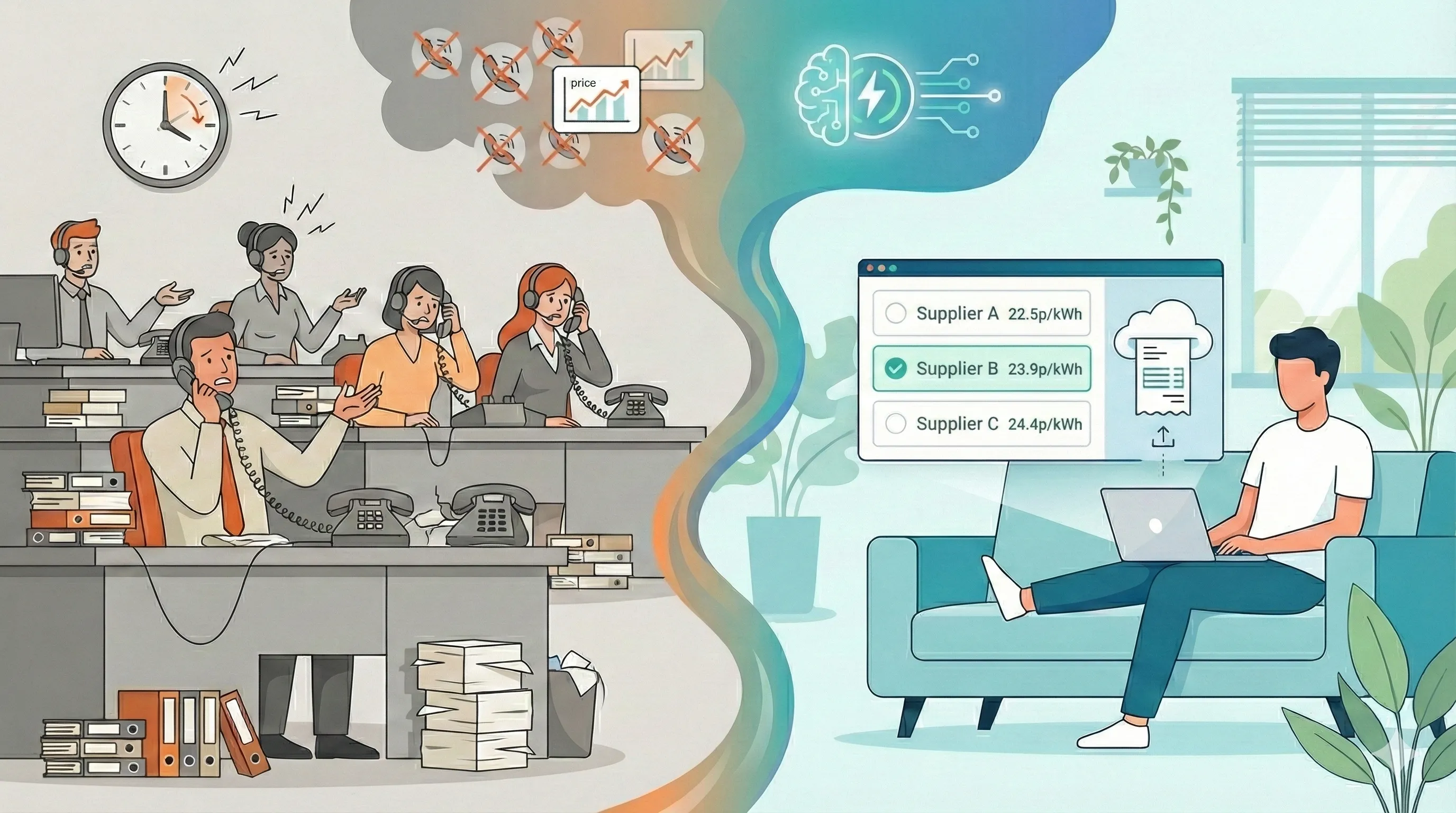
This is 2026. You can manage your entire business finances through an app. You can file your taxes online. But completing an energy switch? That apparently requires a 22-minute phone call with a commissioned salesperson - followed by days of back-and-forth.
The UK’s largest business energy broker employs 288 salespeople - 56% of their entire workforce (according to their public Companies House filing). They’ve built technology to capture leads and generate quotes. But the actual switching? That’s still humans on phones, following scripts, closing deals.
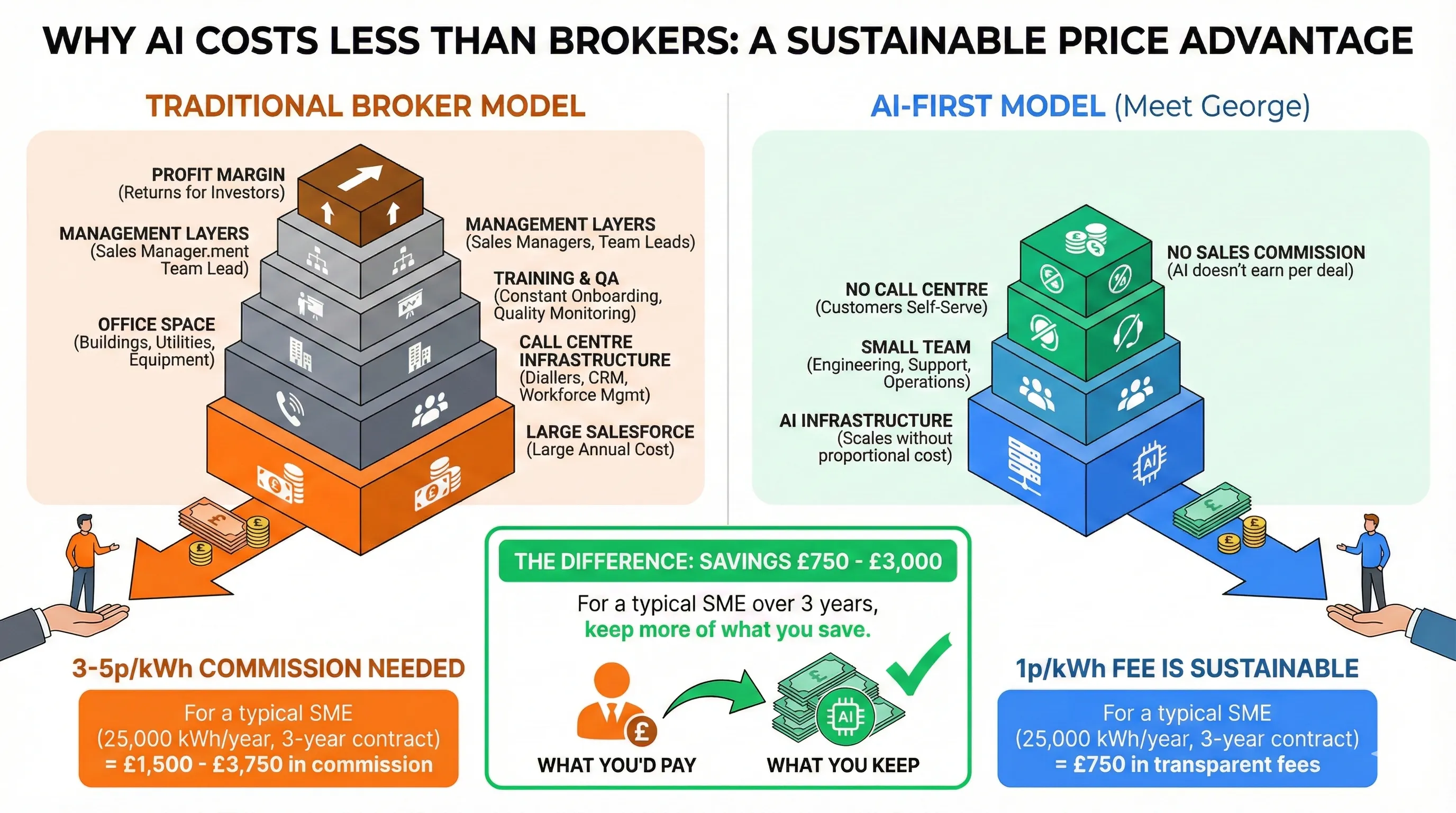
And those 288 salespeople need to be paid. Their salaries, their office, their training, their management - it all gets baked into the commission added to your energy rate. Typically 2-5p per kWh. On a 25,000 kWh contract over three years, that’s £1,500 to £3,750 - just for someone to read you quotes over the phone.
The question isn’t why brokers exist. It’s why, in 2026, anyone still needs to make a phone call to switch energy.
Why Business Energy Has Resisted Automation
The honest answer: it’s genuinely complicated. This isn’t like switching home energy, where you enter a postcode and see prices.
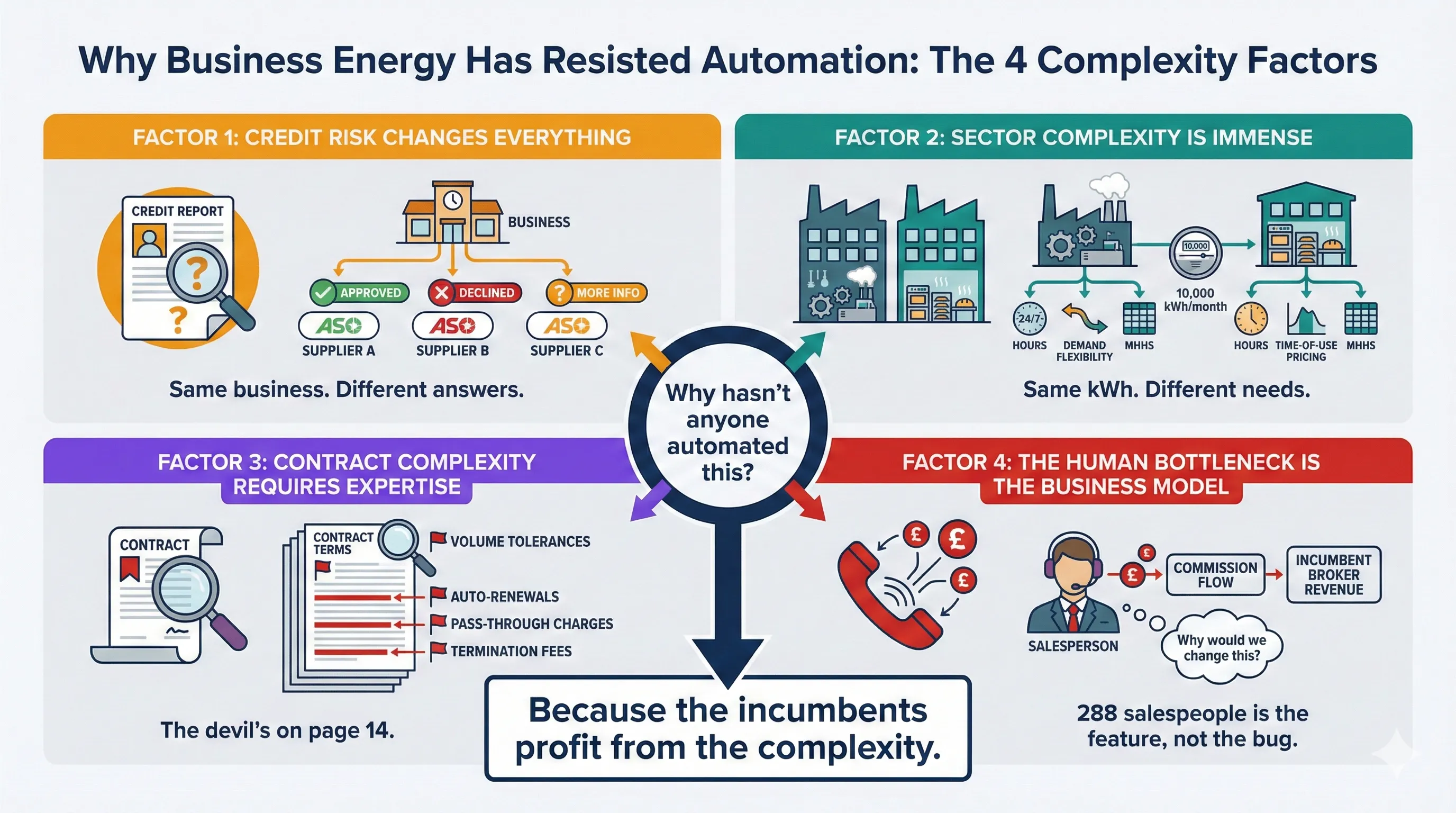
Credit Risk Changes Everything
When you switch your home energy, suppliers may run a soft credit check - but it doesn’t change the prices shown. Every deal available is available to everyone. Simple.
Business energy doesn’t work like that. Suppliers will quote you a price - but before they’ll actually offer you a contract at that price, they run eligibility checks. Credit history, company age, sector risk, corporate structure. A restaurant with three County Court Judgments faces different outcomes than an accountancy firm with pristine credit. Some suppliers won’t accept sole traders. Others avoid charities. Many decline pubs, care homes, and restaurants entirely.
This means comparison sites can show you quotes - but they can’t show you which quotes you’ll actually be eligible for. The price you see isn’t necessarily the price you’ll get. Every supplier has different credit thresholds, different sector preferences, different rules about what business structures they’ll accept. The broker model exists partly because someone has to navigate this complexity and handle the rejections.
Supplier Rejections Are the Hidden Complexity
Even when a business passes credit checks, switches get rejected. A lot.
The biggest reason? Outstanding debt with the current supplier. Around 9 in 10 rejections come from customers who still owe money to their existing supplier - and that supplier blocks the switch until the debt is cleared. The customer often doesn’t even know they have a balance outstanding.
This creates a cascade of manual work: identifying why a switch failed, communicating with the customer, resolving the debt, resubmitting the application, waiting again. Traditional brokers handle this with phone calls and emails. It’s time-consuming, unpredictable, and doesn’t scale.
Genuine automation needs to handle these rejections gracefully - checking for likely blockers upfront, explaining what’s happening, and guiding customers through resolution. That’s a different technical challenge to showing quotes on a screen.
Sector Complexity Is Immense
A bakery and a manufacturing unit might both use 50,000 kWh annually. They’re completely different prospects.
The bakery operates predictable hours with peaks around opening. The manufacturer might run night shifts, with flexibility to move production to cheaper off-peak periods. With Market-Wide Half-Hourly Settlement rolling out, when you use energy matters as much as how much you use. One business can shift demand to save money. The other can’t.
“Compare by postcode and usage” works for domestic energy. Business energy requires understanding the actual business - and sometimes the directors behind it. Phoenix companies, previous business failures, connected entities - these can all affect what suppliers will offer and at what price.
Contract Complexity Requires Expertise
Business energy contracts contain clauses that can cost thousands if you don’t understand them:
- Volume tolerances that can reprice your contract mid-term if usage deviates from forecasts
- Auto-renewal clauses with 60-day notice windows buried in the terms
- Pass-through charges that vary by region and time
- Termination fees hidden on page 14
This is precisely why brokers have value - they understand these clauses. Well, at least they’re meant to. The documented mis-selling cases suggest many don’t explain them properly, or actively obscure the risks. When you don’t understand what you’re signing, it’s easy to embed margin in the fine print.
The Human Bottleneck Is the Business Model
Here’s the thing: traditional brokers might want to automate. Optimising costs, scaling without hiring - these are appealing to any business. But automating business energy switching is a fundamentally different technical challenge to building a website that captures leads.
Handling credit checks across suppliers with different thresholds. Managing rejections and fallback options. Explaining contract clauses in context. Processing the edge cases. This requires AI systems that can reason, not just chatbots that collect phone numbers.
Traditional brokers - even the largest ones with the most resources - have built their operations around human salespeople. Their technology captures leads and generates quotes. The complex work still happens on phone calls. That’s not because they’re villains. It’s because genuine automation is hard, and their existing model works well enough to generate revenue.
How AI Automates Business Energy Switching
What’s different now isn’t that AI exists. It’s that AI can reliably handle the specific tasks that made business energy switching require humans.
AI Bill Reading: Extracting Energy Data Automatically
Energy bills come in hundreds of formats from dozens of suppliers. Contracts contain critical clauses buried in pages of legal language. Historically, extracting the important information required a human to read, find, and type it in.
AI can now read a bill PDF and extract the MPAN, the consumption data, the contract end date, the current rates - reliably, in seconds. Not perfectly - no system is perfect - but reliably enough to be useful. And when it’s uncertain, it can flag that uncertainty rather than guess. Here is a closer look at how AI energy bill analysis works, and what to check yourself.
The same applies to contracts. An AI can read the terms and conditions, identify the volume tolerance clauses, flag unusual termination terms, and explain what they mean in plain English. Not because it’s smarter than a human expert, but because it can do this consistently, for every customer, at any time.
Unbiased Energy Advice Without Sales Pressure
When you ask a human broker “Is this a good deal?”, their answer is shaped by their commission structure. If they earn 4p/kWh on Deal A and 2p/kWh on Deal B, Deal A starts looking more attractive to recommend.
This isn’t malice. It’s human nature combined with financial incentives. The broker might genuinely believe Deal A is good - it’s psychologically convenient when the better deal is also the higher-commission one.
AI doesn’t have this conflict. Ask George “Is this standing charge normal?” and you get an answer based on the data, not on what closes the sale. Ask “What happens if my usage drops 20%?” and you get the contract terms explained, not a reassurance designed to move you toward signing.
Could someone build bias into an AI system? Technically, yes - you could instruct AI to favour certain suppliers. But our business model removes that incentive entirely. We earn the same 1p/kWh regardless of which supplier you choose. There’s no commercial reason to steer you, so we don’t.
24/7 Business Energy Support Without Call Centres
Business owners don’t research energy contracts during sales hours. They look at bills at 10pm after the restaurant closes. They compare quotes at 6am before the warehouse opens. They have questions on Sunday afternoons.
Traditional brokers have office hours. Voicemail after 5pm. “We’ll call you back on Monday.”
AI doesn’t sleep, doesn’t take lunch breaks, doesn’t get impatient at 4:45pm on a Friday. The answer to your question at 11pm is the same quality as the answer at 11am.
Consistent Quality at Scale
The best human energy consultants are genuinely excellent. They know the market, understand contract nuances, and give good advice.
The problem: there aren’t enough of them. Training expert advisors is a significant cost. They leave for other jobs. Quality varies wildly between the consultant you get at 9am versus 4pm, between the experienced advisor and the new starter.
And here’s the harder truth: most SME owners have no way to tell the difference. What does a good broker even look like? How would you know if the advice you’re getting is expert or mediocre? You’re trusting someone whose quality you can’t assess, on a topic you don’t fully understand, for a decision that affects your costs for years.
AI provides the same quality of analysis to every customer, every time. The hundredth bill processed today gets the same attention as the first. The customer in Cornwall gets the same service as the customer in London. And because the analysis is transparent - you can see exactly what’s being compared and why - you can actually evaluate whether the advice makes sense.
This is why we can charge 1p/kWh instead of 3-5p/kWh. Not because we’re cutting corners, but because the cost structure is fundamentally different.
Traditional Broker vs Price Comparison vs Meet George
| Traditional Broker | Price Comparison Website | Meet George | |
|---|---|---|---|
| Getting quotes | Phone call with salesperson | Quotes in seconds online | Quotes in seconds online |
| What happens next | Broker handles switching | Routes to broker, phone calls begin | Complete the switch yourself online |
| Letter of Authority | DocuSign via email | Verbal consent on call (via broker) | Read and sign in web-app |
| Asking questions | Wait for email or callback, sales pressure | Routed to broker call centre, sales pressure | Ask George instantly, no agenda |
| Seeing the fee | Embedded in your unit rate | Embedded in your unit rate | 1p/kWh shown separately |
| Understanding contracts | ”Trust me, it’s fine" | "Trust me, it’s fine” (via broker) | AI explains clauses in plain English |
| Signing | DocuSign via email | DocuSign via email (via broker) | Sign in web-app, sent direct to supplier |
| Availability | Office hours only | Website 24/7, broker office hours | 24/7 |
| Typical cost (25k kWh/yr) | £1,500-£3,750 over 3 years | £1,500-£3,750 over 3 years | £750 over 3 years |
How Self-Service Business Energy Switching Works
Enough theory. Here’s what using Meet George actually involves.
Step 1: Upload Your Business Energy Bill
Drop a PDF of your latest energy bill. Within seconds, you see what we’ve extracted: your MPAN, your annual consumption, your current rates, your contract end date.
No phone call asking you to “just find your meter number - it’s in the top right, usually starts with an S.” No typing 21-digit numbers while someone waits on the line. The AI reads the bill like a human would - just faster and without typos.
If something looks wrong, you can correct it. You’re in control of the data that drives your quotes.
Step 2: Ask George Your Energy Questions
“Is this standing charge normal for my area?”
“What’s the difference between these two suppliers?”
“My usage dropped 30% last year - will that cause problems with this contract?”
“Are there any red flags in these terms?”
George answers in plain English. No “let me check with my manager.” No deflexion toward closing the sale. Just information that helps you decide.
Step 3: Compare Business Energy Quotes Transparently
See every quote we can get you. But critically, see them properly:
- Supplier’s rate: What the supplier charges
- Our fee: 1p/kWh, shown separately
- Total: What you’ll actually pay
No mental arithmetic trying to figure out where the broker’s cut is embedded. No discovering after signing that you’re paying 4p/kWh more than you thought.
You can compare the supplier rates directly. You know exactly what we’re charging. The information asymmetry that traditional brokers depend on simply doesn’t exist.
Step 4: Sign Your Energy Contract Online
No pressure to “lock in this price before 5pm.” No salesperson whose bonus depends on you signing today.
See the quotes, take them away, think about it, come back tomorrow, come back next week. The prices update in real time - you’ll see if rates have changed - but no one is pushing you to decide on a call.
When you’re ready, you sign the contract yourself. We never sign anything on your behalf. No Level 2 Letters of Authority that let someone else commit you to contracts without consent.
Why AI-Powered Switching Costs Less Than Brokers
Traditional brokers charge 2-5p/kWh because they have to. The largest broker’s 288 salespeople represent significant overhead. Add office space, management, training, and CRM systems, and you need serious margin on every deal.
That margin comes from one place: you.
Our cost structure is different:
- No sales team - George handles questions, not commission-hungry reps
- No call centre overhead - No dialler systems, no workforce management, no QA recordings
- Technology-first - AI scales without proportional cost increases
- Direct relationships - No white-label fees to comparison sites
This isn’t loss-leader pricing to buy market share. It’s the natural result of building technology that removes the human bottleneck.
We can operate sustainably at 1p/kWh. Traditional brokers cannot. That’s not because we’ve found a clever trick - it’s because we’ve built a fundamentally different kind of business with a fundamentally different kind of service.
See exactly how our pricing works: How We’re Paid
What We’re NOT Building
Let me be clear about what Meet George isn’t.
Not a Chatbot That Routes to Humans
When you talk to George, you’re talking to George. There’s no “let me transfer you to a specialist” bait-and-switch. No chat window that’s secretly a human typing slowly. No AI for simple questions that escalates to a sales call for anything complex.
If we ever add human support, it won’t be commissioned salespeople. It’ll be people paid to help, not to close.
Not a Lead Generation Funnel
We don’t sell your details to brokers. We don’t earn referral fees for passing you to someone else. We don’t monetise your data.
We make money when you switch through us, from our transparent 1p/kWh fee. That’s it. Our incentive is for you to switch and be happy with the process - not to harvest your phone number for someone else’s call centre.
Not a Replacement for Human Judgement
For 90% of SME energy switches - the standard single-site, single-meter, predictable-usage businesses - AI can provide better service than a phone call with a broker. Faster, more transparent, available when you need it.
The reality is that most single-site SMEs don’t need an energy consultant to discuss solar panels, battery storage, or demand-side flexibility. They simply need the best available rate - and that’s precisely what a phone-based broker model struggles to deliver. When your overheads require 3-5p/kWh commission, “lowest cost” and “broker service” don’t really co-exist.
But some situations genuinely benefit from human expertise. Complex multi-site portfolios. Unusual metering arrangements. Businesses with specific technical requirements.
We’ll tell you if you’re in that 10%. We won’t pretend AI is the answer to everything. If your situation is genuinely complex, the honest answer might be “you need a consultant, not a platform.”
The Future of Business Energy Switching
This isn’t just about energy switching. It’s about what happens when technology removes the intermediary’s ability to hide things.
Transparency Requires Technology
You cannot have transparent pricing with commission-incentivised salespeople. Not because they’re dishonest - most aren’t - but because the model creates conflicts.
When a broker’s income depends on the margin they add to your rate, they have an incentive to add more margin. When their bonus depends on closing calls quickly, they have an incentive to rush your decision. When they can sign contracts on your behalf, they have an incentive to auto-renew you without asking.
These aren’t character flaws. They’re structural incentive problems built into the traditional model.
AI doesn’t have these conflicts. Its only job is to provide accurate information and facilitate your decision. There’s no commission to maximise, no call time to manage, no renewal bonus to chase.
Self-Service Is the Future
UK businesses already manage banking, accounting, payroll, and CRM through software. They buy insurance online, file taxes digitally, and run their operations through dashboards.
Energy switching is one of the last holdouts. A process that still requires phone calls, still hides pricing, still depends on human intermediaries who may or may not have your interests at heart.
The complexity was the barrier. Business energy is genuinely complicated - more complicated than home energy, more complicated than car insurance. That complexity justified the broker model.
AI removes that barrier. The complexity can now be handled by technology that scales, that doesn’t get tired, that has no incentive to mislead.
Regulation Is Catching Up
The energy broker industry is changing, whether it wants to or not.
Since October 2024, Ofgem requires commission disclosure in all business energy contracts. From 2026-2027, Ofgem becomes the direct regulator of energy brokers - with powers to require registration, set conduct standards, and remove bad actors from the market.
The industry that thrived on opacity is being forced toward transparency. But regulation only sets a floor. We’re not building to the minimum legal requirement. We’re building what transparent energy switching should look like.
Why We Built This
I spent a decade at THIS Workspace without ever knowing what I was paying in broker fees. Every broker pitched the same story - “We’ll get you the best rate” - but not once did anyone show me the supplier’s rate separately from their margin.
Maybe I should have asked harder questions. But I was busy running operations. Energy was one of dozens of things competing for attention. I trusted that the system worked reasonably fairly.
It didn’t.
When I finally understood how the market worked - the undisclosed commissions, the auto-renewals, the comparison sites that all route to the same place - I had two options. Accept it, or build something better.
Meet the Founders

Joshua Winterton - Co-Founder & CEO
I spent 10 years at THIS Workspace working with SMEs - from startups to established businesses scaling their operations. Every time energy came up, it was the same story: brokers pitched “the best rate” but no one could verify what they were adding as commission.
That frustration is why I’m building Meet George. Self-service switching where you see everything. Upload a bill, compare quotes with fees shown separately, sign online. No sales calls, no undisclosed margins.

Xiaoyi Lu - Co-Founder & CTO
Xiaoyi is building the engine behind Meet George: AI bill reading, supplier integrations, and automation that turns switching into a self-serve workflow.
His philosophy is simple: the best technology empowers users with transparency and control, not black-box recommendations. Every decision Meet George makes can be explained - because if you can’t explain why you’re recommending something, you probably shouldn’t be recommending it.
Meet George is what we’re building together - business energy switching that respects your time, shows you what you’re paying, and lets you make decisions without sales pressure.
We’re launching in Q3 2026. If you’re tired of the phone calls and undisclosed fees, join the waitlist to be among the first to try it.
Join Platform WaitlistWant to understand the current market? See our analysis of the state of business energy brokers in 2026, learn what broker commission rates really look like, or discover why 77% of businesses think brokers are free.
Ready for transparency? Read about how Meet George’s pricing works or explore our commission calculator to see what you might be paying in undisclosed fees.
Sources:


