

TL;DR: Key Takeaways
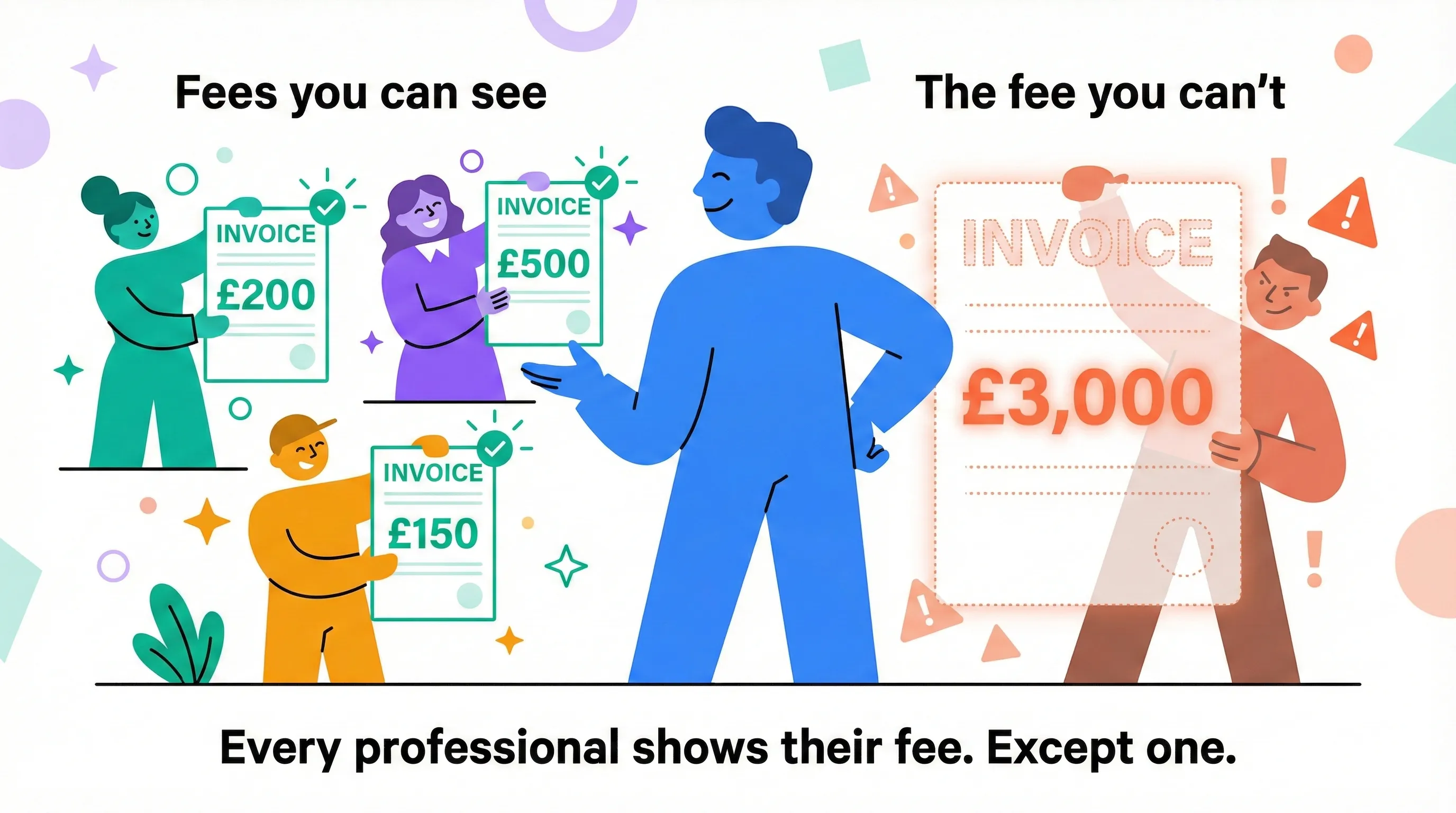
Energy brokers are usually paid by adding their commission - an “uplift” - into your unit rate rather than charging a separate, visible fee, typically 2-5p/kWh and sometimes far more. Since October 2024 they must disclose it in your contract and tell you if you ask, but it is often not shown upfront on the quote - so many businesses never realise it is there until they look.
What is Uplift? Uplift is commission that brokers add into your unit rate rather than charging a separate, visible fee - often 3-5p/kWh or more. It must now be disclosed in your contract, but it is rarely shown on the quote, so it is easy to miss unless you check.
The Real Cost: A typical small business using 25,000 kWh/year could pay £2,250 more over a 3-year contract just in broker fees baked into the rate - money that should be in your bank account.
The Standing Charge Trick: It’s not just unit rates. Some brokers inflate your standing charge too - adding £657+ to your bill over 3 years in a place you’re unlikely to check.
The Law is Changing: As of October 2024, Ofgem requires commission disclosure for all business customers. The government is introducing mandatory regulation for energy brokers, and the industry’s own TPI Code of Practice sets voluntary standards. But legacy contracts remain undisclosed.
Meet George’s Approach: We charge a transparent, fixed 1p/kWh. You see the supplier’s base rate and our fee separately. No undisclosed margins, no “going for gold.”
What Is Hidden Broker Commission (Uplift)?
Undisclosed broker commission, commonly called “uplift” in the energy industry, is the practice of adding a margin to your energy rates without transparent disclosure. Instead of charging you a separate, visible fee for their service, brokers inflate your unit rate - the pence-per-kilowatt-hour you pay for energy.
How the money actually flows: the supplier sets a base rate for your energy. The broker adds an uplift into your unit rate (and sometimes your standing charge). You pay the combined rate on your bill, as if it were one number. The supplier then passes the uplift back to the broker - either monthly “on the drip” as you pay, or as a lump sum upfront. You never see the split unless it is disclosed.
The scale of unawareness is staggering: Ofgem research shows only 14% of businesses using brokers believed they were charged for the service, while 77% thought they paid nothing at all. We explore why businesses think energy brokers are free in depth - but the short answer is that the industry designed it this way. In 2023, before disclosure requirements, only 7% of businesses using brokers reported being charged - despite commissions being embedded in virtually every contract. In our view, this looks designed, not accidental.
If you bought a house, you’d pay an estate agent a fixed fee - maybe 1% or 2%. You’d know exactly what it cost.
Business energy brokers don’t work like that.
For decades, the industry ran on commission hidden inside your unit rate. You might think you’re paying the supplier’s best price. In reality, you could be paying a premium of 4p/kWh or more - costing your business thousands of pounds a year - just to line a broker’s pocket.
At Meet George, we charge a transparent, flat 1p/kWh. We want you to know exactly how the “old way” works so you can spot it a mile off.
Do Energy Brokers Charge Upfront Fees?
Usually not - and that is the catch. Most energy brokers charge small businesses nothing upfront: no invoice, no visible bill, nothing leaving your bank account. The service feels free precisely because the fee is collected the way this article describes - as uplift baked into your unit rate, paid through every energy bill for the life of the contract. An upfront fee would be visible; uplift is not.
Two exceptions are worth knowing about:
- Fee-based consultants. A minority of TPIs charge a visible fixed fee or retainer instead of taking supplier commission, more commonly for larger or multi-site businesses. If a broker quotes you an upfront fee, ask in writing whether they also receive commission from the supplier on top - “fee plus commission” arrangements are exactly the kind of half-disclosed pay structure the courts examined in the Expert Tooling case covered later in this article. Utility auditing and refund-recovery firms, meanwhile, typically work for a percentage of what they recover rather than an upfront fee.
- “Upfront” usually means the opposite of what you’d expect. In industry jargon, an “upfront” payment normally describes the supplier paying the broker their commission as a Day 1 lump sum instead of monthly - covered in the 80% now, 20% later section below. You still pay it back through your unit rate either way.
With Meet George there is no upfront fee and no buried one: you pay our 1p/kWh fee, itemised on every quote and collected via the supplier. See how we’re paid.
The £2,250 Difference: A Real-World Example
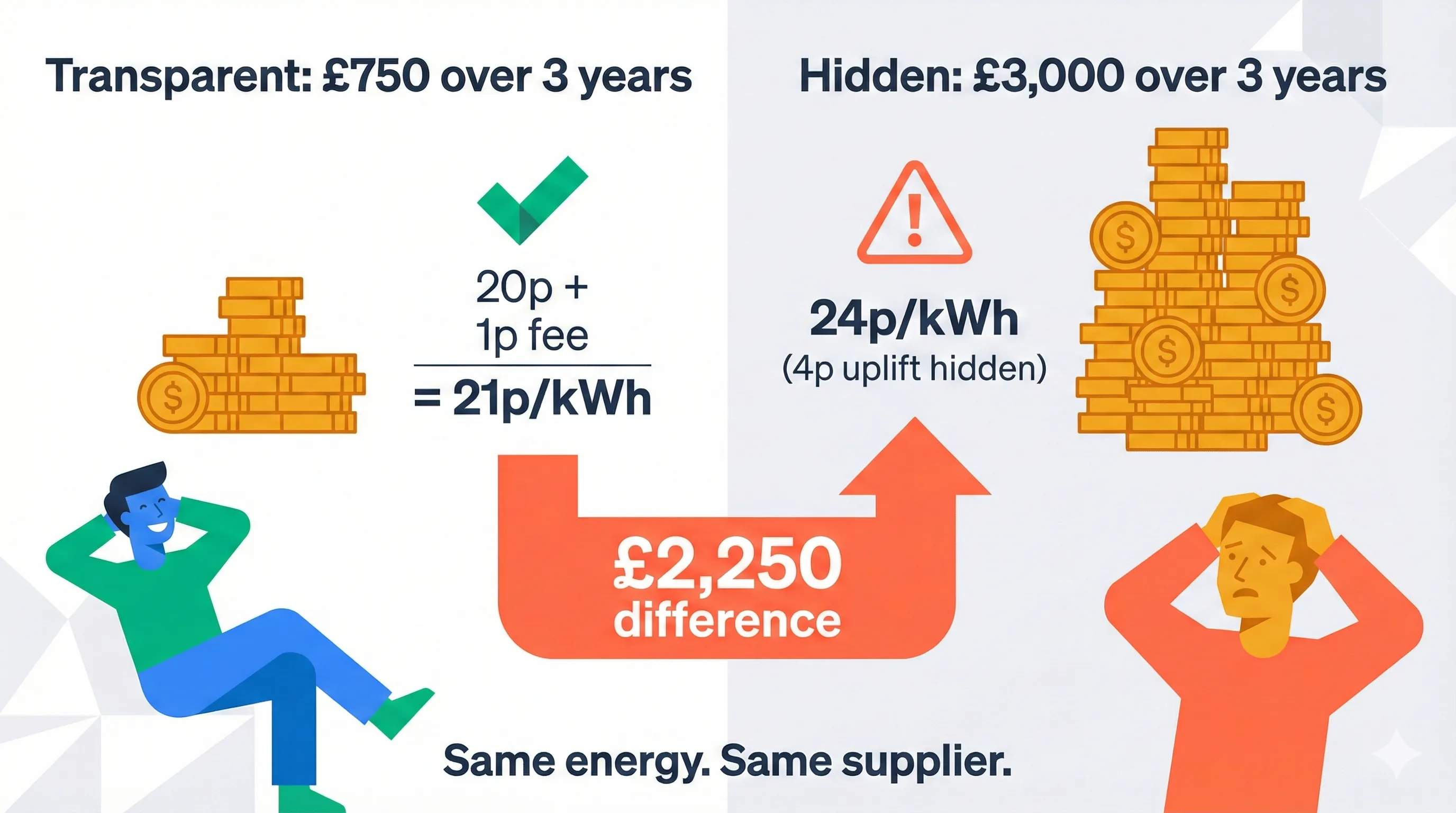
Let’s look at the maths for a typical small business using 25,000 kWh of electricity per year on a 3-year contract.
Scenario A: The Meet George Way (Transparent)
- Supplier Base Rate: 20p/kWh
- Meet George Fee: 1p/kWh (fixed, shown separately)
- Total Rate You Pay: 21p/kWh
- Total Fee Paid: £250 per year (£750 over 3 years)
Result: You pay a fair price for the service. You know exactly what you’re paying for.
Scenario B: The “Predatory Broker” Way (Hidden)
- Supplier Base Rate: 20p/kWh
- Broker “Uplift”: 4p/kWh (Embedded in your rate)
- Total Rate You Pay: 24p/kWh
- Total Commission Paid: £1,000 per year (£3,000 total over 3 years)
Result: You lose £2,250 purely because you didn’t know the broker added a 4p margin.
That £2,250 is money that should be in your bank account, not theirs.
The Problem with “Phone Deals” vs. Visual Clarity
One of the biggest issues with traditional energy brokers is that deals are often done over the phone.
When a broker rattles off a unit rate of “24.5 pence per kilowatt hour,” it sounds abstract. It is very hard for a business owner to mentally calculate what that actually means for their bottom line.
Meet George is different because it is visual. We don’t just show you the rate; we show you the “Pound Note” value:
- “You currently pay £800/month.”
- “With this switch, you will pay £650/month.”
- “You will save £1,800/year.”
Business owners understand profit and loss, not “p/kWh.” By seeing the numbers visually on screen, you can make a decision based on the actual financial impact to your business, without the confusion of energy jargon.
The “Wild West” of Uplift Limits
Not all brokers are bad, and not all suppliers are the same. But the incentives are often misaligned.
- Some reputable suppliers cap the amount of uplift a broker can add (e.g., capping it at 2.5p/kWh or 1p/kWh for renewals).
- But others - often less reputable suppliers - operate with no limits. They allow brokers to “go for gold,” adding uplifts of 6p, 8p, or even 10p.
The Trap: A low-tier broker might push you towards a slightly more expensive supplier simply because that supplier lets them add a massive commission. They are incentivised to sell you the contract that pays them the most, not the one that saves you the most money. If you’re not careful, you could end up paying rates close to deemed rate levels - even while on a fixed contract.
Documented Extreme Cases
These aren’t hypothetical scenarios. Claims-management firms and press coverage have reported real-world examples. Treat the specific figures below as reported allegations rather than court-established fact:
- Golf club: A claims-management company reports a case where a broker allegedly charged around a 50% commission fee, said to have cost the club roughly £24,000 in undisclosed fees
- Church: A claims-management company reports a church where over 50% of total utility spend was said to be undisclosed commission
- Care home: A care home was reportedly quoted broker fees of £68,126, said to have been reduced to £12,606 when challenged (an 81% reduction)
The scale of potential mis-selling has drawn wider legal attention. Law firm Harcus Parker has publicly announced group litigation over allegedly undisclosed energy broker commissions, reported to cover up to around 2 million UK businesses with claims said to run into the billions - all of which remains an unproven allegation to be tested in court. The Energy Ombudsman’s latest data shows broker complaints rose 112% in 2024, with 88% of cases relating to sales practices.
The Standing Charge Sting
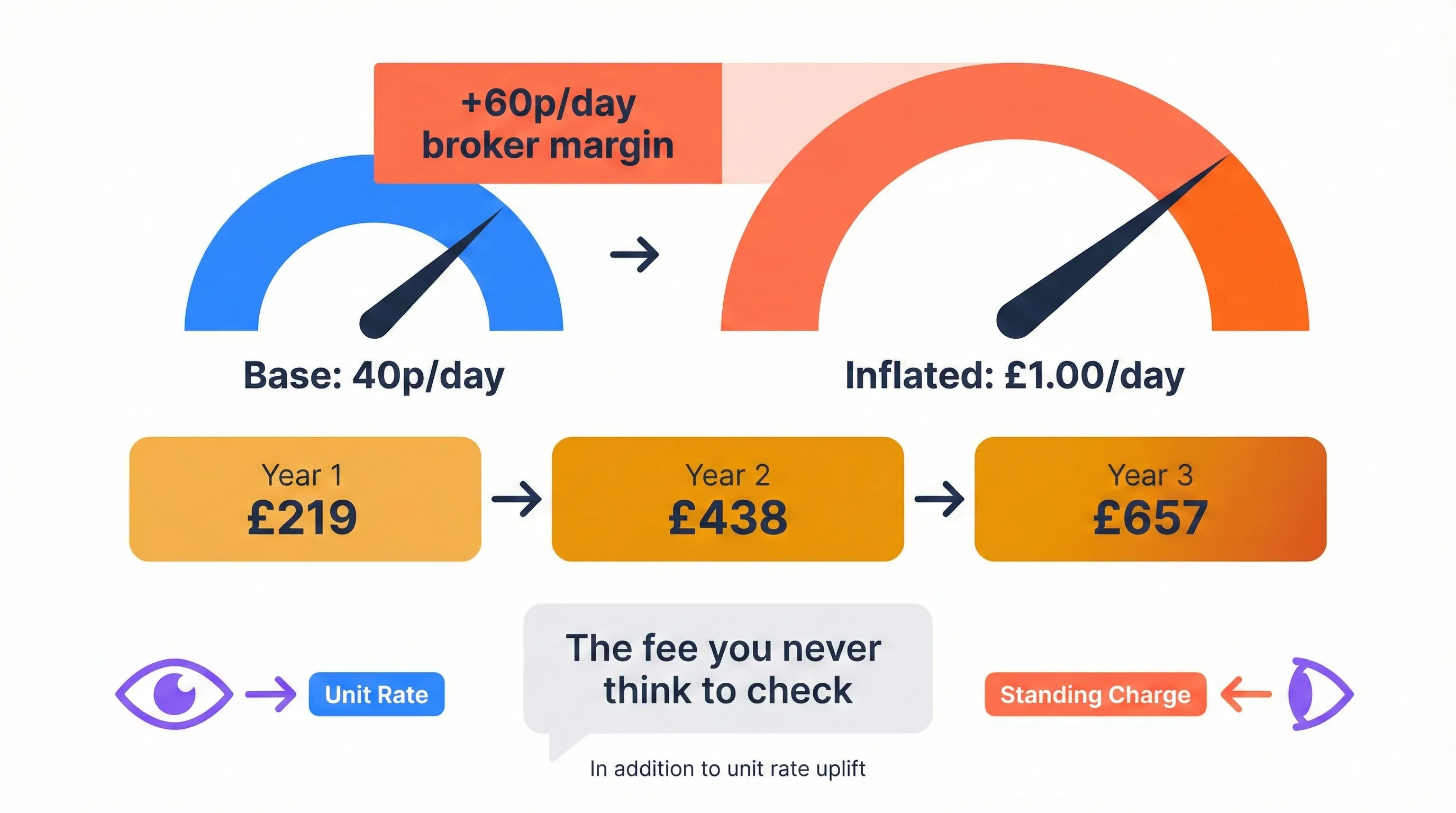
It’s not just your unit rate. Some suppliers also allow brokers to add commission to your standing charge (the fixed daily fee for having a meter).
A broker might take a base standing charge of 40p/day and inflate it to £1.00/day.
The Impact: Over a 3-year contract, that extra 60p/day adds £657 to your bill.
The Deception: Because businesses focus heavily on the unit rate (p/kWh), they often ignore the standing charge, making it the perfect place to embed extra profit.
The Upfront Cash Grab (80% Now, 20% Later)
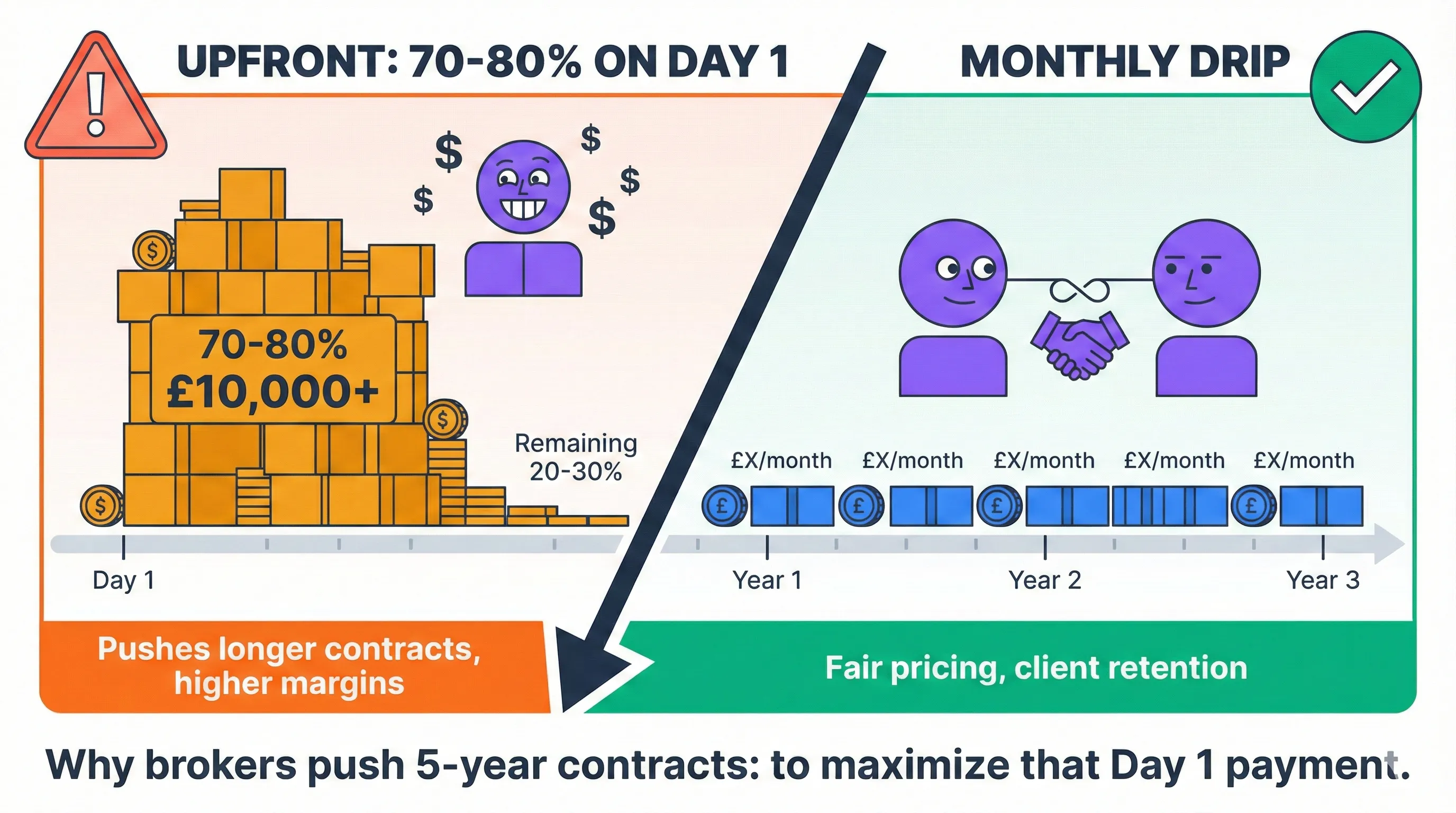
Why do predatory brokers push for long-term contracts (3, 4, or 5 years)? It’s usually about their cash flow, not your price stability.
Many suppliers offer brokers a choice:
Paid on the Drip: The broker gets paid monthly as you pay your bill. This aligns their interest with yours - if you stop paying or the business fails, they stop getting paid.
Upfront Payment: The supplier pays the broker a large proportion of the total commission upfront - in some arrangements the bulk of it lands on Day 1. This model featured in the Expert Tooling v Engie Court of Appeal case.
The “Churn and Burn” Incentive: If a broker signs you to a 5-year deal with a massive uplift, they could receive a payment from the supplier for £10,000+ next week. While there is technically a “clawback” risk (where they have to pay it back if you go bust), many low-tier brokerages ignore this. They want the cash in the bank today and will worry about the clawback later.
The Law is Changing (But Legacy Contracts Remain Hidden)
For years, broker commissions were totally undisclosed. But the net is tightening - and the market is already responding.
The Scale of the Problem
The UK TPI (Third Party Intermediary) market generates £525 million annually in broker commissions (according to Cornwall Insight) - more than double the £232 million it was worth in 2014. Approximately 2,700+ active brokers compete for this revenue, though the market is far more consolidated than it appears - with just four networks controlling the majority of switches.
The Energy Consultants Association (opens in new tab) provides a useful benchmark: a typical SME using 40,000 kWh annually pays around £1,000 in broker commission over a 2.5-year contract - equivalent to 1.0p/kWh.
The 2022 energy crisis fundamentally changed commission dynamics. Pre-crisis, supplier caps typically limited broker uplift to 0.05-2p/kWh. Post-crisis, documented rates range from 0.05-5p/kWh as standard, with extreme cases reaching 10p/kWh. When retail rates spiked to 30-40p/kWh, a 5-7p commission could be embedded without detection - whereas the same amount would have been conspicuous at pre-crisis rates of 16-18p/kWh.
Critically, smaller businesses pay higher commission rates per kWh than larger energy users - even when using the same broker. Here’s what the SME market actually looks like:
| Customer Size | Annual Usage | Good Brokers | Aggressive Brokers |
|---|---|---|---|
| Micro | 0-10,000 kWh | 0.8-1.2p/kWh | 1.5-4.0p/kWh+ |
| Small | 10,000-50,000 kWh | 0.8-1.2p/kWh | 1.5-4.0p/kWh+ |
| Medium | 50,000-100,000 kWh | 0.8-1.2p/kWh | 1.2-2.5p/kWh+ |
Indicative ranges drawn from Energy Consultants Association benchmarks and Cornwall Insight market analysis. Actual commission varies by supplier, contract length and broker.
Why do SMEs pay more? They don’t have dedicated energy managers who understand the market. They negotiate less and are less likely to spot inflated rates. The businesses who need the most protection often pay the highest per-unit commissions.
Meet George charges a flat 1p/kWh - competitive with good brokers’ commission rates and significantly below the 2-4p/kWh charged by aggressive operators targeting SMEs. Want to see the difference for your business? Use our commission calculator to compare what you might be paying now versus transparent pricing.
October 2024: Mandatory Disclosure
As of 1 October 2024, Ofgem rules require suppliers to disclose broker commissions for all business customers (not just microbusinesses). This is a significant step forward.
The Impact: Mandatory disclosure has increased competitive pressure on broker pricing, as customers can now see and compare what they’re paying. Brokers whose commission was not previously visible to customers now face more informed buyers who comparison shop with full visibility.
The Catch: This only applies to new contracts signed after that date.
The Legacy Trap: If you signed a 3-year contract in 2023, your commission is still undisclosed. You won’t know you’ve been overcharged until you renew.
Incoming Regulation for Brokers
The government has confirmed plans to introduce mandatory regulation for Third Party Intermediaries (TPIs) - the official term for energy brokers and switching services.
We welcome this. Read more about our stance on regulation and why we believe it will clean up the market by removing predatory operators.
- Read the Government’s press release on greater protections (opens in new tab)
- Read the consultation on regulating TPIs (opens in new tab)
The Court of Appeal Ruling
In the landmark case Expert Tooling and Automation Ltd v Engie Power Ltd (2025), the Court of Appeal addressed the duties a broker owes to its client, including circumstances in which a “half-secret” commission can put a broker in breach of duty. You can read the full Court of Appeal judgment on the National Archives Caselaw service (opens in new tab).
The dispute centred on commission a broker received from the supplier that was not fully disclosed to the customer - the kind of conflict of interest this whole practice creates.
The takeaway: The courts are waking up to this - make sure you do too.
How to Spot Hidden Uplift
Before signing any energy contract, ask these questions:
-
“What is the supplier’s base rate vs. your commission?” - If the broker can’t (or won’t) separate these, that’s a red flag.
-
“Is your commission in the unit rate, standing charge, or both?” - Force them to be specific. Read our standing charges guide to understand what a fair standing charge looks like.
-
“Are you receiving upfront payment from the supplier?” - If yes, ask what percentage and whether there’s a clawback clause.
-
Check the contract itself - Since October 2024, commission should be disclosed in the “Third Party Costs” section. You’ll need a Letter of Authority (LOA) to access your contract details if a broker arranged the deal.
-
Compare against market rates - If your quoted rate seems 3-5p higher than publicly available rates, you’re likely paying undisclosed uplift. You need a benchmark to do this properly: what a business your size should be paying, and what switching should save you sets out the DESNZ average for each size band alongside worked savings for deemed, rolled-over and sub-optimal fixed contracts.
The Meet George Difference
We built Meet George because we hated this opacity.
- Fixed Fee: We charge a 1p/kWh fee. Always. See how we’re paid.
- Total Transparency: We show you the Supplier Base Rate + Meet George Fee = Total Rate.
- No “Go for Gold”: We present every quote we can get you, ranked on price - not on what pays us most. Our fee is a flat 1p/kWh whichever supplier you choose, so the incentive to steer you simply is not there.
- Visual Clarity: Our platform shows you everything on screen - the 1p fee, total cost, and savings - so you can’t be tricked by fast talk over the phone.
- Pro-Regulation: We welcome incoming regulation because it will clean up the market and remove the predatory operators who give the industry a bad name.
Don’t let a broker retire on your energy bill. Check the rates, ask the hard questions, or switch to a platform that tells you the truth upfront. If you suspect you’ve been overcharged, see our case studies for real examples of what hidden uplift looks like in practice.
Not sure whether to ditch the broker entirely? We have written an honest, non-partisan comparison of broker-assisted, self-service and direct-to-supplier switching - including the multi-site and half-hourly situations where a good broker still earns their commission.
Ready to switch the transparent way? Learn the complete 5-step switching process or join the Meet George platform waitlist to see exactly what you’re paying - no undisclosed margins, no surprises.


