

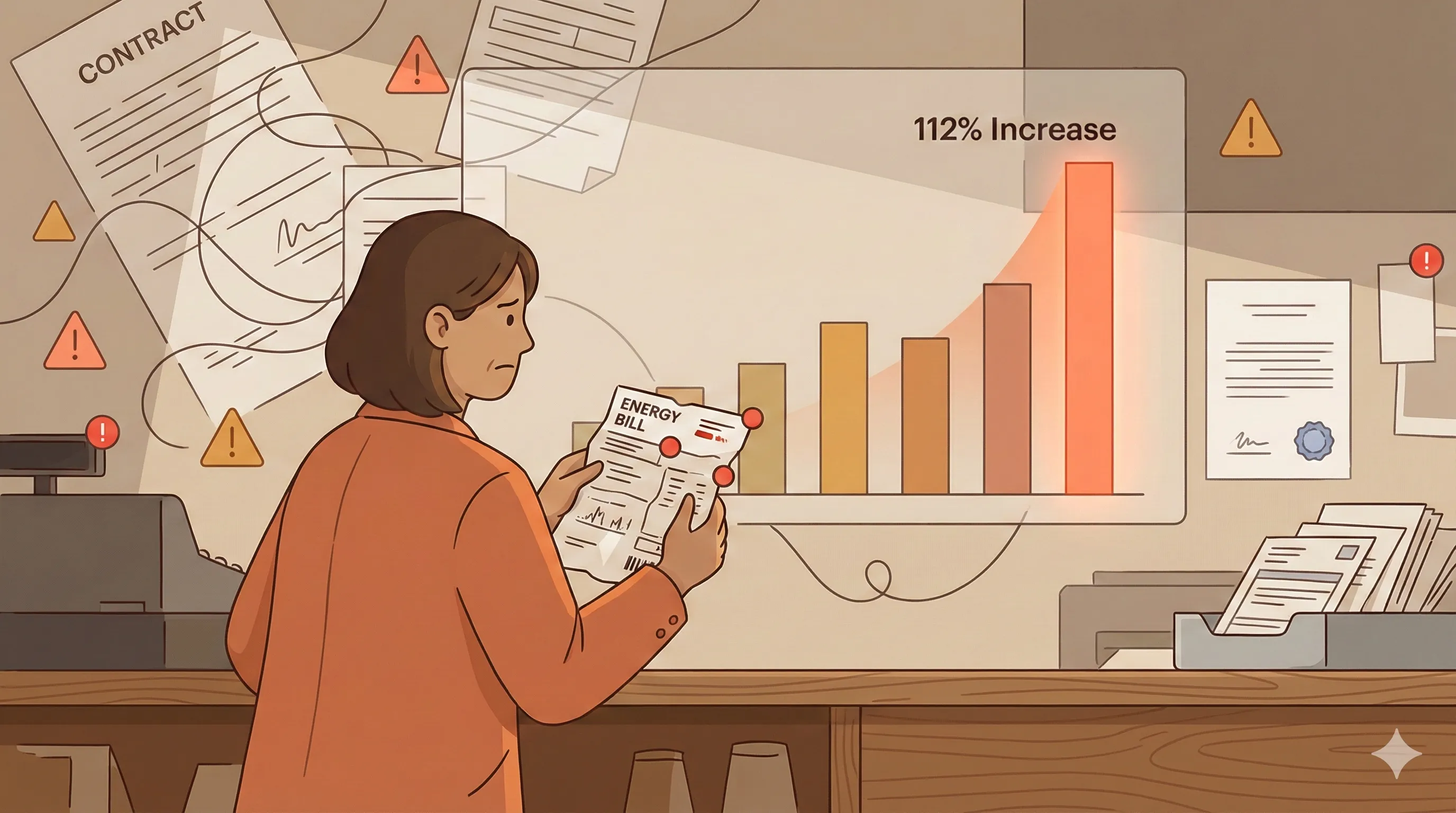
The Energy Ombudsman (opens in new tab) published its second annual Broker Report in June 2025. The numbers aren’t subtle.
1,568 broker-related complaints accepted in 2024. A 112% increase from 2023. 58% upheld in the customer’s favour. And 88% of complaints were about the sales process itself - not service delivery, not billing errors, but how brokers sell energy contracts.
Here’s what the data actually says, and what UK businesses should do about it.
TL;DR: Key Numbers
The surge: 1,568 broker complaints accepted in 2024, up 112% from the previous year
The pattern: 88% of complaints relate to sales practices - misrepresentation, unsuitable contracts (contracts that didn’t match the business’s needs), undisclosed commissions
The outcomes: 58% of complaints upheld in favour of the business, average award £894
The failure: Only 8% of complaints were signposted by brokers - meaning 92% of businesses found the Ombudsman on their own
The context: 470 brokers have left the ADR scheme (opens in new tab) since 2023, and only 63% of remedies were implemented on time
What the 2025 Broker Report Reveals
The Energy Ombudsman’s Broker Report 2025 (opens in new tab) is the second annual report on broker disputes, covering 1 December 2023 to 30 November 2024. Previous annual reports covered brokers as a subset of overall energy disputes. This dedicated report signals that broker complaints have become significant enough to warrant their own analysis.
The Core Data
| Metric | 2023 | 2024 | Change |
|---|---|---|---|
| Broker complaints accepted | 741 | 1,568 | +112% |
| Complaints upheld | 69% | 58% (~910 cases) | -11pp |
| Sales-related complaints | 71% | 88% | +17pp |
| Customer service complaints | 13% | 6% | -7pp |
| Signposting rate (broker-initiated) | 5% | 8% | +3pp |
| Remedies implemented on time | 57% | 63% | +6pp |
Source: Energy Ombudsman Broker Report 2025 (opens in new tab) (December 2023 - November 2024)
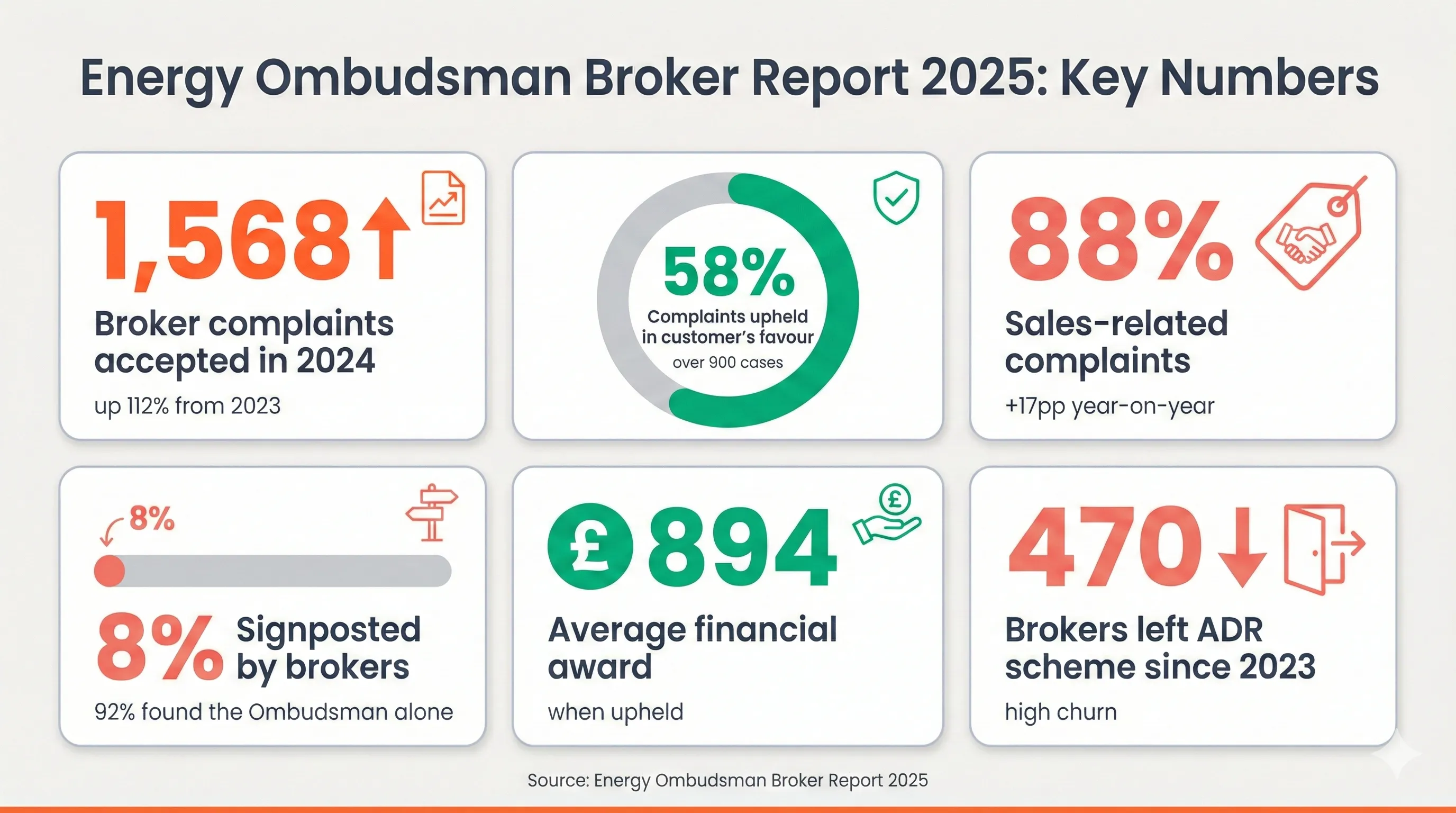
Three things stand out. First, this is overwhelmingly a sales problem. Nearly 9 in 10 complaints are about how the contract was sold - not what happened after. Second, the signposting rate of 8% means brokers are failing to tell businesses they have a right to escalate. Most complainants found the Ombudsman themselves. Third, 25% of all brokers on the ADR scheme had at least one dispute raised against them - meaning 1 in 4 registered brokers generated a complaint.
One figure deserves particular attention: the uphold rate dropped from 69% in Year 1 to 58% in Year 2. More complaints, but a lower proportion upheld. This likely reflects the broader pool of complainants - as awareness grows, not every complaint meets the Ombudsman’s threshold. But 58% is still remarkably high. When businesses do complain, they’re vindicated more often than not.
For context, the Energy Ombudsman (opens in new tab) also handles supplier disputes. Across all energy complaints, 92,938 cases were accepted in calendar year 2024 - a 24% drop from 2023. Broker complaints bucked that trend, surging while overall volumes fell.
Why Complaints Surged 112%
The 112% increase didn’t happen randomly. Three forces converged in 2024.
1. Crisis-Era Mis-Selling Is Catching Up
During 2022-2023, UK energy prices hit 10-11x historical norms (opens in new tab). Businesses were desperate. Brokers used that desperation.
The Ombudsman report (opens in new tab) documented cases where businesses were “misled on rates” - including threats that prices would reach £1/kWh if they didn’t sign immediately. Many of these 2022-2023 contracts locked businesses into 2-3 year terms with inflated commissions embedded in the unit rate.
Those contracts have now expired. Businesses that renewed in 2024-2025 discovered what they actually paid - and the gap between what they were told and what happened fuelled complaints.
One restaurant owner in Liverpool described their experience (opens in new tab) on MoneySavingExpert: their broker locked them into a 3-year contract at 70.64p/kWh for electricity - resulting in monthly bills of around £4,300 compared to roughly £1,000 at current market rates. When they tried to leave, the supplier demanded £39,000 in termination fees. The broker was subsequently convicted of fraud.
2. Awareness Is Growing (Slowly)
Ofgem research (opens in new tab) found that 77% of businesses using brokers believed they weren’t charged for the service. Only 14% thought they paid anything at all. As mandatory commission disclosure took effect in October 2024, businesses started seeing the fees they’d been paying all along.
More awareness meant more people recognised they had grounds to complain.
3. ADR Access Expanded
Since December 2022, Ofgem licence conditions (opens in new tab) require energy suppliers to only work with brokers registered with an ADR scheme. This effectively made broker ADR registration mandatory - enforced through suppliers rather than directly on brokers.
In December 2024, the scope expanded further. Small businesses (under 50 employees, under £6.5m turnover) can now bring broker disputes to the Energy Ombudsman. Previously, only microbusinesses had access. This expansion potentially adds 200,000 businesses to the eligible population.
88% of Complaints Are About Sales
This is the most damning number in the report. Not 88% about customer service. Not billing. Not contract management. Sales.
The complaints break down as:
- 88% sales-related (+17 percentage points year-on-year): Misrepresentation, unsuitable contracts, undisclosed fees, pressure tactics
- 6% customer service (-7pp): Poor communication, unresponsive brokers
- 6% other: Contract terms, switching issues, data handling
What does “sales-related” actually mean? The Ombudsman data points to specific patterns:
Misrepresentation during the crisis. Brokers told businesses prices would keep rising, creating urgency to sign. Some claimed rates would reach £1/kWh without action. Many contracts signed under this pressure contained commissions of 4-7p/kWh - well above the historical norm of 1-2p/kWh. Our commission calculator shows exactly what those rates cost over a typical contract.
No call recordings for defence. Many complaints were upheld partly because brokers couldn’t produce recordings of the original sales call. Without evidence of what was actually said, the Ombudsman relied on the business owner’s testimony.
Unprofessional conduct documented by the Ombudsman. The report flagged specific broker behaviours including threatening to charge businesses case fees for raising disputes, submitting falsified call recordings as evidence, providing falsified quotation documents, and advising businesses to submit false changes of tenancy to avoid exit fees. These aren’t edge cases - they represent a pattern of behaviour from a subset of brokers actively working against their customers’ interests.
Undisclosed fees presented as “free” service. 77% of businesses thought brokers didn’t charge. When they discovered commissions embedded in their unit rate - sometimes 2-4p/kWh on top of supplier rates - they complained - rightly. Malcolm Harrington, a B&B owner in West Sussex, told BBC Rip Off Britain (opens in new tab): “Commission had never been mentioned. I guess they built up trust which as it turned out was betrayed.” When challenged, his broker claimed commissions “would have been revealed had Malcolm asked.” His response: “I started to get really angry because I just couldn’t see the logic behind why I as a customer should have to ask them to reveal something that was hidden.”
Scale of overcharging. Care England reported (opens in new tab) that a care home was quoted £68,126 in broker fees - reduced to £12,606 when independently reviewed. That’s an 81% markup on the fee alone, from a broker who was supposed to be working in the care home’s interest.
Case Studies from the Ombudsman Report
The 2025 Broker Report included specific case studies illustrating common complaint patterns:
Blend-and-extend mis-selling. A business was offered a “blend and extend” deal by their broker - essentially extending their existing contract while blending the old and new rates. The business wasn’t told this would extend their lock-in period or that the blended rate included an increased broker commission. When the business discovered the true cost, the Ombudsman upheld their complaint.
Undisclosed contract variation clauses. A business signed what they were told was a “fixed rate” contract. Buried in the terms was a clause allowing the supplier to vary the rate during the contract period - something the broker never disclosed during the sales process. The business only discovered this when their “fixed” rate increased mid-contract.
Broker role confusion. Some businesses didn’t understand whether their broker was acting independently or as an agent of the supplier. The report found cases where businesses believed the broker was working for them, when the broker’s contractual relationship (and commission) was actually with the supplier. This confusion is at the heart of the commission disclosure problem - and it’s compounded when major comparison sites all route to the same underlying broker.
This matches what Ofgem found (opens in new tab) in its April 2024 Non-Domestic Market Review: brokers “in some cases nearly doubling the cost of the energy contracts they sell.”
The Signposting Scandal: Only 8%
When a complaint isn’t resolved within 8 weeks, brokers are supposed to tell the customer about their right to escalate to the Energy Ombudsman. This is called signposting.
In 2024, only 8% of accepted broker complaints were signposted by the broker. That’s up from 5% in 2023, but still catastrophically low.
What this means: 92% of businesses who successfully complained to the Ombudsman found it on their own. The broker either didn’t tell them about their rights, or actively avoided directing them to an independent arbiter.
The Energy Ombudsman has acknowledged this problem directly, stating they “deal with less than a third of the disputes that we should.” The real complaint volume is likely 3x higher than reported figures - suppressed by brokers failing to inform customers of their escalation rights.
For suppliers, signposting is also poor. Ofgem data shows only a 43% signposting rate across all energy complaints in Q4 2024. But at 8%, brokers are markedly worse.
470 Brokers Have Left the Scheme
Since 2023, 470 brokers have exited the ADR scheme. The scheme went from 1,890 members to 1,819 - with approximately 400 new brokers joining and 470 leaving. The Energy Consultants Association analysis (opens in new tab) and the Ombudsman report point to several reasons:
- Removed for non-compliance - some brokers were expelled from the scheme for repeatedly failing to implement Ombudsman remedies
- Businesses closing down as the market consolidates post-crisis
- Avoiding accountability by leaving before complaints are processed
The report also noted that some brokers who left had disputes pending against them. This creates a practical problem: if your broker exits the ADR scheme mid-complaint, the Ombudsman route becomes more complex. You may still have legal options, but the streamlined dispute process is disrupted.
How to Complain About Your Energy Broker
If you think your broker misled you, overcharged you, or failed to disclose their commission, here’s the process. It’s free for eligible businesses.
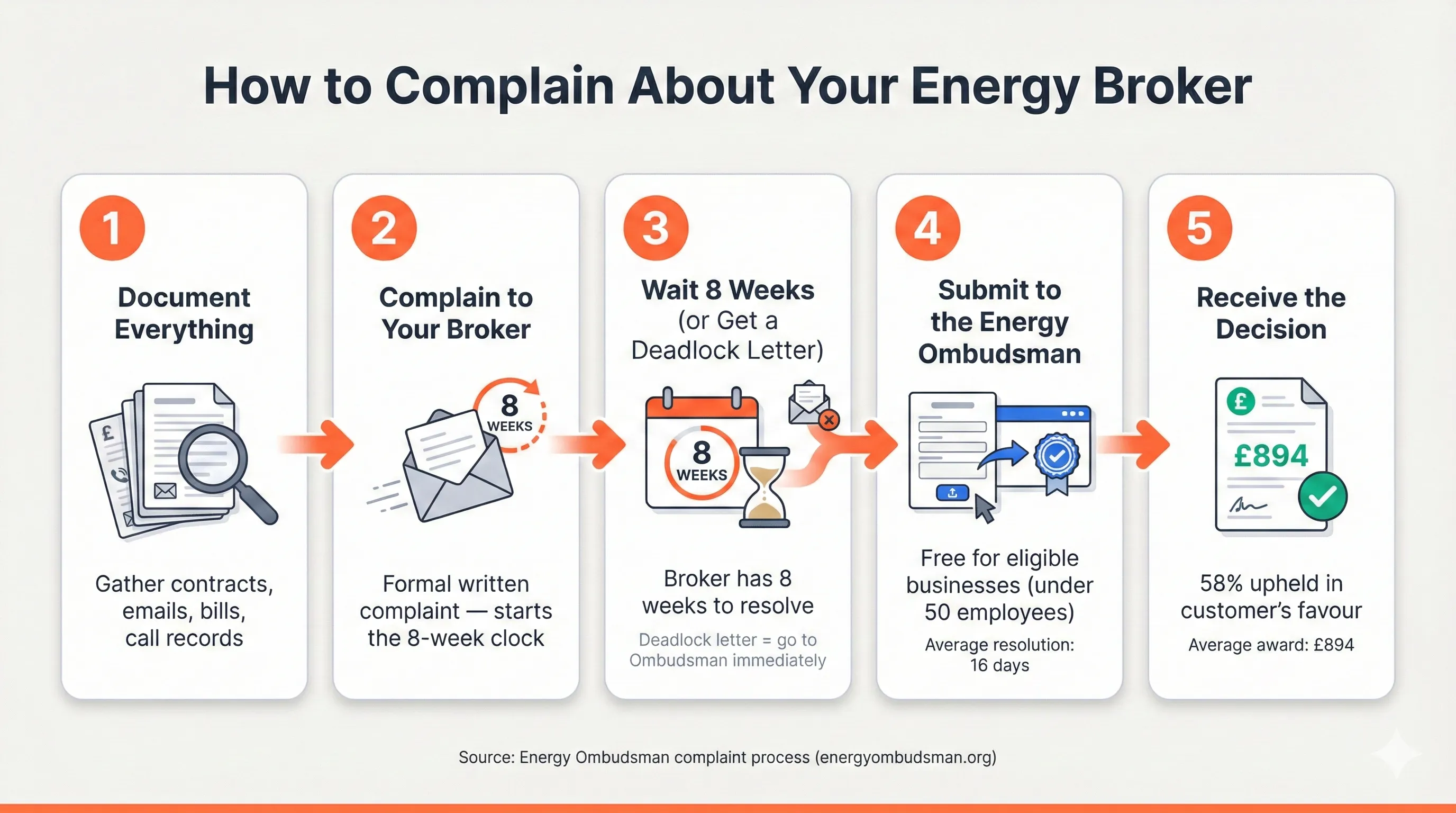
Step 1: Document Everything
Before you contact anyone, gather your evidence:
- Your contract - the original terms, unit rate, and any commission disclosure
- Emails and letters from your broker during the sales process
- Bills showing the rate you’re paying versus what was quoted
- Notes on any verbal promises (dates, names, what was said)
- Request call recordings from your broker - do this early, as retention policies vary
The stronger your documentation, the higher your chances of a successful outcome. The 58% uphold rate rises significantly when businesses provide clear written evidence.
Step 2: Complain to Your Broker Directly
Write a formal complaint (email is fine). Be specific:
- What happened and when
- What you expected versus what you got
- What you want them to do about it (refund, contract release, etc.)
- Reference any evidence
This starts the 8-week clock. Keep copies of everything.
Step 3: Wait 8 Weeks (or Get a Deadlock Letter)
Your broker has 8 weeks to resolve the complaint. Two outcomes:
- They send a “deadlock letter” - meaning they can’t resolve it. You can go to the Ombudsman immediately.
- 8 weeks pass with no resolution - you can escalate regardless.
Don’t wait longer than you need to. If your broker is unresponsive after 8 weeks, that’s your trigger to escalate.
Step 4: Submit to the Energy Ombudsman
Visit energyombudsman.org (opens in new tab) and submit your dispute. You’ll need:
- Your broker’s name and any reference numbers
- A summary of your complaint
- All supporting evidence
- What outcome you’re seeking
Eligibility: Since December 2024, small businesses (under 50 employees) are eligible for broker disputes. Previously only microbusinesses qualified. The service is free.
Resolution time: Average 16 days from submission to decision.
Step 5: Receive the Decision
If the Ombudsman upholds your complaint (58% chance based on 2024 data), they’ll issue a remedy. This might include:
- Financial compensation (average £894)
- Requirement to release you from the contract
- Corrective action by the broker
- An apology with commitment to process changes
If you accept the decision, it’s binding on the broker. If you reject it, you can pursue other routes (such as the courts or joining the £2 billion collective action (opens in new tab) against undisclosed broker commissions).
Only 63% of Remedies Implemented on Time
Even when the Ombudsman rules in your favour, enforcement isn’t guaranteed. The 2025 Broker Report found that only 63% of remedies were implemented on time by brokers - up slightly from 57% in Year 1, but still inadequate.
The trajectory within the year tells the real story. Remedy compliance fell to just 27% in mid-2024 before recovering to 80% by year-end after the Ombudsman intervened. That mid-year collapse suggests some brokers only comply when actively pressured.
That means more than a third of businesses who won their case still faced delays getting the remedy they were awarded. If you’re in this position:
- Contact the Ombudsman to report non-compliance
- Keep records of the deadline and any communication with the broker
- Escalate to Ofgem if the broker repeatedly fails to comply - Ofgem’s expanded Standards of Conduct (opens in new tab) now cover all business sizes
What’s Changing
The broker complaint landscape is shifting, with several regulatory changes either recently implemented or incoming.
Already in Effect
- October 2024: Mandatory commission disclosure for ALL non-domestic contracts. Brokers must show their fee in p/kWh.
- December 2024: ADR scope expanded to small businesses (not just microbusinesses). Complaint handling standards extended.
- December 2024: Suppliers can only work with brokers registered with an ADR scheme.
Coming Next
- 2026-2027: Ofgem will become the direct regulator of energy brokers for the first time. Mandatory registration, fit-and-proper-person checks, and enforcement powers including fines and bans.
- TPI Code: Only 63 of 2,700+ brokers have signed the voluntary TPI Code of Practice. With 2% adoption after 20+ months, voluntary self-regulation has failed. Direct regulation is the government’s answer.
Ed Miliband, Energy Secretary, was direct about the intent: to “end the wild west of ‘cowboy’ brokers charging sky-high fees.”
Ed Dodman, Chief Ombudsman, echoed the need for change in the 2025 report: “We’re optimistic that well-practiced regulation should level the playing field.” Notably, the Ombudsman’s own broker survey found that a majority of brokers support regulation - suggesting even the industry recognises the current system isn’t working. The survey also found that 46% of brokers cite price volatility as their biggest challenge, not the prospect of oversight.
The Bigger Picture
1,568 complaints sounds like a lot - and the 112% increase is significant. But put it in context: brokers handle hundreds of thousands of contracts annually. A complaint rate of under 1% might seem low.
It’s not.
The Ombudsman processes “less than a third of the disputes that we should.” With an 8% signposting rate, most businesses with legitimate grievances never reach the Ombudsman. And of those who did reach the Ombudsman in 2024, 847 disputes were not taken forward - primarily because the business hadn’t complained to their broker first (a required step before escalation). That’s 847 businesses who were frustrated enough to contact the Ombudsman but didn’t know the process.
Add those 847 to the 1,568 accepted cases, and you have 2,415 businesses who actively tried to complain in 2024 alone. The actual volume of broker disputes is likely 4,000-5,000 annually - suppressed by brokers who don’t tell customers where to complain.
And the 58% uphold rate tells you these aren’t frivolous complaints. When businesses do navigate the process, more than half are vindicated.
The question for UK businesses isn’t whether broker practices are improving. The data says they aren’t - complaints doubled while overall energy complaints fell 24%. The question is whether you know your rights, and whether you’ll exercise them.
If you’ve been overcharged, mis-sold a contract, or discovered undisclosed commissions you weren’t told about: the Ombudsman exists, it’s free, and the odds are in your favour.
Sources:
- Energy Ombudsman - Broker Report 2025 (opens in new tab)
- Energy Ombudsman - Broker Report 2024 (PDF) (opens in new tab)
- Energy Ombudsman - Reports and Data (opens in new tab)
- Energy Consultants Association - The 2025 Energy Ombudsman Report: Progress Made, Questions Remain (opens in new tab)
- Ofgem - Non-Domestic Market Review: Decision (April 2024) (opens in new tab)
- Ofgem - Non-Domestic 2024 Research Report (opens in new tab)
- Ofgem - Greater Protection for Businesses (opens in new tab)
- Care England - Ofgem to Clamp Down on Rogue Energy Brokers (opens in new tab)
- Harcus Parker - Energy Broker Litigation (opens in new tab)


