


The energy broker industry has a transparency problem. Out of an estimated 2,700+ brokers operating in the UK, only 63 had signed as of August 2026 the TPI Code of Practice (opens in new tab) - a voluntary code designed to protect businesses from misleading practices.
That’s around 2% of the industry.
Last verified: January 2026 from REC Portal TPI Register (opens in new tab)
TL;DR: Key Takeaways
The Code: The TPI Code of Practice is administered by RECCo (the body running the Ofgem (opens in new tab)-regulated Retail Energy Code). It sets standards for transparency, fair treatment, and dispute resolution.
The Numbers: As of August 2026, only 63 companies had signed out of 2,700+ brokers. Most of the biggest names in business energy broking are absent from the signatory list.
What Signatories Commit To: Disclosing how they’re paid, showing all quotes received, having a complaints procedure, and registering with an ADR scheme like the Energy Ombudsman.
Why It Matters: If your broker hasn’t signed the Code, they haven’t publicly committed to transparency standards. You still have ADR access (all brokers must be registered to work with suppliers), but the Code signals a proactive commitment to fair dealing.
What is the TPI Code of Practice?
TPI stands for Third Party Intermediary - the official Ofgem term for energy brokers, comparison sites, and switching services. The TPI Code of Practice is a voluntary set of standards that these intermediaries can choose to sign.
The Code is administered by RECCo (opens in new tab) (Retail Energy Code Company), the independent company that manages the Retail Energy Code on behalf of Ofgem. This gives it more credibility than an industry self-regulation scheme, though it’s still voluntary.
The 7 Principles
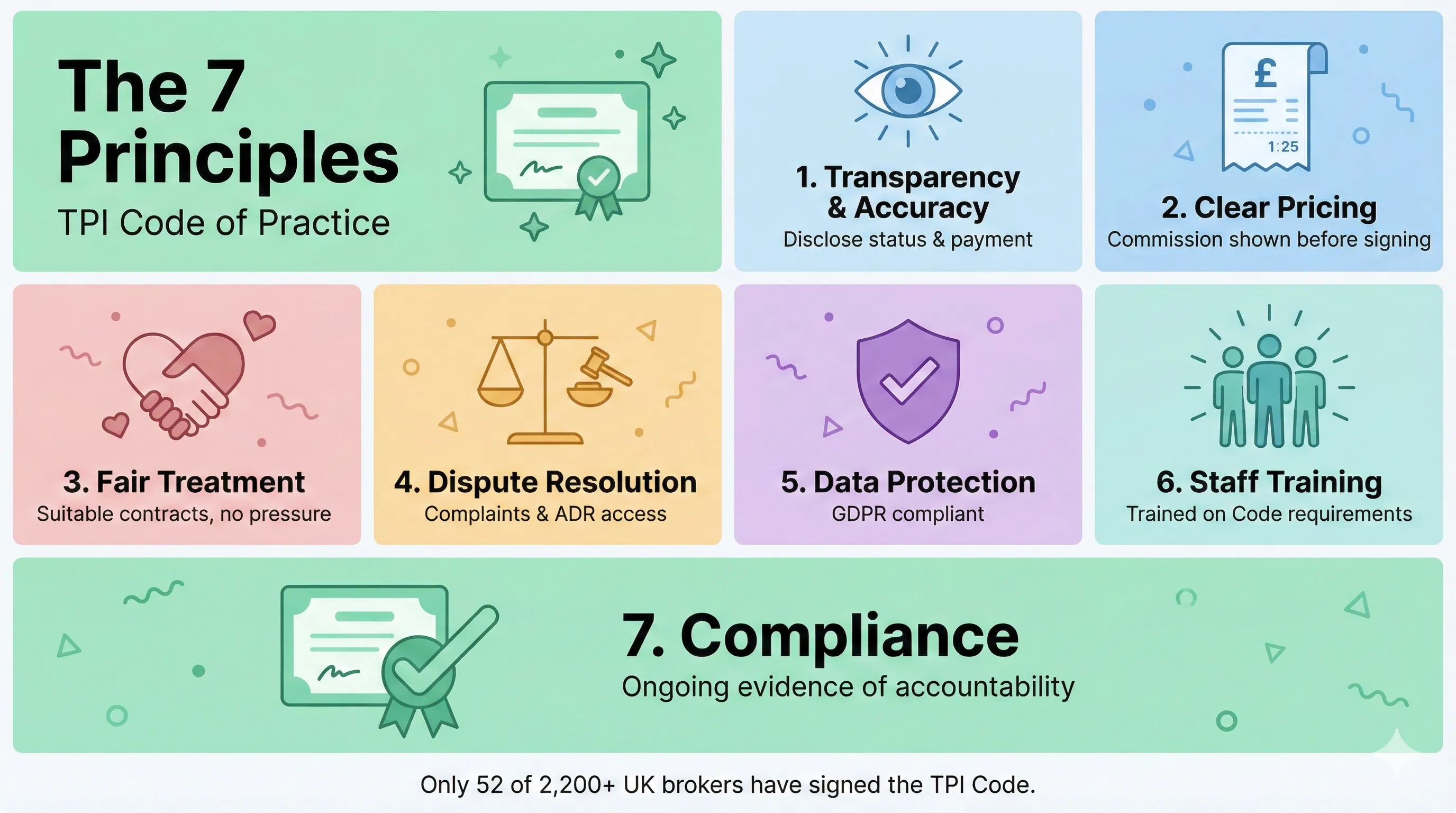
Signatories commit to seven principles:
| Principle | What It Means |
|---|---|
| 1. Transparency & Accuracy | Tell customers upfront that you’re an intermediary and how you’re paid |
| 2. Clear Pricing | Show commission calculation before contract signing |
| 3. Fair Treatment | Only recommend suitable contracts, no pressure tactics |
| 4. Dispute Resolution | Have a complaints procedure and ADR registration |
| 5. Data Protection | Handle data in accordance with GDPR |
| 6. Staff Training | Train staff on Code requirements |
| 7. Compliance | Maintain evidence of ongoing compliance |
These sound like basic business practices. The fact that only around 2% of the industry has signed suggests many brokers don’t want to commit to them publicly.
Why Haven’t More Brokers Signed?
The Code is free to join. There’s no annual fee, no complex application process, and no external auditing. You simply submit a self-certification form declaring that you comply with the principles.
So why haven’t the other 98% signed?
1. Transparency Conflicts With Their Business Model
The traditional broker model relies on undisclosed commissions embedded in your energy rate. When you don’t know what you’re paying in broker fees, you can’t compare brokers on value.
The Code requires signatories to disclose their commission calculation before you sign a contract. For brokers charging 3-5p/kWh in uplift while not proactively telling customers what they’re paying - or letting them assume the service is free - this transparency requirement is a problem.
2. It’s About Public Commitment, Not Just ADR
Here’s an important clarification: while TPIs themselves aren’t directly mandated to register with an ADR scheme, energy suppliers are. Since December 2022, Ofgem licence conditions (opens in new tab) require suppliers to only work with TPIs registered with a qualifying ADR scheme. In practice, this means any broker that wants to place contracts with suppliers must have ADR registration - it’s effectively mandatory, just enforced through suppliers rather than directly on brokers. The main options are:
- Energy Ombudsman (opens in new tab) - handles disputes for small and micro businesses
- Dispute Resolution Ombudsman (DRO) (opens in new tab) - alternative ADR provider
- Utilities Intermediaries Association (UIA) (opens in new tab) - industry body with its own scheme
So why does signing the TPI Code matter if ADR is already required? Because the Code goes further. It’s a public, visible commitment to transparency principles that customers can verify. Signing the Code says: “We don’t just meet the minimum legal requirement - we actively embrace transparency.”
3. No Legal Requirement (Yet)
Ofgem doesn’t regulate energy brokers directly (opens in new tab) - yet. Unlike energy suppliers, who must be licenced, brokers have operated in a largely unregulated space. The TPI Code exists to fill this gap voluntarily.
However, this is changing. The Government has confirmed plans to regulate TPIs (opens in new tab) and has tasked Ofgem with designing the regulatory framework. See our section on upcoming regulation below.
4. Most Businesses Don’t Know to Check
If customers don’t know the TPI Code exists, they can’t use signatory status as a selection criterion. Brokers have little commercial incentive to sign when the sales process doesn’t require it.
This is changing. As awareness grows and more businesses ask “Are you a TPI Code signatory?”, the pressure to sign increases. But we’re not there yet.
Who Has Signed? (And Who Hasn’t)
The REC Portal (opens in new tab) lists every signatory, and the count moves slowly - it was 52 in January 2026. Notable patterns:
Signatories include:
- Newer digital-first platforms prioritising transparency
- Some regional brokers serving local business communities
- Specialist consultancies focused on larger corporate clients
- Meet George (that’s us - see our TPI Code page)
Absent from the list:
- Most of the largest national brokers by customer volume
- The brokers powering major comparison site business energy sections
- Many of the brokers with aggressive cold-calling operations
We won’t name specific non-signatories (you can check the register yourself), but the pattern is clear: the brokers least interested in transparency are least likely to sign a transparency code.
What Does Signing Actually Require?
Let’s be specific about what TPI Code signatories commit to:
Before You Sign a Contract
- Tell you they’re acting as an intermediary (not the supplier)
- Explain how their commission is calculated
- Show you all supplier quotes they received, not just the recommended one (some brokers only recommend suppliers who pay them 80% of commission upfront, creating a conflict of interest)
- Provide clear information about contract terms
During the Process
- No pressure to sign immediately
- No misleading claims about prices, savings, or service
- Written confirmation of what’s been agreed
- Clear explanation of what happens next
If Something Goes Wrong
- A documented complaints procedure
- Response within reasonable timeframes
- Registration with an ADR scheme for escalation
- Signposting to the Ombudsman if complaints aren’t resolved
For businesses that have been burned by brokers in the past - auto-renewals without consent (often enabled by Level 2 LOAs), undisclosed fees, pressure sales tactics - these commitments matter. The Energy Ombudsman data shows complaints about these practices rose 112% in 2024.
The ADR Safety Net (For All Brokers)
Good news: ADR access isn’t limited to TPI Code signatories. Since December 2022, Ofgem licence conditions require suppliers to only work with TPIs registered with a qualifying ADR scheme. This means any legitimate broker should have ADR registration - whether they’ve signed the TPI Code or not.
The Energy Ombudsman
The Energy Ombudsman (opens in new tab) is the main ADR provider for energy-related disputes. Key facts:
- Free to use for consumers and eligible businesses
- Covers micro businesses (fewer than 10 employees, turnover under €2m)
- Can award financial remedies and require brokers to take action
- Decisions are binding on the broker if you accept them
Other ADR schemes include the Dispute Resolution Ombudsman (DRO) (opens in new tab) and the Utilities Intermediaries Association (UIA) (opens in new tab).
How to Escalate a Complaint
- Complain to the broker first - give them a chance to resolve it
- Wait for a final response - or 8 weeks if they don’t resolve it
- Contact their ADR scheme - they’ll assess eligibility and investigate
- Receive a decision - accept it (binding) or reject it (pursue other options)
For eligible businesses, this is free and independent. If a broker claims they’re not registered with any ADR scheme, that’s a major red flag - it likely means suppliers shouldn’t be working with them at all.
See our complaints procedure for how this works with Meet George.
Why We Signed (And What It Means For You)
Meet George signed the TPI Code because it describes how we already operate. Transparent pricing. A flat 1p/kWh fee shown separately. All quotes visible. A proper complaints procedure with Energy Ombudsman registration.
We didn’t sign because we had to. We signed because the Code represents the minimum standard every broker should meet.
What This Means If You Use Meet George
Before you switch:
- You’ll see our 1p/kWh fee itemised separately
- You’ll know exactly how our 1p/kWh fee is calculated
- You’ll see all supplier quotes we receive, not just our recommendation
During the process:
- No pressure to sign immediately
- Clear explanation of contract terms
- Written confirmation of everything agreed
If something goes wrong:
- Formal complaints procedure at complaints@meetgeorge.co.uk
- Escalation to the Energy Ombudsman for unresolved disputes
- Response within documented timeframes
The Code doesn’t make us special. It should be the industry standard. The problem is that 98% of brokers haven’t committed to it.
How to Check Your Broker
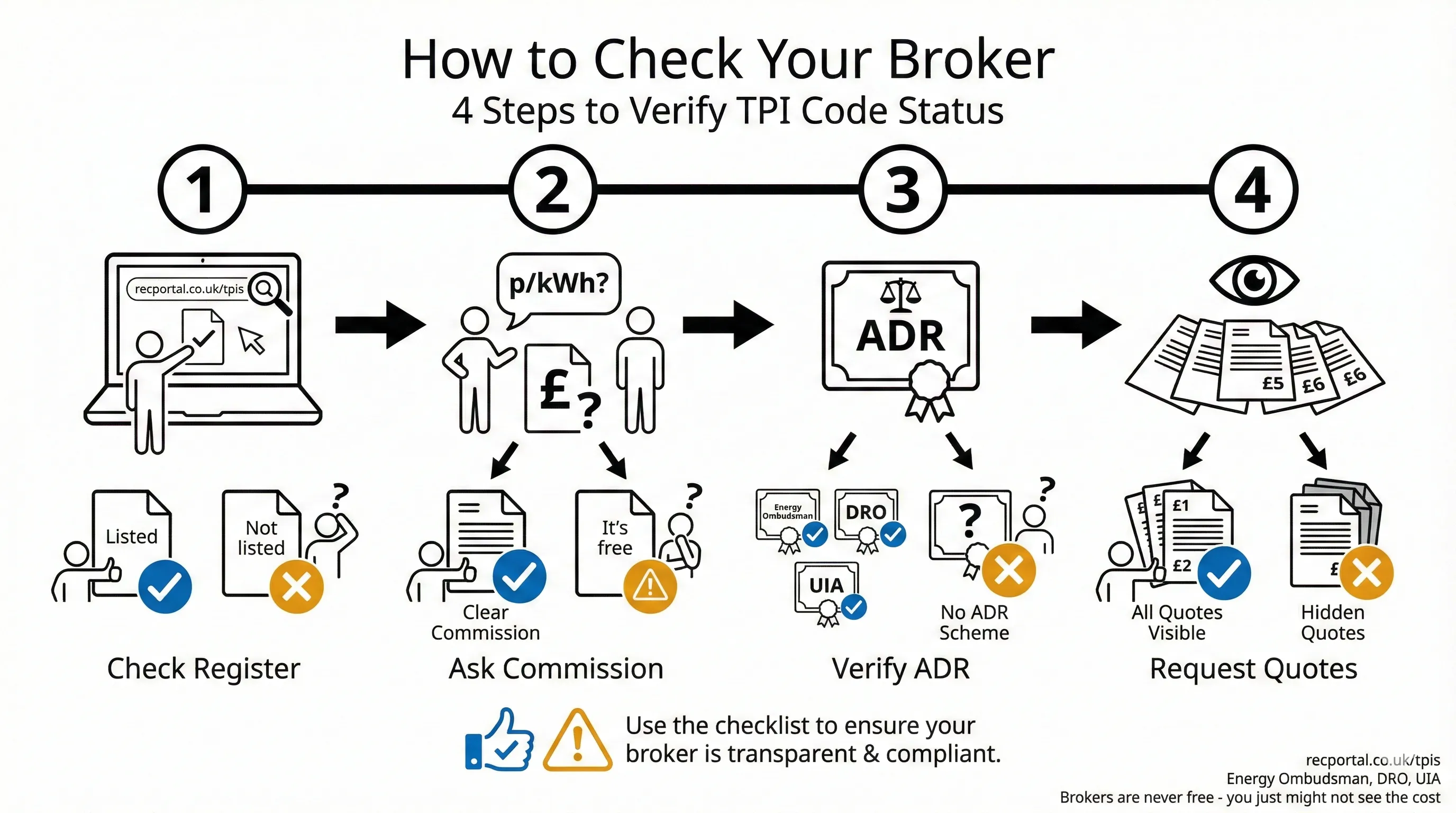
Before working with any energy broker, check whether they’ve signed the TPI Code:
Step 1: Check if Your Broker Signed the TPI Code
Visit the REC Portal TPI register (opens in new tab) and search for your broker’s company name. The list shows all verified signatories. If they’re not on the list, they haven’t committed to the Code’s transparency principles.
Step 2: Ask for Commission Disclosure
TPI Code signatories must disclose how they’re paid before you sign. Ask your broker directly:
- “What is your commission rate in pence per kWh?”
- “How is this commission calculated?”
- “Will this be shown separately on my contract?”
If they’re evasive or tell you their service is “free,” that’s a red flag. Brokers are never free - you just might not see the cost. Our commission calculator shows exactly what different rates mean in pounds and pence for your business.
Step 3: Check Their ADR Registration
Ask which ADR scheme they’re registered with. Legitimate options include:
- Energy Ombudsman (opens in new tab)
- Dispute Resolution Ombudsman (DRO) (opens in new tab)
- Utilities Intermediaries Association (UIA) (opens in new tab)
Since December 2022, suppliers can only work with ADR-registered TPIs. If a broker claims they’re not registered with any ADR scheme, that’s a major red flag - legitimate brokers must have ADR registration to operate.
Step 4: Request All Quotes Received
The Code requires brokers to show all quotes they receive, not just their recommendation. Ask: “Can you show me every supplier quote you received for my switch?”
A broker following the Code will provide this transparency. One that refuses is either not a signatory or not complying with their commitments.
The Future: Mandatory TPI Regulation
The TPI Code was introduced in October 2023 as a voluntary framework - building on a draft Code originally developed by Ofgem in 2013 (opens in new tab) but never formally implemented.
That’s about to change.
Government Has Appointed Ofgem as TPI Regulator
In October 2025, the Government published its consultation response on TPI regulation (opens in new tab), confirming that Ofgem will become the regulator for business energy brokers. The expected timeline:
- 2026: Ofgem surveys TPIs and designs the regulatory framework
- 2027: Broker registration opens (subject to parliamentary timing)
- 2028+: Full enforcement - only registered, compliant brokers can operate
For a full breakdown of what’s coming, see our energy broker regulation page and our article on Ofgem’s plans for mandatory TPI licencing.
What This Means for the TPI Code
The voluntary TPI Code represents the direction of travel. Brokers who’ve already signed are demonstrating they can meet the standards that will likely become mandatory. Those who haven’t signed may face a steeper compliance curve when regulation arrives.
RECCo has also proposed making the TPI Code mandatory (opens in new tab) for all TPIs working with non-domestic suppliers - which would complement Ofgem’s broader regulatory framework.
The Bigger Picture
The 98% of brokers who haven’t signed the TPI Code are betting you won’t check. They’re also betting regulation won’t arrive soon enough to matter.
Both bets are getting riskier.
Now you know to check - and you know what’s coming.
Verify Meet George’s TPI Code Status
We’re on the REC Portal signatory list (opens in new tab). You can verify our status independently - we encourage you to check.
You can also read our full TPI Code of Practice page to see exactly how we implement each of the 7 principles, or review our complaints procedure if you ever need it.
Transparency isn’t a marketing message. It’s a commitment - and now you know how to verify which brokers have actually made it.
Sources:
- REC Portal - TPI Code of Practice Signatories (opens in new tab)
- TPI Code of Practice (PDF) (opens in new tab)
- Ofgem - TPI Programme (opens in new tab)
- Ofgem - ADR Scheme Criteria Decision (opens in new tab)
- DESNZ - TPI Regulation Consultation (opens in new tab)
- RECCo - Retail Energy Code Company (opens in new tab)
- RECCo - Introducing the TPI Code of Practice (opens in new tab)
- Energy Ombudsman (opens in new tab)
- Dispute Resolution Ombudsman (DRO) (opens in new tab)
- Utilities Intermediaries Association (UIA) (opens in new tab)


