

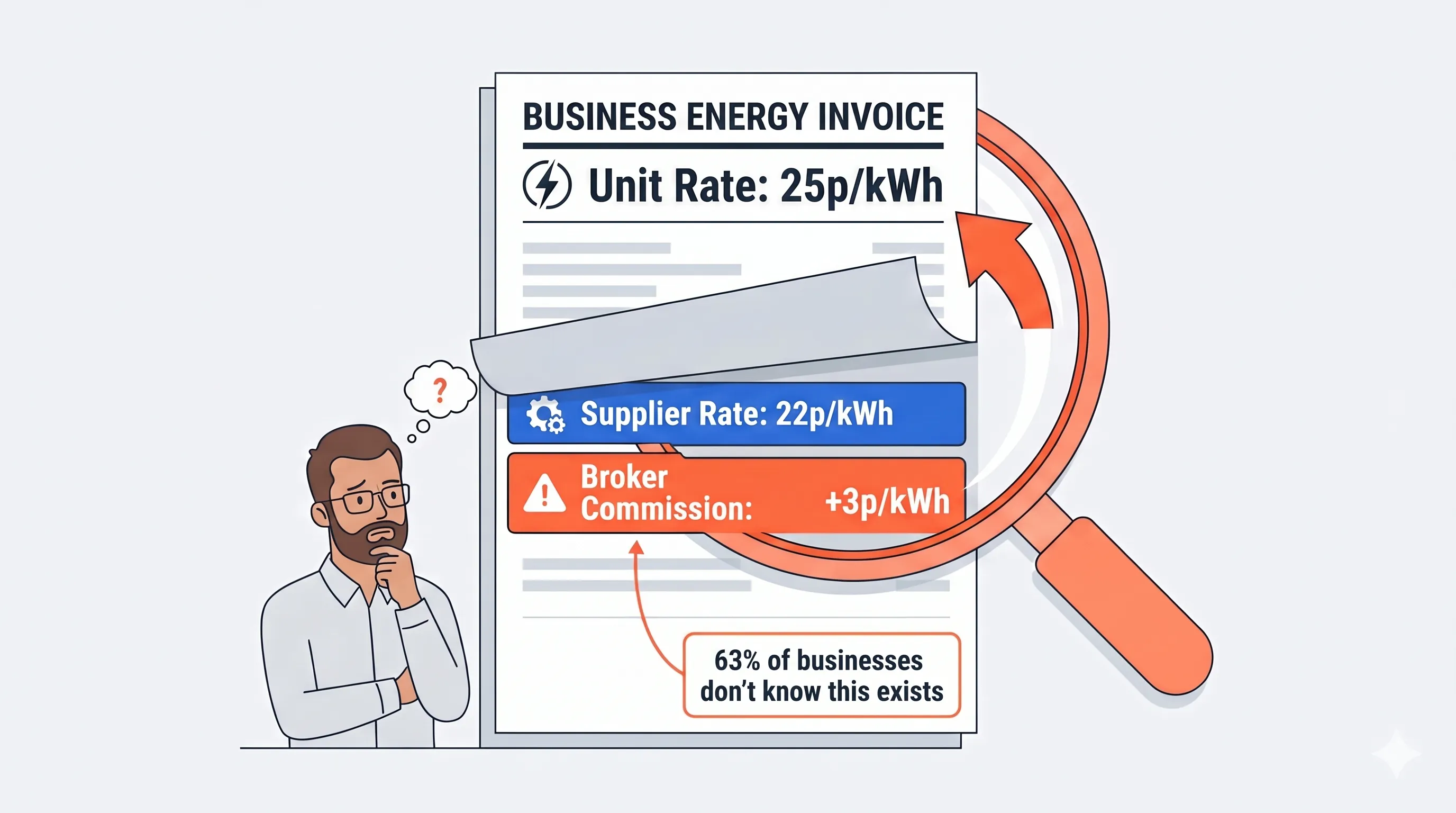
TL;DR: The Undisclosed Truth About “Free” Energy Brokers
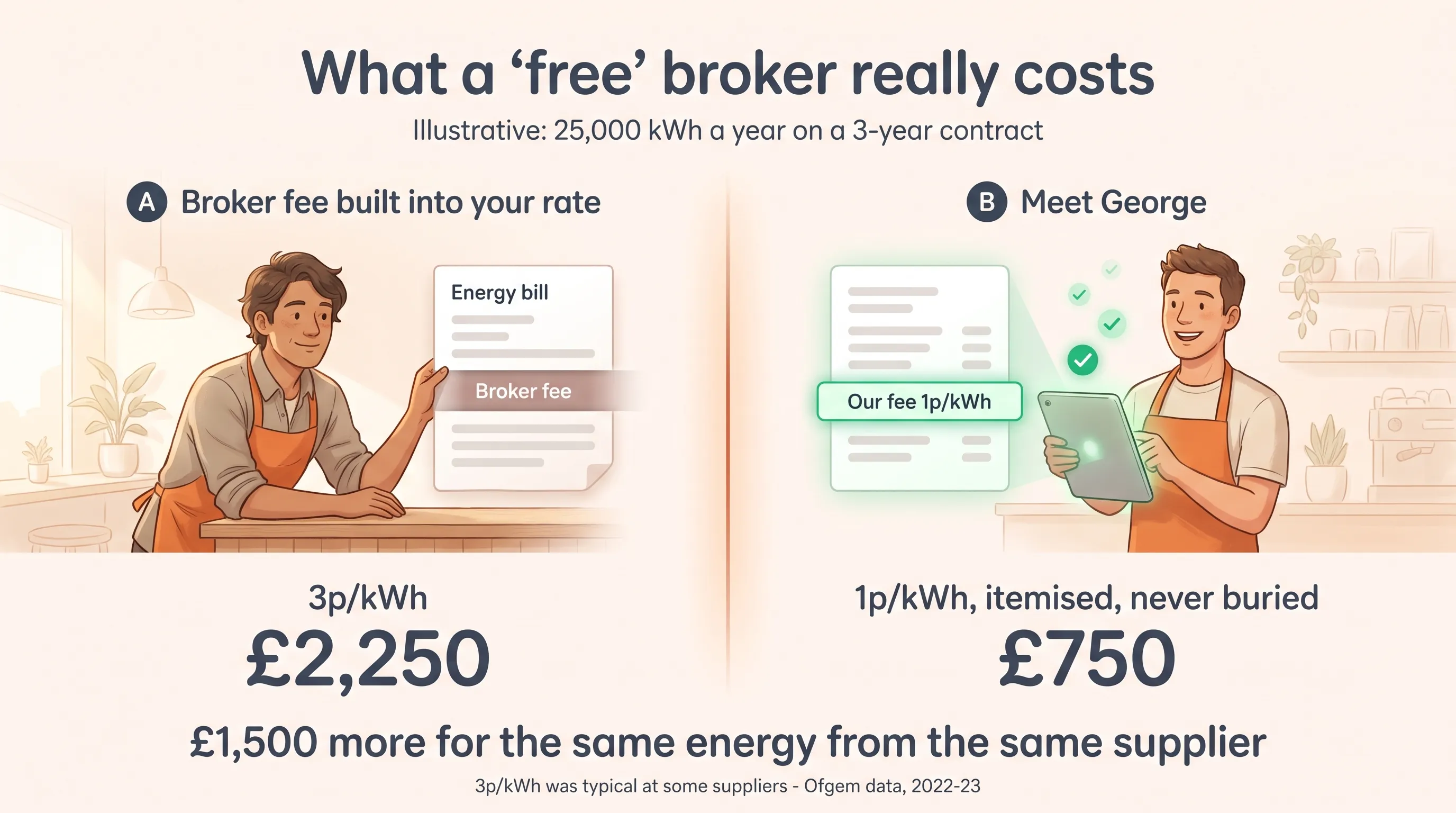
How much they make: Ofgem’s data shows broker fees of about 3p/kWh were typical at some suppliers in 2022-23 - three times our 1p. For a business using 25,000 kWh a year, 3p/kWh is £750 a year, or £2,250 over a 3-year contract.
The Illusion: 63% of businesses that knew they’d used a broker thought they weren’t charged for it, and only 21% thought they were (Ofgem, 2025). Broker commission is usually built into the unit rate, so it’s easy to miss.
The Reality: Brokers earn commission by adding “uplift” to your unit rate. If a supplier’s base rate is 22p/kWh and the broker adds 3p, you pay 25p - with the broker pocketing that 3p for every kWh you use. For typical rates by business size, see our Energy Broker Commission Rates Guide.
The Scale: In cases reported to regulators and in litigation, broker commissions have been said to reach 50% or more of total energy costs. A golf club was reportedly charged £24,000 in undisclosed fees. A care home was quoted £68,126 before challenging it.
The Solution: Ask one question: “What is the supplier’s base rate versus your commission?” If they won’t answer clearly, walk away.
How many businesses think energy brokers are free?
63% of businesses that knew they’d used a broker to switch thought they weren’t charged for it, in Ofgem’s 2025 survey of 1,002 businesses (opens in new tab) in Great Britain. 21% thought they were charged and 13% didn’t know.
That’s down from 73% in Ofgem’s 2024 survey (opens in new tab), when only 14% thought they were charged. The 2024 survey ran before the October 2024 disclosure rules took effect and the 2025 one after, so the rules may be part of the change. Most businesses that use a broker still think it’s free.
This isn’t naivety. It’s the result of a business model designed to obscure how brokers make money.
How “Free” Brokers Actually Get Paid
When you use a traditional energy broker, here’s what happens:
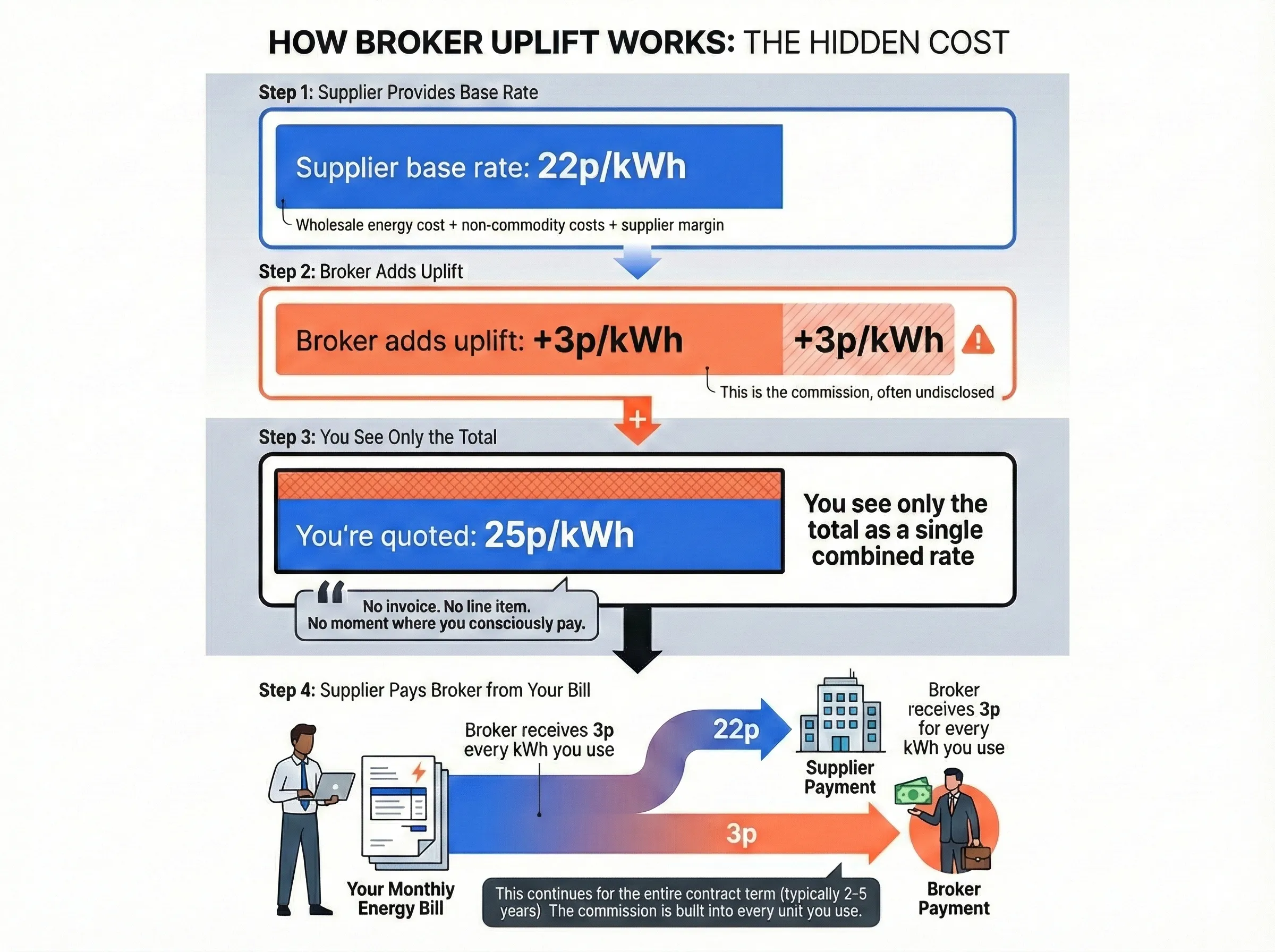
- Suppliers provide base rates - Say, 22p/kWh
- The broker adds their commission - Called “uplift” - say, 3p/kWh
- You see only the total - You’re quoted 25p/kWh, with no breakdown
- The supplier pays the broker - From the uplift they collect from you
You never receive an invoice from the broker. The commission is invisible - extracted through every unit of energy you consume over your entire contract.
This is why it “feels” free. No separate bill. No line item. No moment where you consciously pay.
But you’re paying. Every single day.
Broker commission is also often front-loaded. In one Court of Appeal judgment (opens in new tab), the court noted that a supplier paid the broker a lump sum up front worth 80% of the commission expected over the full contract - which the court found created an incentive to tie the customer into a long-term deal. This is a model-level dynamic, not a claim about any one broker you might deal with.
How Much Do Energy Brokers Make?
Energy brokers earn commission on your unit rate, paid by the supplier out of the rate you pay. Ofgem’s data (opens in new tab) - based on figures suppliers gave it - shows broker fees of about 3p/kWh were typical at some suppliers for micro business electricity in 2022-23, three times Meet George’s 1p, and fees averaged about 1.2p/kWh across suppliers. Individual contracts can be higher. So yes, business energy brokers do charge a fee - you just rarely see it, because it is embedded in your rate rather than sent as a separate invoice.
For a business using 25,000 kWh a year on a 3-year contract, every 1p/kWh of commission works out at £750 over the term - £2,250 at 3p/kWh.
What “Free” Actually Costs
For a typical SME using 25,000 kWh annually on a 3-year contract:
| Broker Commission (illustrative) | Annual Cost | 3-Year Total |
|---|---|---|
| 4p/kWh | £1,000 | £3,000 |
| 3p/kWh (typical at some suppliers, Ofgem 2022-23) | £750 | £2,250 |
| 2p/kWh | £500 | £1,500 |
| 1p/kWh (transparent - Meet George) | £250 | £750 |
The business paying 3p/kWh is paying £1,500 more than one using transparent pricing - for the exact same energy from the exact same supplier. Calculate what undisclosed commission might be costing your business - the results often surprise people. Our analysis of broker commission rates shows how these commissions compound at scale.
Why Businesses Don’t Know They’re Paying
Three factors keep these fees undisclosed:
No invoice, no awareness. Unlike accountants or solicitors who send bills, broker fees are embedded in your energy rate and collected by the supplier over years. There’s no discrete payment moment.
“Free comparison” marketing. Broker websites advertise “free energy comparison” and “no cost to you.” Technically defensible - you don’t pay them directly. But the supplier payment comes from your inflated rate.
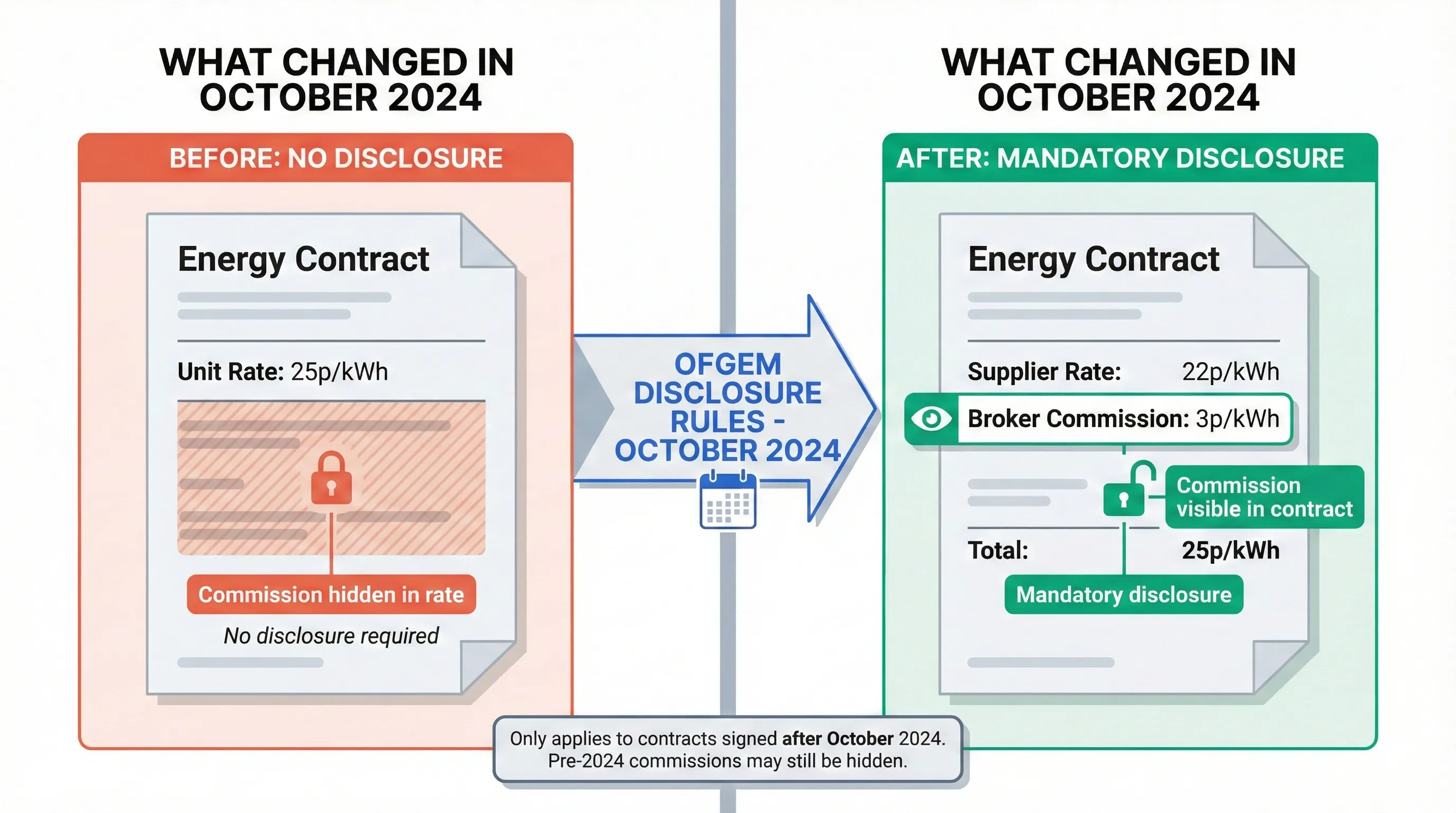
Historical lack of disclosure. Until October 2024, there was no legal requirement to disclose commission. Businesses literally couldn’t find out what they were paying. Even now, disclosure happens in contract paperwork - not when comparing quotes.
Many businesses use brokers precisely because they don’t understand energy markets. They trust the broker’s recommendation. This trust is sometimes warranted - good brokers provide genuine value. But it also creates vulnerability.
Once you know the fee exists, the fair question is whether you need the service at all. Our comparison of broker-assisted, self-service and direct-to-supplier switching puts the three side by side on cost, speed and control - and is straight about the multi-site and half-hourly cases where a broker is still the right answer.
The Evidence: Documented Cases
The Golf Club: 50% Commission
Evidence submitted to Ofgem during its non-domestic market review (opens in new tab) described a broker charging a golf club a reported 50% commission fee - said to have cost the club around £24,000 in undisclosed charges.
On those figures, half the bill was going to the intermediary (energy broker) rather than the supplier.
The Care Home: £68,126 Reduced to £12,606
According to figures reported by the claimant side, a care home was quoted broker fees of £68,126. When challenged, this dropped to £12,606 - an 81% reduction. A gap that large appears not to have been based on cost-to-serve, which is exactly the kind of pricing the model can produce when fees are never shown.
The £2 Billion Class Action
Law firm Harcus Parker (opens in new tab) has filed a class-action lawsuit it values at up to £2 billion on behalf of up to 2 million UK businesses, alleging systematic undisclosed commissions. According to the claim, commission reached as much as 60% of total energy costs in the most extreme cases. These figures are the claimant firm’s own and have not yet been tested at trial.
This follows the Competition and Markets Authority’s 2016 investigation (opens in new tab) which found 45% of microbusinesses stuck on expensive default tariffs, collectively overpaying by £180 million annually.
How to Find Out What You’re Really Paying
The Single Most Important Question
When speaking to any broker, ask this:
Show me the supplier’s base rate separately from your commission. What exactly am I paying you?
A good broker will answer clearly. In our view, if a broker deflects or claims they “can’t” provide this, treat it as a warning sign.
They can. The information exists in every contract.
For New Contracts (Post-October 2024)
Since 1 October 2024, Ofgem requires suppliers to disclose broker commissions (opens in new tab) in all business energy contracts. Check the “Third Party Costs” section of your contract paperwork.
The limitation: In practice, disclosure lands at contract stage - not when you are comparing quotes.
What changed in July 2026: Ofgem published good-practice guidance (opens in new tab) for intermediaries saying it expects them to clearly explain their commission or fee arrangements - including how much they will receive and how the customer pays - before the customer agrees to the contract. It is not enforceable yet, but it is where the rules are going.
Meet George already works that way: we show our 1p/kWh fee separately from the supplier’s base rate on every quote, so you can see exactly what you are paying - and that it is you who pays it - before you decide.
For Existing Contracts (Pre-October 2024)
- Contact your broker and ask for a commission breakdown in writing
- Compare your unit rate against current market rates - if you’re paying 28p when the market is 22p, investigate
- If you believe you were mis-sold, the Energy Ombudsman (opens in new tab) upheld 58% of broker complaints in 2024 with an average award of £894
What’s Changing
The Department for Energy Security and Net Zero confirmed (opens in new tab) that Ofgem will directly regulate brokers from 2026 - including mandatory registration, conduct standards, and enforcement powers. You can track progress on Ofgem’s TPI programme page (opens in new tab).
Mandatory commission disclosure from October 2024 has increased competitive pressure on broker pricing, as customers can now compare what they’re paying. But voluntary codes have failed - only 72 brokers (fewer than 4% of those on the Energy Ombudsman’s register) had signed the RECCo TPI Code by October 2026. And be aware that even if you “shop around” on comparison sites, most route to the same underlying broker. Until mandatory regulation arrives, the onus remains on you to ask the right questions.
The Meet George Difference
We built Meet George because we believe the “free broker” model is broken.
| Factor | Traditional “Free” Broker | Meet George |
|---|---|---|
| Fee visibility | Commission embedded in rate | Our fee shown separately |
| What you pay us | Broker commission built into your rate (about 3p/kWh typical at some suppliers, Ofgem 2022-23) | Flat 1p/kWh fee |
| 3-year cost (25,000 kWh/yr) | £2,250 at 3p/kWh | £750 |
| When you see fees | Contract signing | Quote comparison |
| Sales pressure | Commission-driven | None |
Transparent fee: a flat 1p/kWh fee, shown separately from the supplier’s base rate on every quote.
No Undisclosed Uplift: When we show you 23p/kWh total, you know it’s 22p to the supplier and 1p to us.
AI-Powered, Not Sales-Driven: Our AI assistant analyses contracts without commission incentives. No salesperson pushing you toward higher-margin deals.
The “free” broker costs you more. Every time.
The Bottom Line
The 63% of businesses who thought their broker was free aren’t naive. They’ve been systematically misled by a business model designed to obscure its own costs.
The question isn’t whether brokers should be paid - of course they should. The question is whether you should know what you’re paying before you agree to pay it.
We think the answer is yes.
Ready to see transparent pricing? Learn how Meet George’s 1p/kWh fee works or explore our complete guide to undisclosed broker commissions.
Ready to switch the transparent way? Check if you can switch: upload your latest bill and George tells you in seconds whether you’re in your switching window. No undisclosed margins, no sales calls, no surprises.
Sources
- Ofgem - Businesses’ experiences of the energy market 2025 (opens in new tab) (the 63% figure; survey of 1,002 businesses)
- Ofgem - Non-domestic 2024 research report (opens in new tab) (the 2024 comparison: 73%)
- Ofgem - Non-domestic market review: findings and statutory consultation (opens in new tab) (golf club case; figures as submitted to Ofgem)
- Ofgem - Non-domestic market review decision (opens in new tab) (commission disclosure rules from October 2024)
- Ofgem - Third-Party Intermediaries (TPI) programme (opens in new tab)
- Court of Appeal - Expert Tooling and Automation Ltd v Engie Power Ltd [2025] EWCA Civ 292 (opens in new tab) (front-loaded commission; 80% paid up front)
- GOV.UK - Regulating Third Party Intermediaries: government response (opens in new tab)
- GOV.UK / CMA - Energy Market Investigation (Microbusinesses) Order 2016 (opens in new tab)
- Energy Ombudsman - energyombudsman.org (opens in new tab) (broker complaints redress)
- Harcus Parker - energy litigation campaign (opens in new tab) (claimant firm; class-action figures as alleged, not yet tested at trial)


