

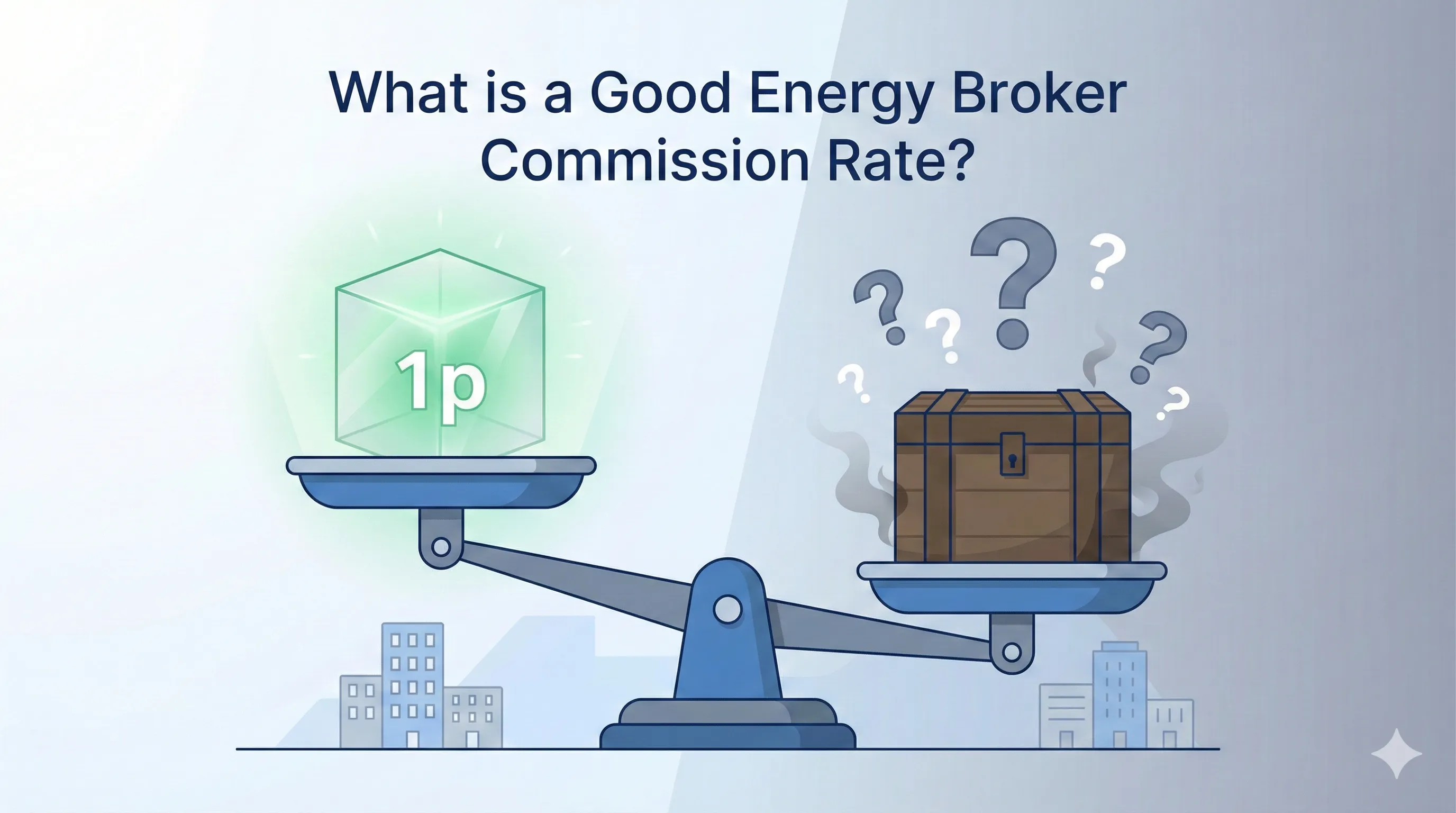
How Much Commission Do Business Energy Brokers Charge?
Energy broker commission is the fee a broker earns for arranging your contract, and in most cases it is built into the price per kWh you pay your supplier, which passes it on to the broker. There is no official average for individual contracts, but Ofgem’s supplier data shows broker fees on micro-business electricity contracts averaged about 1.2p/kWh across suppliers in 2022-23, and reached about 3p/kWh at some - and since 1 October 2024 the supplier must set out yours in the contract.
Ofgem describes the arrangement plainly: “in most cases TPI service fees are paid as part of a customer’s energy bill from their supplier, with the supplier paying fees to the TPI from the payment they receive from the customer” (Ofgem Non-Domestic Market Review decision (opens in new tab), April 2024). It also found “the majority of TPI service fees are charged on a cost per unit basis” - pence per kWh.
What Ofgem’s data shows
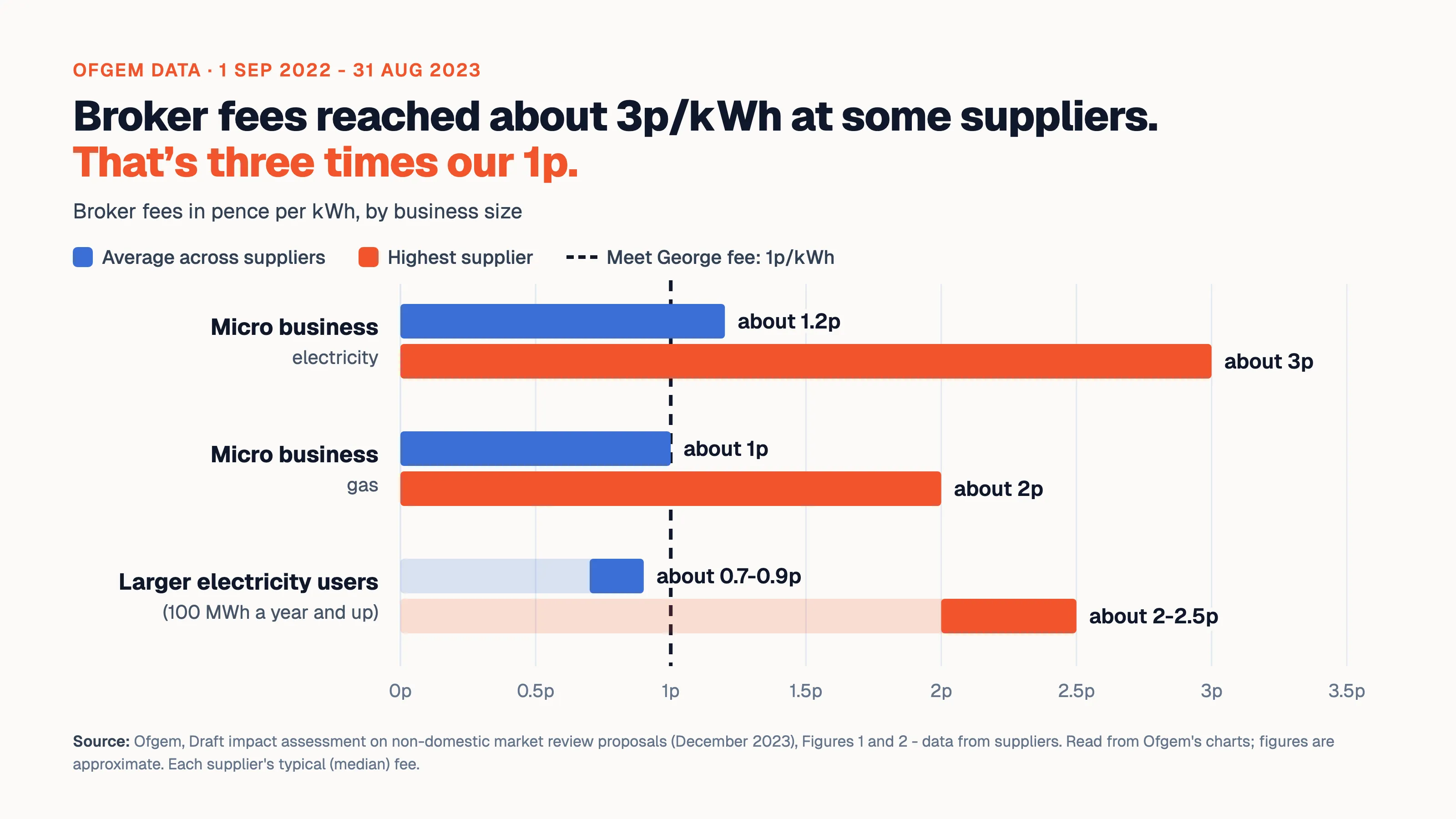
In its December 2023 draft impact assessment (opens in new tab), Ofgem published each supplier’s typical (median) broker fee for contracts between 1 September 2022 and 31 August 2023, by business size. Read from its charts:
| Business size (Ofgem band) | Average across suppliers | Highest supplier |
|---|---|---|
| Micro business - electricity | About 1.2p/kWh | About 3p/kWh |
| Micro business - gas | About 1p/kWh | About 2p/kWh |
| Larger electricity users (100 MWh a year and up) | About 0.7p-0.9p, depending on size | About 2p-2.5p/kWh |
Ofgem’s data shows broker fees of about 3p/kWh were typical at some suppliers in 2022-23 - three times Meet George’s 1p. The figures came from suppliers themselves, in response to a formal request Ofgem sent to 60 non-domestic suppliers in September 2023.
Two things to keep in mind:
- These are medians. Half of each supplier’s broker-arranged contracts paid more than its median, so individual contracts can be much higher. In one case that reached the Court of Appeal, 5.6p per kWh of a 17.82p day rate was the broker’s commission - “an estimated commission of just over £112,000” over a five-year contract (Expert Tooling and Automation Ltd v Engie Power Ltd [2025] EWCA Civ 292 (opens in new tab)).
- Ofgem doesn’t judge value from them. It notes “a variety of services are likely to be included in these cost values, so this data does not infer anything about the value for money of the services provided by TPIs.”
How to find your broker’s commission
- Contracts signed on or after 1 October 2024: Ofgem extended “the requirement for a contract’s principal terms to clearly display any broker fees from Micro Business consumers to all non-domestic customers”, and “suppliers must make this information available upon request” (Ofgem, 5 April 2024 (opens in new tab)). The fee is shown in pence per kWh; micro businesses also see a total.
- Older contracts: ask your broker and your supplier in writing for the fee in pence per kWh.
The rule sits with suppliers: there is no requirement for the fee to appear on your bill, only in the principal terms and on request.
Want to know if the price you’re paying looks high? Upload your latest bill: Meet George’s free bill check lists every charge line by line and compares your all-in price per kWh with the DESNZ average for a business of your size.
What Does Commission Cost in Pounds?
Commission is charged per kWh, so what you pay depends on how much energy you use. This is simple arithmetic, not market data:
Annual Cost by Commission Rate
| Annual Usage | 0.5p/kWh | 1p/kWh | 2p/kWh | 3p/kWh |
|---|---|---|---|---|
| 15,000 kWh | £75 | £150 | £300 | £450 |
| 25,000 kWh | £125 | £250 | £500 | £750 |
| 50,000 kWh | £250 | £500 | £1,000 | £1,500 |
| 100,000 kWh | £500 | £1,000 | £2,000 | £3,000 |
3-Year Contract Cost
| Annual Usage | 0.5p/kWh | 1p/kWh | 2p/kWh | 3p/kWh |
|---|---|---|---|---|
| 15,000 kWh | £225 | £450 | £900 | £1,350 |
| 25,000 kWh | £375 | £750 | £1,500 | £2,250 |
| 50,000 kWh | £750 | £1,500 | £3,000 | £4,500 |
| 100,000 kWh | £1,500 | £3,000 | £6,000 | £9,000 |
The maths: commission (p/kWh) x annual usage (kWh) x contract length (years) = total cost.
For your own numbers, try our commission calculator.
Why Most Businesses Don’t Know What They Pay
Because the fee is collected through the energy bill, many businesses never see it. In research for Ofgem and the government in July 2023, of the businesses that had used a broker, “the majority (77%) thought that they did not pay for this service … Only 7% said they were charged by the broker” (Ofgem Non-Domestic Market Review decision (opens in new tab)).
In our view, the businesses most exposed are small ones. Larger energy users tend to have procurement staff, run tenders and know what a fair price looks like; a small business owner usually has none of that. Ofgem’s data is consistent with this - typical fees were lower for larger users - though it doesn’t explain why.
The defence is a benchmark. Before you take any quote at face value, check it against what a business your size should actually be paying, and what switching should actually save you, which sets out the DESNZ average for each size band.
Real Example: The Information Gap in Action
Dream Looks Boutique, a boutique in Marylebone, came to us after paying 38.6p/kWh on deemed rates for two years. They didn’t know they’d lapsed onto out-of-contract rates, and had low trust in brokers who cold-called them, so they’d done nothing.
We switched them to a 3-year fixed contract at 22.31p/kWh (including our 1p/kWh fee) - a 46% reduction, saving £3,936 over 3 years.
An illustration, not a real quote: imagine a broker had found them instead and quoted 28p/kWh with 6p/kWh of commission built in. That would still have been a big saving on 38.6p - but at their 6,039 kWh a year, the fee would have been about £1,087 over three years, against about £181 at 1p/kWh. Without knowing the fee, they couldn’t have told the difference.
”Good” Isn’t Just About the Rate
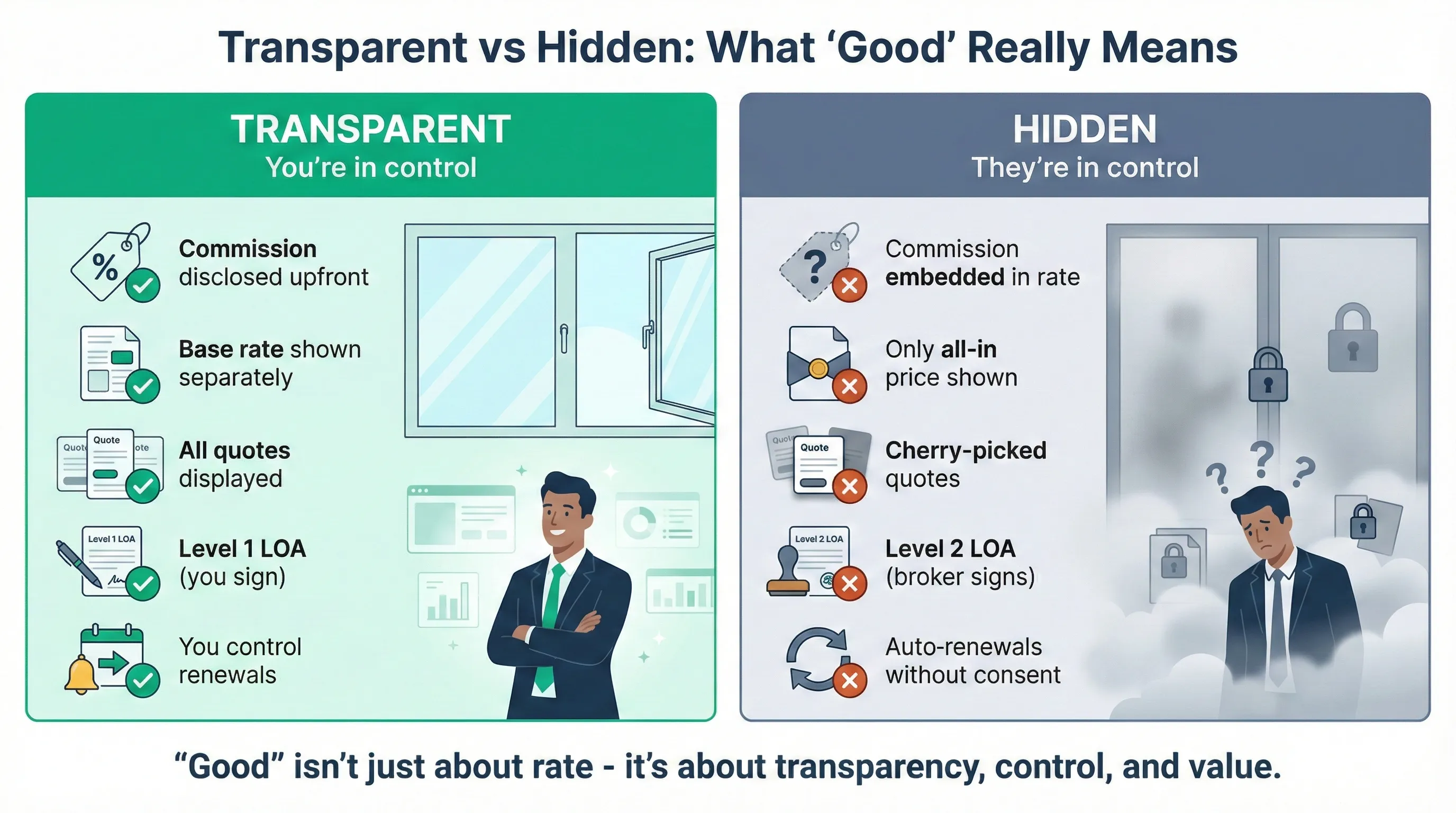
What matters is the fee and what you get for it. Ofgem’s July 2026 good-practice guidance for brokers says: “We would expect any commission or fees you get to reflect the services and benefits given to customers” (Ofgem, Setting up energy contracts: good practice (opens in new tab)). It also expects brokers to “clearly explain your commission or fee arrangements, including how much you’ll receive and how the customer pays their fees”.
Those guidelines aren’t enforceable rules yet - Ofgem says it is “getting new powers” over brokers - but they’re a good checklist for what to expect.
What to Look For
| Factor | Good practice | What to watch for |
|---|---|---|
| Fee disclosure | Fee in p/kWh told to you before you engage | Fee only found later in the contract |
| Rate visibility | Supplier’s price and broker fee shown separately | One all-in rate with no breakdown |
| Quotes shown | Every quote the broker received | Just one “recommended” option |
| Contract signing | You sign yourself (Level 1 LOA) | Broker signs for you (Level 2 LOA) |
| Renewals | You’re told before renewal and you decide | Renewal agreed on your behalf |
| Sales process | No pressure | Pressure to sign quickly |
The Level 1 vs Level 2 LOA Question
A Letter of Authority (LOA) gives a broker permission to act for you. “Level 1” and “Level 2” are industry shorthand, not legal terms, so read what yours actually allows:
Level 1 LOA (information only), usually:
- Lets the broker access your meter data and request quotes
- You sign all contracts yourself
Level 2 LOA (contract authority), usually:
- Also lets the broker agree contracts on your behalf, including renewals
- Means a new contract, with a new fee, could be agreed without you signing it
If a broker asks for contract authority, ask why they need it.
Renewals
With contract authority, a broker can renew your contract without you signing anything, so make sure you’re told before any renewal and that you agree to it. The Energy Ombudsman’s broker report (opens in new tab) for 1 December 2023 to 30 November 2024 found “88% of disputes related to sales” - see our analysis of broker complaint data.
Red Flags
A higher fee isn’t automatically wrong if you get more for it - complex multi-site buying or ongoing account management takes more work. But these are worth questioning:
| Red Flag | What It Means |
|---|---|
| ”Our service is free” | Brokers are paid - usually through your energy bill |
| Won’t tell you the fee in p/kWh | Your supplier must give it to you on request for contracts signed since 1 October 2024 |
| Only shows one or two quotes | You can’t tell whether the choice was made on price or on fee |
| Pushes for immediate signature | Pressure suggests they don’t want you shopping around |
| Asks for contract authority | Ask why they need to sign for you |
| Blend-and-extend offers | These can extend your contract and add a new fee - check both |
| Not signed the TPI Code | Check at recportal.co.uk/tpis (opens in new tab) and ask why not |
What the Energy Ombudsman found
The Energy Ombudsman’s report (opens in new tab) on the second year of its broker scheme (1 December 2023 to 30 November 2024):
- 1,819 brokers registered with the scheme
- 1,568 cases accepted (up 112%)
- 88% of disputes related to sales
- 58% of cases upheld in the consumer’s favour
For more, see our analysis of energy broker mis-selling cases.
What to Ask Your Broker
| Question | Why It Matters |
|---|---|
| ”What is your fee in p/kWh, and on the standing charge?” | Lets you work out the cost in pounds |
| ”Can I see the supplier’s price separately?” | Shows how much of your rate is the fee |
| ”Can you show me all the quotes you received?” | Shows whether you’re seeing the full picture |
| ”Have you signed the TPI Code of Practice?” | Checkable at recportal.co.uk/tpis (opens in new tab) |
| ”Which redress scheme are you in?” | Tells you where to complain if things go wrong |
| ”What will the LOA let you do?” | Data only, or contract authority? |
| ”What happens at renewal?” | Will you be asked, or will it just happen? |
Good answers: a clear fee in p/kWh, the supplier’s price shown separately, every quote shown with a reason for the recommendation, a redress scheme named, and no renewal without your say-so.
Answers to question: “our service is free”, “commission is commercially confidential”, “we only show the best quote”, “the LOA is just standard”.
The Regulatory Picture
Already in effect
- 1 October 2024: suppliers must show any broker fee in the principal terms of contracts for all business customers, in pence per kWh, and provide it on request (Ofgem (opens in new tab)).
- From December 2024: Ofgem said small businesses (not just micro businesses) would be able to take disputes about brokers to a redress scheme such as the Energy Ombudsman (opens in new tab), and that suppliers would have to “only work with Third-party Intermediaries (TPIs), often referred to as brokers, that are members of a redress scheme when securing Small Business contracts”.
- 20 July 2026: Ofgem published good-practice guidance for intermediaries (opens in new tab), including on commission and fees.
Coming next
The government has decided to make Ofgem the regulator for brokers. Its consultation outcome (opens in new tab) sets out a registration regime, with legislation to follow when parliamentary time allows. Announcing it, the government said (opens in new tab) (23 October 2025): “We will also end the wild west of ‘cowboy’ brokers charging sky-high fees for contracts handed out to companies”.
For more, see our State of Business Energy Brokers 2026 report.
How Meet George Prices Differently
You pay our fee: a flat 1p/kWh on electricity and gas, collected through the supplier - itemised, never buried. It’s the same whichever supplier you choose: no supplier pays us more than another, and there are no volume bonuses or preferred suppliers.
For a business using 25,000 kWh a year on a 3-year contract, that’s £750 in total.
| Factor | Meet George |
|---|---|
| What you pay | 1p/kWh, the same for every supplier |
| How it’s shown | As its own line on every quote |
| LOA type | Level 1 only - you sign everything |
| Quotes shown | Every quote we can get you, ranked on price |
| Renewals | You’re told and you decide |
| Sales calls | None |
| TPI Code | Signed |
We’re not the right choice for everyone. If you want someone to handle everything and manage the process for you, a traditional broker might suit you better - that service is what their fee pays for. Work through which model fits your business - broker, self-service, or direct to supplier, which is honest about the multi-site and half-hourly cases where a broker still wins.
But if you want to see exactly what you’re paying, check your bill first: upload it and Meet George tells you in seconds whether you’re in your switching window.
The Bottom Line
Broker commission is usually built into your price per kWh. Ofgem’s data shows micro-business fees averaged about 1.2p/kWh across suppliers in 2022-23 and reached about 3p/kWh at some, and individual contracts vary widely - so find your own figure in your contract’s principal terms.
“Good” isn’t just about the number:
- Transparency: do you know what you’re paying?
- Control: who signs your contracts?
- Choice: are you seeing all the options?
- Value: what do you get for the fee?
Ask the questions, check the LOA, work out the fee in pounds, and decide whether you’re getting value for it.
Sources:
- Ofgem - Non-Domestic Market Review Decision (April 2024) (opens in new tab)
- Ofgem - Draft impact assessment on non-domestic market review proposals (December 2023) (opens in new tab)
- Ofgem - Ofgem confirms greater protection for businesses (5 April 2024) (opens in new tab)
- Ofgem - Setting up energy contracts: good practice (20 July 2026) (opens in new tab)
- DESNZ - Regulating TPIs in the retail energy market: consultation outcome (opens in new tab)
- GOV.UK - Greater protection for families and businesses in energy market (23 October 2025) (opens in new tab)
- Energy Ombudsman - Report on second year of broker scheme (June 2025) (opens in new tab)
- REC Portal - TPI Code signatories (opens in new tab)
- Expert Tooling and Automation Ltd v Engie Power Ltd [2025] EWCA Civ 292 (opens in new tab)


