


The UK business energy broker market serves over 5.7 million SMEs, yet operates with minimal oversight. This report consolidates data from Companies House (opens in new tab), the Energy Ombudsman (opens in new tab), Ofgem (opens in new tab), and RECCo (opens in new tab) to provide an authoritative picture of an industry on the cusp of regulation.
This is the 2026 edition. Last verified: January 2026.
Key Findings
- 1,999 brokers were active members of the Energy Ombudsman’s broker scheme in October 2026
- Fewer than 4% (72, as of October 2026) have signed the voluntary TPI Code of Practice, three years after it launched
- Complaints surged 112% in 2024, with 88% relating to sales practices - not service delivery
- 63% of businesses that used a broker thought they weren’t charged for it (Ofgem’s 2025 survey, down from 73% in 2024)
- All five major comparison sites route business energy customers to the same underlying broker
- Ofgem’s data shows broker fees of about 3p/kWh were typical at some suppliers in 2022-23 - three times Meet George’s 1p, or £1,500/year for a 50,000 kWh business
- Ofgem regulation expected 2027 - mandatory registration with fit-and-proper-person checks
Executive Summary
The core findings:
- Market consolidation is more extreme than it appears. All five major comparison sites route to a single broker, creating an illusion of choice.
- Self-regulation has failed. Fewer than 4% of brokers had signed the voluntary transparency code by October 2026.
- Complaints are accelerating. A 112% increase in Ombudsman cases while overall energy complaints fell 24%.
- Regulation is coming. Ofgem will become the direct regulator of brokers from 2027, with mandatory registration and enforcement powers.
1. Market Structure
Market Size and Concentration
The UK business energy broker market comprises about 2,000 brokers on the Energy Ombudsman’s register (October 2026), ranging from sole traders to large corporate entities. The Energy Ombudsman’s downloadable register (opens in new tab) listed 1,999 active broker members when we checked in October 2026 - though some brokers use alternative ADR providers (the Dispute Resolution Ombudsman or Utilities Intermediaries Association).
Key structural facts:
| Metric | Value | Source |
|---|---|---|
| Active brokers on the Ombudsman register | 1,999 | Energy Ombudsman register, Oct 2026 |
| Brokers exited ADR (2023-24) | 470 | Energy Ombudsman 2025 Report |
| SME switches via brokers | ~70% | Ofgem research |
| Brokers with complaints | 25% of registered | Energy Ombudsman 2025 Report |
The 70% figure is significant: the majority of UK business energy switches flow through intermediaries rather than direct to suppliers. This makes broker conduct a systemic issue for the SME energy market.
Comparison Site Consolidation
One of the most striking findings involves the comparison site market. Our investigation into comparison site ownership revealed that all five major UK comparison brands route their business energy customers to the same underlying broker - a single large intermediary that handles business energy enquiries from across the comparison site ecosystem.
Source: Company disclosures, website footers, and partnership announcements
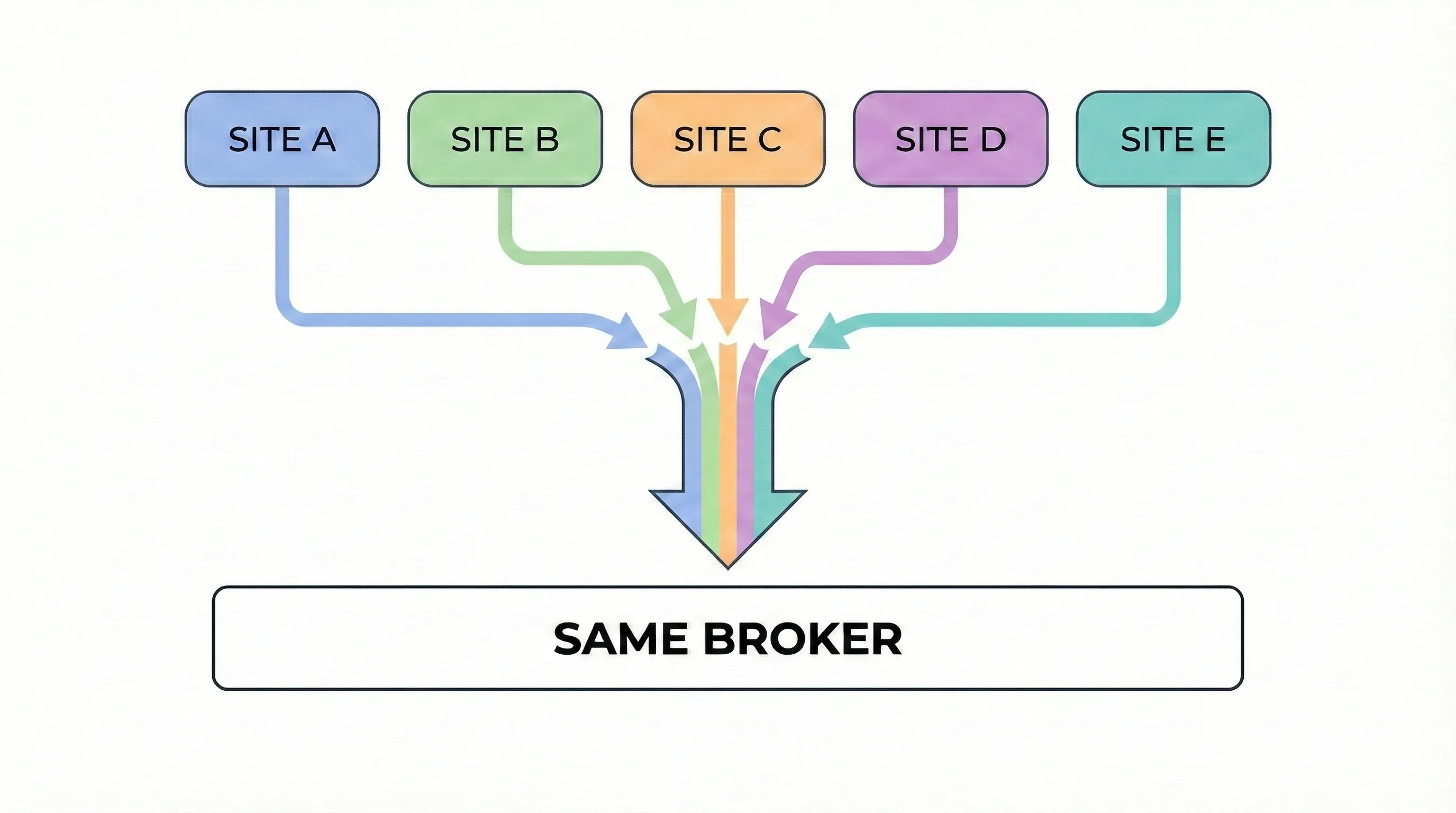
This consolidation means that when SME owners attempt to “shop around” by trying multiple comparison sites, they receive quotes from the same sales operation. The branding differs; the underlying sales operation is the same.
White-Label Networks
The comparison site pattern is replicated at smaller scale through white-label broker networks. Several large brokers power multiple websites that appear independent but route to the same backend operation.
This creates a market structure where apparent competition masks actual consolidation. Businesses believing they’re comparing different services are often simply giving the same broker multiple opportunities to close a sale.
2. Transparency Metrics
TPI Code Adoption: Fewer Than 4%
The TPI Code of Practice, administered by RECCo (the independent body that manages the industry’s Retail Energy Code), was launched in October 2023 as a voluntary transparency framework. After 20+ months:
The Code requires signatories to:
- Disclose their status as an intermediary, not the supplier
- Explain commission calculation before contract signing
- Show all quotes received, not just the recommended option
- Maintain ADR registration and a complaints procedure
- Train staff on Code requirements
These are basic professional standards. A non-adoption rate above 96% suggests most brokers prefer to avoid public transparency commitments.
Data source: REC Portal TPI Register (opens in new tab), verified January 2026
Commission Disclosure
Until October 2024, brokers had no legal obligation to disclose commissions. Ofgem’s 2025 research (opens in new tab) found that, of businesses that knew they had used a broker when switching:
- 63% thought they weren’t charged for it (73% in 2024)
- Only 21% believed they were charged
- 13% didn’t know
This perception gap enabled the undisclosed uplift model, where commissions were embedded in unit rates without customer awareness - Ofgem’s data (opens in new tab) shows about 3p/kWh was typical at some suppliers in 2022-23.
What changed in October 2024: Ofgem’s Non-Domestic Market Review required suppliers to show any broker fee in the contract’s principal terms and to provide it on request. This applies to all non-domestic contracts signed from 1 October 2024. However:
- Disclosure during the sales process is still reactive (only when requested)
- Quote comparison doesn’t show commission breakdown - you see the all-in rate
- Enforcement relies on supplier licence conditions, not direct broker regulation
Update, July 2026: Ofgem has now published good-practice guidance (opens in new tab) aimed directly at intermediaries - the first time it has addressed brokers rather than suppliers. It says Ofgem expects intermediaries to explain their commission arrangements, including how much they receive and how the customer pays, before the customer agrees to a contract. Ofgem is explicit that these are not enforceable rules and that it is still waiting on formal powers, so the gap between expectation and enforcement remains.
Information Asymmetry
The broker market is characterised by extreme information asymmetry:
| What Brokers Know | What Businesses Know |
|---|---|
| All supplier base rates | Only the all-in quote presented |
| Commission ranges by supplier | Commission amount (if they ask) |
| Credit appetite by supplier | Whether they were accepted |
| Historical switching patterns | Only their own contract history |
| Renewal timing and margins | Often nothing until auto-renewed |
This asymmetry is why businesses struggle to assess value. Without seeing the supplier’s base rate separately from the broker’s uplift, there’s no way to compare broker costs across providers.
3. Complaint Trends
2024: A 112% Surge
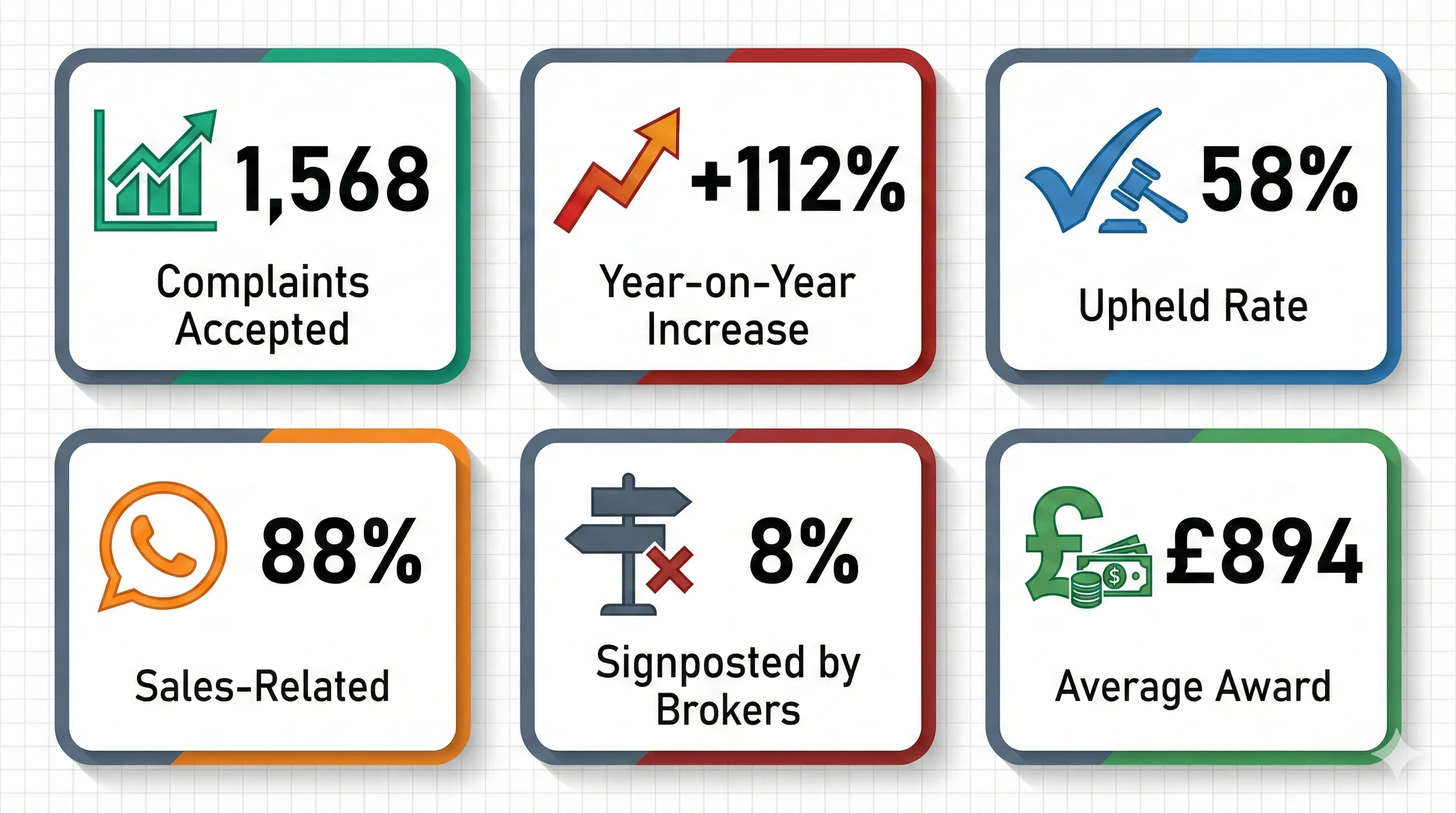
The Energy Ombudsman’s 2025 Broker Report (opens in new tab) documented a dramatic increase in broker complaints:
| Metric | 2023 | 2024 | Change |
|---|---|---|---|
| Complaints accepted | 741 | 1,568 | +112% |
| Upheld in customer’s favour | 69% | 58% | -11pp |
| Sales-related complaints | 71% | 88% | +17pp |
| Signposted by broker | 5% | 8% | +3pp |
| Remedies implemented on time | 57% | 63% | +6pp |
Source: Energy Ombudsman Broker Report 2025 (opens in new tab)
Why Complaints Surged
Three factors converged in 2024:
1. Crisis-era mis-selling catching up. During 2022-2023, brokers used the energy crisis to pressure businesses into contracts with inflated commissions. Those 2-3 year contracts have now expired. Businesses discovering what they actually paid are complaining.
2. Awareness increasing. Mandatory commission disclosure (October 2024) revealed fees that were previously undisclosed. Media coverage of broker practices - including BBC Watchdog investigations - raised the profile of the issue.
3. ADR access expanding. Since December 2024, small businesses (under 50 employees) can use the Energy Ombudsman for broker disputes. Previously, only microbusinesses qualified.
88% Are Sales-Related
The composition of complaints is telling. Nearly 9 in 10 relate to the sales process:
- Misrepresentation of rates, savings, or contract terms
- Undisclosed commissions discovered after signing
- Pressure tactics to sign immediately
- Unsuitable contracts that didn’t match business needs
- Auto-renewals without informed consent
Only 6% of complaints concern customer service. The problem is systemic to how contracts are sold, not incidental to service delivery.
Real-World Examples
The data becomes more concrete through individual cases:
Care home overcharging. Care England reported (opens in new tab) that a care home was quoted £68,126 in broker fees - reduced to £12,606 when independently reviewed. That’s an 81% markup from a broker supposedly working in the care home’s interest.
Undisclosed commission discovery. Malcolm Harrington, a B&B owner in West Sussex, told BBC Rip Off Britain (opens in new tab) about discovering undisclosed commissions: “Commission had never been mentioned. I guess they built up trust which as it turned out was betrayed.” When challenged, his broker claimed commissions “would have been revealed had Malcolm asked.” His response: “I started to get really angry because I just couldn’t see the logic behind why I as a customer should have to ask them to reveal something that was hidden.”
Ofgem’s finding. The regulator’s April 2024 Non-Domestic Market Review found that “in most cases TPI service fees are paid as part of a customer’s energy bill from their supplier”, a structure that “has led to some customers being unaware that they are paying a separate fee to the TPI and how much.”
These aren’t edge cases. The 88% sales-related complaint figure suggests they represent a pattern.
The Signposting Failure
When complaints aren’t resolved within 8 weeks, brokers should signpost customers to the Ombudsman. In 2024, only 8% did so.
This means 92% of businesses who reached the Ombudsman found it themselves. The Ombudsman has stated they handle “less than a third of the disputes that we should” - suggesting actual grievances could be 3x higher than recorded complaints.
Financial Outcomes
When complaints are upheld:
- Average financial award: £894
- 58% uphold rate (down from 69% in 2023, but still majority)
- Only 63% of remedies implemented on time
The remedy compliance figure is concerning. More than a third of businesses who won their case faced delays getting what they were awarded. Mid-2024 saw compliance fall to just 27% before recovering to 80% after Ombudsman intervention.
4. Cost Analysis
Understanding Broker Commission
Broker commissions are typically structured as pence-per-kilowatt-hour (p/kWh) added to the supplier’s base rate. This means the total cost depends on your energy consumption - higher usage means higher absolute commission, though the per-unit rate may be lower.
What Ofgem’s supplier data shows: in its December 2023 draft impact assessment (opens in new tab), Ofgem charted each supplier’s typical (median) broker fee for contracts between 1 September 2022 and 31 August 2023. Read from its charts:
| Business size (Ofgem band) | Average across suppliers | Highest supplier |
|---|---|---|
| Micro business - electricity | About 1.2p/kWh | About 3p/kWh |
| Larger electricity users (100 MWh a year and up) | About 0.7p-0.9p/kWh | About 2p-2.5p/kWh |
So broker fees of about 3p/kWh were typical at some suppliers - three times Meet George’s 1p - and individual contracts can be higher.
During the crisis, when unit rates spiked to 40-50p/kWh, a 5p uplift was less noticeable as a percentage. Now that prices have stabilised around 20-25p/kWh, the same uplift represents a larger proportion of the total bill.
Public Data: What Companies House Reveals
UK company law requires limited companies to file accounts with Companies House (opens in new tab). These public filings provide one of the few windows into broker economics.
For example, public filings from the UK’s largest business energy broker (by customer numbers) reveal the following workforce composition:
| Metric | Value |
|---|---|
| Total staff | 512 |
| Sales staff | 288 (56%) |
| IT staff | 93 (18%) |
| Operations | 71 (14%) |
| Administration | 60 (12%) |
Source: Companies House (opens in new tab) public filing, FY2025
This workforce composition - with more than half dedicated to sales - reflects the phone-based, relationship-driven nature of traditional broker services.
This structure isn’t inherently problematic. Many businesses value the personal service, expert guidance, and hand-holding that broker sales teams provide - particularly when navigating complex contracts or multi-site portfolios. The cost structure reflects the service model.
The question for each business is whether that service model matches their needs and whether they’re getting value for the commission paid.
The Traditional Model
The traditional broker model involves:
- Sales teams for outbound calling and relationship management
- Account managers for ongoing customer support
- Operations staff for contract processing and supplier liaison
- Compliance infrastructure for regulatory requirements
This human-intensive approach has costs that must be recovered through commission. For businesses that want guidance through the switching process, this can represent good value. For businesses that prefer self-service, alternative models are emerging.
5. Regulatory Timeline
The regulatory landscape for energy brokers is changing rapidly. Here’s the current timeline:
Already in Effect
Coming Next
What Regulation Will Include
The Government’s consultation response on TPI regulation (opens in new tab) confirmed Ofgem will gain:
- Mandatory registration for all TPIs
- Fit-and-proper-person tests for directors
- Conduct standards with enforcement powers
- Investigation authority for complaints
- Market removal powers for bad actors
Ed Miliband, Energy Secretary, was direct about the intent: to “end the wild west of ‘cowboy’ brokers charging sky-high fees.”
The TPI Code’s Future
RECCo has proposed making the TPI Code mandatory (opens in new tab) for all TPIs working with non-domestic suppliers. This would complement Ofgem’s broader regulatory framework, creating a dual system of industry code compliance and regulatory oversight.
Brokers who’ve already signed the voluntary Code are positioning themselves for the regulatory future. The more than 96% who haven’t may face a steeper compliance curve.
6. What This Means for Businesses
The Problem Summary
UK businesses face a broker market characterised by:
- Apparent choice, actual consolidation - Multiple brands, same underlying service
- Undisclosed costs - Commissions embedded in rates, not shown separately
- Low transparency adoption - Only 2% committed to voluntary standards
- Rising complaints - 112% increase, with 88% about sales practices
- Weak enforcement - Only 63% of remedies implemented on time
- Delayed regulation - Direct oversight not expected until 2027
What You Can Do Now
Before switching:
-
Ask for commission disclosure in writing. Since October 2024, your supplier must show the broker’s fee in your contract and give it to you on request. Get the p/kWh rate and total £ value.
-
Check TPI Code status. Visit the REC Portal (opens in new tab) to verify your broker’s commitment to transparency standards.
-
Request all quotes received. Code signatories must show every supplier quote, not just their recommendation.
-
Understand the Letter of Authority. Know whether you’re signing a Level 1 (data access) or Level 2 (contract authority) LOA.
If things go wrong:
-
Document everything. Keep contracts, emails, and notes on verbal promises.
-
Complain formally. Write to your broker - this starts the 8-week clock.
-
Escalate to the Ombudsman. After 8 weeks (or a deadlock letter), contact energyombudsman.org (opens in new tab).
-
Know your eligibility. Since December 2024, businesses under 50 employees can use the Ombudsman for broker disputes.
Questions to Ask Any Broker
| Question | Why It Matters |
|---|---|
| ”What is your commission rate in p/kWh?” | Forces specific disclosure |
| ”Have you signed the TPI Code?” | Tests transparency commitment |
| ”Can I see all supplier quotes you received?” | Reveals cherry-picking |
| ”What happens at renewal?” | Exposes auto-renewal practices |
| ”Will you ever sign contracts on my behalf?” | Clarifies LOA type |
The Alternative Landscape
For businesses seeking alternatives to the traditional broker model, three options exist:
| Factor | Traditional Broker | Self-Service Platform | Direct to Supplier |
|---|---|---|---|
| Commission | Built into your rate - about 3p/kWh typical at some suppliers (Ofgem, 2022-23) | Shown separately (Meet George: 1p/kWh) | None |
| Getting quotes | Online or phone | Online, instant | Contact each supplier individually |
| Completing the switch | Phone calls, paperwork, broker-assisted | Online, self-service | Phone/email with supplier |
| Market comparison | Yes (broker’s panel) | Yes (platform’s panel) | No - single supplier only |
| Time required | Low - broker handles process | Medium - you review and decide | High - multiple calls/forms |
| Transparency | Variable (check TPI Code status) | Typically high | N/A |
| Contract signing | Often via Level 2 LOA (broker signs) | You sign directly | You sign directly |
| Best for | Complex needs, multi-site, prefer phone | Tech-comfortable, want control | Large businesses with buying power |
TPI Code signatories represent the more transparent end of traditional brokers - committed to disclosure standards, though still a small pool (72 as of October 2026).
The market is evolving. Regulation, technology, and increased awareness are creating pressure for change. Businesses that understand the current landscape can make better decisions while waiting for systemic improvements.
Methodology and Sources
This report consolidates data from:
Primary Sources
- Energy Ombudsman ADR Register (opens in new tab) - Live register of ADR-registered brokers (1,999 active members when checked in October 2026)
- Energy Ombudsman Broker Report 2025 (opens in new tab) - Complaints data December 2023 to November 2024
- REC Portal TPI Register (opens in new tab) - TPI Code signatory list, verified January 2026
- Ofgem Non-Domestic Market Review (opens in new tab) - Regulatory decisions and research data
- DESNZ TPI Regulation Consultation (opens in new tab) - Government policy direction
- Companies House (opens in new tab) - Public filings for UK limited companies
Secondary Analysis
- Comparison site ownership via company disclosures and website footers
- Industry estimates for total broker numbers (no single official register exists)
- Commission ranges from Ombudsman case studies and industry sources
Limitations
- No single official register of all UK energy brokers exists; our figure is the Energy Ombudsman’s count of active broker members (1,999 in October 2026), which excludes brokers using alternative ADR providers (DRO, UIA)
- Complaint data likely understates actual grievances due to low signposting rates
- Self-reported TPI Code compliance; no independent verification of ongoing adherence
- Commission range data is based on Ombudsman cases and industry sources, not comprehensive market data
Related Reading:
- What is a Good Energy Broker Commission Rate? - Deep dive into broker cost structures
- Fewer Than 4% of Brokers Have Signed the TPI Code - Analysis of voluntary transparency adoption
- Energy Broker Complaints Up 112% - Full breakdown of Ombudsman data
- Ofgem’s 2026 Roadmap - Detailed regulatory timeline
Sources:
- Energy Ombudsman - ADR Register (Live Data) (opens in new tab)
- Energy Ombudsman - Broker Report 2025 (opens in new tab)
- REC Portal - TPI Code Signatories (opens in new tab)
- Ofgem - Non-Domestic Market Review (opens in new tab)
- Ofgem - TPI Programme (opens in new tab)
- DESNZ - TPI Regulation Consultation (opens in new tab)
- Energy Consultants Association - 2025 Ombudsman Report Analysis (opens in new tab)
- Companies House (opens in new tab)


