

TL;DR: Key Takeaways
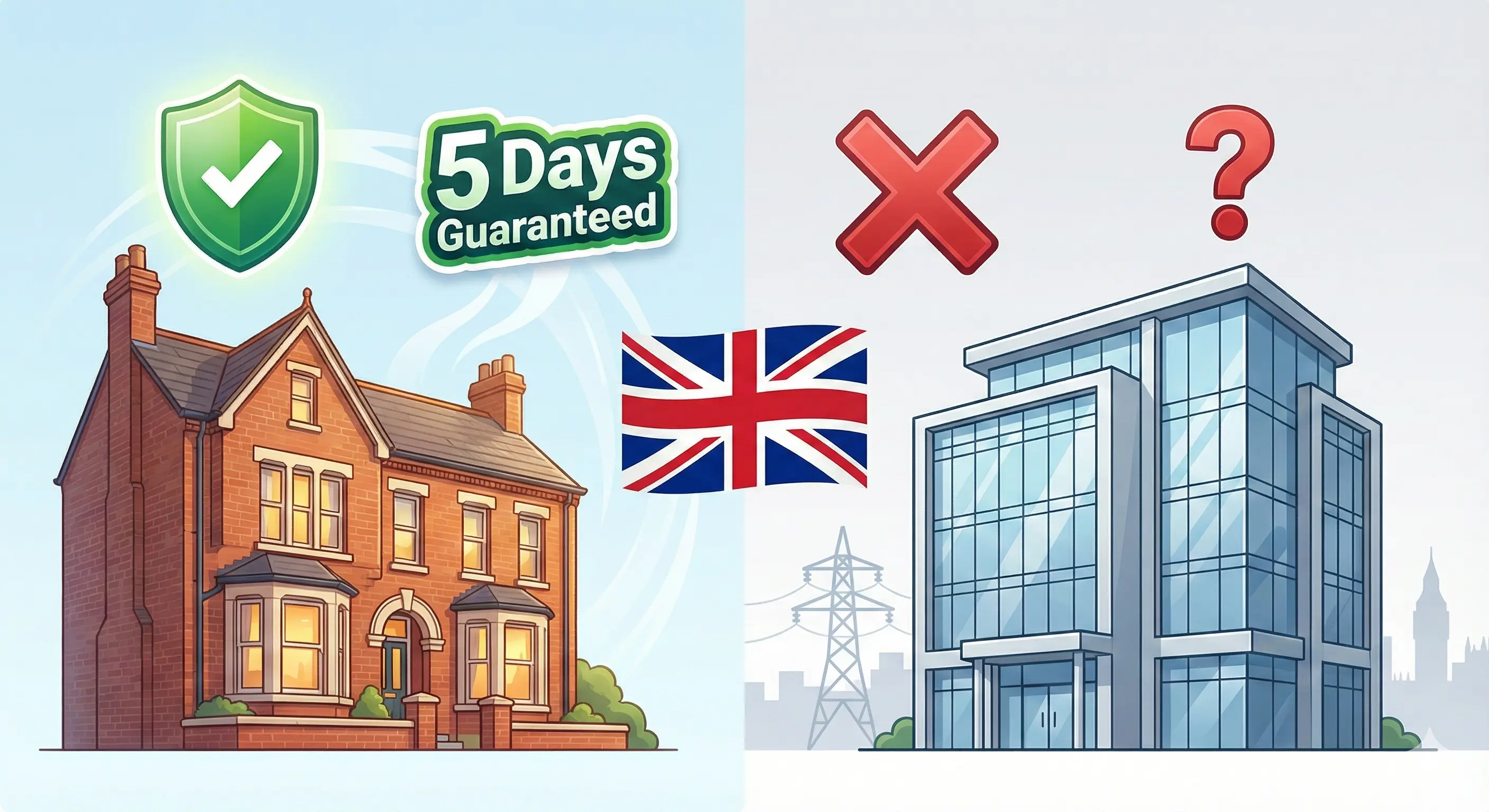
The Energy Switch Guarantee doesn’t cover businesses. It’s a voluntary scheme for domestic households only - promising switches within 5 working days, final bills within 6 weeks, and credit refunds within 10 days. None of these protections apply to UK business energy customers.
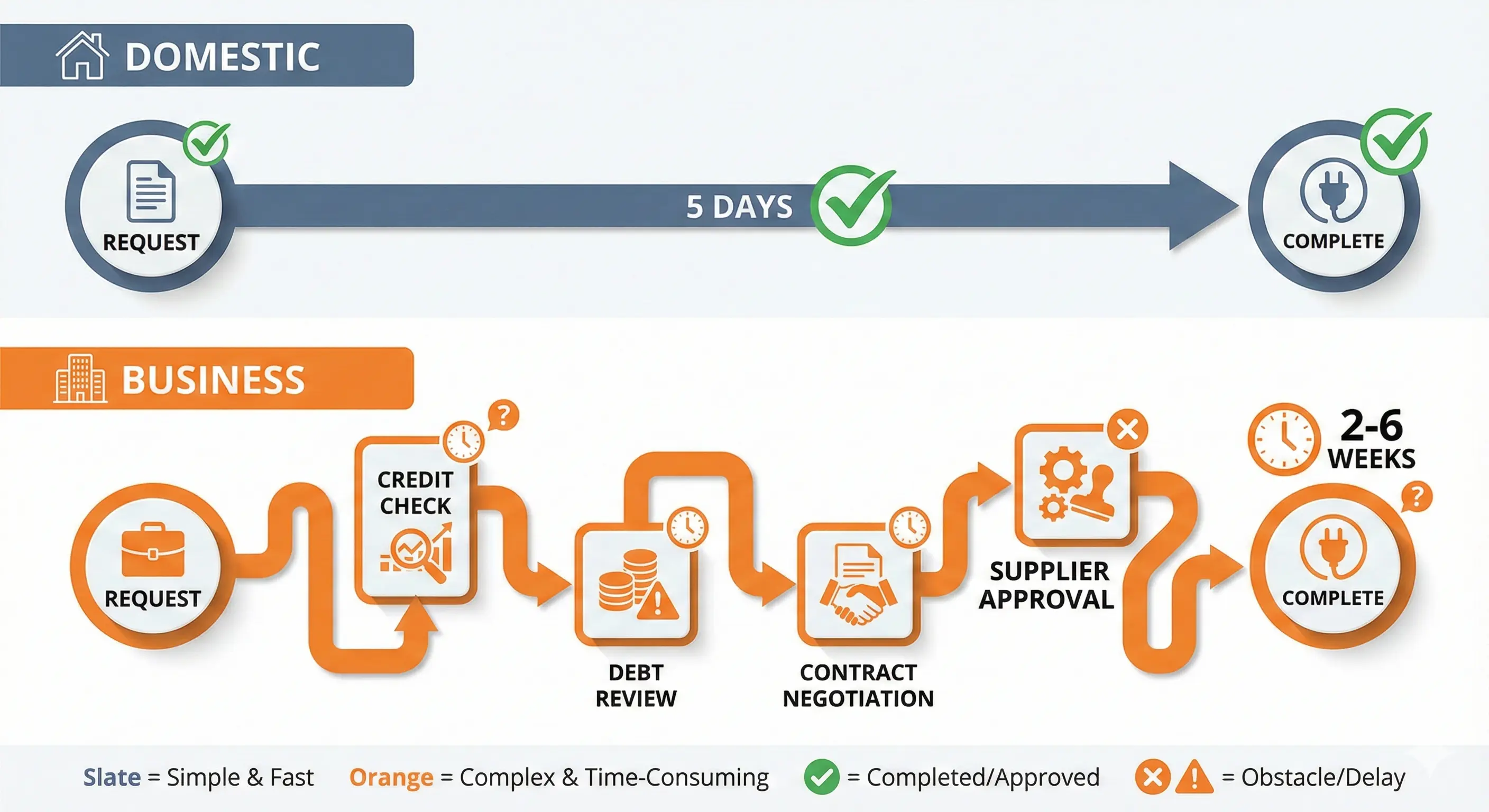
Business switches take longer. Without guaranteed timelines, business energy switches typically take 2-6 weeks. Factors like outstanding debt, meter complexity, and supplier processes can extend this further.
You can be blocked from switching. If your business has outstanding debt that’s been owed for more than 28 days, suppliers can object to your switch - trapping you on expensive rates until the debt is cleared.
Renewal windows are critical. Most business contracts require advance notice before switching. Miss this window and you risk auto-renewal or rolling onto deemed rates that are 40-60% higher than fixed-term contracts.
What Is the Energy Switch Guarantee?
The Energy Switch Guarantee is a voluntary promise, run by the trade body Energy UK, that switching energy tariff or supplier will be quick and simple: switches within five working days, with the new supplier handling the move. It only covers households - Energy UK says it “applies to any domestic household in Britain” switching with a supplier that has signed up - so it does not apply to business energy.
Under the Energy Switch Guarantee (opens in new tab), signatory suppliers commit that:
- Customers can switch tariff within five working days, whether changing supplier or tariff with the same supplier
- The supplier you are moving to handles the whole transfer
- If you change your mind within 14 days, you stay with your existing supplier or tariff
- Any credit due is refunded within 14 days of your final bill
Energy UK checks members against targets each quarter, including at least 98% of switches between suppliers completed within five working days and at least 90% of final bills issued within six weeks. In January to March 2026, signatories completed 99.63% of switches to a new supplier within five working days. The signatories include British Gas, E.ON Next, EDF Energy, Octopus Energy, OVO Energy and ScottishPower, but “not all suppliers are members”.
According to the Energy Switch Guarantee Good Practice Guide 2024-25 (opens in new tab), signatories achieved 99.73% of inter-supplier switches within 5 working days in 2024.
But here’s the critical point: it explicitly covers “domestic household” customers only.
If you’re a business - whether you’re a sole trader, a 5-person office, or a 500-employee enterprise - the Energy Switch Guarantee does not apply to you. Business switches follow your contract’s terms instead, so the first thing to check is whether you’re in your switching window: upload your latest bill and Meet George’s free bill check tells you, and what to do next.
Why Doesn’t It Cover Businesses?
Business energy operates in a fundamentally different market:
1. Credit Risk Changes Everything
Domestic customers are individuals. Suppliers can’t easily refuse to supply a home.
Businesses are different. Suppliers run credit checks on every business customer. A company with poor credit history, CCJs, or limited trading history can be rejected outright - or offered significantly worse rates. This is why some businesses face security deposit requirements before suppliers will accept them.
This credit assessment process takes time and adds complexity that doesn’t exist in domestic switching.
2. Contracts Are Negotiated, Not Standardised
Domestic energy tariffs are largely standardised. You pick a rate, and that’s what you pay.
Business contracts are negotiated. Unit rates, standing charges, contract lengths, pass-through clauses, and termination terms can all vary. This negotiation process - especially when a broker is involved - adds time and complexity.
3. Multi-Site Complexity
Many businesses have multiple meters across multiple sites. Each meter has its own MPAN (for electricity) or MPRN (for gas). Switching 50 meters is inherently more complex than switching one home - and there’s no standardised timeline for it.
4. No Regulatory Mandate
The Energy Switch Guarantee is voluntary. There’s no law requiring suppliers to offer it to anyone. Domestic suppliers participate because of consumer pressure and Ofgem scrutiny.
Business energy faces less public scrutiny, so suppliers have little incentive to extend these protections voluntarily.
What Protections DO Businesses Have?
While there’s no “Business Energy Switch Guarantee,” you’re not entirely without protection:
Micro-Business Rights
If your business qualifies as a microbusiness (fewer than 10 employees AND annual turnover/balance sheet under €2 million), you have additional protections under Ofgem’s regulations (opens in new tab):
- Principal Terms disclosure - suppliers must provide key contract information upfront
- Broker commission disclosure - since October 2024, commission must be disclosed in your contract
- Access to the Energy Ombudsman - you can escalate complaints after 8 weeks
- Renewal notifications - suppliers must contact you at least 90 days before your contract ends (opens in new tab)
- Guaranteed Standards of Performance (opens in new tab) - for network-related issues (not supplier switching)
General Consumer Protection
All businesses are protected by the Business Protection from Misleading Marketing Regulations 2008. Despite this, broker complaints to the Energy Ombudsman rose 112% in 2024 - showing enforcement gaps remain. Brokers and suppliers cannot:
- Make false claims about savings
- Use high-pressure sales tactics
- Hide material terms in contracts
Ofgem’s TPI Programme
Ofgem’s Third Party Intermediaries (TPI) programme (opens in new tab) sets standards for energy brokers, including dispute resolution requirements. The government is also consulting on mandatory broker regulation which may strengthen protections in future.
The Real Risks for Business Switchers
Without the protections domestic customers enjoy, businesses face several risks:
1. Debt-Related Objections
Key point: If your business has outstanding debt that’s been owed for more than 28 days, your current supplier can object to your switch (opens in new tab).
Unlike domestic customers (who have more protections under the Energy Switch Guarantee), businesses can be trapped until debts are cleared. This is particularly painful if you’re already on expensive deemed rates and desperately need to escape to a cheaper deal.
If your supplier objects to your switch, they must tell you the reason. You can then take action (such as clearing the debt) and ask them to remove the objection.
2. No Final Bill Guarantees
Domestic customers get final bills within 6 weeks (90% of the time under the ESG). Businesses have no such guarantee.
Final bills can take significantly longer for business customers, and disputes over final charges or credits are harder to resolve without the structured timelines the ESG provides to households.
3. Missed Renewal Windows
Business contracts typically require advance notice before you can switch without penalty. The exact notice period depends on your specific contract and supplier:
- Micro-businesses: Suppliers must contact you at least 90 days before your contract ends (Ofgem requirement)
- Larger businesses: Notice periods vary - check your contract terms
- Switching window: You can typically switch without exit fees in the last 49 days of your contract
According to British Gas (opens in new tab), they send renewal deals 60 days before contract end. EDF contacts small businesses (opens in new tab) 90 days before, and larger businesses up to 200 days ahead.
Miss your window and you risk:
- Auto-renewal on new (often worse) terms
- Deemed rates - typically 40-60% higher than fixed rates
For more on how renewal traps work, read our guide on the digital renewal trap.
4. No Cooling-Off Period (Usually)
Domestic customers get 14 days to change their mind under the ESG. Most business contracts? Once you sign, you’re committed.
Some micro-business contracts include cooling-off periods, but it’s not guaranteed. Always check the termination terms before signing. If you need to exit early, read can I cancel my business energy contract?
How to Protect Your Business When Switching
Without a formal guarantee, you need to protect yourself:
1. Know Your Renewal Date
Set a reminder 90 days before your contract ends. This gives you the maximum window to compare deals and switch.
Check your current contract for the exact notice period required - it’s often buried in the terms and conditions.
2. Clear Outstanding Debt
If you have any outstanding debt with your current supplier, prioritise clearing it before your renewal window opens. Being blocked from switching due to a debt objection is one of the worst positions to be in - you’re stuck on expensive rates with no escape route.
3. Get Everything in Writing
Before switching, confirm in writing:
- The exact unit rate and standing charge
- Contract start and end dates
- Any broker commission being added to your rate
- What happens if you want to cancel (exit fees)
- The expected switch timeline
4. Don’t Sign Under Pressure
Brokers often push for quick decisions. “This rate expires today!” is usually a sales tactic - good brokers don’t operate this way.
Take your time. Compare multiple quotes. Use a platform that shows you transparent pricing rather than embedding fees in your unit rate.
5. Gather Your Meter Information
Have your MPAN (electricity) or MPRN (gas) ready - you’ll find these on your bill. This speeds up the quoting process and ensures suppliers give you accurate pricing.
6. Use Self-Service Where Possible
Traditional broker-led switches add time and opacity. Self-service platforms like Meet George (now in private beta) let you compare, decide, and sign entirely online - reducing delays and eliminating undisclosed broker fees.
For the complete process, see our 5-step guide to switching business energy.
The Future: Will Businesses Get a Switch Guarantee?
There’s no imminent plan for a “Business Energy Switch Guarantee,” but the regulatory direction is positive:
- Ofgem’s TPI programme is pushing for better broker standards
- Government consultation on regulating Third Party Intermediaries is ongoing
- Commission disclosure rules (from October 2024) are increasing transparency for micro-businesses
- Market-Wide Half-Hourly Settlement (MHHS) is modernising the energy market infrastructure
The domestic Energy Switch Guarantee took years to develop through industry cooperation. Businesses may eventually get similar protections - but for now, the responsibility falls on you to protect your own interests.
Summary: The Bottom Line
In short: The Energy Switch Guarantee is a genuine consumer protection - but it’s exclusively for households, not businesses. UK businesses have no equivalent protection guaranteeing switch timelines, final bill deadlines, or credit refunds.
As a UK business, you face:
- No guaranteed switch timelines (expect 2-6 weeks, not 5 days)
- Debt objections if you have outstanding balances for more than 28 days
- No final bill guarantees (timelines are unpredictable)
- Critical renewal windows that, if missed, cost thousands in deemed rate premiums
The best protection? Be proactive. Know your contract dates, clear debts early, compare multiple quotes, check for undisclosed broker commissions, and don’t sign anything under pressure.
Meet George is in private beta now, making this process faster and more transparent - but even so, the responsibility for timing and preparation remains with you.
Ready to switch? Read our complete 5-step switching guide or explore our business energy glossary to decode the jargon. Need to understand your current deal first? Learn about standing charges, deemed rates, and Letters of Authority.


