

TL;DR: Key Takeaways
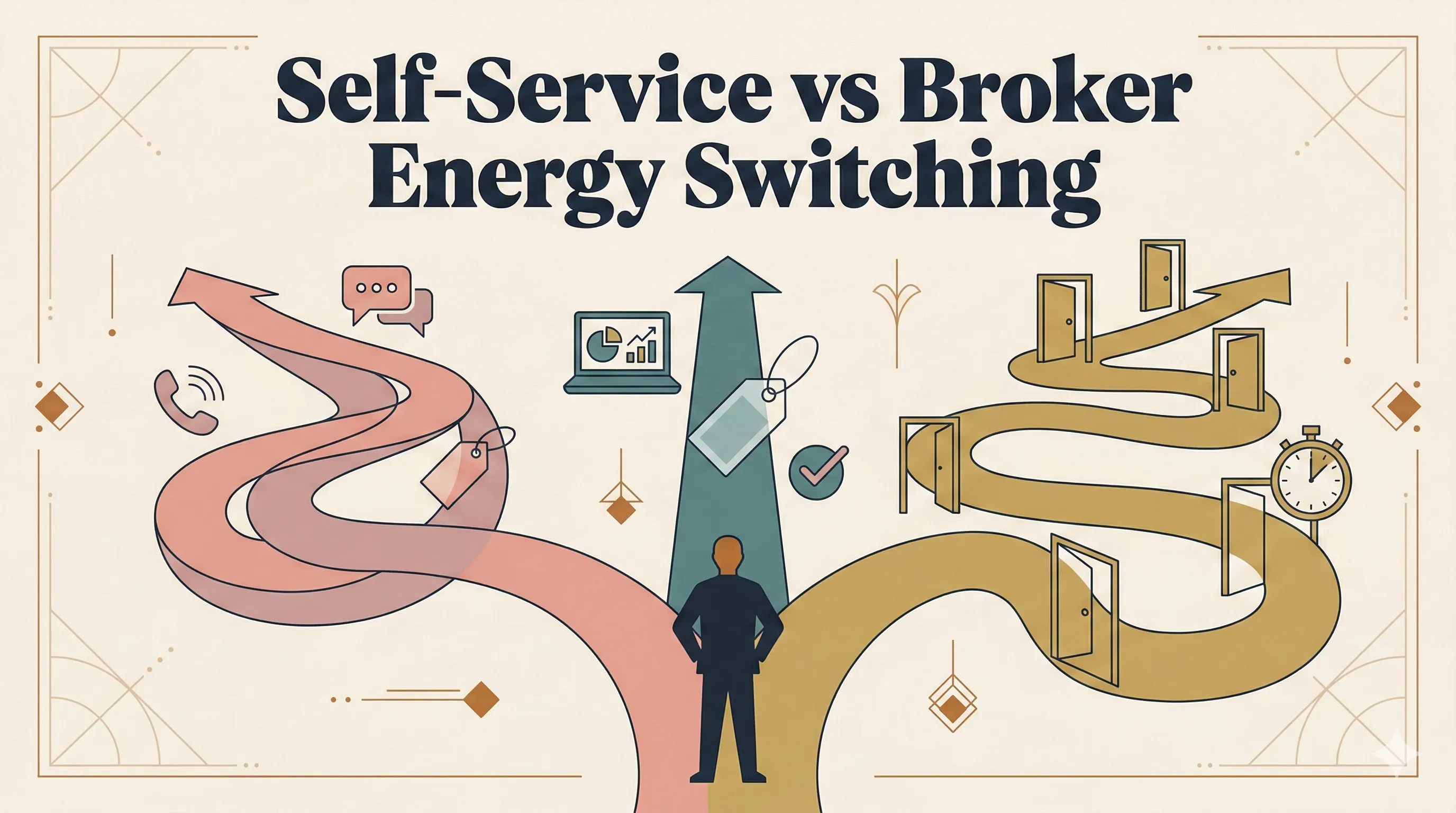
Self-service business energy switching is a model where businesses compare and switch energy suppliers online - without a broker intermediary, without phone calls, and with transparent fees shown upfront.
- Brokers work well for complex multi-site portfolios, half-hourly metered premises, and businesses that prefer phone guidance. Commission is embedded in your unit rate - Ofgem’s data shows about 3p/kWh was typical at some suppliers in 2022-23.
- Self-service platforms are faster, cheaper, and more transparent for straightforward single-site switches. Fees are typically shown separately from supplier rates (e.g. 1p/kWh).
- Going direct to suppliers is free but time-consuming - you’ll need to call 5-10 suppliers individually.
- 40% of UK businesses have never switched energy (Ofgem (opens in new tab)). Both models aim to make switching easier - they just take different approaches.
Neither model is universally better. This guide helps you decide which suits your business.
Why 40% of UK Businesses Have Never Switched
Before comparing the two models, it’s worth understanding why so many businesses don’t switch at all.
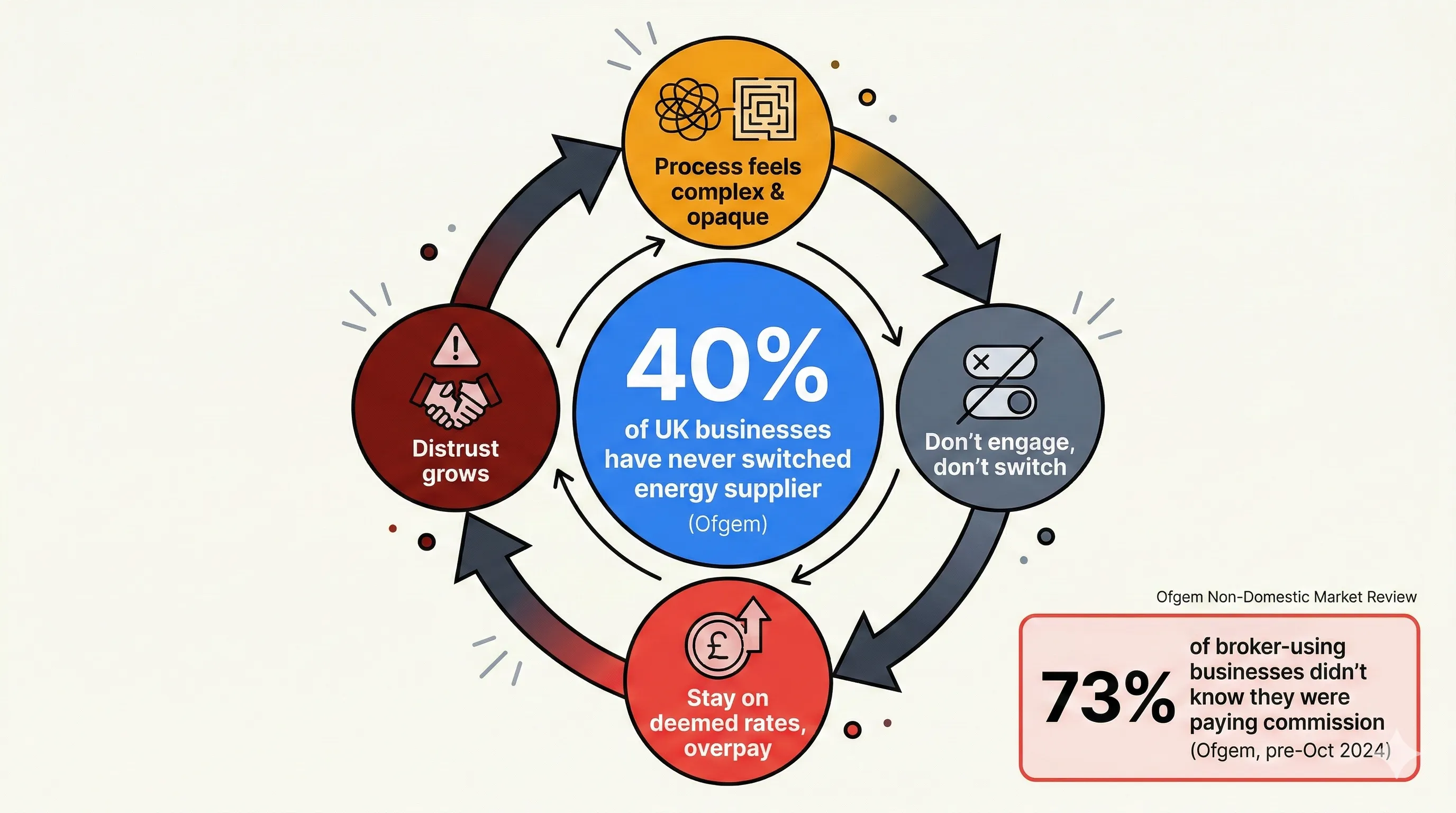
Ofgem’s non-domestic market review (opens in new tab) found that the UK business energy market suffers from low engagement: around 40% of businesses have never actively switched supplier. Those that don’t switch often end up on deemed rates - expensive out-of-contract prices - or get rolled over onto a new contract by their existing supplier that’s less competitive than what they’d get by shopping around. Either way, they pay significantly more than they need to.
The reasons are consistent: the process feels complex, time-consuming, and opaque. Brokers dominate the market (handling roughly 70% of SME switches, according to Ofgem), and 73% of businesses using brokers didn’t know they were paying commission (opens in new tab). Ofgem’s October 2024 disclosure rules now require brokers to include commission in the contract, but that still relies on the business owner reading and understanding the contract paperwork - so awareness remains a work in progress.
This creates a cycle. Businesses that don’t trust the process don’t engage. Businesses that don’t engage overpay. Overpaying - and the feeling of being taken advantage of - deepens distrust in the sector. And the complexity of the market feels so overwhelming that most businesses just stay where they are, paying whatever they’re charged.
Both broker-assisted and self-service switching aim to break this cycle - they just take fundamentally different approaches to the same problem.
Three Routes to Switching: A Quick Overview
Broker-assisted switching is where a Third Party Intermediary (TPI) - commonly called an energy broker - handles the switching process on your behalf, typically via phone, for an embedded commission.
Self-service switching is where you use a digital platform to compare suppliers and switch online, without phone calls, with fees shown separately from the supplier’s rate.
Direct-to-supplier switching is where you contact energy suppliers individually, request quotes, and manage the switch yourself - no intermediary, no fee.
Each has trade-offs. The rest of this guide breaks them down honestly.
How Broker-Assisted Switching Works
The traditional broker model follows this process:
-
You share your details. Either by calling a broker, filling in a form on a comparison site, or responding to an outbound sales call. You provide your MPAN, business details, and current contract information.
-
The broker accesses your data. Using a Letter of Authority (LOA), the broker retrieves your consumption data from industry databases and requests quotes from their supplier panel.
-
A salesperson presents options. Typically by phone. They walk you through 2-5 quotes, explain the differences, and recommend one. This call usually takes 15-30 minutes.
-
You agree - verbally or by signing a contract. Some brokers take verbal agreement over the phone, others send you a contract to sign. Either way, the broker then submits the contract to the supplier and manages the changeover. Some brokers also manage ongoing renewals.
What Brokers Charge
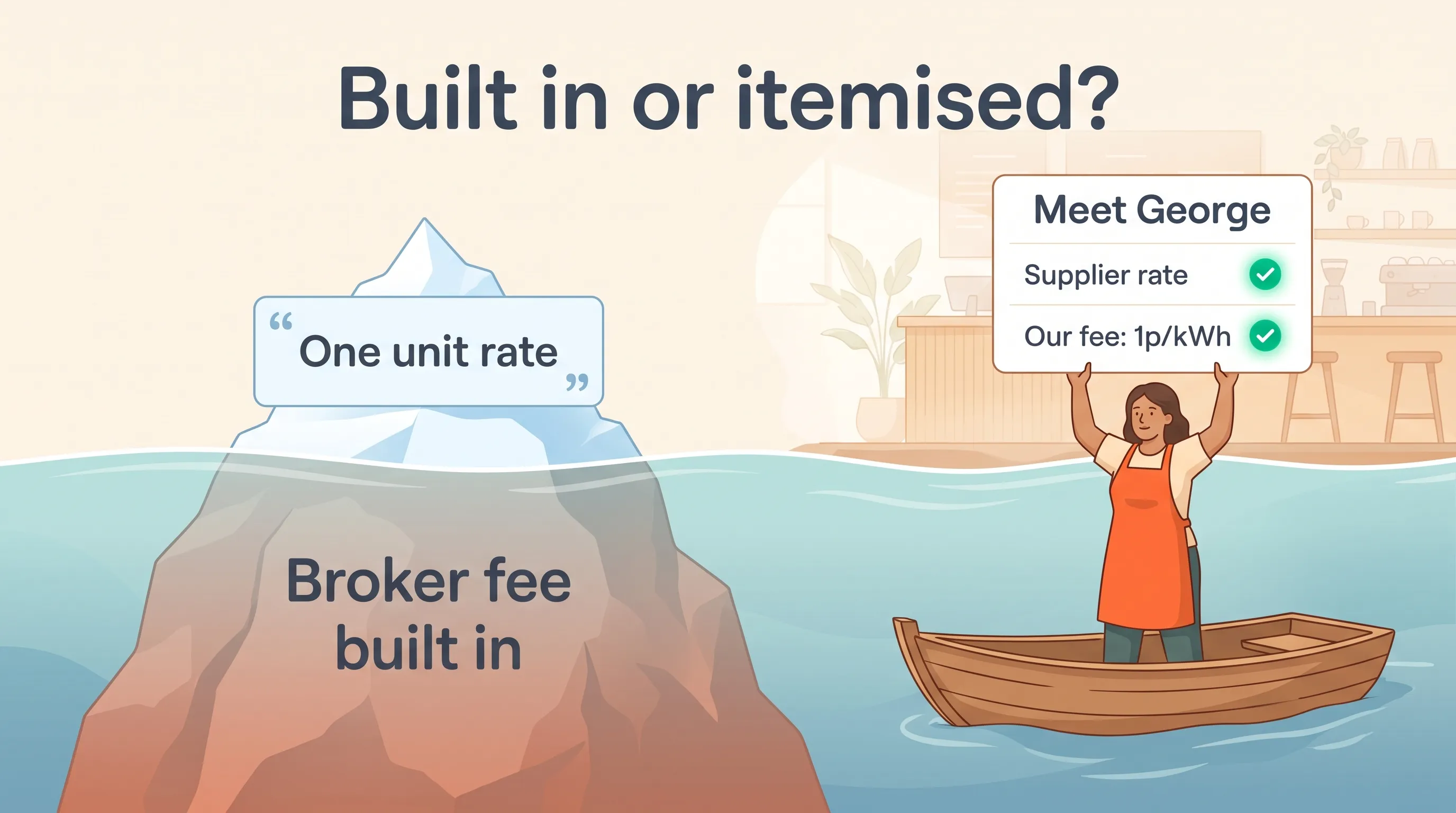
Broker fees are typically embedded in your unit rate as an “uplift” - an amount added on top of the supplier’s base rate. You see one combined rate, not the breakdown.
Ofgem’s data (opens in new tab) shows broker fees of about 3p/kWh were typical at some suppliers in 2022-23 - three times Meet George’s 1p. Broker fees vary, so here is what different rates cost a business using 25,000 kWh per year:
| Commission rate | Annual cost to you | Over a 3-year contract |
|---|---|---|
| 1p/kWh | £250 | £750 |
| 2p/kWh | £500 | £1,500 |
| 3p/kWh | £750 | £2,250 |
| 4p/kWh | £1,000 | £3,000 |
These rates are illustrative. Individual broker rates vary - Ofgem’s data shows larger users’ broker fees averaged under 1p/kWh, while in the Court of Appeal case Expert Tooling v Engie (2025) (opens in new tab), 5.6p of a 17.82p/kWh day rate was the broker’s commission.
Since October 2024, Ofgem’s supplier licence conditions (opens in new tab) have required the broker’s commission to be set out in the contract’s principal terms and disclosed on request, for all non-domestic customers. In practice that means brokers have had to declare their commission so it can appear in the contract - so commission on new contracts is no longer hidden.
Two gaps remain. The enforceable duty sits with the supplier, not the broker: Ofgem has said it does not yet hold direct regulatory powers over intermediaries. And the disclosure lands at contract stage rather than when you’re comparing quotes, so you may not know the commission until after you’ve invested time in the process.
In July 2026 Ofgem published good-practice guidance (opens in new tab) addressed to intermediaries themselves, saying it expects them to explain their commission before the customer agrees to a contract. Ofgem states plainly that this is not an enforceable rule - but it is the direction of travel.
For a deeper breakdown, see our complete guide to broker commission rates.
Why Broker Commission Exists
It’s worth understanding why brokers charge what they charge. This isn’t about greed - it’s about cost structure.
Phone-based energy broking is expensive to run. A typical broker operation needs:
- Sales teams. Trained advisors who understand business energy contracts, supplier panels, and customer needs. Salaries, training, management.
- Call centre infrastructure. Telephony, CRM systems, call recording for compliance.
- Office overhead. Many brokers operate large call centres - that means rent, utilities, equipment.
- Supplier relationship management. Maintaining and negotiating access to multiple supplier pricing panels.
- Compliance costs. Since October 2024, commission disclosure is mandatory. Upcoming government regulation (opens in new tab) will add further compliance requirements including mandatory broker registration.
- Debt servicing. Some larger brokers carry significant debt from acquisition-led growth, which must be serviced from operating revenue.
All of these costs get recovered through the commission embedded in your rate. A broker charging 2p/kWh isn’t pocketing 2p - they’re covering the cost of the infrastructure that makes phone-based switching possible.
This is important context because it explains why self-service platforms can charge less. It’s not that brokers are overcharging - it’s that their model has structurally higher fixed costs.
The White-Label Model
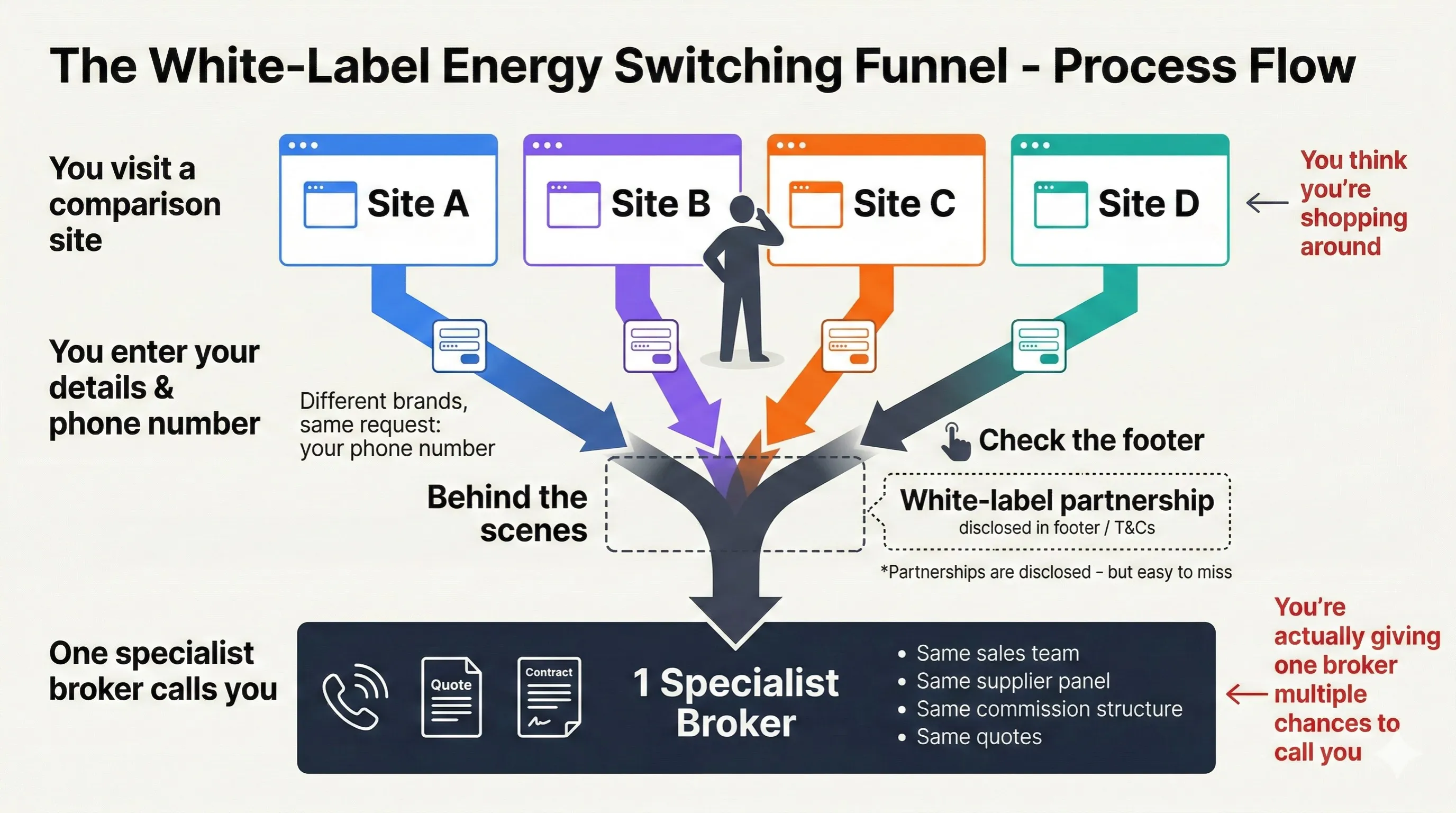
Something most SME owners don’t realise: many of the UK’s well-known comparison sites don’t actually operate their own business energy switching service. Instead, they partner with specialist brokers through white-label arrangements.
Here’s how white-label energy switching typically works:
- You visit a comparison site and enter your business details
- Instead of seeing instant online quotes, you’re asked for your phone number
- A specialist broker’s sales team calls you - not the comparison site’s own staff
- The broker handles everything: quotes, sales call, contract, switching
The comparison site provides the brand and the web traffic. The broker provides the infrastructure, supplier relationships, and sales team. The broker typically pays the comparison site a fee for each lead generated.
You can verify this yourself. Check the website footer or terms and conditions of any major comparison site’s business energy page. Most disclose the partnership - often in small text that’s easy to miss.
Why does this matter? Because if you try multiple comparison sites thinking you’re casting a wide net, you may actually be giving the same underlying broker multiple chances to contact you. The branding differs, but the underlying service - including commission structure and sales process - can be identical.
This isn’t deceptive (the partnerships are disclosed if you look), but it means “shopping around” across comparison sites is often less useful than most business owners assume.
The LOA Question
When you engage a broker, you’ll sign a Letter of Authority. There are two types, and the difference matters:
-
Level 1 LOA: Authorises the broker to access your energy data only. They can see your meter details, consumption, and current tariff. They cannot act on your behalf.
-
Level 2 LOA: Authorises the broker to negotiate and sign contracts on your behalf. This is what enables auto-renewal - where a broker renews your contract without you actively agreeing each time.
Level 2 LOAs have attracted significant regulatory attention. The Energy Ombudsman’s 2024 annual report (opens in new tab) showed broker complaints rose 112% year-on-year to 1,568 complaints, with 88% being sales-related. The average compensation award was £894. Many complaints involved businesses being renewed into contracts they didn’t actively choose.
The key question to ask any broker: “Does this LOA allow you to renew my contract without my signature?” If the answer is yes, you’re signing a Level 2 LOA - and you should understand exactly what authority you’re granting before you sign it.
The Industry Track Record
To put the broker model in context, here are the official numbers:
- About 2,000 active brokers on the Energy Ombudsman broker register (opens in new tab))
- Only 72 (fewer than 4%) had signed the voluntary TPI Code of Practice as of October 2026 - see our detailed analysis
- 1,568 complaints to the Energy Ombudsman in 2024 - up 112% from 2023, with 58% upheld (Energy Ombudsman annual report (opens in new tab))
- 73% of broker-using businesses didn’t know they were paying commission before Ofgem’s October 2024 disclosure rules (Ofgem NDMR (opens in new tab))
- The Expert Tooling v Engie Court of Appeal case (2024) revealed undisclosed broker uplifts of 5p/kWh and established that 80% of broker commission is typically paid upfront by suppliers - see our mis-selling cases analysis
These are industry-wide statistics, not representative of all brokers. Many brokers operate transparently and provide genuine value. But the data explains why regulatory reform is underway.
Can You Switch Business Energy Without a Broker?
Yes - and more businesses are doing so. There are two broker-free routes:
Going Direct to Suppliers
The simplest approach: call energy suppliers individually, request quotes, and compare them yourself.
Pros:
- No broker commission at all - you get the supplier’s base rate
- Direct relationship with the supplier
- Full control over every decision
Cons:
- Time-consuming. You need to call 5-10 suppliers to get a representative market view
- Requires energy market knowledge to compare contracts properly
- No guidance on contract clauses, pass-through charges, or volume tolerances
- No single view of the market - you’re comparing quotes received at different times, in different formats
This works for businesses with time, energy market expertise, and the patience to manage the process. For most time-pressed SME owners, it’s not practical - which is partly why 40% have never switched at all.
Using Meet George, a Self-Service Platform
Self-service platforms automate what you’d do manually. Meet George is one example: you upload your bill, AI reads the key figures off it, the platform retrieves your data, fetches quotes from multiple suppliers, and lets you compare and switch online - without phone calls.
Instead of embedding commission in your unit rate, Meet George charges a transparent 1p/kWh fee shown separately from the supplier’s rate. You see exactly what you’re paying for energy and what you’re paying for the service.
Pros:
- Transparent pricing - you see the 1p/kWh fee separately from the supplier’s rate
- No phone calls - compare and switch at your own pace
- AI-powered contract analysis flags red flags that human sales teams might not mention (because mentioning them could kill the sale)
- Faster - no waiting for callback slots, no 20-minute sales calls
- You remain in control - no Level 2 LOA, no auto-renewal
Cons:
- Less hand-holding. If you want someone to walk you through every option on the phone, this isn’t the model for you
- Newer category - fewer established platforms with long track records
- May not handle complex multi-site portfolios as well as experienced brokers (yet)
- No face-to-face relationship
What Self-Service Looks Like in Practice
To make this concrete: Dream Looks Boutique, a fashion boutique in Marylebone, had been on deemed rates for two years without realising it. Their standing charge was 79% above the current market rate. Through analysis and switching, they saved 46% on their annual energy costs - £3,936 over a 3-year contract.
That is one business. For the market-wide picture, our guide to how much a business actually saves by switching works the numbers for all three starting positions - around 40.8% off deemed rates, 27.4% off a rolled-over contract, and 15% off a sub-optimal fixed deal - so you can estimate your own before you pick a switching route.
This isn’t an attack on brokers - it’s a structural observation. A broker earns commission when you switch. That means their revenue depends on generating switches. There’s no commission in telling you your current contract is already competitive. There’s no commission in flagging that your standing charge is inflated but the unit rate is fine. And there’s no commission in advising you to wait three months because wholesale prices are trending down. The best brokers build long-term relationships through trust and honest advice - but the short-term incentive structure rewards activity over patience.
The Fair Comparison
Here’s an honest side-by-side of all three models:
| Factor | Broker-Assisted | Meet George (Self-Service) | Direct to Supplier |
|---|---|---|---|
| How you get quotes | Phone call with sales advisor | Upload your bill online | Call each supplier individually |
| Time to compare | 15-30 min phone call + callbacks | 5-10 minutes online | 2-4 hours (calling multiple suppliers) |
| Fee model | Commission embedded in unit rate (about 3p/kWh typical at some suppliers, Ofgem 2022-23) | Transparent 1p/kWh fee shown separately | No fee |
| Fee visibility | Disclosed in contract only (since Oct 2024) | Visible before you commit | N/A - no fee |
| Human guidance | Yes - trained advisor | AI guidance + self-service tools | Supplier’s sales team only |
| Contract review | Advisor explains key terms (incentivised to close) | AI flags risks (no sales incentive) | You review it yourself |
| Auto-renewal risk | Possible - depends on LOA type signed | No - you control every renewal | No - direct with supplier |
| Complex multi-site | Strong | Developing | Very time-consuming |
| Availability | Business hours (typically 9-5 Mon-Fri) | 24/7 | Business hours |
| Supplier access | Broker’s panel (may be limited) | Supplier-agnostic - best offer wins | Any supplier you contact |
| Market view | Limited to broker’s panel | Multiple suppliers compared side-by-side | Fragmented - different quotes at different times |
Cost Comparison on a Typical Switch
For a business using 25,000 kWh per year on a 3-year fixed-term contract:
| Broker (2p/kWh) | Broker (4p/kWh) | Meet George (1p/kWh) | Direct to supplier | |
|---|---|---|---|---|
| Annual fee cost | £500 | £1,000 | £250 | £0 |
| 3-year total fee | £1,500 | £3,000 | £750 | £0 |
| Fee visible upfront? | No (until contract) | No (until contract) | Yes | N/A |
| Your time investment | Low (broker handles it) | Low | Low-medium | High (hours of calls) |
| 3-year difference vs Meet George | +£750 | +£2,250 | - | -£750 (but hours of your time) |
The commission range matters significantly. A broker charging 1p/kWh costs the same as a typical self-service platform. A broker charging 4p/kWh costs four times as much. The problem is that you typically don’t know the broker’s commission rate until you’re already deep in the process.
Going direct saves the most money but costs the most time. For a business owner billing their time at £50-100/hour, 3-4 hours of supplier calls costs £150-400 in opportunity cost - at which point Meet George’s 1p/kWh fee (£250/year on a 25,000 kWh business, for example) starts looking like good value for doing the comparison in minutes instead of hours.
When Brokers Are the Better Choice
This isn’t a “brokers bad, self-service good” article. Brokers genuinely add value in specific situations:
Complex Multi-Site Portfolios
If your business has 5+ sites with different contract end dates, different meter types (half-hourly and non-half-hourly), and different consumption profiles, a good broker can coordinate the entire portfolio. They’ll stagger renewals, consolidate where possible, and manage the supplier relationships across sites.
Self-service platforms are getting better at this, but multi-site portfolio management is still where experienced brokers have a genuine edge.
Half-Hourly Metered Premises
Businesses with HH meters (typically those using 100,000+ kWh/year) often get bespoke pricing rather than standard matrix rates. Meet George can handle the switching side of this, but businesses at this scale typically have the physical space and consumption volume to benefit from energy efficiency measures - solar, battery storage, demand-side response - that go beyond just switching supplier. This is where specialist brokers and energy consultants can add genuine value, advising on the full picture rather than just the tariff.
Specialist Sectors
Businesses with unusual consumption patterns - manufacturers running 24/7, cold storage facilities, data centres - benefit from brokers who understand sector-specific contract considerations. Volume tolerance clauses, maximum import capacity charges, and reactive power charges all need specialist knowledge.
You Prefer Phone-Based Guidance
Some business owners want to talk through their options with a person. That’s completely valid. A good broker can explain the trade-offs between contract lengths, fixed vs flexible pricing, and supplier reliability in a way that builds confidence. Self-service platforms like Meet George can provide the same guidance through AI-powered analysis - but if you specifically want a human voice on the phone walking you through it, the broker model is built for that.
The Caveat
In all these cases, the broker should earn their commission through genuine expertise. Before committing, ask:
- Are they a TPI Code of Practice signatory? (Fewer than 4% of brokers were, as of October 2026)
- Will they disclose commission before you commit - not just at contract stage?
- Is this a Level 1 or Level 2 LOA?
- Do they show quotes from all suppliers on their panel, or just those paying highest commission?
If a broker can’t or won’t answer these questions, that tells you something.
When Self-Service Is the Better Choice
Self-service switching works best when:
Straightforward Single-Site Switches
If you have one site, a standard meter, and you want a fixed-rate contract - you don’t need a 20-minute phone call. You need to compare rates, check the contract terms, and switch. Meet George does this in minutes. And while single-site switches are the sweet spot today, the platform is actively expanding to handle increasingly complex switching scenarios.
You’re Cost-Conscious
The maths is simple. If a broker charges 3p/kWh and a self-service platform charges 1p/kWh, you save 2p/kWh - that’s £500/year on a 25,000 kWh contract, or £1,500 over three years. For a small business, that’s meaningful.
You Want Transparency
Self-service platforms that show their fee separately from the supplier rate let you see exactly what you’re paying for the service and what you’re paying for energy. With broker-embedded commission, these are blended into one number.
Since October 2024, brokers must disclose commission in contracts. But the disclosure comes after you’ve spent time on calls and invested in the process. Self-service transparency comes first.
You Don’t Want Sales Pressure
Broker sales teams are incentivised to close deals. That’s not a criticism - it’s how commission-based sales works. But it means the person advising you has a financial interest in you signing today rather than thinking about it.
Meet George has no sales team. Nobody is incentivised to push you towards a particular supplier or contract length. You compare at your own pace. And because Meet George charges a flat 1p/kWh regardless of which supplier you choose, the platform is genuinely supplier-agnostic - the supplier with the most compatible offer wins, not the one that pays the highest commission or offers the best payment terms to us.
You’re Concerned About Auto-Renewal
If you’ve been auto-renewed into a contract you didn’t actively choose, or you’ve heard stories about it, self-service switching removes that risk entirely. You control every decision. Nobody signs anything on your behalf.
Five Questions to Ask Any Switching Service
Whether you choose broker-assisted, self-service, or direct - ask these questions before committing:
1. “What exactly will this cost me?”
For brokers: “What is your commission per kWh, and is it fixed for the contract term?” For platforms: “What is your fee, and is it shown separately from the supplier rate?” For direct: “Is this the supplier’s base rate with no intermediary markup?“
2. “What authority am I granting you?”
Understand whether you’re signing a Level 1 or Level 2 LOA. If Level 2, understand the auto-renewal implications. If going direct or using self-service, confirm you’re not granting any third-party authority over your contract.
3. “Do I see all available suppliers?”
Some brokers only show quotes from suppliers where they’ve agreed an incentivised commission structure - and those suppliers may not offer the best price or the best fit for your business. This is sometimes called “panel bias.” Ask whether their panel includes all major suppliers or a subset, and whether commission rates vary by supplier (which could influence which quotes they recommend). Meet George is supplier-agnostic - the same 1p/kWh applies regardless of supplier. Going direct gives you access to any supplier, but you have to call each one.
4. “What happens at renewal?”
Will you be contacted with options before your contract ends? Will someone auto-renew on your behalf? What’s the renewal window - how far in advance should you start looking? If nobody contacts you and your contract expires, you’ll fall onto deemed rates - which are almost always significantly more expensive.
5. “Can I see the full contract before committing?”
You should always be able to review the full contract terms - including pass-through clauses, termination fees, and volume tolerances - before signing. Our contract red flags guide covers the seven most common traps to look for.
The Regulatory Landscape Is Changing
The UK business energy broker market is undergoing significant regulatory reform that affects both models:
Already in force:
- October 2024: Ofgem’s non-domestic market review (opens in new tab) made commission disclosure mandatory in all broker-assisted contracts.
- December 2024: Small businesses (under 50 employees or £6.5m turnover) gained access to the Energy Ombudsman (opens in new tab) for broker complaints - previously limited to microbusinesses.
Coming soon:
- 2025-2027: The UK government has proposed mandatory TPI registration (opens in new tab), giving Ofgem powers to register brokers, set conduct standards, investigate complaints, and remove bad actors from the market. This would be the first time brokers face direct statutory regulation.
- TPI Code of Practice: RECCo’s voluntary code (opens in new tab) may become the baseline for mandatory standards. As of October 2026, only 72 brokers had signed.
These changes should improve standards across the industry. Self-service platforms will also fall under TPI regulation - transparency and consumer protection requirements will apply to all intermediaries, not just traditional brokers.
For a detailed timeline of all upcoming changes, see our state of business energy brokers 2026 report.
The Decision Framework
Still not sure? This matrix scores each model across the factors that matter most. Rate your priorities, then match them to the strongest model.
| Factor | Broker | Self-Service | Direct to Supplier |
|---|---|---|---|
| Single-site, standard meter | Overkill | Best fit | Good if you have time |
| Multi-site portfolio (5+ sites) | Best fit | Developing | Very time-consuming |
| Half-hourly metered / bespoke pricing | Best fit | Limited | Possible but hard to negotiate |
| Specialist sector (manufacturing, cold storage) | Strong | Limited | You need deep expertise |
| Cost-conscious (lowest fees) | Varies - about 3p/kWh typical at some suppliers | Mid-range (e.g. 1p/kWh) | Free |
| Time-poor | Low effort | Low effort | High effort (hours of calls) |
| Wants transparency on fees | Disclosed at contract stage | Visible upfront | N/A |
| Comfortable with digital tools | Not required | Required | Not required |
| Wants phone guidance | Yes | No | Supplier sales teams only |
| Concerned about auto-renewal | Risk if Level 2 LOA | No risk | No risk |
In short:
- Broker if your switch is complex (multi-site, HH metered, specialist sector) and the expertise justifies the commission
- Self-service if your switch is straightforward and you value transparency, speed, and control
- Direct if you have the time and knowledge to manage the process yourself
The Bottom Line
There’s no single right answer. The right switching method depends on your business complexity, time availability, and how much you value transparency vs hand-holding.
What matters is that you switch informed - understanding what you’re paying, who’s acting on your behalf, and what authority you’ve granted. 40% of UK businesses have never switched at all. Whether you use a broker, a self-service platform, or go direct, doing something is almost always better than doing nothing.
The worst outcome isn’t choosing the wrong switching method. It’s staying on deemed rates or silently rolling onto an uncompetitive contract because the process felt too complicated to start. Right now, 45% of UK microbusinesses are on default tariffs, paying up to 101% more per kWh than they need to.* Whether you use a broker, Meet George, or go direct - the first step is checking what you’re currently paying.
*45% of microbusinesses (fewer than 10 employees or under 100,000 kWh/year) are on default tariffs. Sources: Ofgem 2024 non-domestic market review (opens in new tab), DESNZ quarterly energy prices (opens in new tab).
Want to try self-service switching? See how we’re paid - our 1p/kWh fee is itemised on every quote, never buried in your unit rate. No phone calls, no auto-renewal. Check if you can switch: upload your latest bill and George tells you in seconds whether you’re in your switching window.
Still researching? Start with how much you could actually save by switching, then read our guides to how broker commissions work, what to look for in energy contracts, or how to switch business energy step by step.


