


TL;DR: Key Takeaways
The renewal wave is here. Many UK business energy contracts signed during the 2022-23 crisis have ended or are ending. If you signed a 3-year deal at the peak, it ended in late 2025 or early 2026.
Prices have eased, but not back to “normal”. DESNZ figures show the average price businesses paid for electricity peaked at 28.39p/kWh at the end of 2023 and was 24.51p/kWh in April to June 2026 - still well above the 14.81p/kWh of early 2021.
When you fix matters. Business energy prices have been very volatile since 2021. A fixed contract locks your price for its term, so a swing in the market reaches you at renewal - which is why your renewal date is when you’re most exposed.
The biggest risk is doing nothing. If your contract ends and you don’t act, you’re moved onto your supplier’s deemed or out-of-contract rate - usually far more expensive than a fixed deal. Learn how to switch.
The Four-Phase Energy Crisis Cycle
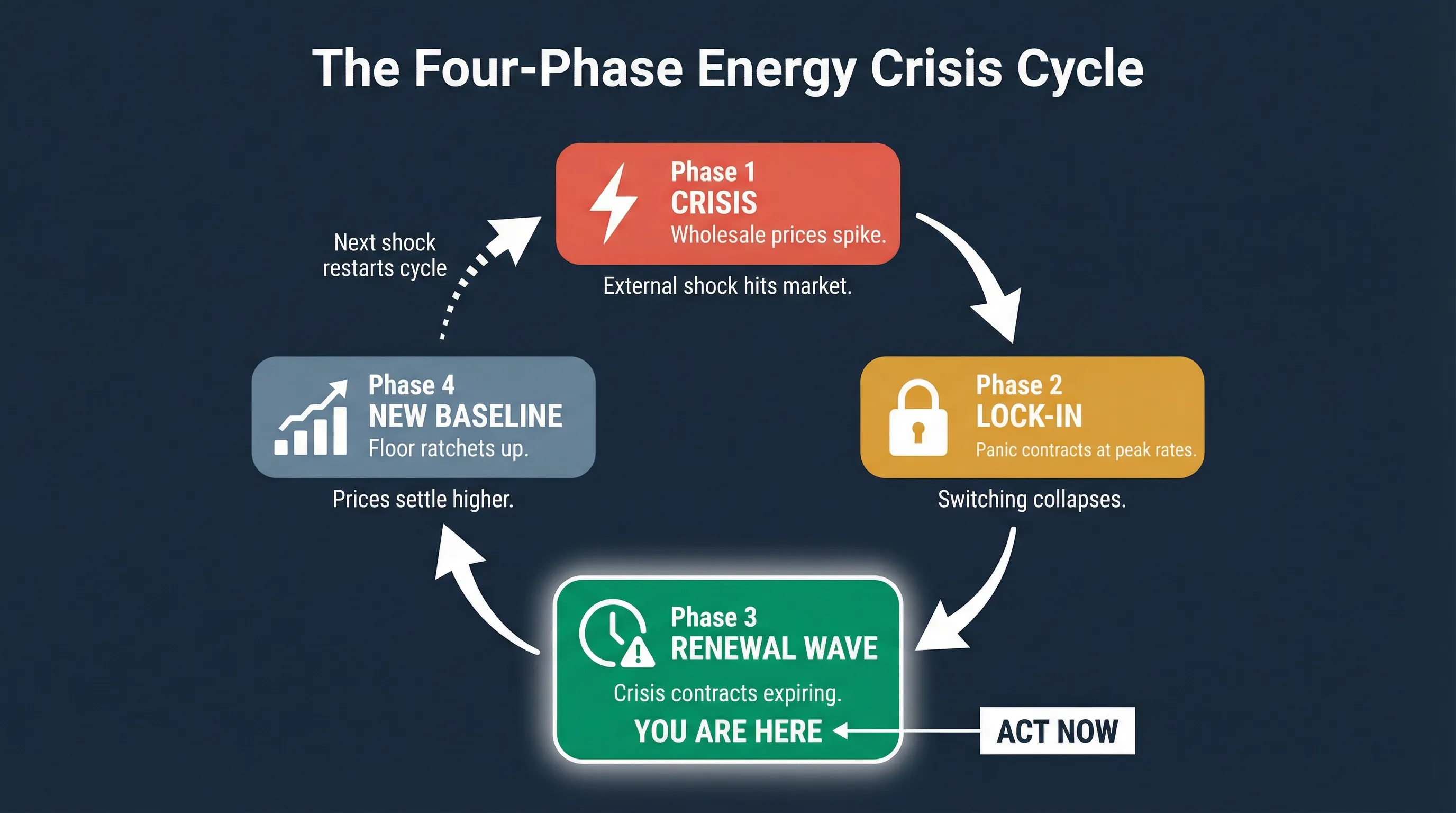
In our view, the 2022 energy crisis followed a pattern worth understanding, because it tells you where we are now and what to do about it. We think of it in four phases:
- Crisis - An external shock (geopolitical conflict, supply disruption, extreme weather) causes wholesale energy prices to spike.
- Lock-in - Some businesses sign contracts at high prices; others delay and end up on expensive default rates.
- Renewal wave - 12-36 months later, those contracts end and businesses face a renewal decision.
- New baseline - Prices settle, but so far at a higher level than before the shock.
For contracts signed in 2022-23, we are in Phase 3. Those contracts are ending, and businesses that compare now can avoid rolling onto default rates.
What Happened in 2022-2023 (And Why It Matters Now)
Business energy prices rose sharply through 2022 and 2023. DESNZ’s figures for the average price businesses paid show electricity going from 13.58p/kWh in April to June 2021 to 25.37p/kWh in January to March 2023, and gas from 2.59p/kWh to 7.18p/kWh over the same period (see the full series below). Businesses renewing then faced a hard choice:
Some fixed. They locked into 1, 2 or 3-year contracts at the prices of the time, prioritising certainty.
Some waited. Others let contracts lapse and were moved onto deemed or out-of-contract rates, which were also high.
Both groups are now at the same point: a renewal decision in a market where prices have eased from their peak.
The Expiration Timeline
The different contract lengths mean contracts signed in the crisis end at different times:
| Contract Signed | Length | Expires | Status |
|---|---|---|---|
| Q4 2022 | 12 months | Q4 2023 | Already renewed (into a still-elevated market) |
| Q4 2022 - Q1 2023 | 24 months | Q4 2024 - Q1 2025 | Ended |
| Q4 2022 - Q1 2023 | 36 months | Q4 2025 - Q1 2026 | Ending now |
How much you can save depends on the rate you fixed at and what you can get now. As a rule of thumb, every 1p/kWh on 25,000 kWh a year is worth £250. For a fuller picture by starting position - deemed rates, rollovers and fixed deals - see what a typical business saves by switching, which works through DESNZ size-band pricing.
Current Market Rates: What You Can Expect
The price you’re offered depends on your size, region, meter, usage and when you ask, so there is no single market rate. The best public benchmark is DESNZ’s quarterly figures for what businesses actually pay: in April to June 2026, 24.51p/kWh for electricity across all businesses and 38.36p/kWh for the smallest users (up to 20,000 kWh a year), including standing charges and the Climate Change Levy but not VAT (DESNZ (opens in new tab)). A competitive fixed quote should come in below the average for your size, which includes businesses on expensive default rates.
Why Prices Haven’t Gone Back to 2021 Levels
Your bill isn’t just the cost of the energy itself. Alongside the wholesale price, it pays for non-commodity charges - network costs, policy levies and taxes - which don’t fall when wholesale prices do. They include:
- Network charges (DUoS, TNUoS) - which pay for the electricity networks, including grid upgrades
- Policy costs and taxes (CCL, the Renewables Obligation, Contracts for Difference)
- New infrastructure costs - including the nuclear RAB levy
How quickly that changes depends on how fast the UK reduces its reliance on gas for setting electricity prices - through renewables, storage, nuclear and demand-side flexibility. Waiting for prices to “go back to normal” is not a plan for a contract ending now.
RAB and TNUoS Charges: Ask How Each Quote Handles Them
Two non-commodity costs are worth asking about when you compare renewal quotes: the nuclear RAB levy, which helps fund new nuclear power stations, starting with Sizewell C, and TNUoS, the transmission network charge set by NESO.
Suppliers don’t all handle them the same way. A quote can include them in the unit rate or standing charge, show them as separate line items, or allow increases to be passed through during the contract. A headline rate that leaves them out can look cheaper and end up costing more, so ask every supplier how its quote treats RAB and TNUoS, and whether either can change before your contract ends.
How Volatile Are UK Business Energy Prices?
Very volatile in recent years: DESNZ figures show the average price UK businesses paid for electricity roughly doubled between mid-2021 and the end of 2023, and gas nearly tripled, before both eased back. Business prices are still well above where they were before the crisis, so when you fix your contract matters as much as which supplier you choose.
Here is how the average price businesses actually paid has moved, including standing charges and the Climate Change Levy but not VAT:
| Quarter | Electricity (all businesses) | Gas (all businesses) |
|---|---|---|
| April to June 2021 | 13.58p/kWh | 2.59p/kWh |
| October to December 2022 | 24.80p/kWh | 6.03p/kWh |
| January to March 2023 | 25.37p/kWh | 7.18p/kWh (peak) |
| October to December 2023 | 28.39p/kWh (peak) | 6.40p/kWh |
| April to June 2026 | 24.51p/kWh | 5.28p/kWh |
DESNZ table 3.4.2, average across all business sizes, published 29 September 2026 (GOV.UK (opens in new tab)).
On those figures, the average electricity price rose about 109% from mid-2021 to its peak at the end of 2023, and is still about 80% above mid-2021. Gas rose about 177% to its peak in early 2023, and is about 104% above mid-2021. Smaller businesses pay more per kWh than these averages: the latest figure for the smallest electricity users is 38.36p/kWh.
The average moves more slowly than the wholesale market because it blends contracts agreed at different times, which is likely why business electricity peaked in late 2023, well after the 2022 spike in wholesale prices. What that means for you:
- A fixed contract locks your price for its term. Ofgem notes that fixed-rate contracts “fix the price of unit rates and standing charges for the length of the contract” (Ofgem (opens in new tab)), so a swing in the market only reaches you at renewal.
- Out-of-contract and deemed rates follow the market and are usually far higher than a fixed deal (what they cost).
- Your renewal date is your exposure. Get quotes well before your contract ends, so you are not forced to fix in a spike.
Want to know when your contract ends and how your price compares with today’s averages? Upload your latest bill to Meet George’s free bill check.
What Happens When Your Business Energy Contract Ends
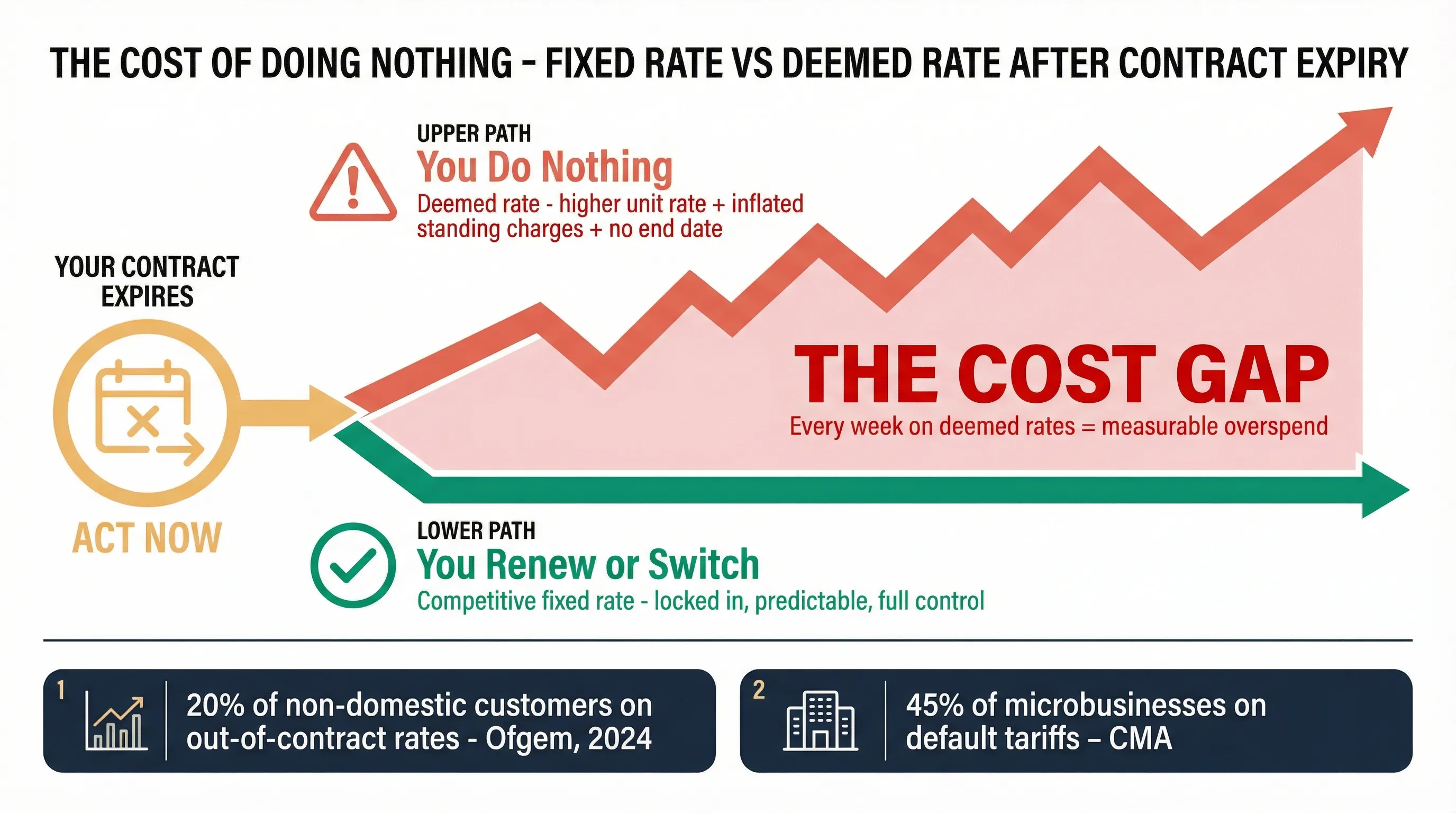
If your contract ends and you don’t renew or switch, your supplier moves you onto its deemed rate - also called an out-of-contract or default tariff. These are usually far more expensive than a competitive fixed deal, with standing charges often higher too.
Ofgem accepts that deemed rates reflect the higher risk and cost of supplying customers without a contract, but suppliers must take all reasonable steps to make sure the terms are not “unduly onerous”, and Ofgem expects them to keep their current deemed rates easy to find, for example on their website (Ofgem’s guidance on deemed contracts (opens in new tab)). Rates change periodically, so check your supplier’s current schedule rather than an old comparison.
It is a common outcome: in Ofgem’s 2025 research, 19% of businesses whose energy contract had ended in the previous 12 months said they were placed onto an out-of-contract rate (Ofgem, Businesses’ experiences of the energy market 2025 (opens in new tab)). If that’s you, you can usually switch straight away.
Watch Out for Volume Tolerance Clauses
If you are renewing, check one more thing beyond the headline unit rate: volume tolerance.
When you sign a fixed contract, the supplier plans to buy energy for the usage it expects you to have. Volume tolerance sets a band around that forecast within which your fixed price applies; outside it, the contract can let the supplier charge more. A business that cuts its usage sharply - as many may have during the price spike - can find itself outside the band.
When renewing, ask for the tolerance band in writing and what happens outside it, especially if your usage is seasonal or likely to change. Disputes do happen: Energy Ombudsman disputes about business energy rose 112% in the year to November 2024 (our analysis of the Ombudsman’s data).
How Long Should You Fix For?
There is no single right answer, because nobody can reliably predict wholesale prices. The trade-off is simple:
- A longer fix gives you price certainty for longer - useful if your margins depend on a stable energy budget. If prices fall, you won’t benefit until it ends.
- A shorter fix lets you come back to the market sooner - useful if you expect your usage or premises to change. If prices rise, you’ll renew into them sooner.
In our view, the better question is not “what will prices do?” but “what can my business live with?”. Ask for quotes on more than one term and compare their total annual cost. Whatever you choose, doing nothing is the worst option: it leaves you on a default rate.
When to Renew Your Business Energy Contract
In our view, a good time to start is three to six months before your contract ends. That gives you time to compare several offers rather than accepting the first quote under pressure, and to finish the switch before your end date.
If your contract ends in the next 6 months, start looking now. If it has already ended, you’re on a deemed or out-of-contract rate and can usually switch straight away with no exit fees.
What’s Changed Since the Last Crisis
The market you’re renewing into has more protections than it had in 2022. Ofgem’s Non-Domestic Market Review (opens in new tab) introduced changes including (Ofgem factsheet (opens in new tab)):
Stronger Regulation
- Standards of Conduct for all businesses - from 1 July 2024, the requirement for suppliers to treat customers fairly applies to businesses of any size, not just microbusinesses
- Complaints and the Energy Ombudsman for small businesses - from December 2024, suppliers must have suitable complaints processes for small business customers and point them to the Energy Ombudsman if a complaint isn’t resolved
Broker Transparency
Since 1 October 2024, any broker fee must be shown in your contract’s principal terms, and suppliers must make it available on request. From December 2024, suppliers may only work with brokers that are members of a redress scheme when securing small business contracts. The TPI Code of Practice adds further standards for brokers that sign up. Read how broker uplift works before signing anything.
Half-Hourly Settlement (MHHS)
Market-wide Half-Hourly Settlement (MHHS) is moving every electricity meter to settlement on half-hourly data; Elexon, which runs the programme, says it will complete in May 2027 (what MHHS means for your bills). For businesses renewing now, it may mean:
- Pricing based on when you use power - suppliers will settle your usage on actual half-hourly data
- New tariff types - time-of-use tariffs that reward using power at cheaper times
What to Do Right Now
If your contract ends in the next 12 months:
- Find your contract end date (it’s on your bill, or ask your supplier)
- Start comparing quotes now - don’t wait until the last month
- Compare total annual cost, not just the headline unit rate
- Check the volume tolerance band before signing anything
- Ask how each quote handles RAB and TNUoS charges
- Read the contract red flags guide before you sign
If your contract has already ended and you’re on a deemed rate:
You can usually switch straight away with no exit fees. Learn how to switch.
If you’re not sure what you’re on:
Check your bill for the tariff name. Names such as “Deemed”, “Out of Contract” or “Standard Variable” suggest you’re on a default rate. If you’re unsure, compare your unit rate with the DESNZ average for your size above - a big gap is worth looking into.
Is your contract in the renewal wave? Upload your latest bill and Meet George finds your contract end date, spots deemed and out-of-contract rates, and tells you in seconds whether it’s time to switch, or read how switching works first. Our 1p/kWh fee is shown separately, so you always know what you’re paying.


