

Quick Answer: Out-of-contract business energy rates are the default prices a supplier charges when you use its energy without a live contract - after a deal expires, a move-in, or a supplier failure. They are usually among the most expensive prices a supplier publishes. As of September 2026, published no-contract electricity rates from major suppliers run from about 39p to over 66p per kWh, while DESNZ data (opens in new tab) puts the average for even the smallest businesses at 35.02p - a figure that includes the Climate Change Levy, while the supplier rates exclude it and VAT, so the real gap is slightly wider than it looks.
You are not being punished. You are being priced for a contract you never signed. And unlike almost every other way of overpaying for energy, this one can be fixed today.
TL;DR
- What they are: out-of-contract business energy rates are the default prices - deemed, out-of-contract or rollover terms - a supplier charges whenever energy flows with no agreed contract behind it.
- The distinction nobody makes: deemed, out-of-contract and rollover are three different arrangements. Drax’s published deemed rate (September 2026) is 3.2p/kWh above its own out-of-contract rate - same meter, same limbo, different label.
- The protections: the rules that restrict default rates, require renewal notices and cap rollover contracts apply to microbusinesses only. Everyone else is on their own diary.
- The escape: no exit fees, no notice period. Check your bill’s tariff name today; if it says deemed, out of contract or standard variable, you can switch immediately - or fix a far more competitive rate with your existing supplier.
What are out-of-contract business energy rates?
Out-of-contract rates are the prices your supplier charges when your fixed-term contract has ended and nothing has replaced it. The lights stay on and the meter keeps running - what changes is the pricing: a variable unit rate and standing charge that the supplier sets, publishes and can change with notice (30 days’ written notice, in British Gas’s published schedule, for example).
“Out of contract” is also the umbrella term people use for every version of energy-without-a-contract. That shorthand hides a distinction worth hundreds to thousands of pounds a year: there are actually three different arrangements, and which one you are in changes what you pay and what rights you have.
Deemed vs out-of-contract vs rollover: what is the difference?
They get used interchangeably. They should not be.
| Arrangement | How you got there | What you pay | Are you locked in? |
|---|---|---|---|
| Deemed contract | You used energy having never agreed terms - a move-in, a change of tenancy, or a supplier of last resort transfer | The supplier’s published deemed rates - typically its most expensive | No - leave any time, no exit fee |
| Out-of-contract | Your fixed deal expired and you did nothing | Default out-of-contract rates - at some suppliers the same as deemed, at others a separate (slightly lower) schedule | No - leave any time, no exit fee |
| Rollover | Your supplier auto-renewed you onto a new fixed term when you missed the renewal deadline | The rolled contract’s rates - usually worse than a negotiated deal | Yes - a fixed term, and leaving early can trigger a termination fee |
Deemed and out-of-contract definitions follow Ofgem’s guidance on deemed contracts (opens in new tab) (November 2023), which requires suppliers to publish their deemed contract terms.
Here is the proof these are genuinely different products, from a supplier’s own published schedules. Drax lists deemed and out-of-contract as two separate tariffs: from 1 September 2026, its published deemed electricity rate is 41.87p/kWh and its out-of-contract rate is 38.67p/kWh (Drax, September 2026 (opens in new tab)). Same supplier, same no-contract limbo - a 3.2p/kWh difference depending on whether you moved in without a contract or let one expire.
A rolled-over contract is the odd one out: a new fixed term you never chose. That cuts both ways: the rates are usually better than deemed, but you are locked in, and escaping can cost money. The other two you can walk away from before lunch.
Why do businesses end up on expensive out-of-contract energy rates?
Because nobody chooses default rates - you land on them, through one of four doors:
- Your fixed contract expired and the renewal letter got buried. The deal ran out, the supplier moved you to default prices, and the first anyone noticed was the bill. This is the classic digital renewal trap, and missing the renewal window is a very common route.
- You moved into premises and used energy before agreeing a contract. The textbook deemed contract under Ofgem’s rules - you are “deemed” to have accepted supply from whoever already serves the meter. A supplier you never picked, at prices you never saw.
- Your supplier went bust. Ofgem appoints a supplier of last resort and your supply transfers to it - onto its default rates. British Gas’s deemed schedule says this in terms: the charges “may apply to any customer supplied as a consequence of us receiving a direction from the Gas and Electricity Markets Authority (Ofgem) to act as the supplier of last resort”. Here is what happens when a business energy supplier goes bust.
- A change of tenancy left the meters running with no contract. You bought a business or took on a lease, inherited live meters, and never signed your own deal.
Four doors, one room - and as the next section shows, “default” is doing a lot of work in this story.
What do out-of-contract and deemed rates actually cost?
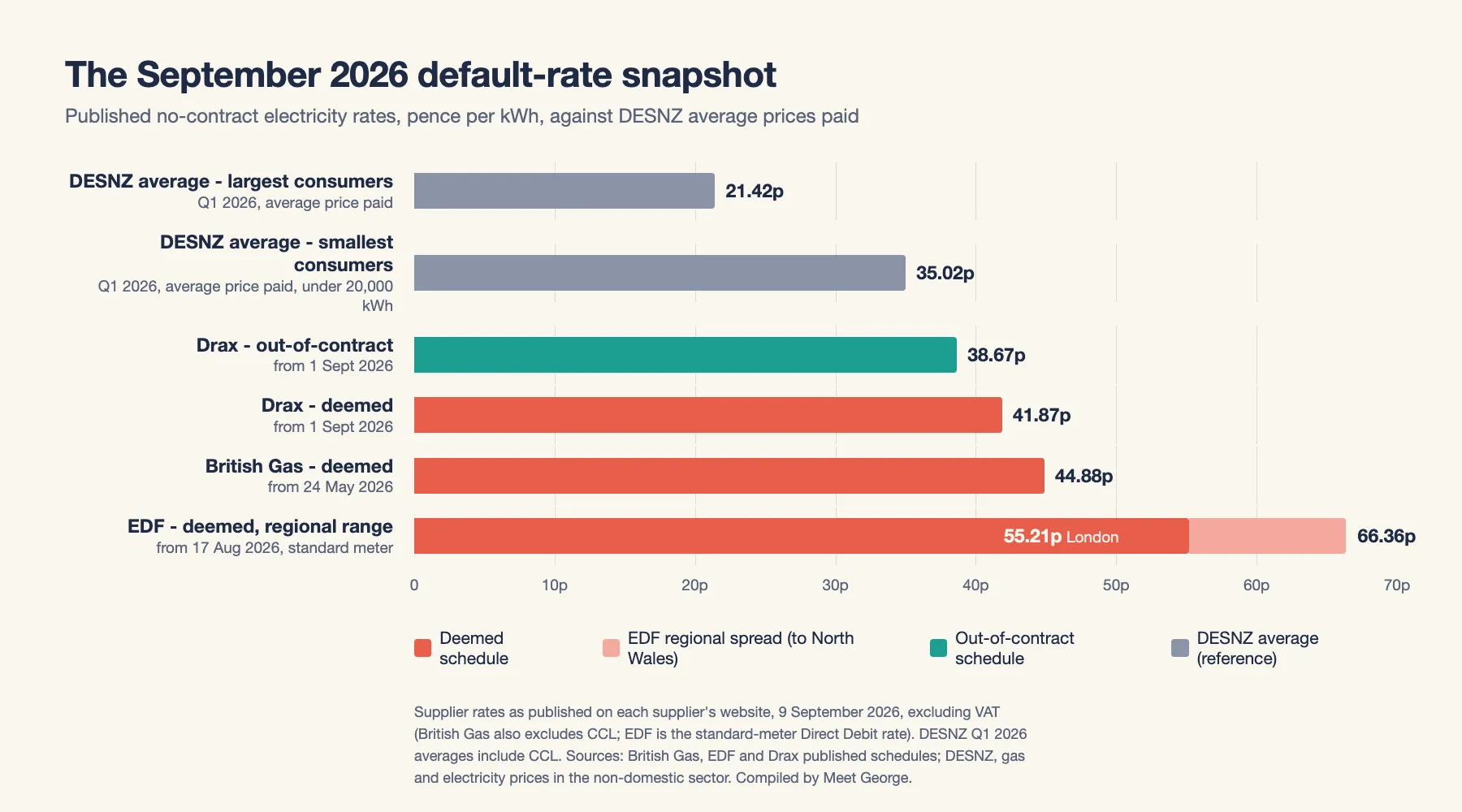
We checked the published schedules of major non-domestic suppliers on 9 September 2026 - call it the September 2026 default-rate snapshot. Where a supplier publishes a rate card, here it is:
| Supplier and schedule | Fuel | Unit rate | Standing charge | Effective from |
|---|---|---|---|---|
| British Gas - deemed | Electricity | 44.88p/kWh | 214.15p/day | 24 May 2026 |
| British Gas - deemed | Gas | 15.01p/kWh | 182.98p/day | 24 May 2026 |
| EDF - deemed (varies by region) | Electricity | 55.21p - 66.36p/kWh | 215p/day | 17 Aug 2026 |
| EDF - deemed (varies by region) | Gas | 16.38p - 17.42p/kWh | 250p/day | 17 Aug 2026 |
| Drax - deemed | Electricity | 41.87p/kWh | - | 1 Sept 2026 |
| Drax - out-of-contract | Electricity | 38.67p/kWh | - | 1 Sept 2026 |
All rates as published on each supplier’s website on 9 September 2026: British Gas deemed rates (opens in new tab) (non-half-hourly electricity and smaller gas meters, excluding VAT and the Climate Change Levy (CCL)), EDF deemed pricing (opens in new tab) (standard meter, Direct Debit, excluding VAT), Drax deemed and out-of-contract rates (opens in new tab).
Three things jump out of that table.
The spread is enormous. From 38.67p to 66.36p is a 27.7p/kWh gap for the same predicament - a business with no contract - depending on supplier, region and which default schedule applies. It is a lottery you never bought a ticket for.
The same supplier charges different regions very differently. EDF’s deemed rate spans 55.21p (London) to 66.36p (North Wales) - an 11p/kWh spread inside one tariff.
And these rates move. Drax’s own schedule lists its deemed rate at 39.51p from 1 August 2026 and 41.87p from 1 September - a 2.36p rise in a single month. Default rates are variable and can climb while you sit on them.
Not every supplier makes its current figures easy to find. E.ON Next’s own renewals page (opens in new tab) says its out-of-contract prices are higher than its variable plan, and when we checked on 9 September 2026 the figures themselves were available on request rather than published online. If your supplier does not publish a rate card, ask for the current figures in writing before you assume anything.
For scale against the wider market: DESNZ’s non-domestic price series (opens in new tab) puts the Q1 2026 average at 35.02p/kWh including CCL for the smallest consumers (under 20,000 kWh a year), and 21.42p for the largest. Put British Gas’s deemed rate on the same basis - 44.88p plus the 0.801p CCL (opens in new tab) is 45.68p - and a small business on it pays 10.66p/kWh above the average for its own size band. On 25,000 kWh a year:
10.66p x 25,000 kWh = £2,665 a year - our arithmetic from the two published figures, and conservative, because that DESNZ average already includes businesses overpaying on default rates.
We have seen this up close. A London boutique we helped had drifted out of contract two years earlier without realising: 38.6p/kWh when we found them, peaking at 56p during volatile periods, moved to a fixed contract at 22.31p - £1,307 a year back, a 46% saving. Rates have moved since, but the shape of the story has not: the money was not buying better electricity. It was the price of not switching.
We have broken down what switching typically saves by starting position - deemed and out-of-contract rates are consistently the biggest-saving starting point there is.
Why are out-of-contract rates so expensive?
Because your supplier cannot plan around you - and it prices that risk into every unit.
When you sign a multi-year deal, the supplier buys most of your energy in advance on the wholesale market, locking in costs because it knows you will still be a customer next winter. When you have no contract, you might leave next week. So the supplier buys your energy at short notice, at whatever the market costs that day, and passes the risk premium to you. During a cold snap, that premium spikes - which is how our boutique briefly paid 56p.
To be fair to the suppliers: the risk is real, and deemed customers also carry higher credit risk - the supplier often does not know who is on the meter, let alone whether they will pay. High default rates also do a job for the supplier: they nudge you towards a contract. British Gas’s schedule points at the intended destination - it “may offer to enter into a formal contract with you instead”.
Default tariffs also tend to carry friendlier-sounding names than “deemed” - watch for words like freedom, flexible or rolling in a tariff name. The friendliness is not a discount: the highest published deemed rate in our snapshot is nearly double the DESNZ small-business average. In energy, stability is cheap and freedom is expensive.
Are out-of-contract rates always more expensive for small businesses?
Almost always - but not uniformly, and that is the real trap.
Every published no-contract rate in our snapshot sits above the DESNZ small-business average, so the direction is not in doubt. The size of the premium, though, ranges from about 10% (Drax out-of-contract, against the smallest-band average) to nearly 90% (EDF’s top regional deemed rate). Two identical cafés in different towns, both contract-free, can be paying wildly different prices for the same inaction.
There is one group with a safety net. Microbusinesses - businesses meeting any one of: fewer than ten employees with turnover under 2 million euros, under 100,000 kWh of electricity a year, or under 293,000 kWh of gas - get Ofgem’s enhanced protections (opens in new tab), which restrict out-of-contract rates, require suppliers to give renewal-window notice, and cap any rollover: in Ofgem’s words (opens in new tab), “microbusinesses cannot have a rollover contract for more than 12 months”.
Grow past any of those lines and the safety net stops. A business with 10 to 49 employees keeps the right to complain - the Energy Ombudsman’s remit (opens in new tab) has covered small businesses since December 2024 - but not the upfront rules that would have prevented the problem. We have written a full guide to the protection gap when your business outgrows microbusiness status; the one-line version is that past the microbusiness line, the renewal reminder has to be your own.
How do you stop your business paying default energy rates?
Switch or sign - today. Default rates have no notice period and no exit fees, which makes this the rare energy problem with an immediate fix.
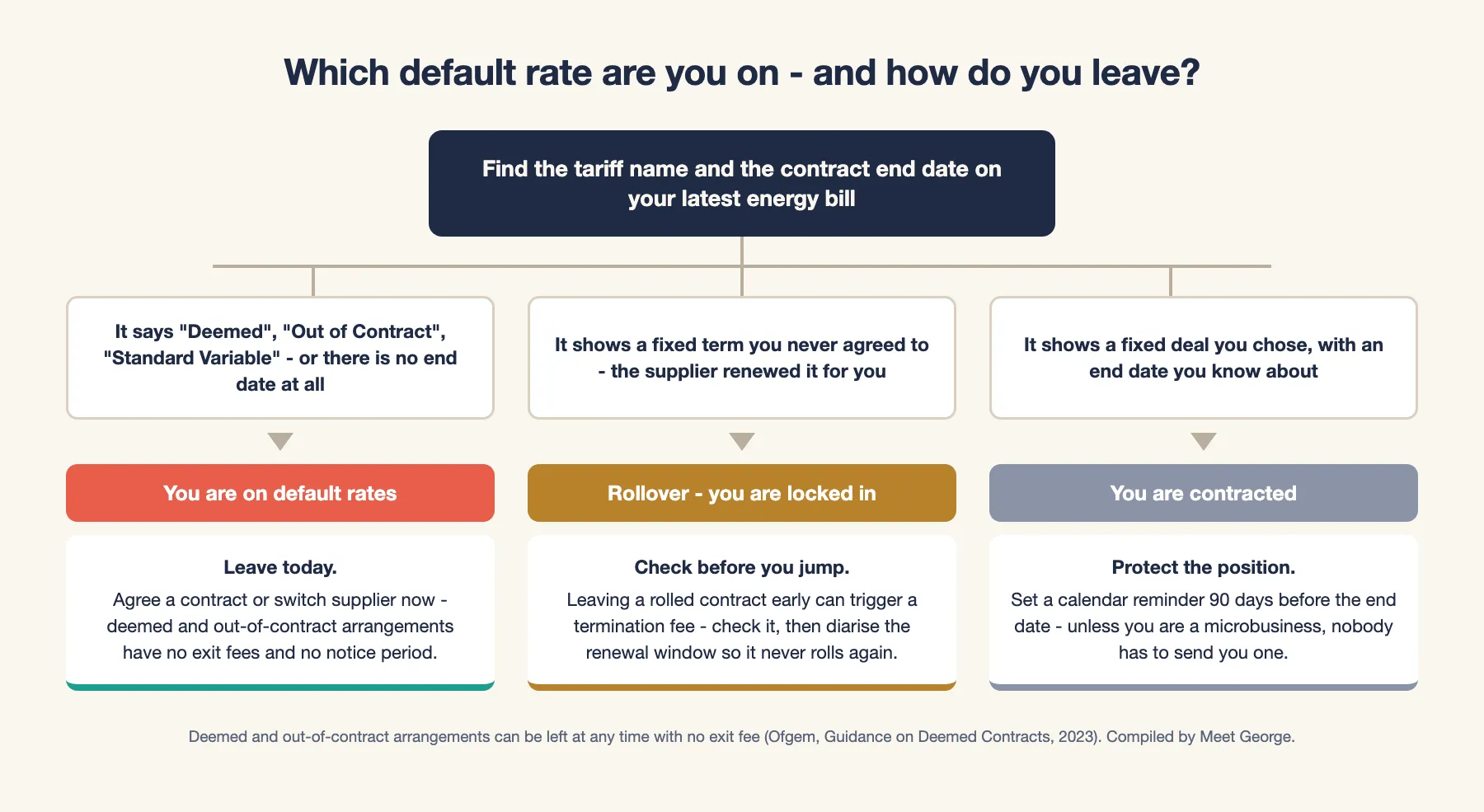
- Check whether you are on default rates. Look at the tariff name on your latest bill. “Deemed”, “Out of Contract”, “Standard Variable” or a friendly-sounding name built on words like freedom, flexible or rolling - or no contract end date at all - means you are likely paying default rates.
- Find your annual usage and meter numbers. Your annual kWh and your MPAN (your electricity meter’s unique number) or MPRN (the gas equivalent) are on the same bill - our guide to MPAN and MPRN numbers shows exactly where to look.
- Agree a contract or switch supplier - immediately. Deemed and out-of-contract arrangements have no exit fees and no notice period, so there is nothing to wait for. A fixed contract at market rates beats every number in the published deemed schedules.
- Diarise your renewal window for next time. Set a calendar reminder 90 days before the new contract ends. Suppliers only have to remind microbusinesses, so for everyone else the reminder has to be your own.
And the question our search data says businesses actually ask: do you need a broker to avoid out-of-contract rates? No. The protection is a calendar reminder, and calendar reminders are free. Renewal management is a genuine service some brokers provide - but in the traditional model it is paid for through commission added to your unit rate, so if you go that route, ask exactly how they are paid. Meet George does the comparison and the switch for a flat, itemised 1p/kWh fee, and the reminder we would give you either way is the one in step 4.
If you have never switched before, our step-by-step guide to switching business energy walks the whole process in about 20 minutes.
The bottom line
Out-of-contract, deemed and rollover rates are what happens when energy keeps flowing and nobody signs anything - and they are priced accordingly: 39p to 66p/kWh on suppliers’ own published schedules this month, against a 35p average for even the smallest businesses. Deemed and out-of-contract arrangements can be left at any time with no exit fee, so the only thing keeping any business on them is not knowing. Check the tariff name on your bill today. If it promises a freedom you never asked for, that promise is the most expensive thing your business is buying.
Sources
- Ofgem - Guidance on Deemed Contracts (SLC 7.3 and 7.4), November 2023 (opens in new tab)
- Ofgem - Non-Domestic Market Review decision, 2023 (opens in new tab)
- Ofgem - Set up a business energy contract (microbusiness rollover cap) (opens in new tab)
- British Gas - schedule of deemed contract charges, effective 24 May 2026 (opens in new tab)
- EDF - deemed pricing, effective 17 August 2026 (opens in new tab)
- Drax - out-of-contract and deemed rates, September 2026 (opens in new tab)
- E.ON Next - business renewals and out-of-contract prices (opens in new tab)
- DESNZ - gas and electricity prices in the non-domestic sector, Q1 2026 (published 30 June 2026) (opens in new tab)
- HMRC - Climate Change Levy rates (opens in new tab)
- Energy Ombudsman - small business annual review, 2026 (opens in new tab)


