


Moving business premises is complicated enough without the energy side of it turning into a months-long fight with your supplier. But that’s exactly what happens to thousands of UK businesses every year - stuck on deemed rates they didn’t agree to, chasing suppliers who won’t process their paperwork, and sometimes being told they owe money for energy the previous tenant used.
It doesn’t have to be this way. Since 27 June 2025, REC Schedule 33 (opens in new tab) has given businesses clear rights, standardised evidence requirements, and enforceable timelines for the first time. This guide covers everything you need to know.
TL;DR: The Quick Reference
| What | Detail |
|---|---|
| CoT = CoO | Change of Tenancy and Change of Occupier are the same thing |
| Supplier review SLA | 10 working days to review your evidence (REC Schedule 33) |
| Extra evidence SLA | Another 10 working days if they request more documents |
| Switching timeline | Minimum 2 working days after switch request (non-domestic) |
| Deemed rates | Automatic if you take supply without a contract - switch immediately |
| Previous tenant’s debt | You are NOT liable - Ofgem will act against suppliers who try this (opens in new tab) |
| Termination fees | Moving usually counts as early termination - check your contract |
| Supplier blocking | Suppliers cannot block a switch away from a deemed contract |
What is Change of Tenancy?
Change of Tenancy (CoT) - also called Change of Occupier (CoO) - is the process that happens when the business responsible for an energy supply at a premises changes. This includes moving into new premises, vacating premises, buying or selling a business property, or undergoing certain legal changes like converting from sole trader to limited company.
The industry uses both terms interchangeably. “CoT” is the commercial term you’ll hear from brokers and suppliers. “CoO” is the legal term in the Retail Energy Code (opens in new tab) (REC Schedule 1 defines it as a situation where “the consumer at a premises has changed or is due to change”). There is no difference in your rights or obligations - they’re the same process.
What is the change of tenancy (CoT) process?
The change of tenancy (CoT) process is how an energy supplier moves a premises’ account from the business that is leaving to the business that is arriving. You tell the supplier the date and a meter reading, send evidence that you now occupy the premises, and under REC Schedule 33 the supplier has 10 working days to accept it, reject it or ask for more.
In five steps:
- Tell the supplier for the premises your move-in or move-out date, with a meter reading from that day.
- Send evidence of occupancy, such as a lease, completion statement or business rates bill. One or two documents is usually enough.
- Wait up to 10 working days for the supplier to accept, reject or ask for specific extra evidence - and another 10 working days if it asks for more.
- Agree a contract or switch supplier. Until you do, you are on deemed rates, and the supplier cannot block a switch away from them.
- Check your first bill for the right start date, opening reading and tariff, and no charges from before you moved in.
The sections below cover each route in detail: leaving a site, moving in with the existing supplier, and moving in while switching.
The deemed rates trap
This is the single most important thing to understand about moving premises: if you use energy before agreeing a new contract, your supplier will put you on deemed rates.
How deemed contracts work
Under the Electricity Act 1989 (opens in new tab) (Schedule 6, paragraph 3) and the Gas Act 1986 (Schedule 2B, paragraph 8), when someone takes energy supply “otherwise than in pursuance of a contract”, a deemed contract automatically exists between the occupier and the existing supplier from the moment supply begins.
In plain English: you walk into a new premises, the lights are on, and you’re already on a deemed contract with whoever supplied energy to the previous tenant. You didn’t sign anything. You didn’t agree to the price. It happened automatically by law.
Why deemed rates are expensive
Deemed rates are almost always higher than contracted rates. Ofgem’s guidance on deemed contracts (opens in new tab) (Standard Licence Conditions 7.3-7.4 - SLCs are the rules energy suppliers must follow as a condition of their Ofgem licence) acknowledges that suppliers can legitimately charge more for deemed customers to reflect higher risk and uncertainty - a deemed customer can leave at any time, so the supplier hasn’t hedged energy for them at a fixed price.
However, Ofgem also states that setting deemed rates at a very high level solely to coerce customers into fixed-term contracts is not acceptable. Deemed terms must not be “unduly onerous”.
The good news: you can switch immediately
Here’s the critical point most businesses don’t know: suppliers cannot block a switch away from a deemed contract.
Ofgem’s impact assessment on non-domestic objections confirms that deemed contracts are not in scope of the objection period rules (Standard Licence Condition 14.2) - the licence condition that normally allows suppliers to object to a customer transferring away. This means you can arrange a new contract with any supplier from day one. Don’t sit on deemed rates waiting for the CoT paperwork to resolve.
Step by step: leaving a site
If you’re the outgoing business vacating premises:
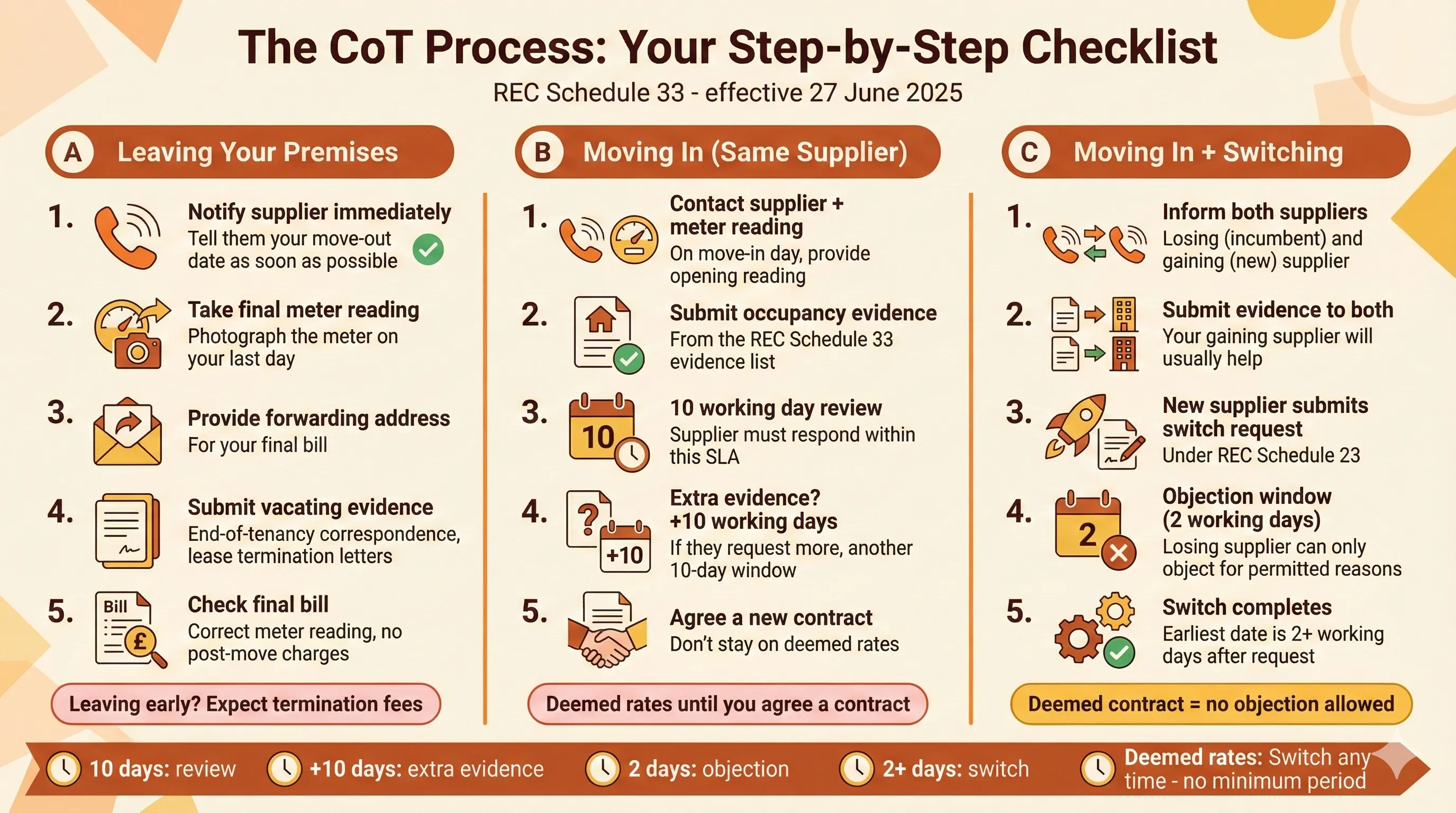
1. Notify your current supplier as soon as possible. Don’t wait until the day you leave. Tell them your move-out date, even if you’ve already arranged supply at your new premises.
2. Take a final meter reading on your last day. Photograph the meter and note the date. This protects you from being billed for energy used after you leave.
3. Provide a forwarding address for your final bill.
4. Provide evidence of vacating if requested - end-of-tenancy correspondence, lease termination letters, or solicitor confirmation.
5. Check your final bill carefully. Make sure it’s based on your actual final meter reading, not an estimate. Ensure there are no charges for energy consumed after your move-out date.
If you’re leaving before the end of a fixed-term contract, your supplier may charge termination fees. More on this below.
How do you find out who supplies your new premises?
If you move into business premises and don’t know who supplies the energy, look the supplier up by postcode or meter number. For gas, search the Find My Supplier service (opens in new tab). For electricity, find your local network operator on the Energy Networks Association’s postcode tool (opens in new tab), then ask it who your supplier is. Ofgem points businesses to both services (Ofgem (opens in new tab)).
A few things make the search quicker:
- Check the meters. The electricity meter or a recent bill may show the 13-digit MPAN; the gas equivalent is the MPRN. Your supplier, or the lookup services, can identify the supply from these numbers.
- Ask the landlord, agent or previous occupier. They often have the last bill.
- Act quickly anyway. From the moment you use energy, you are on a deemed contract with whoever already supplies the meter, at its deemed rates. Not knowing who that is does not pause the charges.
SSE Energy Solutions, for example, gives the same two routes on its moving-premises page, along with the Meter Number Helpline for gas on 0870 608 1524 (SSE Energy Solutions (opens in new tab)).
Once you have your first bill from the supplier, upload it: Meet George’s free bill check reads it line by line and flags deemed or out-of-contract rates.
Step by step: moving in (keeping the existing supplier)
If you’re the new occupier and want to stay with the supplier already at the premises:
1. Contact the current supplier on the day you move in (or as close to it as possible). Tell them you’re the new occupier and provide an opening meter reading. Many suppliers have dedicated online CoT portals or forms on their website - check your supplier’s support pages first, as this is often faster than calling.
2. Provide evidence of occupancy. This is where REC Schedule 33 (opens in new tab) (effective 27 June 2025) now gives you clear rights. You’ll typically need one or two of the following:
- Signed lease or tenancy agreement
- Property sale documents or title deeds
- Land Registry title (e.g. TR1 transfer forms)
- Business rates bills or council correspondence for the site
- Solicitor, accountant, or landlord confirmation letters
- Companies House filings (if the legal entity has changed)
- Bank letters confirming the new address
You don’t need all of these - one or two strong documents is usually enough. The full list is in the documents section below.
3. Wait for the supplier’s decision within 10 working days. Under the new rules, the supplier must either:
- Accept the CoT and update accounts, or
- Reject the CoT with clear reasons, or
- Request specific additional evidence, explaining exactly what’s missing and why.
4. If they request more evidence, the supplier must tell you exactly what’s missing and why they need it. They can only ask for documents a reasonable occupier could be expected to have - they can’t keep adding new requests to delay the process. Once you provide the additional evidence, the supplier has another 10 working days to make a final decision.
5. Negotiate a new contract. Until you agree terms, you’ll be on deemed rates. Don’t delay - start discussing contract options immediately, even before the CoT paperwork is finalised.
Step by step: moving in and switching supplier
If you want to switch to a different supplier:
1. Inform both suppliers - the existing (incumbent) supplier and your chosen new (gaining) supplier.
2. Provide evidence of occupancy to both. Your new supplier will usually help with the paperwork.
3. The gaining supplier submits a Switch Request under REC Schedule 23. For non-domestic premises, the earliest supply start date is at least 2 complete working days after the switch request is submitted.
4. The losing supplier has an objection window - until 17:00 on the second working day after the switch request. They can only object for permitted reasons (e.g. you’re still in a fixed-term contract, or certain pre-2004 debts). They cannot object if you’re on a deemed contract.
5. Where the switch is flagged as a Change of Occupier, both the gaining and losing supplier must retain the evidence they relied on for at least one year (REC Schedule 23). This creates an audit trail in case of disputes.
What documents do you need?
Before REC Schedule 33, there were no standardised evidence requirements. Each supplier demanded whatever they wanted, and some demanded a lot. Ofgem’s enforcement action against Maxen Power Supply - which resulted in a £1.65 million payment (opens in new tab) - found that Maxen “put unreasonable requirements on customers to evidence a change of tenancy by asking for a large number of documents”, trapping customers on expensive deemed rates.
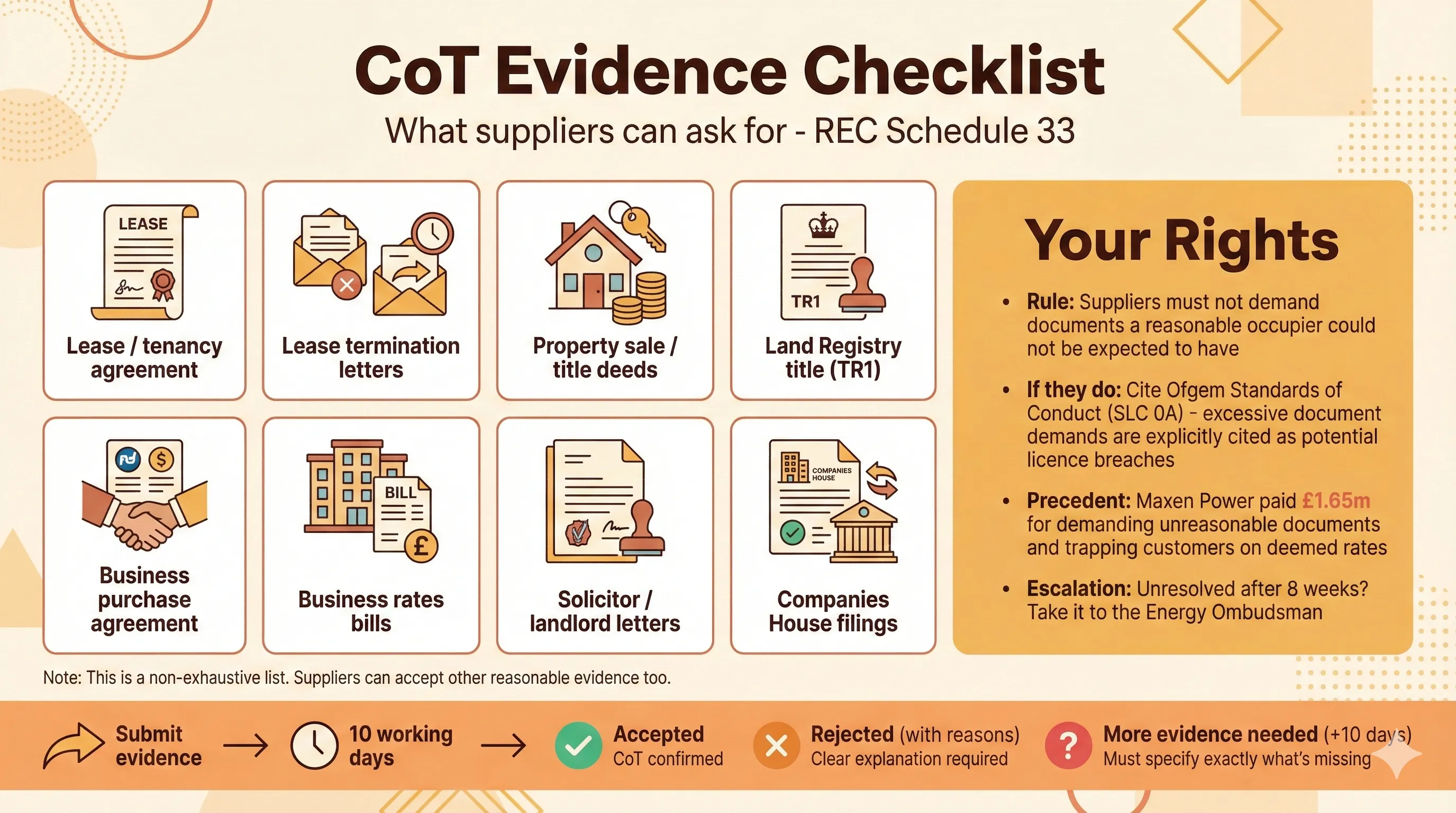
Now, REC Schedule 33 provides a non-exhaustive evidentiary list that standardises what suppliers can reasonably expect. There is no single mandatory form - but suppliers should align with this list:
- Signed lease or tenancy agreement
- Lease termination or surrender letters
- Property sale documents or title deeds
- Land Registry title (e.g. TR1 transfer forms)
- Business purchase or asset transfer agreements
- Business rates bills or council correspondence for the site
- Solicitor, accountant, or landlord confirmation letters
- Companies House filings (for entity changes)
- Mortgage documents
- Bank letters confirming the new address
The key rule: suppliers must not demand documents that a reasonable occupier could not be expected to have. If your supplier asks for something unreasonable, cite Ofgem’s Standards of Conduct for energy suppliers (opens in new tab) - which explicitly uses excessive CoT document demands as an example of conduct that may breach licence conditions.
What does each supplier require for a change of tenancy?
The regulatory framework is the same everywhere - REC Schedule 33’s evidence list and a 10-working-day review clock - but the notification route, the forms and the paperwork differ supplier by supplier. We checked the published change-of-tenancy processes of nine major non-domestic suppliers on 10 September 2026 (EDF splits its process by business size, so it appears twice). Here is what each asks for:
| Supplier | How to notify | What they ask for | Published timescales |
|---|---|---|---|
| SSE Energy Solutions (opens in new tab) | One online moving form for moving in or out, cot4business@sse.com, or 0345 026 0304 | Moving date and meter details (reading, serial number, invoice structure identifier) - no legal documents listed, and they will estimate a reading if you have none | Forms accepted up to a week in advance; final bill 5-7 business days after the change is recorded |
| British Gas (opens in new tab) | Online account (“Moving premises”), or 0333 009 5801 | Meter reading and the exact date legal responsibility changed; proof of occupancy or tenancy (lease, surrender of lease, sale deed) “may be required” | Move-out date can be set up to 28 days ahead or 5 days in the past; around 10 working days to process |
| EDF - SME (opens in new tab) | Email documents to BM@edfenergy.com | One legal document (lease or completion statement) plus a photo of the meter; extra documents (business rates letter, sometimes a solicitor’s letter) if the previous occupier owes money or had over 6 months left on their contract | Email confirmation within 10 working days |
| EDF - large business (opens in new tab) | Online moving-location form | Signed lease or sale documents, Land Registry or TR1, meter readings, MPAN/MPRN | Notify within 28 days of the change - after that, valid legal documents are required or the change is processed only from the day you notify |
| E.ON Next (opens in new tab) | Online account (moving out), hellobusiness@eonnext.com, or 0808 501 5699 | Dates, meter readings, forwarding address and the landlord’s or new occupier’s details - no documentary evidence listed on the help page | None published; credit refunds normally about 10 working days after the final bill |
| TotalEnergies (opens in new tab) | Online moving-premises form, or the Change of Occupancy Proforma to COOEnq.uk@totalenergies.com | A signed and dated lease agreement, solicitor’s letter or landlord’s letter recommended; meter readings and details of both outgoing and incoming parties | ”At least 28 days’ notice is required” (opens in new tab); processing “can extend up to eight weeks” |
| Drax (opens in new tab) | CoT form plus evidence to movingpremises@drax.com | One document from a 12-item list (lease, surrender, title deed, insolvency notice, letters of administration…) plus a verification document (bank letter, solicitor’s letter or business rates invoice) and a meter reading or photo | None published; a £50 (inc VAT) charge if a third-party site visit is needed because no evidence was provided |
| ScottishPower | 0800 074 0062 or icbusinesscustserv@scottishpower.com | The incoming tenant’s or landlord’s contact details - they contact them before finalising the old account; a lease or supporting documents only “in certain circumstances” | None published; a final direct debit is taken about 14 days after the final invoice |
| Yu Energy (opens in new tab) | Online change-of-tenancy form | Lease or completion-of-sale documents (moving in) or a Surrender of Lease (moving out) as mandatory; ID, insurance documents and a business rates bill recommended | None published; they warn that re-submitting or chasing the request slows it down |
| Maxen Power (opens in new tab) | Online change-of-occupancy form, businessmove@maxenpower.com, or 02079 30 30 30 | A meter reading with the date it was taken plus a clear photo of the meter, and - per its moving-in guide (opens in new tab) - one occupancy document certified by a legal adviser (lease, tenancy agreement, title deeds, or a contractual right to use the property) | None published; agreed refunds usually within 10 working days of the final bill |
Each row is taken from the supplier’s own published change-of-tenancy, moving-premises or FAQ pages, checked 10 September 2026. ScottishPower’s process comes from its commercial change-of-tenancy page, which blocks automated access, so quotes were taken from the rendered page the same day. Processes change - treat this as a dated snapshot and the supplier’s page as the live source.
Four patterns worth noticing in that table:
- The evidence burden varies enormously for the same event. SSE Energy Solutions asks for a moving date and meter details with no legal documents at all; Drax asks for a document from a 12-item list plus a second verification document. Same regulatory framework, very different paperwork.
- Only TotalEnergies publishes a hard notice period - at least 28 days - and it also quotes the longest processing window, at up to eight weeks. The backstop applies to everyone, though: under REC Schedule 33, a supplier must review your evidence within 10 working days of receiving it, whatever its own quoted timescales say.
- Whoever supplies the site, no contract means default pricing. Every supplier in the table places an incoming occupier without a contract on deemed or variable rates - British Gas says plainly that these are “typically our most expensive rates”. SSE is the interesting outlier in language: it never uses the word “deemed” on its moving page, placing you on its “variable business rate” instead. Different label, same principle.
- Timing rules cut both ways. SSE will not take a form more than a week before you move; British Gas lets you set a move-out date 28 days ahead but only 5 days in the past. Late notification does not just slow the paperwork - it can cost you accuracy on the final bill, because the readings and the legal-responsibility date drift apart.
How do you fill in SSE’s business change of tenancy form?
SSE Energy Solutions, SSE’s business energy supplier, takes changes of tenancy through one online moving form (opens in new tab) for both moving in and moving out. The required fields are your moving date and meter details - a meter reading, the meter serial number and the invoice structure identifier - and no legal documents are listed (SSE Energy Solutions (opens in new tab)).
What else SSE’s own moving-premises page says:
- Timing: send the form “as close to your move or change in tenancy date as possible”. SSE accepts it up to a week in advance.
- No meter reading? SSE will estimate one, and you can submit an actual reading once the move is processed.
- Moving in: you go onto SSE’s “variable business rate”. You can say on the form that you want a contract, and SSE will contact you about options.
- Several sites: a business can submit multiple requests through the same form; brokers use a separate form for bulk requests.
- Costs: “there are no penalties or charges for moving”, and your account number stays the same.
- After you submit: a confirmation email if you gave an address, a welcome letter once the change is complete, and a first bill within a month.
SSE’s variable business rate is its no-contract price, so treat the form as step one and agree a contract, with SSE or another supplier, straight after.
Can you be held liable for the previous tenant’s debt?
No. The law is clear on this.
Deemed contract provisions under the Electricity Act 1989 and Gas Act 1986 take effect from the time the new occupier begins to take supply. The previous tenant’s debt belongs to the previous tenant.
Ofgem’s Standards of Conduct for energy suppliers provides a specific example of what suppliers must not do: threatening a new occupier with disconnection if they don’t pay the previous tenant’s debt, while simultaneously dragging out the CoT evidence process. This is explicitly cited as conduct that may breach their licence conditions.
The Maxen Power case (opens in new tab) is the clearest precedent. Ofgem found that new occupiers were threatened with disconnection unless they paid the previous tenant’s debt - despite having provided evidence they were a different legal entity. Maxen paid £1.65 million.
If a supplier tries to hold you responsible for someone else’s debt:
- Put your objection in writing, citing Ofgem’s Standards of Conduct for energy suppliers.
- Provide your evidence of occupancy again.
- If unresolved after 8 weeks (or if you receive a deadlock letter), escalate to the Energy Ombudsman (opens in new tab).
What happens to the previous tenant’s contract?
Most non-domestic energy contracts are site-specific - tied to a particular MPAN (electricity) or MPRN (gas) and address, not to the customer as a person or company.
When the previous tenant leaves:
- Their contract at that site ends (or enters early termination).
- The supplier may pursue termination fees from the outgoing tenant.
- You, as the new occupier, are not party to that contract. You start fresh on a deemed contract and can negotiate your own terms.
If you’re the one leaving before contract end
Moving premises before your fixed-term contract expires is typically treated as early termination. Your supplier may charge exit fees, usually calculated as:
- A percentage of remaining estimated charges, and/or
- A “loss of bargain” calculation based on remaining term and wholesale price movements. For example, if you signed a 3-year contract at 28p/kWh but wholesale prices have since dropped to 22p/kWh, your supplier locked in energy at a higher price on your behalf. If you leave early, they may charge the difference (6p/kWh) multiplied by your estimated remaining usage to cover their loss.
There is no licence condition or statute that automatically voids a non-domestic contract or waives termination fees because of a genuine CoT. It’s governed by contract law and Ofgem’s general fairness requirements for energy suppliers (the Standards of Conduct).
However:
- Microbusinesses get additional protections. If your contract was auto-renewed (i.e. your supplier rolled you onto a new deal without you actively agreeing), there are legal limits on what termination fees they can charge - this comes from a Competition and Markets Authority (CMA) order specifically protecting small businesses. However, this protection only applies to auto-renewed contracts, not if you’re leaving a contract mid-term because you’re moving premises.
- Some suppliers voluntarily waive fees if you transfer your supply to new premises with the same supplier. This is commercial goodwill, not a regulatory right - ask before assuming.
- For larger I&C customers, there are no specific regulatory protections on termination fees. Contract negotiation and general fairness principles are your main levers.
Legal changes at the same premises
You don’t have to physically move to trigger a CoT. Industry and REC guidance treat certain legal changes as CoO events, even if operations continue at the same address:
- Sole trader to limited company - a new Companies House number means a new legal entity is “occupying” the premises.
- Change of proprietor in a partnership - the “consumer” at the premises has changed.
- Business sale or asset transfer - a new company takes over the site.
These go through the same CoT evidence process. Suppliers tend to scrutinise them more closely because they’re higher-risk for fraud - the business hasn’t physically moved, only the legal entity has changed. The sole-trader-to-Ltd conversion in particular is difficult for suppliers to challenge, since a genuine conversion is indistinguishable from a fraudulent one on paper.
If you’re making a genuine legal change, prepare your evidence thoroughly. Companies House filings, the incorporation certificate, and solicitor confirmation of the conversion will usually satisfy the REC Schedule 33 requirements.
How long can you be stuck on deemed rates?
There is no minimum period. You can start arranging a new contract or switching supplier from the moment you move in. The regulatory position is unambiguous:
- Deemed contracts have no fixed term - you can get off deemed rates at any time by agreeing a new contract or switching supplier.
- Suppliers cannot block a switch away from deemed rates - the objection rules don’t apply to deemed contracts.
- Any unpaid charges on the deemed contract can still be pursued through normal debt collection, but they can’t be used to prevent you switching.
The practical bottleneck is usually your own speed in arranging a new deal. Don’t wait for the CoT paperwork to be finalised before shopping around. Get quotes, compare unit rates and standing charges, and have a contract ready to sign the moment the CoT is confirmed.
The route and paperwork vary supplier by supplier - the supplier-by-supplier table earlier in this guide shows each one - but the regulatory backstop is identical for all of them: under REC Schedule 33, a supplier must respond within 10 working days of receiving your documents. If any supplier takes longer, whatever its own quoted timescales say, you have grounds to escalate.
The bottom line
The CoT process used to be a mess - no standardised evidence, no timelines, and suppliers who could (and did) drag their feet while you sat on expensive deemed rates. Since June 2025, REC Schedule 33 has changed that. You now have clear evidence requirements, a 10-day review SLA, and Ofgem precedent showing they’ll act against suppliers who abuse the process.
The most expensive mistake businesses make when moving premises is doing nothing. Every day you spend on deemed rates without actively arranging a new contract is money wasted. Notify your supplier, gather your evidence, and start switching immediately.
This guide is based on Ofgem’s June 2025 “Change of tenancy for businesses” guidance, REC change proposal R0155 (Schedule 33 - Non-Domestic Change of Occupier), Ofgem’s Standards of Conduct for energy suppliers, the Electricity Act 1989, and Ofgem’s enforcement action against Maxen Power Supply. All regulatory references are current as of February 2026.


