


Small business energy protections are not the same as microbusiness protections - and the gap catches growing businesses off guard. In its first annual review of small-business energy disputes, covering 19 December 2024 to 31 December 2025, the Energy Ombudsman (opens in new tab) set out a distinction most owners never notice: once your business grows past the microbusiness line, a specific set of contract protections that shield the smallest firms stops applying. You still gain the right to complain - that door opened to small businesses in December 2024 - but some of the upfront rules that would have stopped the problem do not grow with you.
Put plainly: a nine-person café and a thirty-person care home are treated differently by the rulebook, even though both are “small”. Here is what you keep, what you lose, and how to cover the gap yourself.
TL;DR
- The gap: small business energy protections are not microbusiness protections - the microbusiness rules that restrict out-of-contract rates, require a renewal-notice window and block automatic rollover apply only to microbusinesses, not to firms with 10 to 49 employees.
- What you keep: fair, honest and transparent dealing (Ofgem’s Standards of Conduct, all sizes since July 2024), your right to see any broker fee set out in the contract (all sizes since October 2024), and - since December 2024 - Energy Ombudsman access.
- What the data shows: in the Ombudsman’s first small-business review, 72% of investigated complaints were upheld, and sales complaints ran at 29% for small businesses versus 15% for microbusinesses.
- The lottery: around one in five small businesses that complained were treated as a microbusiness by their supplier anyway - a courtesy, not a legal right.
- What to do: know your status, get any fee in writing, diarise your renewal window, and only ever sign a Level 1 Letter of Authority.
What did the Energy Ombudsman’s first small business review find?
The remit extension in December 2024 brought an estimated 211,000 more businesses into scope, meaning the Energy Ombudsman can now help around 99% of UK businesses (Energy Ombudsman, 2026 (opens in new tab)). Its first year of small-business data gives the clearest independent picture yet of what actually goes wrong.
72% of investigated small-business complaints were upheld - meaning something had gone wrong that the supplier had not put right before the case reached the Ombudsman (Energy Ombudsman, 2026 (opens in new tab)). That is not a fringe number. Across the year it supported 751 small businesses, formally investigated 416 complaints, and made financial awards totalling £133,867.
Two categories dominate the disputes:
- Billing - around 57% of complaints. Arguments over the accuracy of charges, how much energy was used, or who is responsible for the bill.
- Sales - around 29%. Businesses telling the Ombudsman they were misled into agreeing a new contract.
Of the 416 complaints, 58 were raised against energy brokers and 358 against suppliers. The most complained-about sector was Hospitality and Food Services (26%), followed by Manufacturing, Retail, Healthcare and Real Estate - the ordinary, community-facing businesses on most high streets.
Are you a microbusiness or a small business?
This is the question the whole gap turns on, and most owners have never checked. Both labels are about size, and you qualify as a microbusiness if you meet any one of the criteria - not all of them.
A microbusiness meets at least one of: fewer than 10 employees and turnover under €2 million; annual electricity use under 100,000 kWh; or annual gas use under 293,000 kWh. Meet any one and you get Ofgem’s enhanced microbusiness protections.
A small business, for Energy Ombudsman access, has fewer than 50 employees and turnover of no more than £6.5 million (or a balance sheet up to £5 million), or uses between 100,000 and 200,000 kWh of electricity, or between 293,000 and 500,000 kWh of gas (Energy Ombudsman (opens in new tab)).
The trap is in that “any one” test. A business can have just a handful of staff but tip over 100,000 kWh of electricity - a busy restaurant, a small manufacturer, a care home running around the clock - and stop being a microbusiness on the usage line alone, without ever growing its headcount. Plenty of owners assume “we’re tiny, we must be a microbusiness” and are wrong.
Which small business energy protections do you lose past microbusiness?
Here is the part the Ombudsman’s review makes explicit. Much of the regulatory framework that protects microbusiness contracts does not apply to larger businesses (Energy Ombudsman, 2026 (opens in new tab)). The microbusiness rules that restrict out-of-contract rates, require a renewal-notice window and block automatic rollover onto a new fixed term stop at the microbusiness line.
Two things do carry over to a business of any size, and it is worth being clear about them, because they are genuine protections you keep: fair, honest and transparent dealing under Ofgem’s Standards of Conduct (extended to all non-domestic businesses in July 2024), and the right to see any broker fee set out in your contract’s principal terms (extended to all non-domestic customers in October 2024) (Ofgem (opens in new tab)).
It helps to separate two things that are easy to confuse:
- The right to complain - redress after something goes wrong. This extended to small businesses in December 2024. If a deal goes bad, you can now take it to the Energy Ombudsman for free.
- The upfront contract rules - protection before anything goes wrong. The out-of-contract, renewal-window and anti-rollover rules still apply only to microbusinesses.
You now have the first. You do not have all of the second.
What does that look like in practice? Picture two firms on the same two-year fixed deal. The microbusiness must be written to inside a set window before its end date, told the renewal terms in plain sight, and cannot be quietly rolled onto another long fixed term without agreeing to it. The twenty-person firm next door gets no such guarantee - if that reminder never lands and the end date slips by, it can wake up rolled onto a fresh term, or onto pricier out-of-contract rates, with catching it left entirely to the owner.
| Protection | Microbusiness | Small business (10-49) | What it means for you |
|---|---|---|---|
| Fair, honest, transparent dealing (Standards of Conduct) | Yes | Yes | You can challenge unfair treatment, whatever your size |
| Broker fee shown in your contract (Ofgem, since Oct 2024) | Yes | Yes | You can ask to see any intermediary’s fee before you sign |
| Free access to the Energy Ombudsman | Yes | Yes (since Dec 2024) | You can complain for free if a deal goes wrong |
| Renewal-notice window before your contract rolls over | Yes | Not guaranteed | Track your own renewal date - no warning is required |
| Restrictions on out-of-contract / deemed rates | Yes | Not guaranteed | You can be moved onto the priciest rates with less protection |
| Protection from automatic rollover onto a new term | Yes | Not guaranteed | Act before your end date or you can be locked in again |
Sources: Ofgem Standards of Conduct and broker fee-disclosure rules; Energy Ombudsman Small Business Annual Review (2026). “Not guaranteed” means no microbusiness-specific rule compels it, though some suppliers extend it voluntarily.
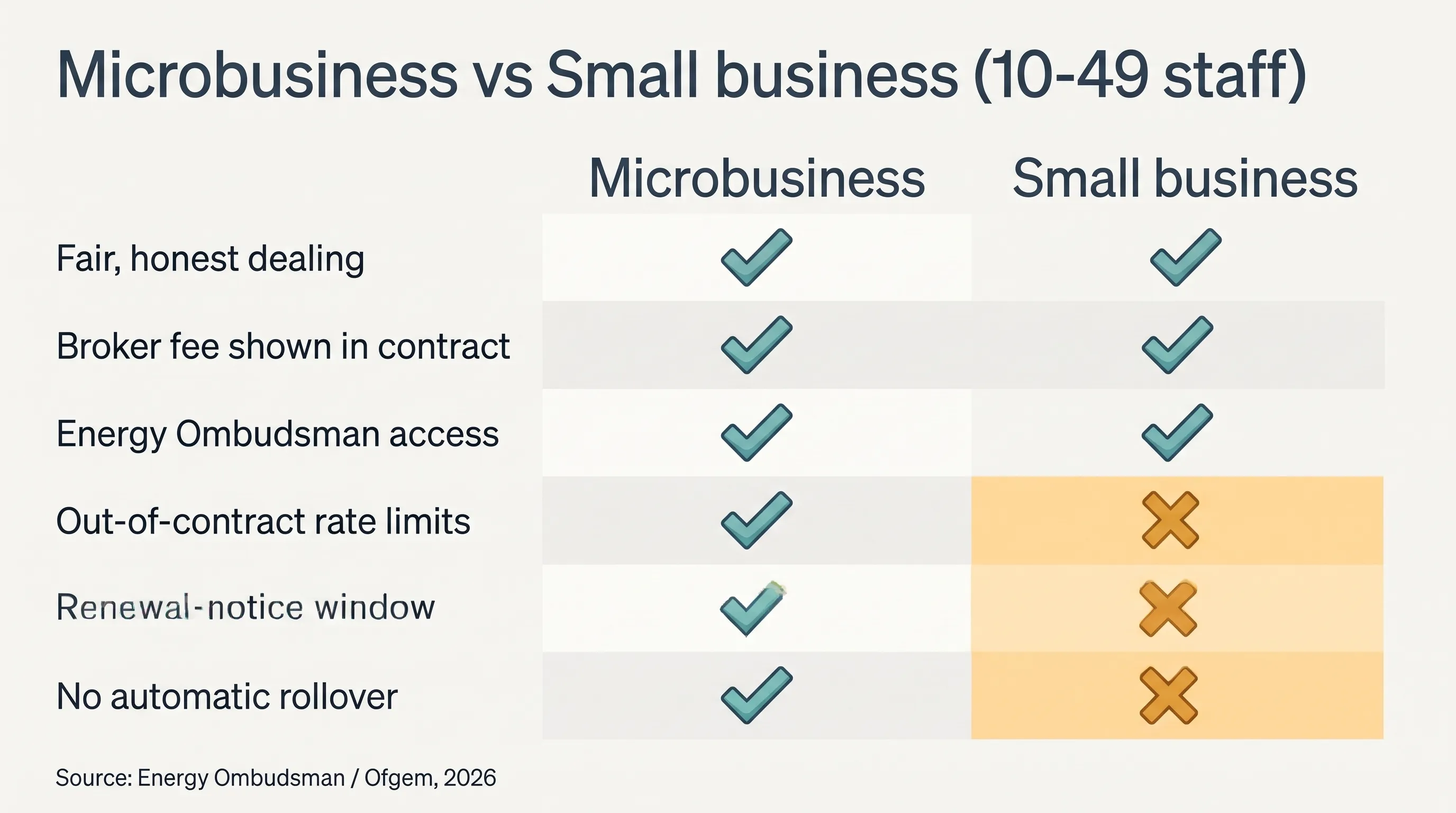
There is a further twist. The review found that around one in five small businesses that complained were treated as a microbusiness by their supplier anyway - given microbusiness contracts and protections even though the law did not require it. That is welcome, but it is discretionary: whether you get those protections can come down to your supplier’s goodwill rather than your rights. We think a protection you cannot rely on is not really a protection.
Why mis-selling hits growing businesses hardest
The data shows where the risk concentrates. Sales complaints made up 29% of small-business cases, against 15% from microbusinesses (Energy Ombudsman, 2026 (opens in new tab)) - nearly double. In plain terms, larger small businesses are more likely to feel they were talked into a contract they did not fully understand.
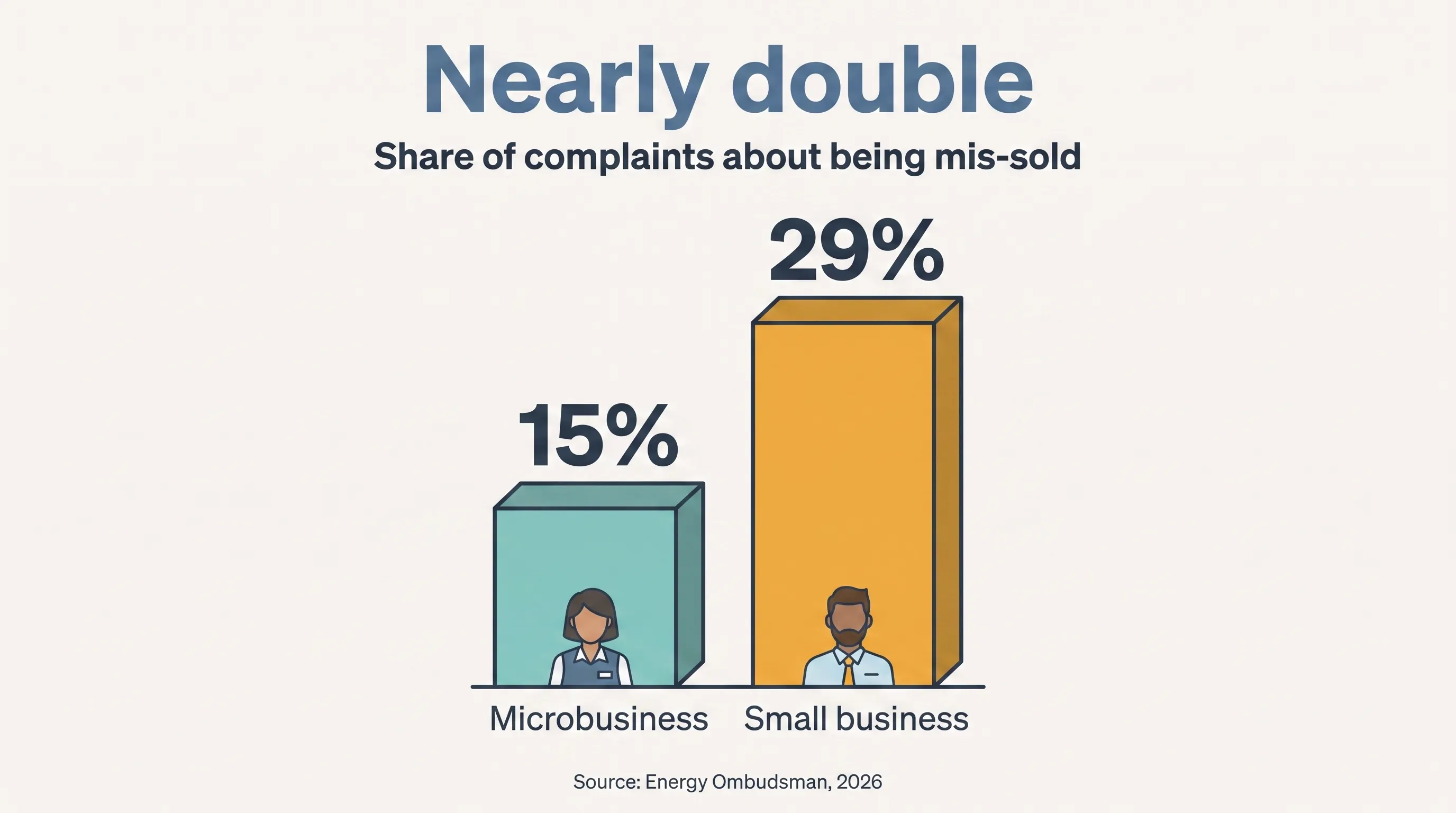
That is unlikely to be a coincidence. Businesses in the 10 to 49 band tend to run across more than one site, use more energy, and sign more complex contracts - without the microbusiness rules on how renewals and rollovers are handled. More value at stake, fewer guardrails once the contract is running.
This is where the broker model matters. Plenty of brokers do genuine work, especially on complex multi-site deals - the issue is not the people, it is the incentive. Mis-selling happens at the point of a sale, so the honest fix is to change the sale. Ofgem now requires any broker fee to be disclosed in your contract, whatever your size - a real step forward - but a fee folded into your unit rate is still a fee, and when the amount is open-ended and someone is paid to sign you up, the pull to nudge that rate higher does not vanish just because it is written down. (For how those charges are typically recovered through your rate, see how broker commissions actually work, and for the broker-side complaint numbers, the Ombudsman’s broker complaint data.)
We will be straight about where Meet George fits. Like any intermediary, we are paid through your rate - our 1p/kWh fee is added to your unit rate, the same mechanism a broker’s commission uses. The difference is that we are relentless about showing it: it is a flat, fixed 1p/kWh, and it appears in your quote, in your contract, and openly on our website, so you decide with the number in front of you. And because switching with us is self-service, there is no salesperson whose pay rises if you sign a worse deal, and we only ever use a Level 1 Letter of Authority, so nothing is signed without you.
How to protect your business if you are not a microbusiness
You cannot vote yourself back into the microbusiness rules, but you can close most of the gap yourself. Five steps:
- Work out your status. Check your headcount and your annual kWh on a recent bill against both definitions above. If you are over 100,000 kWh of electricity, assume you are a small business, not a microbusiness, whatever your headcount.
- Get the fee and the rates in writing before you sign. Ofgem now requires any broker fee to be shown in your contract’s principal terms, so ask for it in writing and check whether it is built into your unit rate. If nobody will put the number in writing, treat that as your answer.
- Diarise your renewal window and contract end date. Small businesses are not guaranteed the microbusiness renewal-notice rules, so the reminder has to be yours. Missing the window is how you roll onto out-of-contract rates.
- Only ever grant a Level 1 Letter of Authority. A Level 1 LOA lets someone gather quotes; a Level 2 lets them sign contracts for you. Without the microbusiness protections, a Level 2 is a bigger risk for a small business, not a smaller one.
- If it goes wrong, use the complaint route. Raise it with your supplier first - they have up to eight weeks to resolve it, unless they issue a deadlock letter sooner - then take it free to the Energy Ombudsman (opens in new tab).
The bottom line
Growing past the microbusiness threshold quietly moves your business into a lighter-touch part of the rulebook. You keep the right to fair treatment, the right to see any broker fee, and - since December 2024 - the right to complain, but you lose the specific microbusiness rules that restrict out-of-contract rates, guarantee a renewal-notice window and block automatic rollover. The Ombudsman’s own first-year data - 72% of complaints upheld, and sales complaints running at nearly double the microbusiness rate - suggests that gap is exactly where growing businesses get caught. Knowing which side of the line you sit on, and getting every fee in writing before you sign, is the cheapest protection you have.
Sources
- Energy Ombudsman - Small Business Disputes: Annual Review, Year 1 (19 December 2024 to 31 December 2025): energyombudsman.org/reports-and-data/small-business-annual-review (opens in new tab)
- Energy Ombudsman - Can my business get help?: energyombudsman.org/advice-for-consumers/can-my-business-get-help-from-energy-ombudsman (opens in new tab)
- Energy Ombudsman - Extends access to small businesses: energyombudsman.org/news/energy-ombudsman-extends-access-to-small-businesses (opens in new tab)
- Ofgem - Greater protection for businesses: ofgem.gov.uk/press-release/ofgem-confirms-greater-protection-businesses (opens in new tab)
Not sure which side of the microbusiness line your business sits on? The fastest place to start is your latest bill: your annual kWh is on it, and it decides more than most owners realise. Learn the terms in the energy glossary so nothing in your next contract catches you out.


