
Business energy for hairdressers Sort your salon's next energy contract between clients.
Upload your latest electricity bill. George reads it in seconds and tells you whether you're in your switching window and what to do next.
- Result in seconds
- No account needed
- No sales calls
Bill check
Read by George in seconds
- Unit rate
- 28.4p/kWh
- Standing charge
- 62.0p/day
- Contract ends
- 28 Mar 2027
Result
In your switching window
You're ready to continue with Meet George.
Too early? Ask George to remind you when it's time.
Updated
How much electricity does a hair salon use?
- Estimated use, 49 m² salon
- 13,600 kWh a year
- Estimated annual cost
- £5,220
That's an estimate for a 49 m² salon, the median size in DESNZ's building survey. Don't know how much yours uses? You don't need to work it out - upload your bill and George reads it for you.
- 20 m² 5,600 kWh £2,150 a year
- 35 m² 9,700 kWh £3,720 a year
- 49 m² (Median in the DESNZ survey) 13,600 kWh £5,220 a year
- 60 m² 16,700 kWh £6,410 a year
- 70 m² 19,400 kWh £7,440 a year
DESNZ doesn't publish a median yearly figure for salons or barbershops, so these are estimates.
How we calculated this
These estimates are floor area multiplied by the median electricity use per m² that DESNZ's Building Energy Efficiency Survey found for hairdressers and beauty salons in England and Wales in 2014-15, about 278 kWh per m² a year, from a small sample. The survey counted men's hairdressers in the same group, so the estimates are a rough guide for barbershops too. The median salon in that survey was 49 m². The estimates assume the same use per m² at every size, so treat them as a rough guide. There's no newer figure for salons alone, but DESNZ's median for all shops, from a different dataset, fell from 160 kWh per m² in 2014 to 108 in 2024. Costs use the provisional Q2 2026 average paid by businesses using up to 20,000 kWh a year (38.36p per kWh, every charge except VAT, including Climate Change Levy that salons using up to 1,000 kWh a month don't pay). Salons bigger than about 72 m² would pass 20,000 kWh a year, where a different price band applies, so they aren't shown.
Sources: DESNZ (formerly BEIS), Building Energy Efficiency Survey 2014-15, retail report and tables; DESNZ, ND-NEED 2026 (2024 data), table 9A; DESNZ, non-domestic energy prices, table 3.4.2 (Q2 2026)
How switching works with Meet George
A quick bill check first, so you only sign up when switching makes sense. Then you switch yourself, on the platform we built.
Step 1 · The bill check
See if you can switch in seconds
- Upload a recent electricity bill. No account needed.
- George reads it in seconds and tells you whether you're in your switching window and what to do next.
- Too early? Ask George to remind you when it's time.
No sales call, and no waiting for a reply.
Step 2 · Switch on Meet George
Do the whole switch yourself, online
- 01
Create your account
Sign up on Meet George. Nobody needs to call you.
- 02
Compare the contracts available to your business
Our 1p/kWh fee is shown separately on every quote.
- 03
Sign online
Your new supplier takes over from the agreed start date.
The whole switch happens on Meet George, not over the phone.
Where a salon's electricity goes
Lighting is the biggest use. DESNZ's 2014-15 building survey said decorative lighting in inefficient fittings, such as halogen spotlights, contributed to salons' high lighting use, and found that heat from lights and salon equipment meant many salons were air conditioned. Hot water comes next, and across all fuels, heating water is a salon's biggest energy job: University of Southampton research with salon owners found that heating water takes far more energy than drying hair. Swapping halogens for LEDs helps, but what you pay for each kWh comes down to your contract.
-
34% Lighting
-
21% Hot water Water heated by gas or oil isn't counted here
-
16% Heating
-
8% Cooling and fans Mostly air conditioning
-
2% Tills and office equipment
-
19% Everything else Includes other salon uses, laundry and TVs
Shares of hairdressers' electricity across the UK in 2025. DESNZ bases the split on its 2014-15 Building Energy Efficiency Survey, which groups hairdressers with beauty salons, so the shares cover both.
Four things worth checking before your salon's next contract
They can make a bigger difference to the bill than switching the straighteners off.
Has your contract ended, or did you take over the salon without one?
Taking over a salon without your own contract puts you on a deemed contract, and an expired deal can roll onto out-of-contract rates. Both usually cost more.
Look for: The tariff name and end date. "Deemed" or "out of contract" usually indicates default rates; a missing end date may just not be printed.
Read more Show less
Ofgem says you're responsible for any energy you use before your own contract starts, so tell the supplier you've taken over as soon as you can. If you're already on deemed or out-of-contract rates, Ofgem says you can switch to a new supplier at any time.
Sources: Ofgem, Switch your business energy supplier; Ofgem, Get a business energy contract; Ofgem, Change of tenancy for businesses
Is your hot water on this bill, or on a gas one?
Salons use far more electricity on hot water than shops do. If yours is heated by gas, that's a second contract with its own end date to check.
Look for: A separate gas bill, or a gas meter number (MPRN) as well as your electricity MPAN.
Read more Show less
Across all salons in DESNZ's 2014-15 survey, electric water heating averaged about 60 kWh per m² a year, compared with less than 1 kWh per m² in small shops, and that average includes salons that heat some or all of their water with gas. A gas contract has its own standing charge too, and the same survey found salons had the highest median use of gas and other fuels per m² of any kind of retail premises.
Source: DESNZ (formerly BEIS), Building Energy Efficiency Survey 2014-15, retail report and tables
Is each bill over or under the VAT limit?
A bill averaging more than 33 kWh a day normally pays 20% VAT. At DESNZ's median use per m², a salon bigger than about 43 m² would.
Look for: The VAT rate on each bill, and the kWh it covers divided by the number of days.
Read more Show less
Under the limit, HMRC treats the supply as domestic use: a lower VAT rate than 20% and no Climate Change Levy. It judges the limit on each bill, not your year, so a salon near that size can fall either side from one bill to the next. If a bill averages 33 kWh a day or less and still shows 20%, ask your supplier to correct it.
Sources: HMRC, VAT Notice 701/19, section 5.2; HMRC, VAT Fuel and Power Manual, VFUP2310; HMRC, Excise Notice CCL1/3, paragraph 2.5; DESNZ (formerly BEIS), Building Energy Efficiency Survey 2014-15, retail report and tables
Whose name is on the contract?
If paying the energy bill is your responsibility, you can choose the supplier, even if the lease names a preferred one. Check whose name the account is in.
Look for: Whose name is on the bill, and what your lease says about who pays for energy.
Read more Show less
Your landlord could be responsible instead if they pay the supplier and recharge you as a service charge, or include energy in your rent. Check your lease for clauses saying you must tell your landlord if you plan to switch, or switch back to a particular supplier when the tenancy ends. If you rent out chairs, HMRC's VAT guidelines list heat, light and water among the services the salon provides, and say agreements should be clear on what stylists pay for them.
Sources: HMRC, VAT Taxable Persons Manual, VTAXPER69100 (hairdressing); Ofgem and partners, non-domestic energy advice (2022), p.31 'If you are a tenant'
Not sure what contract you're on?
Upload your latest bill. George reads it in seconds and tells you where you stand.
Worth reading next

How we're paid
Our 1p/kWh fee on gas or electricity, who pays it and how it shows on every quote.

How to read your bill
Find your unit rate, standing charge, VAT and contract end date.
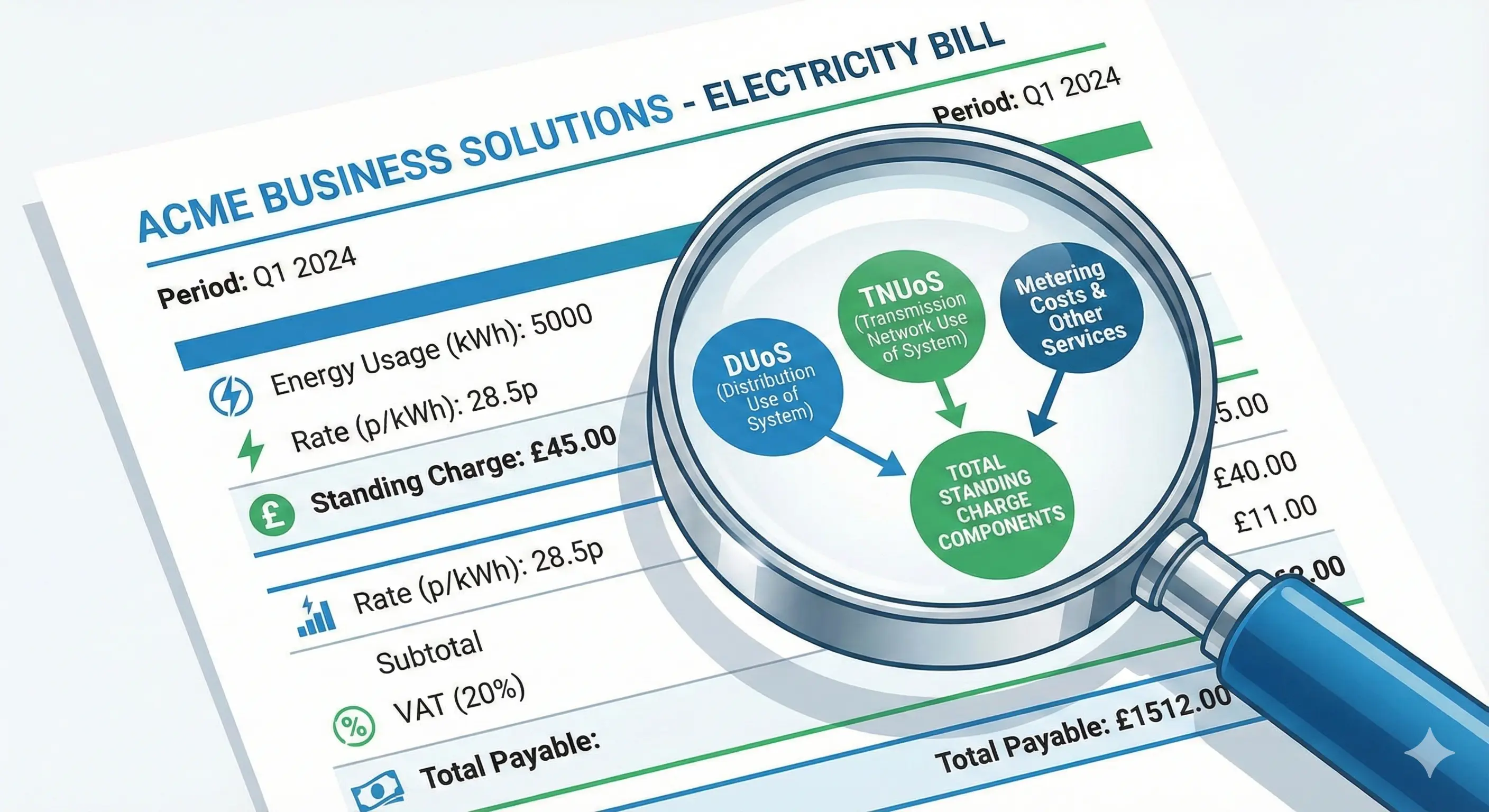
Standing charges explained
The daily charge you pay whether the salon's open or closed.
Can you cancel a business energy contract?
No cooling-off period, exit fees and what to check before you sign.
Questions salon owners ask
How much electricity does a hair salon use?
About 13,600 kWh a year for a salon of 49 m², the median size in DESNZ's Building Energy Efficiency Survey, but that's an estimate: DESNZ doesn't publish a median yearly use for salons. The survey found hairdressers and beauty salons used a median of about 278 kWh of electricity per square metre a year in 2014-15, second only to large food shops among the retail premises it covered and about two and a half times the median for small shops. Your bill shows what yours actually uses.
What's the average electricity bill for a hair salon?
There's no official figure for salons, but at an estimated 13,600 kWh a year, a 49 m² salon would pay about £5,220 a year before VAT, or £440 a month, at the provisional Q2 2026 average paid by businesses using up to 20,000 kWh a year (38.36p per kWh, including every charge except VAT). Electric water heating, air conditioning and a bigger floor area tend to push it up. If your hot water runs on gas, that's a separate bill on top.
What uses the most energy in a hair salon?
Heating water. University of Southampton research with 20 salon owners found it's the most energy-intensive activity in a salon, far more than hair drying, and DESNZ's building survey also puts hot water first once gas and other fuels are counted. On the electricity bill alone, lighting comes first at about a third, then hot water at about a fifth. The same survey found salons used more electricity per square metre on cooling than any other kind of shop, because heat from lights and salon equipment meant many were air conditioned.
Should my salon pay 20% VAT on electricity?
It depends on each bill. HMRC treats electricity averaging no more than 33 kWh a day (1,000 kWh a month) as domestic use, so there's no Climate Change Levy, no certificate needed and a lower VAT rate instead of 20%: 0% in Great Britain from 1 October 2026 to 31 March 2027, then 5% again, and 5% in Northern Ireland. Salons use a lot of electricity for their size, so check each bill rather than assuming: 20% is correct on a bill over the limit, but if a bill averages 33 kWh a day or less and still shows 20%, ask your supplier to correct it. Gas has its own limit, 145 kWh a day, and stays at 5% within it.
I rent out chairs. Who sorts the salon's energy contract?
Whoever is responsible for paying the salon's energy bill, and your lease should say whether that's you or your landlord. If it's you, Ofgem's 2022 advice for business tenants, written with Citizens Advice and Energy UK, says you can still switch even if the lease ties you to a preferred supplier, but check for clauses saying you must tell your landlord if you plan to switch, or switch back to a particular supplier when the tenancy ends. Your landlord could be responsible instead if they pay the supplier and recharge you, or include energy in your rent. HMRC's VAT guidelines for salons with self-employed stylists list heat, light and water among the services the salon provides.
Do these figures cover barbershops?
Yes. DESNZ's building survey sampled men's hairdressers in the same group as hair and beauty salons, so the estimates and the electricity split on this page cover barbershops too. DESNZ doesn't publish separate figures for barbers, so your own bill is the only exact figure for your shop.
I rent a chair or space in a salon or barbershop. Who pays for the electricity?
It depends on your agreement. HMRC's guidance gives the example of a barbershop owner who rents chairs to self-employed barbers, taking an agreed percentage of every appointment as rent and adding VAT for the chair, and HMRC's guidelines say chair agreements should be clear on services such as heat, light and water. So check what your agreement says your rent covers. The energy contract itself belongs to whoever is responsible for paying the premises' energy bill, so check whose name the account is in.
I've just taken over a salon. What happens to the energy?
Tell the current supplier as soon as you can, with a meter reading if you can take one: Ofgem says both the business moving in and the one moving out should. The supplier can ask for evidence such as your lease and reviews it within 10 working days. You're responsible for any energy you use before your own contract starts, and moving in without arranging one puts you on a deemed contract, at rates Ofgem says are usually higher than negotiated ones.
Is there a cooling-off period on a salon's energy contract?
No. Ofgem says there's no cooling-off period on a business energy contract, so check the terms and fees before you sign, and if a contract is offered over the phone, ask for it in writing before you agree. Checking your bill takes seconds; signing shouldn't be rushed. On Meet George you compare electricity contracts and sign online in your own time, with our 1p/kWh fee shown separately on every quote.
What does Meet George cost a salon?
A flat 1p per kWh, and you only pay it if you switch through Meet George. For a salon using an estimated 13,600 kWh a year, that's £136 a year. The same 1p per kWh applies to gas. Electricity switches happen online; gas isn't on the platform yet, so for now our team arranges gas contracts with you directly. You pay the fee through your energy supplier, and it's itemised on every quote, never buried.
Sources (16)
DESNZ (formerly BEIS), Building Energy Efficiency Survey 2014-15, retail report and tables; DESNZ (formerly BEIS), Building Energy Efficiency Survey 2014-15, Appendix B, table 1.4; HMRC, Check employment status if you work in hair and beauty; DESNZ, Energy Consumption in the UK 2026, table U6; University of Southampton, Building sustainability into hair and beauty (2019); DESNZ, non-domestic energy prices, table 3.4.2 (Q2 2026); HMRC, VAT Notice 701/19, section 5.2; HMRC, VAT Fuel and Power Manual, VFUP2310; HMRC, Revenue and Customs Brief 10 (2026); HMRC, Excise Notice CCL1/3, paragraph 2.5; HMRC, VAT Taxable Persons Manual, VTAXPER69100 (hairdressing); Ofgem and partners, non-domestic energy advice (2022), p.31 'If you are a tenant'; Ofgem, Change of tenancy for businesses; Ofgem, Switch your business energy supplier; Ofgem, Get a business energy contract; Ofgem, Managing business energy costs in an uncertain market (blog)
Your salon's next energy contract, sorted between clients.
Upload your latest bill. George reads it in seconds and tells you what to do next. If you're ready to switch online, you can continue with Meet George.
- Result in seconds
- No account needed
- No sales calls


