

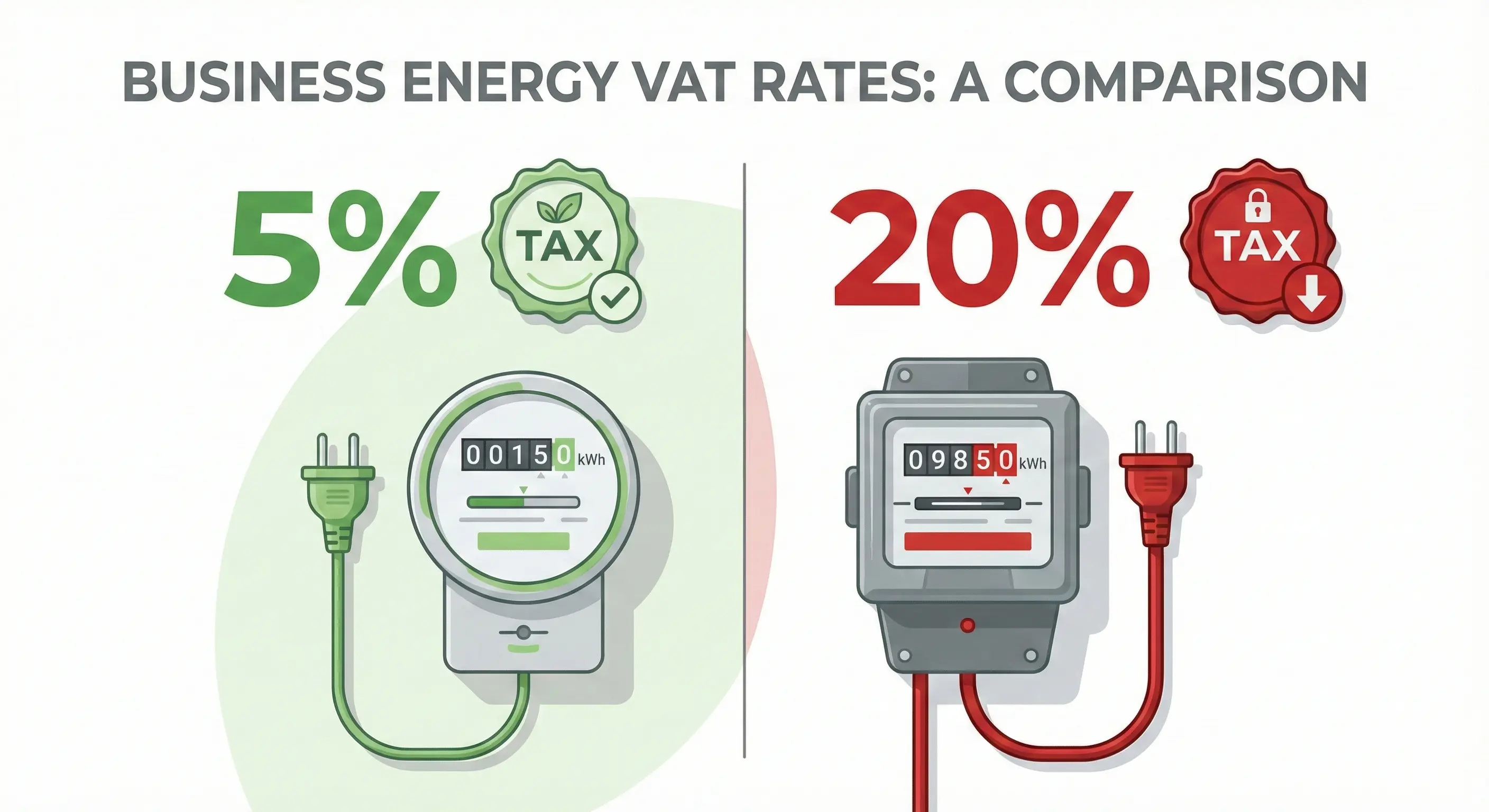
Quick answer: VAT on business electricity and gas is charged at the standard rate of 20%. The reduced rate of 5% applies to “qualifying use” - domestic or residential use and a charity’s non-business use, with the whole supply reduced-rated where 60% or more of it is for qualifying use - and to small “de minimis” supplies of not more than 33 kWh of electricity or 145 kWh of gas a day on average, which HMRC treats as domestic use even when the customer is a business (VAT Notice 701/19 (opens in new tab)). From 1 October 2026 to 31 March 2027, qualifying electricity in Great Britain is zero-rated (0% VAT) instead of 5%.
Update, 24 September 2026: From 1 October 2026 to 31 March 2027, qualifying electricity supplied in Great Britain (England, Scotland and Wales) is zero-rated (0% VAT) instead of charged at 5%, under a temporary measure the government announced on 21 July 2026 (HMRC Revenue and Customs Brief 10 (2026) (opens in new tab)). Who qualifies has not changed. Qualifying gas stays at 5%, as does qualifying electricity in Northern Ireland, and business use that does not qualify is still 20%. If a bill covers 1 October 2026, suppliers may split it by when the energy was used. This guide has also been checked against HMRC’s updated fuel and power notice (VAT Notice 701/19) (opens in new tab).
TL;DR: Key Takeaways
In short: Most UK businesses pay 20% VAT on energy, but supplies that qualify pay the reduced rate of 5% - and from 1 October 2026 to 31 March 2027, qualifying electricity in Great Britain is zero-rated (0% VAT). On an electricity bill of around £5,700 a year before VAT, the gap between 20% and 5% is roughly £855 per year - money that’s yours if your supply qualifies and you know the rules. (Illustrative: a 15 percentage point gap on £5,700.)
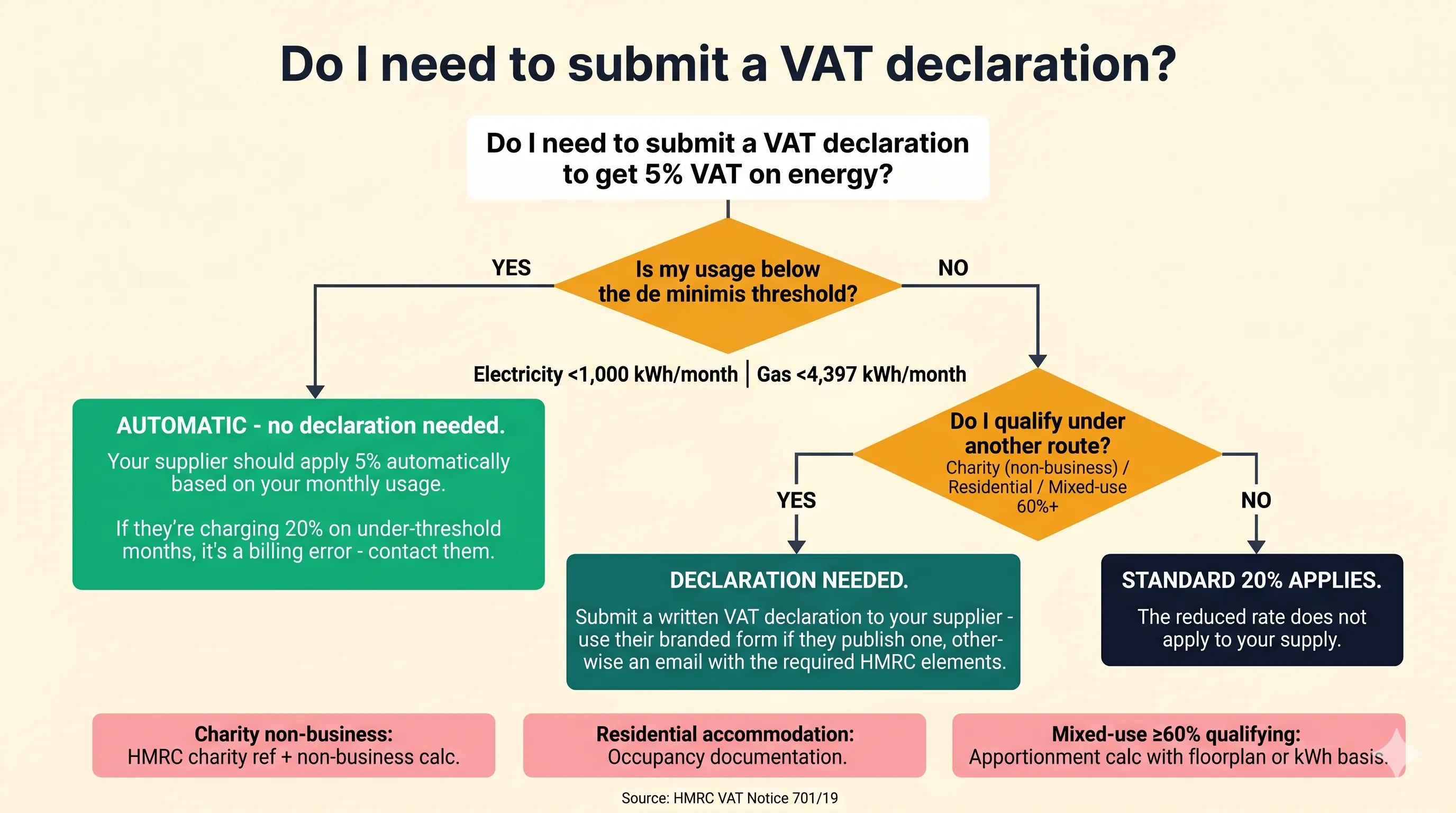
The De Minimis Rule: If the electricity supplied to one of your premises averages no more than 1,000 kWh a month (or 4,397 kWh of gas), that supply gets the reduced rate automatically - no certificate needed. HMRC always treats these supplies “as being made for domestic use, even when the supply is to a business customer”.
Suppliers Default to 20%: For every other route - residential use, a charity’s non-business use, mixed-use premises - suppliers charge 20% until you declare that the supply qualifies, usually on a VAT declaration certificate. If you’re within de minimis and your bill shows 20%, query it.
How to Apply: Within de minimis there is nothing to apply for. For every other route, send your supplier its VAT declaration form with evidence of the qualifying use, then check the rate on your next bill.
You Can Claim Refunds: If you’ve been overcharged, ask your supplier for a refund - it can claim overpaid VAT back from HMRC for up to 4 years. That’s potentially £3,400+ (illustrative, based on the ~£855/year example above).
Temporary 0% on GB Electricity: On 21 July 2026 the government announced that qualifying electricity in Great Britain would be zero-rated from 1 October 2026 to 31 March 2027. Gas, Northern Ireland electricity, the 20% standard rate and the de minimis limits are unchanged. The November 2025 Budget made no changes to energy VAT.
What Are the VAT Rates on Business Energy?
Business energy VAT rates are 20% as standard, 5% for qualifying supplies, and 0% on qualifying electricity in Great Britain from 1 October 2026 to 31 March 2027. The standard VAT (opens in new tab) rate on business electricity and gas in the UK is 20% - it is what most businesses pay, and what energy suppliers charge by default.
However, HMRC provides a reduced rate of 5% for qualifying uses. The most common qualification route for microbusinesses and small businesses is the de minimis threshold - essentially, if a premises uses no more than a set amount of energy, HMRC treats the supply as domestic use and the lower rate applies.
The temporary zero rate: From 1 October 2026 to 31 March 2027, qualifying electricity supplied in Great Britain is zero-rated (0% VAT) rather than charged at 5%. Qualifying gas stays at 5%, and so does qualifying electricity in Northern Ireland. HMRC is explicit that “there are no changes to the supplies of electricity that qualify for relief” - if your electricity in Great Britain qualified for 5% before, it is charged at 0% in that window. Where a billing period includes 1 October 2026, HMRC says suppliers may work out the VAT based on the date the energy is consumed, and recommends using meter readings to split the bill.
Here’s the problem: unless your supply is within de minimis, suppliers bill at 20% until you tell them it qualifies. They apply the standard rate and wait for you to tell them otherwise.
A business that qualifies but is billed at 20% pays 15 percentage points more VAT than it should - 20 points on qualifying GB electricity while the zero rate applies. On a £5,000 annual electricity bill (including VAT at 20%), that’s £625 per year going straight to HMRC that didn’t need to.
The De Minimis Threshold: Do You Qualify for 5%?
The de minimis rule is simple: if the energy supplied to one of your premises is not more than certain limits, that supply qualifies for the reduced rate - no questions asked about what the energy is used for, and no certificate needed. HMRC’s guidance is that “supplies within the limits should be taxed at the reduced rate”.
Electricity De Minimis Threshold
| Period | Threshold |
|---|---|
| Daily (average) | Not more than 33 kWh |
| Monthly (average) | Not more than 1,000 kWh |
| Annual (equivalent) | About 12,000 kWh |
Gas De Minimis Threshold
| Period | Threshold |
|---|---|
| Daily (average) | Not more than 145 kWh (5 therms) |
| Monthly (average) | Not more than 4,397 kWh (150 therms) |
| Annual (equivalent) | About 52,764 kWh |
HMRC sets the limits as an average daily or monthly rate of supply, to one customer at any one of the customer’s premises, and applies them whether the bill is based on a meter reading or an estimate. The law counts all the electricity (or gas) the same supplier provides you at those premises, so two meters with one supplier are added together, and HMRC works the daily average out over the whole period each bill covers (VFUP2310 (opens in new tab)). A business with several sites is judged site by site. The annual figures are the monthly limit multiplied by 12.
How to check: Look at your latest bill for your monthly or annual consumption. If you’re within these limits, you should be paying 5% VAT on gas and 5% on electricity - or 0% on electricity in Great Britain from 1 October 2026 to 31 March 2027. If you’re being charged 20%, you’re overpaying.
Or let Meet George do the sum: upload your latest electricity bill and Meet George’s free bill check works out your daily average from the bill’s own dates and checks the VAT you’re charged against HMRC’s limit, in seconds.
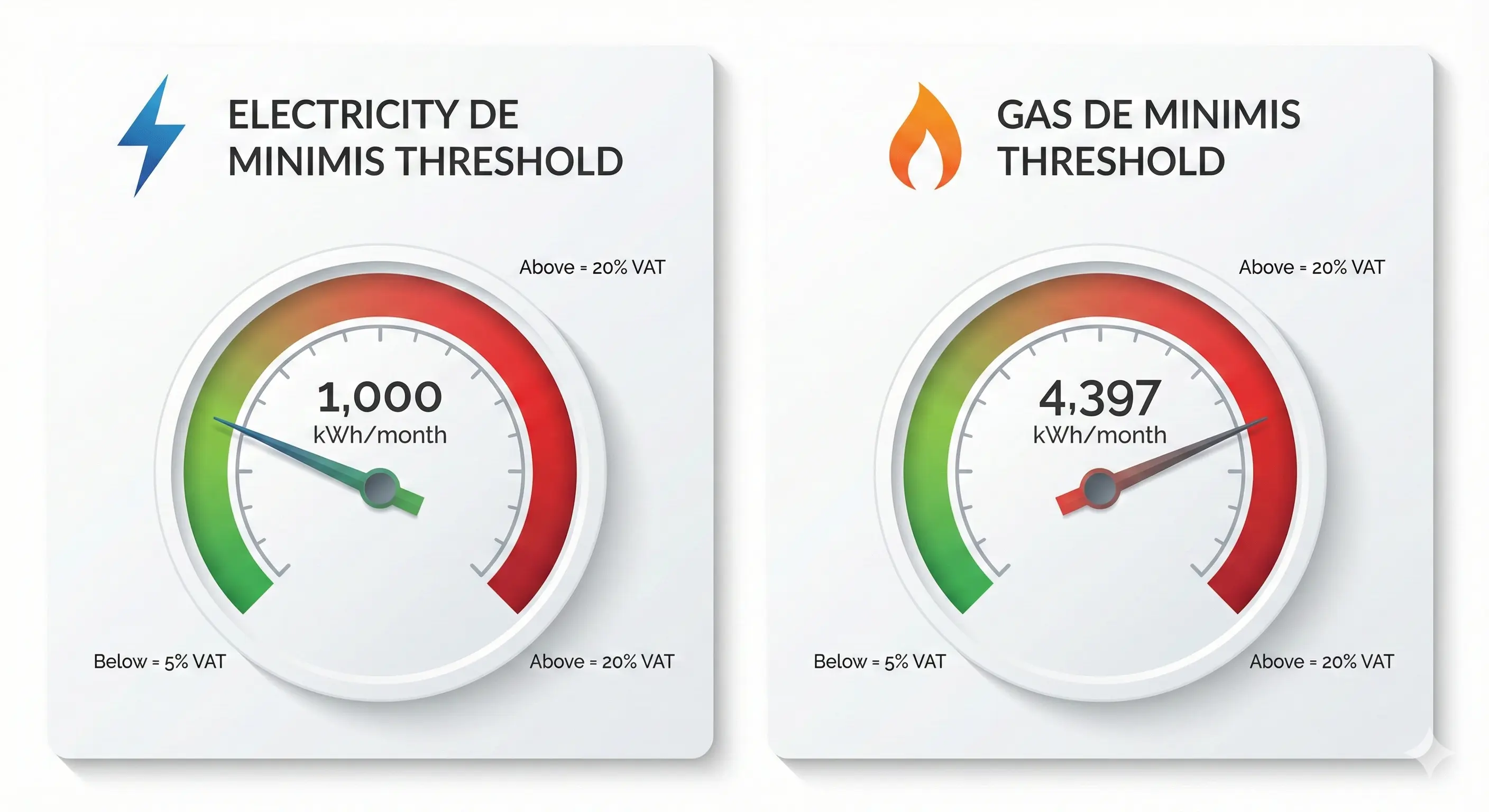
The graphic shows the 5% reduced rate. From 1 October 2026 to 31 March 2027, qualifying electricity in Great Britain is zero-rated (0% VAT), and a supply above these limits can still qualify through residential use, a charity’s non-business use or mixed use.
Who Else Qualifies for 5% VAT?
Beyond the de minimis rule, a supply qualifies for the reduced rate regardless of volume if the energy is for domestic use or a charity’s non-business use. In Great Britain, qualifying electricity in these categories is zero-rated from 1 October 2026 to 31 March 2027.
Qualifying Uses
- Charities - For non-business use. HMRC says a charity’s activities are generally non-business if it does not make a charge; supplies for no charge or a nominal charge are normally non-business, and supplies made for remuneration are normally business
- Care homes, children’s homes and hospices - Residential accommodation, including homes providing care for elderly or disabled people
- Self-catering holiday lets - Treated as domestic use
- Student halls of residence - School and university residential accommodation for students or pupils
- Homes, flats, caravans and houseboats - Including flats where each tenant is billed on their own meter
Places of worship are not a category of their own: they can qualify only through a charity’s non-business use or de minimis. Hotels, inns, hospitals and prisons do not count as residential accommodation.
These routes are about use, not volume, so your supplier has to be satisfied that the supply qualifies - HMRC can make a supplier pay VAT it undercharged if it cannot show it took reasonable steps. Expect to complete a VAT declaration.
Mixed-Use Premises (60% Rule)
If your premises uses 60% or more of its energy for qualifying purposes (domestic use or a charity’s non-business use), the entire supply is charged at the reduced rate.
For example: a building on one supply where 70% of the electricity goes to residential flats and 30% to a ground-floor office qualifies for the reduced rate on the whole bill.
For premises below 60% qualifying use, you can still claim apportioned VAT - the reduced rate on the qualifying portion and 20% on the rest. Either way, HMRC says the supplier should get a certificate from you stating the exact percentage of qualifying use, you may need to send the calculation behind it, and you must tell the supplier if that use changes.
The Real Cost: How Much Are You Losing?
The difference between 5% and 20% VAT is substantial. Here’s what a business loses each year if its supply qualifies but it is charged 20%. The bills are illustrative round figures, and the overpayment is simply 15% of the bill before VAT:
Electricity VAT Overpayment (Annual)
| Business Size | Annual Bill (before VAT) | VAT at 5% | VAT at 20% | Annual Overpayment |
|---|---|---|---|---|
| Micro (home office, small shop) | £2,700 | £135 | £540 | £405 |
| Small (e.g. self-catering holiday let) | £5,700 | £285 | £1,140 | £855 |
| Medium (e.g. small care home, or flats on one supply) | £11,500 | £575 | £2,300 | £1,725 |
Between 1 October 2026 and 31 March 2027, qualifying electricity in Great Britain is zero-rated, so for those six months the gap is the full 20% of the bill rather than 15 percentage points.
Gas VAT Overpayment (Annual)
| Business Size | Annual Bill (before VAT) | VAT at 5% | VAT at 20% | Annual Overpayment |
|---|---|---|---|---|
| Micro | £920 | £46 | £184 | £138 |
| Small | £1,830 | £92 | £366 | £274 |
| Medium | £3,690 | £185 | £738 | £553 |
Check your kWh, not your bill size: the electricity limit works out at about 12,000 kWh a year at each premises, but it’s judged bill by bill, and a bill over it qualifies only through residential use, a charity’s non-business use or mixed use.
Combined electricity and gas: On the “small” rows above, paying 20% instead of 5% on both fuels costs approximately £1,130 per year. Over a 3-year fixed-term contract, that’s £3,390.
Why Suppliers Charge 20% by Default
There are three reasons suppliers default to the higher rate:
1. It’s Safer for Them
If a supplier charges the reduced rate to someone who doesn’t qualify and cannot show HMRC it took reasonable steps to check, it can be made to pay the VAT it undercharged. Charging 20% means it never underpays HMRC - the risk sits entirely with you.
2. There’s No Upside in Checking
The extra VAT goes to HMRC, not into the supplier’s profit, so overcharging earns them nothing. But billing at 20% creates no friction for them either, and undercharging is the only mistake that costs them.
3. The Paperwork Comes From You
For de minimis supplies the burden is not on you: HMRC says they should be taxed at the reduced rate, with no certificate needed. For every other route, the supplier has to be satisfied the supply qualifies, and for mixed-use premises HMRC’s VAT Notice 701/19 (opens in new tab) tells suppliers to get a certificate from the customer. Suppliers are following the rules - they’re just not being helpful about it. Ofgem, the energy regulator, doesn’t directly govern VAT - this is HMRC’s domain.
How Do I Apply for the 5% VAT Rate?
If your supply is within the de minimis limits, you don’t apply at all - HMRC says “You do not need a certificate to apply the reduced rate to such supplies” (VAT Notice 701/19 (opens in new tab)). If your bill still shows 20%, that’s a billing error: ask the supplier to correct it and send your meter readings as evidence. For every other route - residential use, a charity’s non-business use or mixed use - you send your supplier a VAT declaration certificate with evidence of the qualifying use. Don’t expect the reduced rate to appear on its own: HMRC’s manual notes that “the default position for many suppliers is that supplies to a new non-domestic customer are standard-rated unless a certificate is received” (https://www.gov.uk/hmrc-internal-manuals/vat-fuel-and-power/vfup2530 (opens in new tab)).
The temporary zero rate adds no paperwork: HMRC’s impact note (opens in new tab) says the self-certification requirements are “exactly the same regardless of whether the VAT rate is 5% or 0%”.
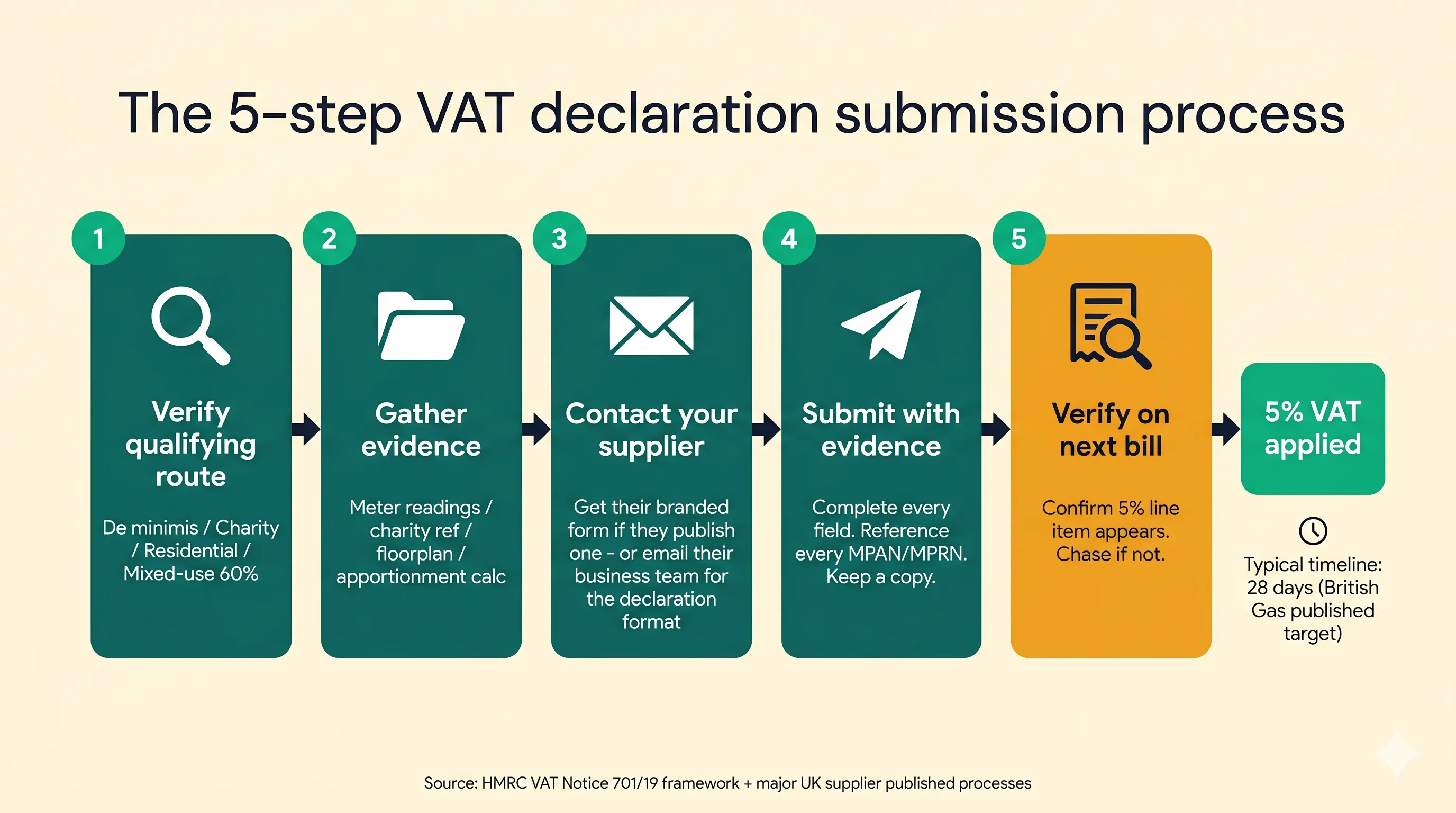
Step 1: Confirm Your Qualifying Route
Work out which route you fit: de minimis, a charity’s non-business use, residential use, or mixed use (see who else qualifies). If you are close to a line - around 1,000 kWh of electricity a month, or just under 60% qualifying use - work the figures out precisely rather than rounding.
Step 2: Gather Your Evidence
| Qualifying route | Evidence to have ready |
|---|---|
| De minimis | No declaration needed - but if you’re wrongly charged 20%, 12 months of meter readings showing usage within the limits |
| Charity (non-business use) | Charity Commission number or HMRC charity reference, plus the share of non-business use if any of the premises is used for business (a charity shop’s trading floor, for example) |
| Residential | Documents showing the use, such as a lease, licence or occupancy schedule |
| Mixed use | Your calculation of the qualifying percentage - by floor area or by kWh - with the method and figures behind it |
Charities: HMRC’s charities notice is plain that “A charity must give its supplier evidence that it is a charity. If asked for further evidence the charity must be able and willing to give it before VAT relief can be given” (VAT Notice 701/1 (opens in new tab)). If your charity isn’t registered with the Charity Commission, the confirmation HMRC sends when it recognises your charity for tax purposes (opens in new tab) carries the HMRC charity reference suppliers ask for. The test for non-business use is whether the charity charges: “If a charity does not make a charge, its activities are generally non-business” (VAT Notice 701/19, paragraph 3.3). Space used for paid events or room hire is business use.
Step 3: Get Your Supplier’s Form
Use your supplier’s own VAT declaration form if it publishes one - it asks for exactly what that supplier needs. HMRC does not prescribe a form: its manual says customer certificates “are the usual way of evidencing qualifying use but are not legally required” (https://www.gov.uk/hmrc-internal-manuals/vat-fuel-and-power/vfup2530 (opens in new tab)). If your supplier has no form, email its business team and ask for its process, or send a written declaration.
For mixed use, VAT Notice 701/19, paragraph 3.5 (opens in new tab) lists what the certificate should show:
- the supplier’s name and address
- your name, address and VAT registration number
- the address of the premises the supply relates to
- the qualifying use as a percentage of total use - “always give an exact percentage”
- a declaration by a responsible officer, with their signature, name, position and the date
Supplier forms also ask for your MPAN or MPRN, so put them on a written declaration too. HMRC asks for a separate certificate for each premises, and warns that “Anyone providing an incorrect certificate may be liable to a financial penalty”.
Step 4: Submit Everything in One Go
- Use the account holder’s name exactly as it appears on your bill, including “Ltd” or any trading name
- List every MPAN (electricity) and MPRN (gas) at the premises - Engie, for example, asks for all meters at the site
- Send the form and evidence together, through the channel your supplier asks for
- Keep a copy of everything, with the date sent and any reference number
- If you were eligible earlier and want a refund, ask for it in the same submission (see backdating)
For suppliers that take declarations by email, a short cover note helps. Copy and adapt:
Subject: VAT declaration - Account [account number], MPAN [MPAN]

Dear [Supplier] Business Team,

Please find attached our signed VAT declaration for the above
account, certifying qualifying use under [charity non-business use /
residential use / mixed use of [X]%], with supporting evidence.
Please apply the reduced rate from [effective date] and confirm the
date from which it will apply.

[Optional:] We were eligible from [date] and request a backdated
refund of overpaid VAT of £[amount] for [start date] to [today].
Calculation attached.

Yours sincerely,
[Name], [Position]
[Account holder name as on bill] | [Phone] | [Email]
Step 5: Check Your Next Bill
- Look for the reduced rate on the qualifying consumption: 5% on gas, and 0% on qualifying electricity in Great Britain from 1 October 2026 to 31 March 2027
- Check the maths: the charge before VAT multiplied by the rate should equal the VAT line (nil on zero-rated electricity)
- Below 60% qualifying use, expect two VAT lines - the reduced rate on the qualifying share, 20% on the rest
- A bill that spans 1 October 2026 may also show two rates, split by when the energy was used
- If the bill still shows 20%, contact the supplier with your submission date and reference and ask whether the declaration was accepted, is in review or was rejected
Where to Find Your Supplier’s VAT Declaration Form
This is a reference for customers of these suppliers, not a full list - the rules are HMRC’s and the same everywhere; only the form and the channel differ. All nine suppliers’ forms, pages and email addresses checked on 15 October 2026:
| Supplier | Form / submission route | Notes |
|---|---|---|
| British Gas Business | Online VAT reduction application (opens in new tab) | Aims to review within 28 days. Separate online forms for gas and electricity. Electricity customers already on the reduced rate “don’t need to do anything” for the 0% rate. |
| EDF | SME VAT FAQs (opens in new tab) - Customer Declaration Certificate | Says it can backdate relief “for a maximum of 4years (if appropriate)”. |
| Engie | VAT Certificate Declaration page (opens in new tab) - email customerdata@engie.com or post | Declarations not completed in full “will not be processed and will be returned”. Backdating up to 4 years, at its discretion. |
| E.ON Next | Request the form from hellobusiness@eonnext.com (business help (opens in new tab)) | Form sent on request. |
| TotalEnergies Gas & Power | VAT eligibility page (opens in new tab) - email the form to contactus@business.totalenergies.uk | ”To ensure you’re paying the correct VAT, we must receive a valid exemption certificate.” |
| SSE Energy Solutions | VAT Declaration Form V2 (opens in new tab) (PDF) - email sme.southern.business@sse.com | Asks for every MPAN/MPRN and, below 100% relief, the method and calculation behind the percentage. |
| Sefe Energy (formerly Gazprom Energy) | VAT help page (opens in new tab) - email customeronboarding@sefe-energy.com | |
| Crown Gas & Power | VAT declaration page (opens in new tab) - online form | Charities “may be able to claim a rebate for up to 12 months from the date we receive a valid VAT Certificate”. |
| npower Business Solutions | Separate PDFs for electricity (opens in new tab) and gas (opens in new tab) - email yourbusiness@npower.com | Supporting spreadsheet needed for more than 10 MPANs. |
If your supplier isn’t listed, look for a “VAT declaration” or “VAT reduction” page in its business help section, or email its business team.
How to Avoid a Rejected Declaration
| Check | Why it matters |
|---|---|
| Name matches the account holder exactly | The supplier has to match the declaration to your account |
| Every MPAN and MPRN at the premises is listed | Meters left off can’t be matched to the declaration |
| Mixed-use percentage is calculated, not estimated | HMRC tells customers to “always give an exact percentage” |
| Every field is complete, including the effective date and signature | Engie returns declarations that are not completed in full |
| You use the supplier’s current form, if it has one | Forms change - SSE’s current form is V2 |
| Evidence is attached | Charity, residential and mixed-use claims need it - see Step 2 |
Will the Reduced Rate Be Backdated?
Not automatically. Suppliers usually apply the reduced rate from the date of a valid declaration - British Gas, for example, says “We’ll back date from the date we receive a valid VAT certificate”. Backdating to an earlier period is up to the supplier: HMRC’s manual calls it “a commercial decision between the supplier and the customers” (https://www.gov.uk/hmrc-internal-manuals/vat-fuel-and-power/vfup2530 (opens in new tab)). Suppliers can claim overpaid VAT back from HMRC for up to 4 years, so their limits sit within that - EDF and Engie say up to 4 years, and Crown Gas & Power says up to 12 months for charities. Ask for it explicitly, with a figure, and if you have already overpaid see how to reclaim overpaid VAT.
Don’t Submit a Declaration You Can’t Substantiate
The penalty risk sits with whoever gives the declaration. HMRC’s manual says “A customer who provides an incorrect certificate is liable to a penalty”, and where the supplier took all reasonable steps to check the declaration, HMRC will not recover the tax from the supplier (https://www.gov.uk/hmrc-internal-manuals/vat-fuel-and-power/vfup2530 (opens in new tab)).
- The penalty equals the VAT undercharged. Under section 62 of the VAT Act 1994 (opens in new tab), whoever gives an incorrect certificate is liable to a penalty equal to the difference between the VAT charged on the strength of it and the VAT that should have been charged. HMRC’s penalties manual (opens in new tab) says it is “charged at 100% of the tax”.
- HMRC doesn’t have to prove intent. Its guidance to officers (opens in new tab) says “We do not have to show intention or dishonesty, only that the certificate is incorrect.” The defence is a reasonable excuse.
- When no penalty should be charged: the same guidance says “If the person who gives the incorrect certificate is registered for VAT and could have claimed back all of the VAT which was not charged due to the incorrect certificate as input tax, no incorrect certificates penalty should be charged.”
Where to be careful:
- Rounding up to clear 60%. If the real qualifying share is 52% and the declaration says 65%, the certificate is incorrect.
- Certifying 100% because you’re usually within de minimis. HMRC’s manual flags this as a known source of errors when usage later goes over the limits.
- “Non-profit” is not the same as “charity”. You need evidence of charitable status.
If you’re unsure, check VAT Notice 701/19 (opens in new tab) or take a tax adviser’s view before you submit.
How Do I Reclaim Overpaid VAT on Business Energy?
Ask your energy supplier - not HMRC - to refund the difference, going back up to 4 years. If your supply qualified for the reduced rate but you were charged 20%, send the supplier your evidence, a calculated figure and a written request for the backdated refund; if it refuses, make a formal complaint, then take it to the Energy Ombudsman. HMRC is clear that this is between you and your supplier (VAT Notice 700/45 (opens in new tab)):
“If you think you’ve been wrongly charged an amount as VAT by your supplier, this is a commercial matter. You should seek a refund from your supplier. If you overpaid your supplier and your supplier accounted to HMRC for a corresponding amount, they can make a refund claim to HMRC in order to reimburse you.”
Not sure whether a site is under the de minimis limit? Upload its latest electricity bill and Meet George’s free bill check works out the daily average from the bill’s own dates and checks the VAT you’re charged against HMRC’s limit, in seconds.
How Far Back Can You Reclaim?
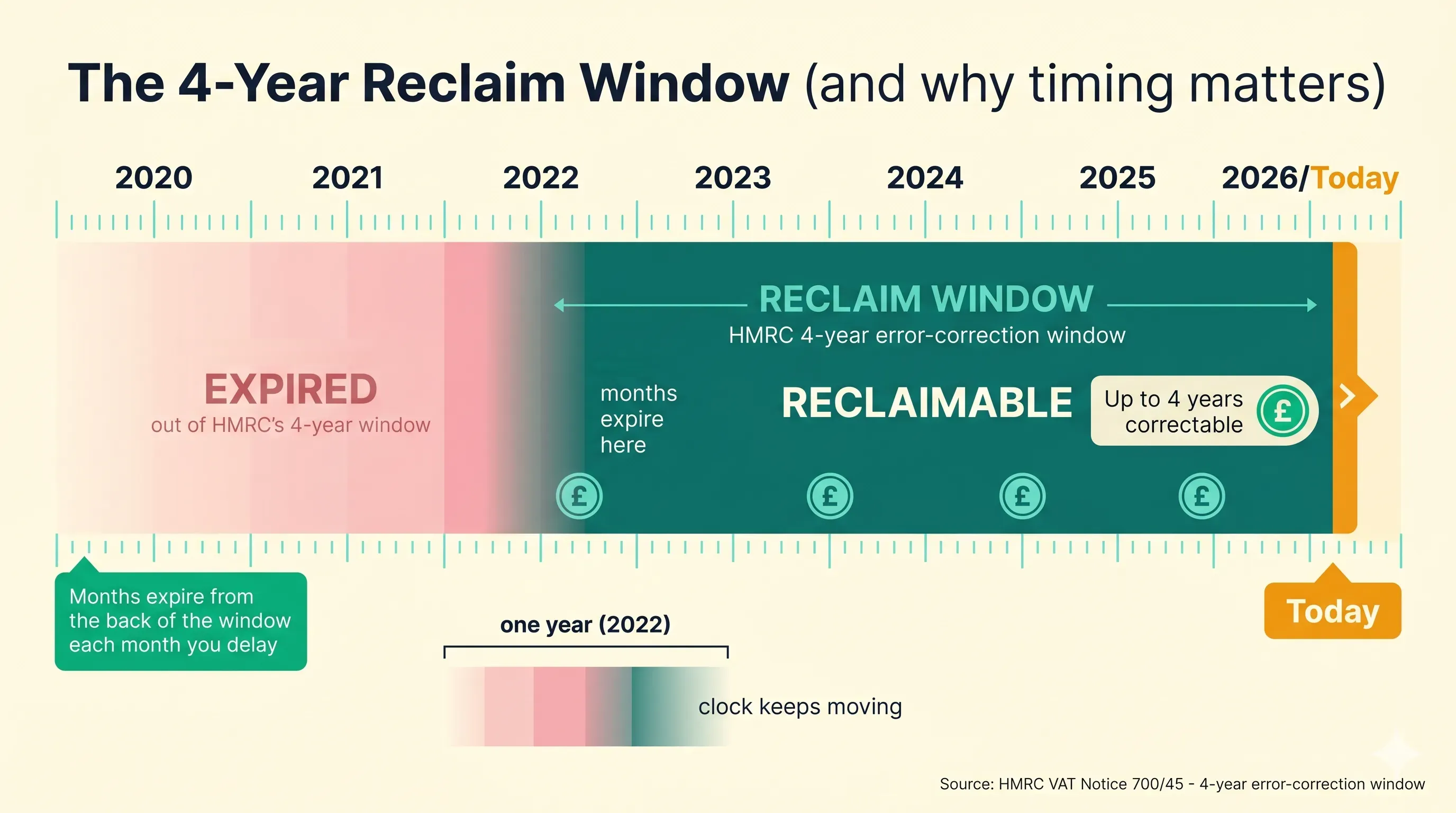
Up to 4 years. HMRC limits a supplier’s claims for overpaid VAT to 4 years, counted from the end of the VAT accounting period in which the error was made (VAT Notice 700/45, sections 4.7 and 5.2), so that is the most you can ask for. Within that cap, backdating a declaration is the supplier’s call: HMRC’s fuel and power manual (opens in new tab) says the supplier “may agree to adjust the VAT” and calls it “a commercial decision between the supplier and the customers”. Supplies within the de minimis limits are different: VAT Notice 701/19 (opens in new tab) says they “should be taxed at the reduced rate”, so 20% on them was the supplier’s own error.
Two reasons not to wait:
- The window keeps moving. Every month you delay, the oldest month falls off the back of the 4 years. If you were overcharged from May 2022 and file in May 2026, you get the full window; file in August 2026 and you lose three months.
- The refund is a separate request. A declaration or a corrected rate only changes future bills. Ask for the backdated refund explicitly, in writing, at the same time.
Step 1: Gather Evidence the Supplier Will Accept
Pull at least 12 months of bills and meter readings. The de minimis limit is an average worked out over each bill, not over the year - HMRC says the daily rate “should be calculated over the entire period of the bill” (VFUP2310 (opens in new tab)) - so one high-usage bill can go over it. Most refusals come down to evidence:
| Accepted | Rejected |
|---|---|
| 12+ months of supplier-issued meter readings showing each bill within the limit | Your own readings only, or a 3-month sample |
| HMRC charity reference with a written declaration of non-business use | ”We are a not-for-profit” without a charity reference |
| A floorplan or schedule with the qualifying percentage worked out | ”Around 60-70%” with no measurement |
| Bills listed by date, MPAN or MPRN, and amount | One round-number total with no working |
| A written request naming the period and the £ figure | A general “please refund overpaid VAT” |
Step 2: Calculate the Overpayment
The overpayment is 15% of the bill before VAT, per year, per meter - the gap between 20% and 5%. For a small office:
- Annual electricity bill before VAT: £4,200
- VAT charged at 20%: £840
- VAT that should have been charged at 5%: £210
- Overpayment: £630 a year, or £2,520 over 4 years
For qualifying electricity in Great Britain from 1 October 2026 to 31 March 2027, the correct rate is 0%, so the overpayment for those months is the full 20%. Work out gas and each meter separately, show the figure for every billing period, and attach your working: suppliers rarely accept a total without it.
Step 3: Send One Request With Everything In It
Send, in one go:
- A VAT declaration certificate, if your route needs one - for residential, charity or mixed use, not for de minimis (see how to apply).
- The evidence and your calculation.
- A written request for the backdated refund, naming the period and the amount.
Sending the going-forward correction first and the refund later tends to split them into two tickets, and the refund part stalls. Email it, and if the supplier has a portal, upload it there too and keep the trail. Copy and adapt:
Subject: VAT reclaim request - Account [account number], MPAN [MPAN]

Dear [Supplier] Business Team,

I am writing to request a refund of overpaid VAT on the above account
for the period [start date, max 4 years back] to [today's date]. My
business qualifies for the reduced VAT rate under [de minimis /
charity / residential / 60% mixed-use rule] - evidence attached.
[Mixed-use, charity or residential only: I attach a signed VAT
declaration certificate so the reduced rate applies going forward.]
[De minimis only: please also apply the correct rate going forward -
HMRC's VAT Notice 701/19 (para 3.2.2) says no certificate is needed
for supplies within the de minimis limits.]

In line with the 4-year time limit in HMRC's VAT Notice 700/45, please
refund the difference between the 20% VAT charged and the correct
rate for this period, totalling £[amount] across this meter.
Calculation attached.

Please acknowledge receipt within 5 working days and confirm a
decision within 28 days. If this is unresolved within 8 weeks I will
treat it as a formal complaint and refer it to the Energy Ombudsman.

Yours sincerely,
[Name], [Position]
[Business name] | [Phone] | [Email]
Step 4: Chase, Then Escalate
British Gas publishes a 28-day review target on its VAT reduction page (opens in new tab), a fair benchmark for any supplier:
- No acknowledgement after 5 working days: chase, quoting your submission date.
- No decision after 28 days: send a formal complaint, marked as one.
- Still unresolved after 8 weeks, or a deadlock letter: take it to the Energy Ombudsman (opens in new tab), which is free for micro and small business customers and binding on the supplier. You have 12 months from a deadlock letter to do so.
There is no route through HMRC yourself - VAT Notice 700/45 treats VAT wrongly charged by a supplier as a commercial matter. Citizens Advice (opens in new tab) summarises the complaint and ombudsman process for business energy.
If the Supplier Pushes Back
| What the supplier says | How to reply |
|---|---|
| ”We can only refund from the date we received your declaration.” | Backdating a declaration is the supplier’s commercial decision, so this is within its rights - but if your supply was within de minimis, Notice 701/19 says it “should be taxed at the reduced rate”, so the 20% was its error, not a missing form. Ask in writing for the basis of the refusal. |
| ”Your evidence is insufficient.” | Ask exactly what is missing, and supply it. |
| ”Your contract type doesn’t allow refunds.” | Ask for the clause in writing. On de minimis supplies, cite Notice 701/19. |
| ”We need approval from HMRC first.” | Correcting the VAT is the supplier’s own process; you don’t need to wait on HMRC. |
| ”We’ll apply the reduced rate going forward, but not backdate it.” | Accept the going-forward change in writing and restate the backdated request with its figure: “I accept the going-forward correction. I am also formally requesting the backdated refund of £X for [date] to [date]. Please confirm the basis for declining this, or treat this as a formal complaint.” |
What If You’ve Switched Supplier Since?
You still claim from whoever overcharged you. The 4-year limit runs back from each original bill, so if you used two suppliers in that time, send each its own request for its own period. Ask former suppliers in writing for final bills and statements if you no longer have them.
What If Your Business Is VAT-Registered?
You already reclaim the VAT on business energy through your VAT return, whatever rate you paid, so the reduced rate does not change your tax over time. It is still worth having:
- Cashflow: less VAT paid up front each quarter.
- The Flat Rate Scheme: you don’t recover input VAT in full on the FRS, so the reduced rate at source keeps money the scheme would not give back.
- Climate Change Levy: a de minimis supply also falls outside the main rates of CCL (see below), and CCL is not recoverable through a VAT return.
If your business is not VAT-registered, a refund is straight cash back.
What a Reclaim Can Be Worth
A salon using around 9,500 kWh of electricity a year, with every bill within the de minimis limit, charged 20% on a £3,800 bill before VAT since 2022:
- Overpayment: £570 a year
- Four years backdated: £2,280
- Outside the main CCL rate from then on, at 0.801p/kWh: about £76 a year
These are illustrative figures. The cost of claiming is a few hours pulling readings and writing the request.
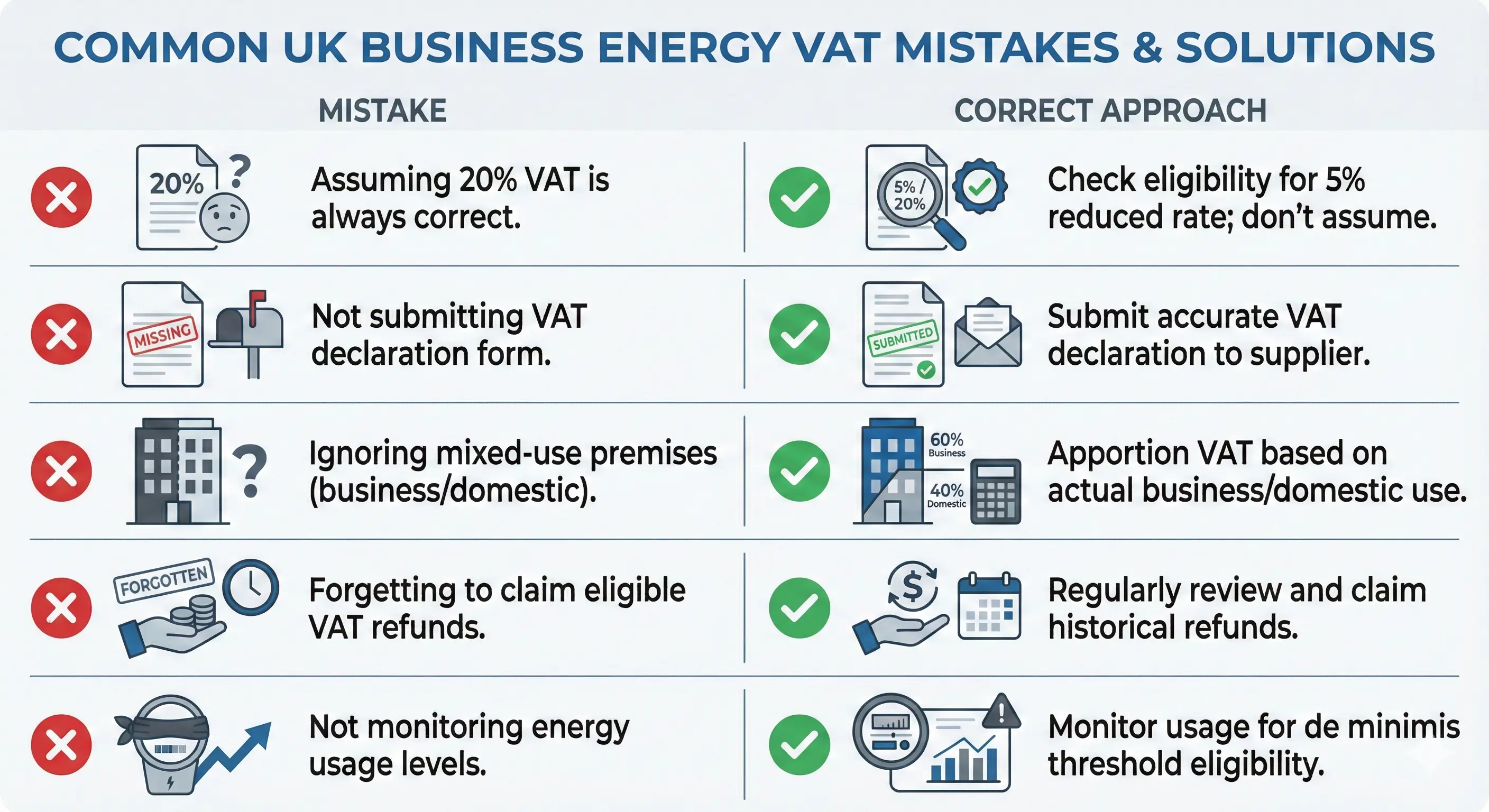
Common Mistakes That Cost You Money
These are the VAT errors worth checking for:
1. Assuming 20% Is Correct
It is easy to see 20% VAT on a bill and assume “that’s just what businesses pay” without checking whether the supply qualifies for less.
Fix: Always check your consumption against the de minimis limits, especially for a small, low-usage site such as a single office, kiosk or small shop.
2. Not Submitting a Declaration for Qualifying Uses
Charities, care homes and holiday lets qualify by use, not volume, so the supplier has to be satisfied that the supply qualifies before it applies the reduced rate. Without a declaration, expect to be billed at 20%.
Fix: If you fall into a qualifying category, submit a declaration immediately - even if you’re mid-contract.
3. Ignoring Mixed-Use Apportionment
Businesses in mixed-use premises (e.g., a flat above a shop) can end up paying 20% on everything when they could claim the reduced rate on the residential portion.
Fix: Calculate your split and submit an apportionment declaration. Even 40% of the supply at the reduced rate beats none of it.
4. Forgetting to Claim Refunds
Discovering you’ve overpaid is only half the battle. Correcting future bills does not recover what you have already overpaid - the backdated refund has to be requested from your supplier separately.
Fix: Explicitly request a refund for up to 4 years of overpayments, with a specific figure - see how to reclaim overpaid VAT.
5. Not Monitoring Usage Changes
A site that’s below de minimis in summer can exceed it in winter when heating is running. This can trigger a VAT rate change mid-year.
Fix: Review your quarterly usage via your smart meter data or bills. If you’re close to the threshold, budget for potential VAT changes.
VAT vs Climate Change Levy: Double Savings
If you are within the de minimis limits, you do not just get the reduced VAT rate - you also fall outside the main rates of the Climate Change Levy (CCL), an additional environmental tax on business energy. The two land together because they run off the same test. HMRC’s CCL reliefs notice (opens in new tab) says the CCL domestic and charitable exclusions “are based on the VAT fuel and power ‘qualifying use’ provisions”, and the thresholds are identical in both regimes: 1,000 kWh of electricity or 4,397 kWh of gas per month.
Here is what changes either side of those limits:
| Within the limits | Above the limits | |
|---|---|---|
| VAT on electricity | 5% (0% in Great Britain, 1 Oct 2026 - 31 Mar 2027) | 20% |
| VAT on gas | 5% | 20% |
| Climate Change Levy | Not charged | Charged at the main rate |
Above the limits, a supply can still get the lower rate if it qualifies another way, such as residential or charity non-business use (see who else qualifies).
CCL main rates from 1 April 2026, per HMRC’s rates guidance (opens in new tab):
- Electricity: 0.801p per kWh
- Gas: 0.801p per kWh
Both fuels are charged at the same rate, and both rise to 0.827p per kWh on 1 April 2027. The temporary zero rate is a VAT change only - the Order that introduces it modifies the VAT Act 1994 - so CCL rates and reliefs are unchanged.
For a small business using 10,000 kWh of electricity a year, dropping out of CCL saves an additional £80.10 per year on top of the VAT reduction.
You do not need a certificate for this one either. As with the reduced VAT rate, a de minimis supply is treated as domestic use automatically - HMRC is explicit that “within these limits there is no requirement for such supplies to be certified as being for domestic use”. A separate CCL declaration is only needed if you are claiming on other grounds, such as charity non-business use or a mixed domestic/business split.
Does Switching Supplier Affect VAT?
No. Your VAT rate is determined by HMRC rules, not by your supplier. Switching to a cheaper energy deal doesn’t change your VAT status.
However, when you switch:
- If you qualify on use (residential, charity or mixed use), submit a VAT declaration to your new supplier - HMRC expects the supplier’s checks to be done within a reasonable time when it takes over a customer
- Until the new supplier has your declaration, expect it to bill at 20%. De minimis supplies need no declaration, but check your first bill
- Any refund claims for overcharges stay with your old supplier
HMRC’s manual says “If a customer switches to a different supplier, a new certificate should be given to the new supplier” (https://www.gov.uk/hmrc-internal-manuals/vat-fuel-and-power/vfup2530 (opens in new tab)), and VAT Notice 701/19 warns that if the supplier’s checks are not done, “it could result in the full rate of VAT being charged”.
When to Update Your Declaration
A declaration stays in place while your qualifying use is unchanged, including through the move to 0% on qualifying GB electricity and back to 5% after 31 March 2027. Give your supplier a new one when:
- your qualifying percentage changes - HMRC says customers “must advise the supplier of any significant change in their circumstances”, and gives a fall from 60% to 59% as an example, because the whole supply is then no longer reduced-rated
- you move premises, or change supplier
- your supplier asks you to confirm it
Tip: When using Meet George or comparing business energy quotes, factor in VAT correctly. If you’re comparing a quote at 22p/kWh, remember that’s before VAT - at 20% it becomes 26.4p/kWh, at 5% it becomes 23.1p/kWh, and at 0% (qualifying electricity in Great Britain, 1 October 2026 to 31 March 2027) it stays at 22p/kWh.
What Changed: The 2026 Zero Rate and the 2025 Budget
21 July 2026: Temporary Zero Rate on Qualifying GB Electricity
On 21 July 2026 the government announced a temporary zero rate of VAT for qualifying electricity in Great Britain. It is now law: The Value Added Tax (Supplies of Domestic Electricity) Order 2026 (opens in new tab) applies to supplies made from 1 October 2026 to 31 March 2027, and HMRC explains how it works in Revenue and Customs Brief 10 (2026) (opens in new tab).
Key points:
- Qualifying electricity in Great Britain is zero-rated (0% VAT) - England, Scotland and Wales
- Northern Ireland stays at 5% for qualifying electricity
- Gas is unaffected - qualifying gas stays at 5%
- Who qualifies has not changed - the de minimis limit, the 60% rule and the qualifying uses are the same
- Bills that include 1 October 2026 can be split by when the energy was used, and HMRC recommends meter readings to do it
- Electricity that does not qualify is still 20%
HMRC’s impact note expects suppliers to move qualifying electricity back from 0% to 5% when the zero rate ends on 31 March 2027.
November 2025 Budget
The Autumn Budget 2025 (opens in new tab) delivered by Chancellor Rachel Reeves on 26 November 2025 made no changes to VAT rates on energy - HMRC’s fuel and power notice was not updated again until 8 September 2026, for the zero rate.
Key confirmations:
- Standard VAT rate remains 20% (Budget 2025 rates annex (opens in new tab))
- Reduced rate remains 5% for qualifying uses
- De minimis thresholds unchanged
The budget did include energy bill reductions for households (the Institute for Government puts the cut at £130 for a typical household), but this applies to domestic customers, not businesses.
For business energy, the Budget’s tax change was to CCL. It set the CCL main rate for 1 April 2027 at 0.827p/kWh, on top of the rise to 0.801p/kWh that took effect on 1 April 2026 (added to HMRC’s rates guidance in November 2024). Electricity and gas are charged at the same rate throughout. Who qualifies for relief has not changed - only what the levy costs if you do not.
Quick Reference: VAT on Business Energy
| Question | Answer |
|---|---|
| Standard business energy VAT rate | 20% |
| Reduced rate for qualifying uses | 5% |
| Qualifying electricity in Great Britain, 1 Oct 2026 - 31 Mar 2027 | 0% (zero-rated) |
| Qualifying electricity in Northern Ireland | 5% |
| Qualifying gas | 5% |
| Electricity de minimis (monthly average) | Not more than 1,000 kWh |
| Gas de minimis (monthly average) | Not more than 4,397 kWh |
| Qualifies with no certificate | De minimis (low-usage) supplies |
| Qualifies by use | Homes and residential accommodation, holiday lets, charity non-business use, mixed use at 60%+ |
| How to claim reduced rate | De minimis: supplier should apply it; other uses: VAT declaration to supplier |
| Refund period for overpayments | Up to 4 years (supplier’s claim to HMRC) |
| Escalation for disputes | Energy Ombudsman |
Next Steps
- Check your bills - Are you paying 0%, 5% or 20% VAT? What’s your monthly consumption?
- Compare to thresholds - Electricity no more than 1,000 kWh/month? Gas no more than 4,397 kWh/month?
- Get the declaration form - From your current supplier (see where to find it), if you qualify on use rather than de minimis
- Submit and request refund - Include backdated claim for up to 4 years
- Monitor going forward - Verify future bills show the correct rate, including 0% on qualifying GB electricity from 1 October 2026 to 31 March 2027
If you’re also paying over the odds on your unit rate or standing charge (see our complete standing charges guide), VAT is just one piece of the puzzle. Switching supplier could save you far more - especially if you’re stuck on deemed rates (learn more about what out-of-contract rates cost and how to leave) - but make sure you’re not overpaying on VAT first, or you’ll carry that error to your new contract.
Ready to stop overpaying? Learn how to switch business energy, or check if you can switch: upload your latest bill and Meet George tells you in seconds whether you’re in your switching window. Switching with Meet George means no undisclosed broker fees.


