
Business energy for cafes and coffee shops Sort your cafe's next energy contract without picking up the phone.
Upload your latest electricity bill. George reads it in seconds and tells you whether you're in your switching window and what to do next.
- Result in seconds
- No account needed
- No sales calls
Bill check
Read by George in seconds
- Unit rate
- 28.4p/kWh
- Standing charge
- 62.0p/day
- Contract ends
- 28 Mar 2027
Result
In your switching window
You're ready to continue with Meet George.
Too early? Ask George to remind you when it's time.
Updated
How much electricity does a cafe use?
- Estimated use, 71 m² cafe
- 27,900 kWh a year
- Estimated annual cost
- £7,980
That's an estimate for a 71 m² cafe, the median size in DESNZ's building survey. Don't know how much yours uses? You don't need to work it out - upload your bill and George reads it for you.
- 25 m² 9,800 kWh £3,760 a year
- 40 m² 15,700 kWh £6,020 a year
- 71 m² (Median in the DESNZ survey) 27,900 kWh £7,980 a year
- 100 m² 39,300 kWh £11,240 a year
- 140 m² 55,000 kWh £15,720 a year
DESNZ doesn't publish a median yearly figure for cafes, so these are estimates, and real cafes vary widely around them.
How we calculated this
These estimates are floor area multiplied by the median electricity use per m² that DESNZ's Building Energy Efficiency Survey found for cafes in England and Wales in 2014-15, 393 kWh per m² a year, from a small sample of 48 cafes. The median cafe in that survey was 71 m², and the middle half were between about 40 and 140 m². Use per m² varied widely too, from 160 to 530 kWh for the middle half, so any one cafe can be well above or below these figures. The survey didn't measure cafes' catering directly: it estimated it from an allowance per meal served, calibrated against metered data and published research, and DESNZ rated its confidence in the estimate for any single cafe in the survey as low. There's no newer figure per m² or per cafe. DESNZ's median for hospitality buildings with a recorded floor area, from a different dataset, fell from 206 kWh per m² in 2014 to 160 in 2024, and its median hospitality building used 10,000 kWh in 2024. Neither is a cafe figure: that category also covers restaurants, pubs, hotels, hostels, guesthouses and holiday homes, and in the 2014-15 survey cafes' median electricity use per m² was nearly three times pubs' and more than four times hotels'. Costs use DESNZ's provisional Q2 2026 average prices, every charge except VAT, including Climate Change Levy that bills averaging up to 1,000 kWh a month don't pay: 38.36p per kWh for businesses using up to 20,000 kWh a year and 28.59p for those using 20,000 to 499,999 kWh. Costs switch price band at 20,000 kWh, so a cafe just over that line can show a lower estimated cost than one just under it.
Sources: DESNZ (formerly BEIS), Building Energy Efficiency Survey 2014-15, hospitality report and tables; DESNZ, ND-NEED 2026 (2024 data), tables 9A and 14A; DESNZ, ND-NEED 2026 methodology, Table 12 (building use categories); DESNZ, non-domestic energy prices, table 3.4.2 (Q2 2026)
How switching works with Meet George
A quick bill check first, so you only sign up when switching makes sense. Then you switch yourself, on the platform we built.
Step 1 · The bill check
See if you can switch in seconds
- Upload a recent electricity bill. No account needed.
- George reads it in seconds and tells you whether you're in your switching window and what to do next.
- Too early? Ask George to remind you when it's time.
No sales call, and no waiting for a reply.
Step 2 · Switch on Meet George
Do the whole switch yourself, online
- 01
Create your account
Sign up on Meet George. Nobody needs to call you.
- 02
Compare the contracts available to your business
Our 1p/kWh fee is shown separately on every quote.
- 03
Sign online
Your new supplier takes over from the agreed start date.
The whole switch happens on Meet George, not over the phone.
Where a cafe's electricity goes
Catering accounts for almost four-fifths of cafe electricity. DESNZ groups coffee machines, drink boilers, kitchen and servery equipment, dishwashers and cold storage for food together as catering, so there isn't an official split showing how much goes to the espresso machine, oven or dishwasher. The survey also found that in many smaller cafes and restaurants the kitchen isn't separated from the seating area, so heat from cooking can do some or all of the heating. Your kitchen kit has to run, but what you pay for each kWh comes down to your contract.
-
79% Catering Coffee machines, kitchen kit, dishwashers
-
7% Heating
-
5% Lighting
-
3% Fridges and freezers Some are counted in catering instead
-
2% Hot water Water heated by gas or oil isn't counted here
-
4% Everything else Fans, air conditioning, tills and more
Shares of cafes' electricity across the UK in 2025. DESNZ bases the split on its 2014-15 Building Energy Efficiency Survey, which estimated catering from an allowance per meal served rather than measuring it machine by machine, so treat the split as a guide. Shares are rounded so the bar adds to 100%.
Four things worth checking before your cafe's next contract
Have your latest bill to hand: most of the answers are on it.
Did you take over the cafe without a contract, or has yours ended?
Moving in without your own contract puts you on a deemed contract, and an expired deal can roll onto out-of-contract rates. Ofgem says both usually cost more.
Look for: The tariff name and end date. "Deemed" or "out of contract" usually indicates default rates; a missing end date may just not be printed.
Read more Show less
Energy isn't usually why someone opens a cafe. In DESNZ's 2014-15 survey, cafes were the only kind of hospitality business where more than half (55%) said managing energy wasn't a priority. But the contract dates still matter: Ofgem says you're responsible for any energy you use before your own contract starts, and if you're already on deemed or out-of-contract rates, you can switch to a new supplier at any time.
Sources: DESNZ (formerly BEIS), Building Energy Efficiency Survey 2014-15, hospitality report and tables; Ofgem, Switch your business energy supplier; Ofgem, Get a business energy contract
Is each bill over or under the VAT limit?
A bill averaging more than 33 kWh a day normally pays 20% VAT and the Climate Change Levy. At DESNZ's median use per m², a cafe bigger than about 31 m² would.
Look for: The VAT rate on each bill, and the kWh it covers divided by the number of days.
Read more Show less
Under the limit, HMRC treats the supply as domestic use, with a lower VAT rate than 20% and no levy, and in Great Britain that lower rate is 0% from 1 October 2026 to 31 March 2027. HMRC judges the limit on each bill, not your year, so a cafe near that size can fall either side from one bill to the next.
Sources: HMRC, VAT Notice 701/19, section 5.2; HMRC, VAT Fuel and Power Manual, VFUP2310; HMRC, Revenue and Customs Brief 10 (2026); HMRC, Excise Notice CCL1/3, paragraph 2.5; DESNZ (formerly BEIS), Building Energy Efficiency Survey 2014-15, hospitality report and tables
Is your kitchen on a gas contract too?
Mains gas supplies about two-fifths of the energy cafes use for catering. If you cook on gas, that's a second contract with its own end date and VAT limit.
Look for: A separate gas bill, or a gas meter number (MPRN) as well as your electricity MPAN.
Read more Show less
That figure comes from DESNZ's end-use tables for UK cafes. Ovens, hobs and water heaters on mains gas all run on the gas contract, which has its own standing charge and its own VAT limit: 145 kWh a day, more than four times electricity's, so a gas bill at 5% and an electricity bill at 20% can both be right. Our 1p/kWh fee is the same on gas, but gas isn't on the online platform yet, so for now our team arranges gas contracts directly.
Sources: DESNZ, Energy Consumption in the UK 2026, table U6; HMRC, VAT Notice 701/19, sections 3.2.2 and 4.2 (de minimis and gas)
Is the contract yours, or the building's?
61% of cafes in DESNZ's survey occupied only part of a building. If a host business or landlord pays the supplier and recharges you, the contract is theirs.
Look for: Whose name is on the bill, and what your lease or agreement says about who pays for energy.
Read more Show less
So if you trade inside a garden centre, gym or office, check who holds the contract. Where a host resells you the energy, Ofgem's maximum resale price rule, which stops a reseller charging more than they paid, doesn't apply to energy resold for use at commercial premises. If paying the energy bill is your responsibility, you can still choose the supplier, even if the lease names a preferred one, but check for clauses saying you must tell your landlord before you switch.
Sources: DESNZ (formerly BEIS), Building Energy Efficiency Survey 2014-15, hospitality report and tables; Ofgem, resale of gas and electricity guidance; Ofgem and partners, non-domestic energy advice (2022), p.31 'If you are a tenant'
Not sure what contract you're on?
Upload your latest bill. George reads it in seconds and tells you where you stand.
Worth reading next

How we're paid
Our 1p/kWh fee on gas or electricity, who pays it and how it shows on every quote.

How to read your bill
Find your unit rate, standing charge, VAT and contract end date.
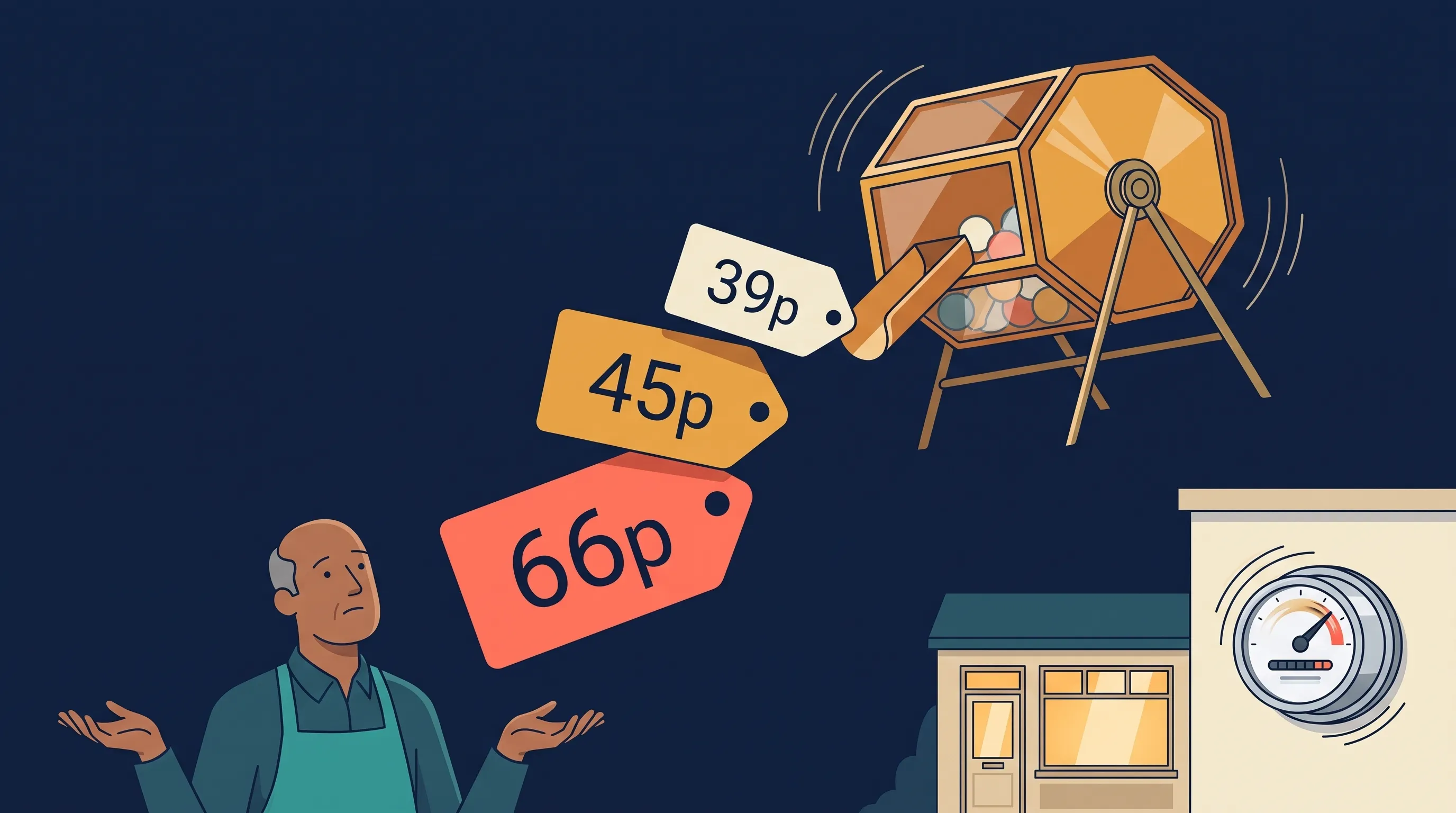
Out-of-contract rates
Why businesses end up on them, and how to move onto a contract.
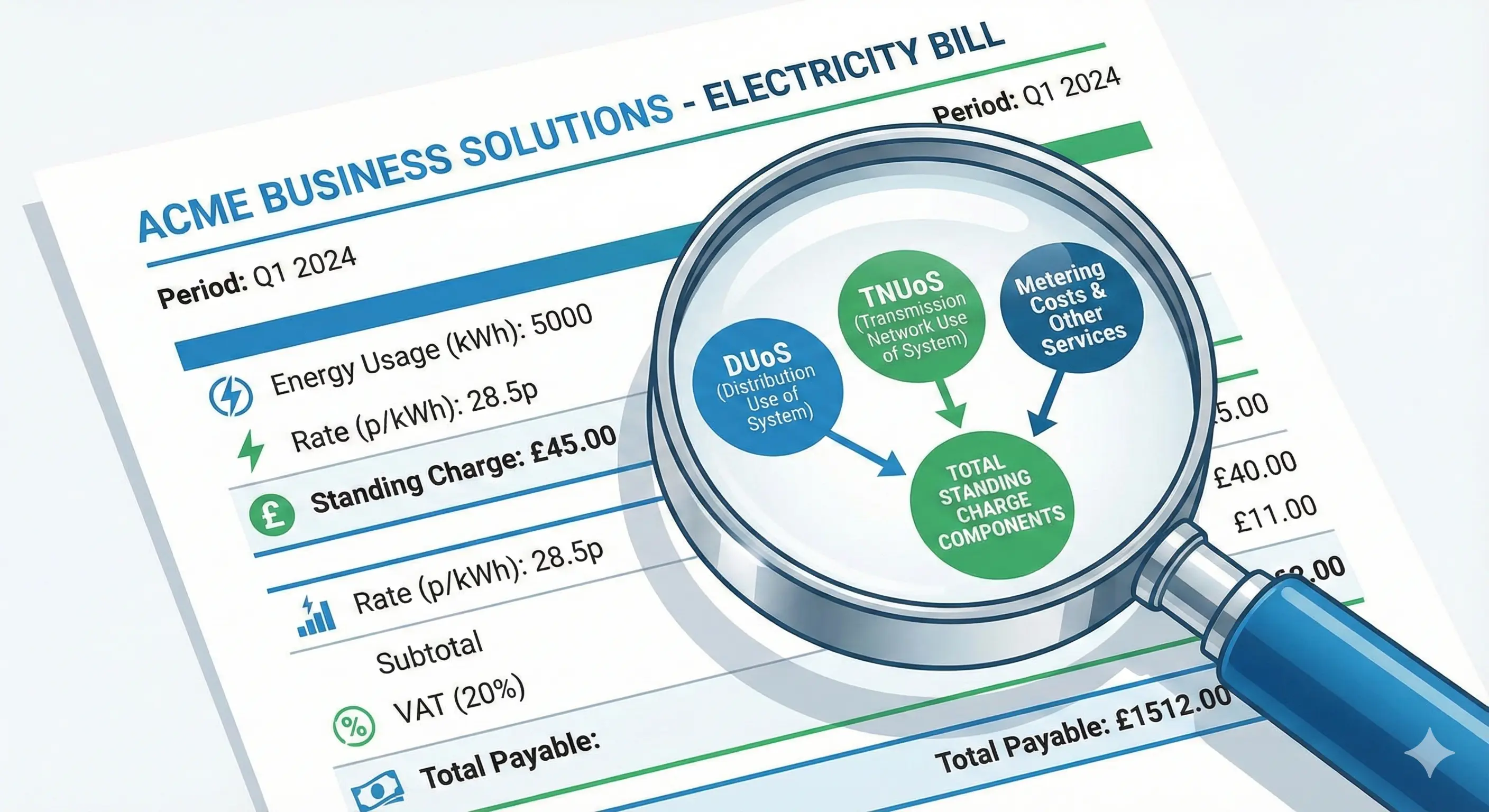
Standing charges explained
The daily charge you pay whether the cafe's open or shut.
Questions cafe owners ask
How much electricity does a cafe use?
About 27,900 kWh a year for a cafe of 71 m², the median size in DESNZ's Building Energy Efficiency Survey, but that's an estimate: DESNZ doesn't publish a median yearly use for cafes. The survey found cafes used a median of 393 kWh of electricity per square metre a year in 2014-15, on a par with large food shops and about three and a half times the median for small shops. Cafes vary widely around that, so your bill shows what yours actually uses.
What's the average electricity bill for a cafe?
There's no official figure for cafes, but at an estimated 27,900 kWh a year, a 71 m² cafe would pay about £7,980 a year before VAT, or £670 a month, at the provisional Q2 2026 average paid by businesses using 20,000 to 499,999 kWh a year (28.59p per kWh, including every charge except VAT). A cafe using up to 20,000 kWh a year falls in DESNZ's smallest band instead, where the average was 38.36p. If your kitchen runs on gas, that's a separate bill on top.
What uses the most electricity in a cafe?
Catering: about 79% of cafes' electricity in DESNZ's end-use tables. DESNZ's building survey counts coffee machines, hot water boilers for drinks, kitchen and servery equipment, dishwashers and cold storage for food in that category, so there's no official split between the espresso machine and the oven. Heating comes next at about 7%, then lighting at about 5%. The survey estimated catering from an allowance per meal served, so treat the split as a guide.
My cafe uses gas and electricity. Do I need two energy contracts?
Usually, yes. Gas and electricity are separate supplies with separate meter numbers (an MPRN for gas, an MPAN for electricity), and each normally has its own contract, end date and standing charge, so check both dates. Gas has its own VAT limit too: HMRC treats up to 145 kWh a day as domestic use, against 33 kWh for electricity. The same 1p/kWh fee applies to both, but gas isn't on the online platform yet, so for now our team arranges gas contracts with you directly.
Will my cafe pay 0% VAT on electricity from October 2026?
On bills that average 33 kWh a day (1,000 kWh a month) or less, yes, in Great Britain. HMRC treats those as domestic use, so there's no Climate Change Levy and 0% VAT from 1 October 2026 to 31 March 2027, then 5% again; Northern Ireland stays at 5%. Cafes use a lot of electricity for their size: at the median use per m² in DESNZ's building survey, a cafe bigger than about 31 m² would average over the limit, and a bill over it normally carries 20% VAT and the levy. HMRC judges each bill on its own, so check each one: if a bill averages 33 kWh a day or less and still shows 20%, ask your supplier to correct it. Mains gas has its own limit, 145 kWh a day, and stays at 5% within it.
I charge VAT on hot drinks. Does that change the VAT on my energy bill?
No, they're separate rules. The VAT you charge customers follows HMRC's catering rules, under which hot takeaway drinks are standard-rated. The VAT on your energy bill depends on how much energy each bill covers, not on what you sell: HMRC treats small supplies, averaging up to 33 kWh of electricity or 145 kWh of mains gas a day, as domestic use even when the customer is a business, and they carry a lower VAT rate.
My cafe is inside another business. Can I switch the electricity?
It depends who's responsible for paying the energy bill, and your lease or agreement should say. If it's you, Ofgem's 2022 advice for business tenants, written with Citizens Advice and Energy UK, says you can still switch even if the lease ties you to a preferred supplier, but check for clauses saying you must tell your landlord if you plan to switch, or switch back to a particular supplier when you leave. If the host business or landlord pays the supplier and recharges you, the contract is theirs, and Ofgem's limit on resale prices doesn't apply to commercial premises. DESNZ's 2014-15 survey found 61% of the cafes it surveyed occupied only part of a building.
I've just bought or taken over a cafe. What happens to the energy?
If your business is new to the premises, tell the current supplier as soon as you can, with a meter reading if you can take one: Ofgem says both the business moving in and the one moving out should. The supplier can ask for evidence such as your lease or property sale documents, and reviews it within 10 working days. You're responsible for any energy you use before your own contract starts, and moving in without arranging one puts you on a deemed contract, at rates Ofgem says are usually higher than negotiated ones. If the kitchen has a gas meter, do the same for the gas.
What does Meet George cost a cafe?
A flat 1p per kWh, and you only pay it if you switch through Meet George. For a cafe using an estimated 27,900 kWh of electricity a year, that's £279 a year. The same 1p per kWh applies to gas. Electricity switches happen online; gas isn't on the online platform yet, so for now our team arranges gas contracts directly. You pay the fee through your energy supplier, and it's itemised on every quote, never buried.
Sources (15)
DESNZ (formerly BEIS), Building Energy Efficiency Survey 2014-15, hospitality report and tables; DESNZ (formerly BEIS), Building Energy Efficiency Survey 2014-15, retail report and tables; DESNZ, Energy Consumption in the UK 2026, table U6; DESNZ, non-domestic energy prices, table 3.4.2 (Q2 2026); HMRC, VAT Notice 701/19, section 5.2; HMRC, VAT Notice 701/19, sections 3.2.2 and 4.2 (de minimis and gas); HMRC, VAT Fuel and Power Manual, VFUP2310; HMRC, Revenue and Customs Brief 10 (2026); HMRC, Excise Notice CCL1/3, paragraph 2.5; HMRC, Catering, takeaway food (VAT Notice 709/1), sections 2.1 and 4.1; Ofgem and partners, non-domestic energy advice (2022), p.31 'If you are a tenant'; Ofgem, resale of gas and electricity guidance; Ofgem, Change of tenancy for businesses; Ofgem, Switch your business energy supplier; Ofgem, Get a business energy contract
Your cafe's next energy contract, sorted without picking up the phone.
Upload your latest bill. George reads it in seconds and tells you what to do next. If you're ready to switch online, you can continue with Meet George.
- Result in seconds
- No account needed
- No sales calls


