


TL;DR: Key Takeaways
- MHHS is moving every UK electricity meter to half-hourly settlement. Elexon, which runs the programme, says it will complete in May 2027. If you’re on a non-half-hourly meter (NHH - Profile Class 03 or 04), your supplier will migrate it.
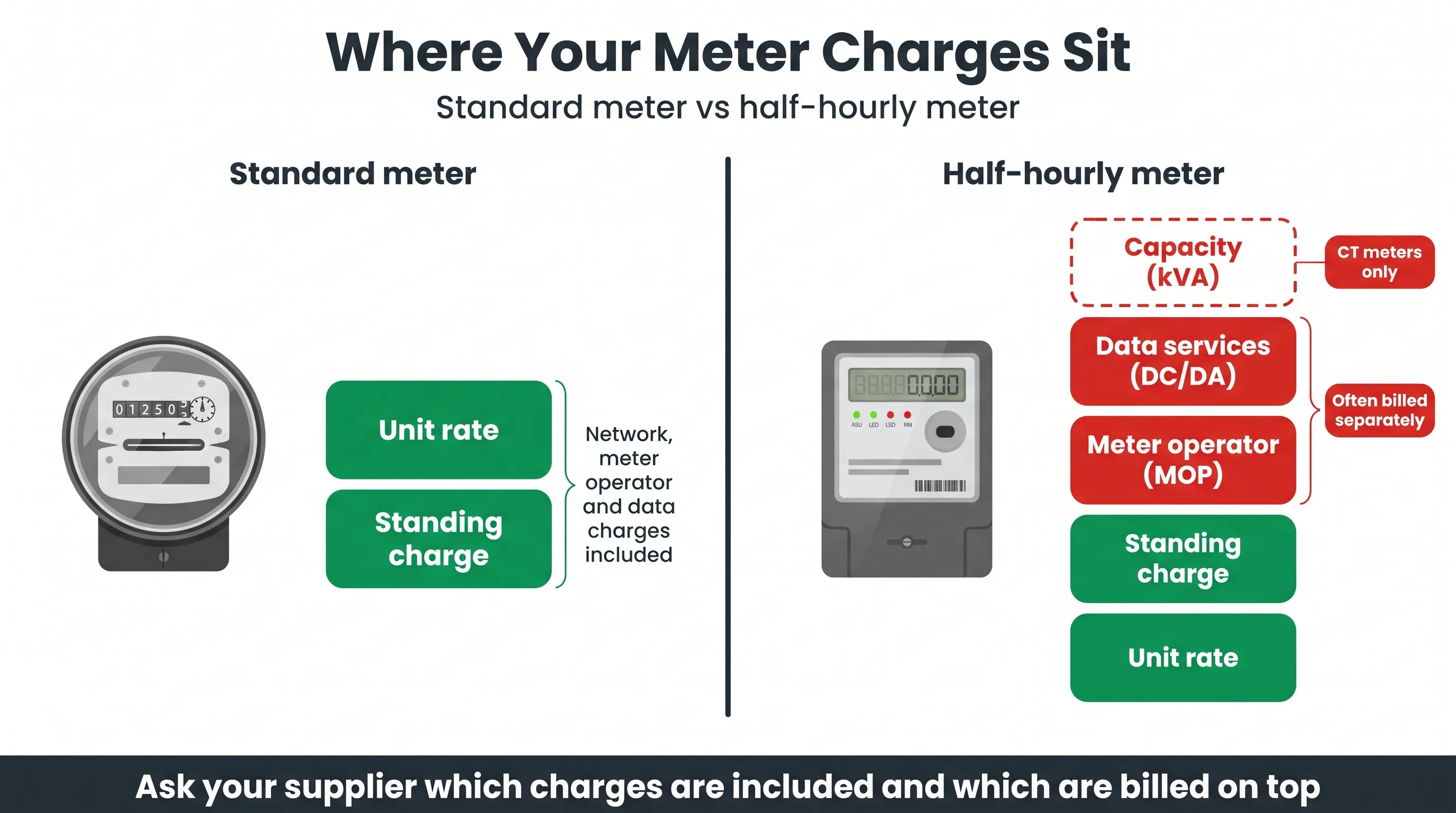
- Half-hourly meters can carry up to 5 charge layers that standard meters build into the price or charge differently: MOP charges, DC/DA charges, capacity charges (CT meters only), time-of-use DUoS, and TNUoS.
- Suppliers’ own rate cards show the split. npower Business Solutions’ published default rates include meter operator and data charges in its standard-meter prices, but list them as billed on top of its half-hourly prices.
- Migration doesn’t automatically add these lines. No public source we have found says a small business moved to half-hourly settlement under MHHS starts paying new, separately itemised metering charges. Ask your supplier.
- Capacity charges only apply to CT-metered sites, which are larger connections almost always already on half-hourly settlement.
- If you’re already half-hourly, check for default charges. npower’s published defaults for meter operation are £300 to £900 a year per meter, plus £345 for data services (2016 prices), and its terms say a written agreement may reduce them.
If you run a small or medium-sized business in the UK, the way your electricity is settled is changing - and, separately, so are the rules on your meter. MHHS itself doesn’t require a meter replacement: traditional meters can continue to be settled using profiled estimates. But on 1 September 2026 the government confirmed (opens in new tab) that from 1 September 2027, new fixed-term contracts for small and medium non-domestic sites must include a term that the customer “has, or agrees to have, smart or advanced meters installed”. So while MHHS is about settlement, the smart meter rollout is pushing hardware upgrades through contract requirements.
Market-Wide Half-Hourly Settlement (MHHS) is an Ofgem-led programme that moves every UK electricity meter onto settlement based on half-hourly consumption data. Previously, most SME meters were on non-half-hourly (NHH) settlement - the industry assumed a typical usage pattern based on standard profiles. Under MHHS, settlement uses what you used in every 30-minute window, where the meter can provide it.
The MHHS central systems went live on 22 September 2025, and suppliers have been migrating meters since. Elexon (opens in new tab), which runs the programme, says it “will complete the implementation of half-hourly settlement in May 2027”.
The headline benefit is more accurate settlement and billing for meters that send readings automatically. Ofgem estimated (opens in new tab) the programme will deliver net benefits to GB energy consumers “in the range of £1,559m-£4,509m over the period 2021-2045”.
What’s talked about less is the cost side. Half-hourly meters have long carried charges that standard meters build into the price. Here are the 5 you need to know about - what they are, whether they apply to you, and what MHHS migration does and doesn’t change.
What are MOP, DC and DA charges?
MOP, DC and DA charges pay for three metering services: the meter operator (MOP) that installs and maintains your electricity meter, the data collector (DC) that reads it, and the data aggregator (DA) that totals those readings for the industry’s settlement system. On a standard non-half-hourly meter they are usually built into your unit rate and standing charge; on a half-hourly meter they are often billed as separate charges.
Suppliers’ own rate cards show the split. npower Business Solutions’ published default electricity rates list “Meter Operator (MOP)”, “Data Aggregator (DA)” and “Data Collector (DC)” among the costs its non-half-hourly charges include - but for half-hourly meters, the same three are listed under “Charges exclude the following”, so they are added on top (npower Business Solutions (opens in new tab)). Drax’s out-of-contract rates for half-hourly sites likewise add “Metering/DA/DC” charges “at cost” (Drax (opens in new tab)).
To find them on your bill, look for lines called meter operator, MOP or metering; data collection or DC; and data aggregation or DA. If there are none, they are inside your standing charge or unit rate. The sections below cover what published default charges look like and how to appoint your own providers.
On a half-hourly meter? Upload your latest bill to Meet George’s free bill check: half-hourly bills go to a person from our team.
MOP Charges: The Meter Operator Fee You May Be Overpaying
Every electricity meter has a licenced Meter Operator (MOP) - the company responsible for installing, maintaining, testing and commissioning the metering equipment. Under MHHS, the MOP role is being renamed MOA (Meter Operating Agent). Same job, new name.
If you haven’t arranged your own meter operator, your supplier provides or appoints one, and the charge reaches you either as a separate line or inside your standing charge, depending on the supplier. Many businesses never see what they pay for it, or realise they have a choice.
How much do MOP charges cost on a half-hourly meter?
There is no official price list, but suppliers publish their own defaults. npower Business Solutions’ half-hourly metering terms set out what it charges when it provides the service because you have no agreement of your own (npower Business Solutions metering terms (opens in new tab)):
| Service | npower Business Solutions default charge |
|---|---|
| Meter operation and meter asset provision (MOP/MAP) | £300, £600 or £900 a year per meter, depending on the meter’s class (its code of practice) |
| Data collection and aggregation (DC/DA) | £345 a year per meter |
Prices “with effect from 1 October 2016”, in terms still published on npower Business Solutions’ website when we checked on 15 October 2026. Other suppliers set their own charges.
The same terms say: “You may be able to reduce your Charges if you enter into a written agreement with us for the provision of Metering Services.”
What is a MOP contract, and can you choose your own meter operator?
A MOP contract (a Meter Operator Agreement) is your agreement with a meter operator for renting and maintaining your meter. E.ON, for example, says one is “required for supplies above 110kVA” and that “Without an agreement, we can’t install a meter” (E.ON new connections (opens in new tab)); if you don’t arrange your own, suppliers such as npower Business Solutions charge their default metering rates above.
Yes, you can choose your own. You can find accredited meter operators through the Association of Meter Operators (opens in new tab). The process involves choosing a provider, agreeing a contract and notifying your supplier, which records the appointment under BSC procedures. No official source publishes typical independent prices, so get quotes and compare them against the default charges on your bill.
DC/DA Data Charges: Paying for Your Meter to Be Read
Half-hourly meters generate 17,520 readings a year (48 half-hours x 365 days). That data needs to be collected, validated and submitted into the national settlement system. Two roles handle this:
- Data Collector (DC): Collects your meter’s readings, validates the data and checks it for errors
- Data Aggregator (DA): Combines your half-hourly data with data from other sites and submits it to Elexon for settlement
On a standard NHH meter, these costs are usually inside your rates rather than a separate line. Readings are either collected automatically via AMR (Automatic Meter Reading) or estimated using standard industry profiles. With estimated reads, your supplier assumes a typical usage pattern and bills you on that. If your actual usage doesn’t match the estimate, you get a catch-up bill or a reconciliation credit, sometimes months later.
For meters that send readings automatically, MHHS improves this: settlement uses what you actually used and when. Under MHHS, the DC/DA roles are being restructured into SDS (Smart Data Services) for smart meters and ADS (Advanced Data Services) for advanced meters.
How much does meter reading cost on a commercial meter?
On a half-hourly commercial meter, meter reading is the data collection and aggregation (DC/DA) charge, and it is often billed as its own line; on a standard meter it is usually inside your unit rate and standing charge. There is no official price list. npower Business Solutions’ published default for half-hourly data collection and aggregation is £345 a year per meter (2016 prices, as above). Put together with its lowest meter operation default of £300, a half-hourly meter on npower’s defaults would cost £645 a year for metering and data services alone - our arithmetic from its published terms.
How to appoint your own DC/DA: Just as with meter operators, you can arrange your own data services instead of accepting your supplier’s default. Choose an accredited provider, agree terms and notify your supplier.
Capacity Charges (kVA): The Big One - But It Probably Doesn’t Apply to You
This is the charge that sounds the scariest - but here’s the critical detail: capacity charges apply to businesses with CT meters (current transformer meters), and CT-metered sites are almost always already on half-hourly settlement. MHHS migration doesn’t give you a CT meter.
Suppliers’ rate cards reflect this. npower Business Solutions’ published default rates for half-hourly low-voltage sites include a capacity charge, but its rates for half-hourly whole current meters have no capacity charge at all (npower Business Solutions (opens in new tab)).
What’s the difference between a CT meter and a whole current meter?
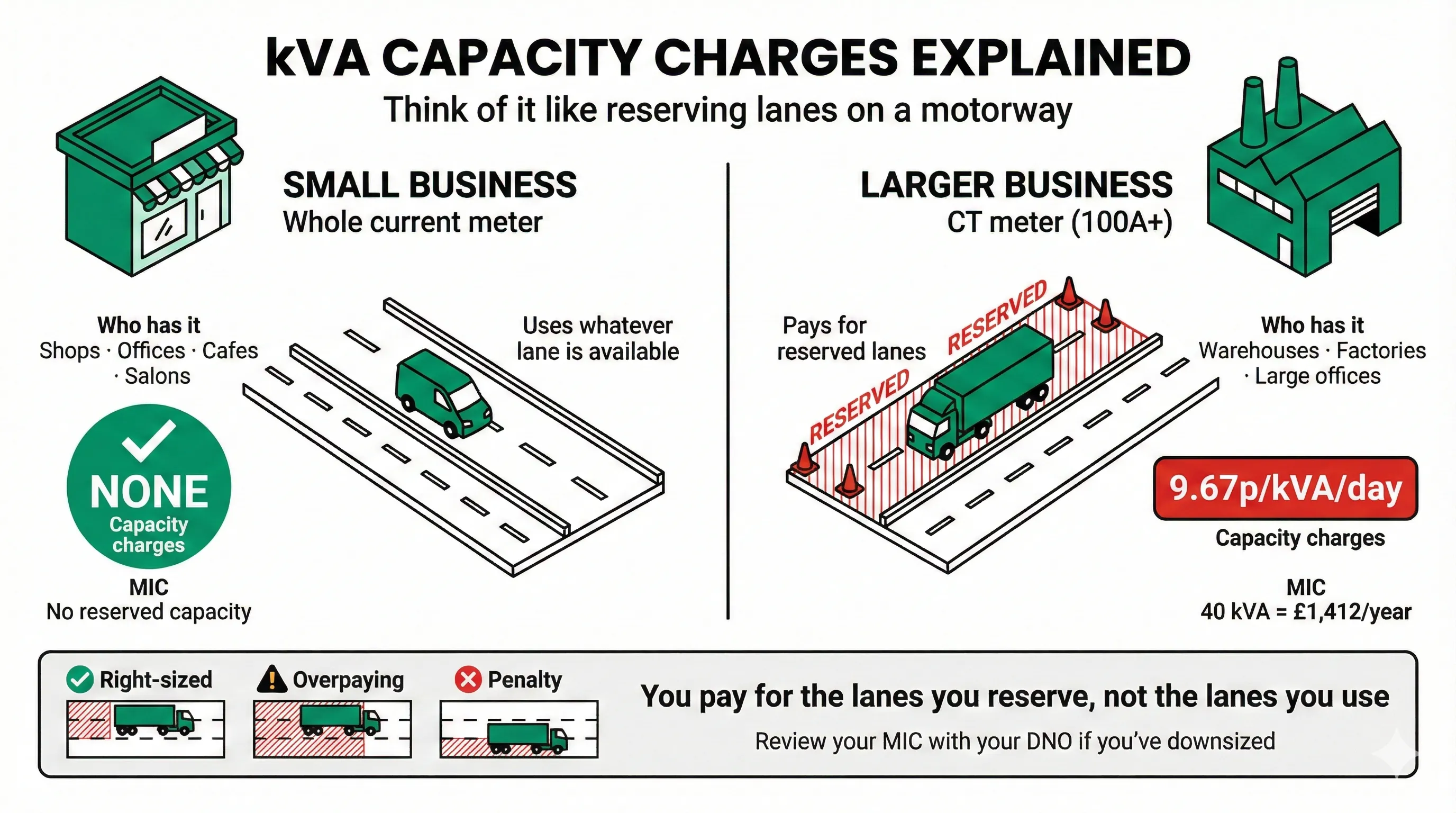
Think of it like the water supply to a building. A house has a standard pipe coming in from the mains - it handles normal flow and nobody asks you to pay for the size of the pipe. That’s a whole current meter. The electricity passes straight through it, it measures what you use, and that’s it. Most small businesses - shops, offices, cafés, salons - have this type.
But a warehouse, factory or large office block needs a much bigger supply. The electrical current flowing in is too strong for a standard meter to measure directly, so it uses current transformers (CTs) - devices that step the current down to a level the meter can read (opens in new tab). That’s a CT meter. Because you’re drawing from a bigger chunk of the network, your local Distribution Network Operator (DNO) sets an agreed Maximum Import Capacity (MIC) - the maximum amount of power (measured in kVA) your premises can pull at any moment. Think of it like reserving lanes on a motorway - you pay a fixed daily charge for that reserved capacity whether you use it or not.
Why this usually isn’t an MHHS issue: Businesses with CT meters are generally on Profile Class 00 - already half-hourly. The businesses being migrated under MHHS are on Profile Class 03 and 04, typically whole current connections. So if MHHS is the reason you’re reading this article, capacity charges are unlikely to apply to you. We include them for completeness.
How to tell which one you have: If your business runs off a standard supply - the kind you’d find in a high street shop or small office - you most likely have a whole current meter (opens in new tab). If you’re in a larger unit with a meter cupboard full of equipment, you may have a CT meter - and you’re probably already on HH settlement. You can also check your bill: a line for “availability charges” or “capacity charges” means you have an agreed capacity.
What it costs (for businesses that do have CT meters):
Capacity charge rates vary by region and supplier. npower Business Solutions’ published default rates for half-hourly low-voltage sites, from 1 October 2026, range from 3.92p per kVA per day (Yorkshire) to 15.27p (North Scotland). In our THIS Workspace case study, a flexible office provider in Bournemouth was paying 32.94p/kVA/day with its existing supplier and was quoted 9.67p/kVA/day by Tem Energy. For more on how kVA and capacity charges work, see our guide to business electricity standing charges.
To show the scale: a 40 kVA capacity at 9.67p/kVA/day comes to about £1,412 a year, and 100 kVA at the same rate is £3,530 a year (our arithmetic). These costs apply to CT-metered connections, which are already on HH settlement.
Excess capacity charges can add to this. If your demand exceeds your agreed capacity, you are charged for the excess too - npower lists “Excess Capacity” among the charges added on top of its half-hourly rates.
The opportunity: If your business has downsized, removed equipment or improved efficiency since your capacity was set, you may be paying for capacity you don’t need. You can ask your DNO to review your agreed capacity, and compare suppliers’ p/kVA/day rates - in the THIS Workspace case, the quoted rate was less than a third of what the business was paying.
DUoS Charges: How Network Costs Change on HH Meters
Distribution Use of System (DUoS) charges exist on both NHH and HH meters - you’re paying for the local distribution network either way. But the structure changes when you move to HH settlement.
On an NHH meter, DUoS is built into simple rates: a p/kWh element plus a daily fixed charge.
On an HH meter, DUoS splits into time-of-use bands (red, amber and green periods with different rates depending on when you use electricity). If you also have a CT meter with an agreed capacity, DUoS includes a kVA-based component too.
The difference between NHH and HH DUoS varies across the 14 DNO regions in Great Britain, and the red-band hours differ from region to region. For businesses that can shift usage away from red-band periods, the time-of-use structure could reduce DUoS costs compared with a flat rate.
Important context: If you have a whole current meter, the DUoS change is less dramatic. You move from flat rates to time-of-use bands, but you don’t pick up the capacity element.
TNUoS Charges: The Big Pylons Explained
Transmission Network Use of System (TNUoS) charges pay for the national high-voltage transmission network - the big metal pylons you see from the motorway. This is the infrastructure that carries electricity across the country before it reaches your local distribution network. Think of it as the motorway system for electricity, while DUoS covers the local roads.
Many guides about HH meters describe the old Triad-based charging system as if it still fully applies. It doesn’t.
What changed: Under Ofgem’s Targeted Charging Review (opens in new tab) (decision December 2019), “residual charges will be levied in the form of fixed charges for all households and businesses”. For transmission, the demand residual moved to fixed charges by band from 1 April 2023 (opens in new tab). Before that, HH-metered businesses paid TNUoS demand charges based on their usage during the three highest-demand half-hours each winter (the Triads).
What this means for your business: The residual part of TNUoS is now a fixed charge whether your meter is settled half-hourly or not, so migration doesn’t change that part. Separately, a 2016 code change, CMP266 (opens in new tab), fixed a problem where, when a profile class 1-4 customer moved to half-hourly settlement, “suppliers are overcharged for transmission charges in the year the customer migrates”.
Regional note: TNUoS demand charges are locational, and NESO publishes the tariffs annually (opens in new tab). For more on how location affects your energy costs, see our guide to regional business energy prices.
What Could These Charges Cost? Published Examples
How much extra does a half-hourly meter cost per year?
There is no official figure for what a half-hourly meter adds to a small business’s bill, and what you pay depends on your supplier, your meter and your contract. What suppliers publish lets you put rough numbers on each layer:
| Charge | Standard (NHH) meter | Half-hourly meter: published example |
|---|---|---|
| MOP (meter operation) | Included in rates (npower) | £300-£900 a year per meter, npower default (2016 prices) |
| DC/DA (data services) | Included in rates (npower) | £345 a year per meter, npower default (2016 prices) |
| Capacity (kVA) | None | None on whole-current meters; 3.92p-15.27p per kVA per day on npower’s low-voltage default rates (October 2026) |
| DUoS | Flat rates | Time-of-use bands, varies by region |
| TNUoS residual | Fixed charge by band | Fixed charge by band (unchanged) |
Sources: npower Business Solutions default electricity charges (opens in new tab) and metering terms (opens in new tab); Ofgem’s Targeted Charging Review decision (opens in new tab). npower’s metering prices are its defaults for customers without their own agreement.
For a business moving from a standard meter under MHHS, the open question is whether the first two rows change at all. Ofgem’s impact assessment expected that “firms will pass programme and delivery costs through to consumers” (Ofgem, April 2021 (opens in new tab)), but it doesn’t say whether that means new lines on a small business’s bill or changes inside the unit rate and standing charge. We have found no public source that settles it, so ask your supplier before your meter migrates.
How these charges appear on your bill: Metering and data charges don’t change your unit rate. They are either built into your standing charge or shown as separate daily or annual lines.
The Upside: Why HH Metering Isn’t All Bad News
This isn’t all doom and gloom. There are genuine reasons Ofgem is pushing this reform, and some businesses will benefit:
More accurate billing. For meters that send readings automatically, there are no estimated reads and no surprise catch-up adjustments. You pay for what you used, when you used it. If your actual consumption pattern differs from the profile your supplier assumed, you might pay less.
Time-of-use savings. If your business can shift consumption to off-peak periods (overnight, weekends, early morning), time-of-use tariffs become possible. A bakery starting at 4am can pay less than a restaurant firing up ovens at 6pm, even if both use the same total kWh.
Demand-side response revenue. Half-hourly data is a prerequisite for flexibility markets, where you get paid to reduce or shift consumption at peak times. For businesses with flexible loads (EV chargers, HVAC, refrigeration), this can generate revenue.
Better load shape visibility. Half-hourly data shows exactly when you’re using electricity. That makes it easier to spot waste and challenge your supplier if charges don’t look right.
The catch is that these benefits favour larger businesses with energy managers and automated systems. A small shop has limited ability to shift its usage to 3am. But checking whether you’re paying default metering charges is something every half-hourly customer can do.
How to Manage Your Half-Hourly Meter Charges: 6 Steps
1. Check your meter type. Look at the first two digits of your MPAN (on your electricity bill). Profile Class 03 or 04 means you’re on NHH and will be migrated. Profile Class 00 means you’re already HH. Then find out whether you have a CT meter or a whole current meter - this determines whether capacity charges apply.
2. Ask your supplier about your migration timeline. Suppliers are migrating meters in phases, and Elexon (opens in new tab) expects migration to finish by May 2027. Find out when your meter is scheduled to move.
3. Ask which charges are included and which are billed on top. Ask your supplier whether MOP, DC/DA and (if applicable) capacity charges are built into your rates or itemised, and whether that will change at migration. If they’re bundled into your standing charge, you can’t tell whether you’re overpaying.
4. Check for default metering charges. If you’re half-hourly and never arranged your own meter operator or data services, you’re probably on your supplier’s defaults. Ask what they are and get quotes from accredited providers through the Association of Meter Operators (opens in new tab) - npower’s own terms say a written agreement may reduce its default charges.
5. Review your capacity charges (if you have a CT meter). There are two separate ways to reduce capacity costs. First, contact your DNO to review your agreed MIC - if your business has downsized or improved efficiency, your peak demand may be lower than your agreed capacity. Second, the p/kVA/day rate itself varies by supplier: in our THIS Workspace case study, the business was paying 32.94p/kVA/day and was quoted 9.67p/kVA/day elsewhere.
6. Check your contract for HH settlement provisions. Does your contract say how half-hourly charges are handled? If your renewal is coming up, make sure the new contract reflects the half-hourly charging structure. Our guide on business energy contract red flags covers the key clauses to watch for - including pass-through charges and volume tolerance traps that become more relevant under HH settlement.
What This Means for Your Business
MHHS is part of a broader shift in how the UK energy market works. Ofgem says wholesale energy is typically “about 40% of your electricity bill” for a business (Ofgem, March 2026 (opens in new tab)), so most of the rest is network, policy and supplier costs. With half-hourly settlement, some of these charges become more visible and more granular. That’s good for transparency, but it adds complexity.
The key takeaway: not all HH charges are equal, and not all businesses face the same charges. If you have a whole current meter (most small businesses), capacity charges don’t apply, and whether migration changes how your metering and data costs are billed is a question for your supplier. If you already have a CT meter and are on HH settlement, check for default metering charges and review your capacity with your DNO.
The businesses that do best from MHHS will be those that understand which charges apply to them, ask their supplier the right questions, and use the better data to manage their usage. The ones that get stung will be those who never look at the detail.
Sound familiar? It’s the same dynamic we see with broker commissions, deemed rates and contract red flags. In energy, the businesses that pay the most are usually the ones that know the least about what they’re paying for.
Not sure what MHHS means for your own bill? Upload your latest bill and Meet George’s free bill check reads your meter type from your MPAN in seconds, with your capacity and what you pay for it if your bill shows them. If it’s half-hourly, we can still switch it: a person from our team gets your quotes and talks you through them.
Further Reading
- Understand your current bill: 7 Red Flags in Business Energy Contracts - including pass-through clauses that become more relevant under HH settlement
- Standing charges & capacity: Business Electricity Standing Charges UK Guide - including how kVA capacity charges work and the motorway lane analogy
- The cost pressure on SMEs: The SME Energy Triple Whammy - prices, brokers, and transparency
- Regional differences: Regional Business Energy Prices UK - why DUoS and TNUoS vary by location
- Broker transparency: The TPI Code and Energy Broker Transparency - how commission disclosure is changing the market
- What a broker letter means: What is a Letter of Authority? - know your rights before signing anything
For official guidance, Ofgem’s MHHS decision and full business case (opens in new tab) sets out the regulatory framework and expected benefits, and Elexon’s MHHS page (opens in new tab) tracks implementation.
Important: The charges in this article come from suppliers’ published rate cards and terms, cited at each point; npower’s metering defaults are dated October 2016. Actual charges vary significantly by supplier, DNO region, connection size and meter type, and the MHHS timeline has been revised before. Always confirm specific charges with your supplier or DNO.
Sources: npower Business Solutions default electricity charges (opens in new tab) (October 2026) and half-hourly metering terms (opens in new tab); Drax out-of-contract and deemed rates (opens in new tab); Ofgem MHHS decision and full business case (opens in new tab) and final impact assessment (opens in new tab) (April 2021); Elexon MHHS implementation (opens in new tab); Ofgem Targeted Charging Review decision (opens in new tab) (December 2019); NESO CMP343 implementation (opens in new tab); Ofgem CMP266 decision (opens in new tab) (December 2016); DESNZ non-domestic smart meter rollout: government response (opens in new tab) (September 2026); Ofgem business energy costs blog (opens in new tab) (March 2026); Association of Meter Operators (opens in new tab); Meet George THIS Workspace case study.


