

The price on your business electricity quote is not a price - it is a stack: the factors affecting business electricity costs are nine separate charges sitting under a single number like 28p/kWh, set by seven different organisations, and only four of them change when you shop around. Every figure below has a primary source; for what each line on the paper means, read the guide to reading a bill.
TL;DR: Key Takeaways
- Nine charges hide inside one number, and five are identical whoever quotes you. The three network charges, the government levies and the Climate Change Levy attach to your meter and region, not your supplier.
- Size drives much of the variation. DESNZ data for Q1 2026 puts the smallest non-domestic consumers at 35.02p/kWh, the largest at 21.42p/kWh.
- The April 2026 bill cut was for households. Those changes were legislated around domestic supply; business still carries the full Renewables Obligation.
- Nobody publishes a business bill breakdown, and one cost need never appear on yours. About 5.8p/kWh can be built from published rates; the rest is an estimate. Since 1 October 2024 the third-party fee must be a cost per unit in your Principal Terms, the contract summary sent at signing, which Ofgem says need not go on bills.
What are the factors affecting business electricity costs?
Nine charges stack into the price: wholesale energy, hedging and shape risk, three network charges (DUoS, TNUoS and BSUoS), government levies, the Climate Change Levy, supplier margin and any third-party fee. The right-hand column matters most: who owns a number tells you whether it is worth arguing about.
| Layer | What it is | Who sets it |
|---|---|---|
| Wholesale energy | What your supplier paid for the electricity, on the day it bought it | Traded markets |
| Hedging and shape risk | The premium for buying a site’s expected pattern of use in advance | Your supplier |
| DUoS | Charges for the local network reaching your building | Your regional DNO |
| TNUoS | Charges for the high-voltage national network | NESO, the National Energy System Operator |
| BSUoS | The cost of balancing the system minute by minute | NESO, as a fixed tariff |
| Government levies | Renewables Obligation, Contracts for Difference, Capacity Market, Feed-in Tariff, nuclear Regulated Asset Base | Government, collected via suppliers |
| Climate Change Levy | A per-kWh tax on business energy use | HMRC |
| Supplier operating cost and margin | Billing, metering agents, credit risk, bad debt, profit | Your supplier |
| Third-party fee | The intermediary’s charge, if a broker arranged it | Your broker |
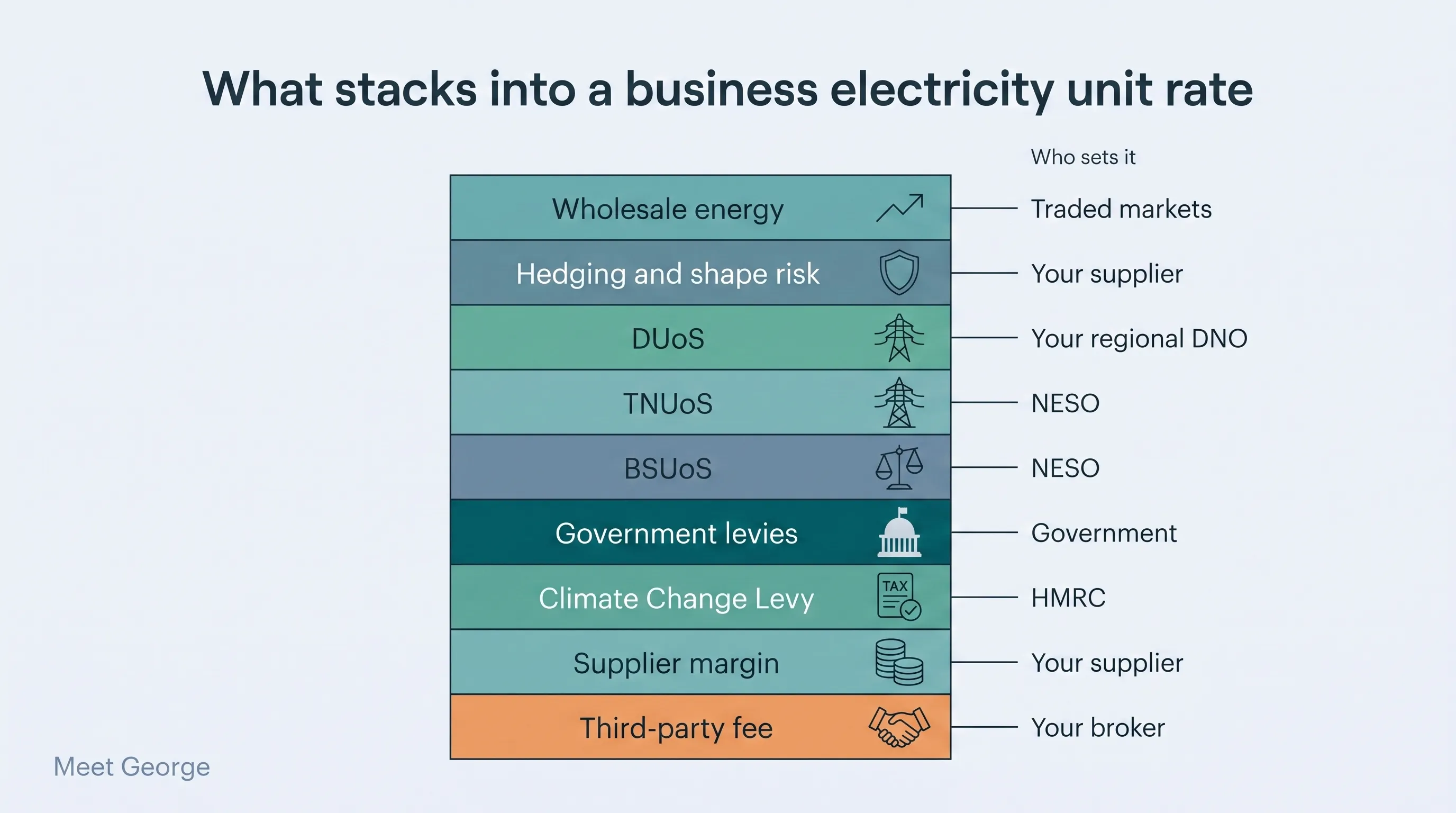
Those five fixed layers are the non-commodity charges or pass-through charges you may see named on a bill, and they are not your supplier’s invention: Ofgem’s guidance on supplier obligations (opens in new tab) says “All licenced electricity suppliers are obligated under the Renewables Obligation (RO) schemes”.
Why is the wholesale price not the price you pay?
Wholesale is the raw cost of the electricity and the only layer that moves daily, but you buy at the price your supplier paid when it bought energy for your contract. That is hedging: sign a two-year fixed deal and your rate becomes a snapshot of one day, so a falling market does not cut it.
Suppliers price unpredictability too. Erratic peaks cost more to forecast than a steady nine-to-five load, and the shape fee covers that gap, while volume tolerance clauses bite if you use far more or less than expected.
Who sets the network charges, and why do two identical shops pay different ones?
Three charges move electricity from generation to your meter, and they are why geography changes your bill.
DUoS (Distribution Use of System) pays for the local network - the poles, cables and substations run by your regional Distribution Network Operator. Each of the 14 DNO regions in Great Britain publishes a charging statement under Standard Licence Condition 14. What you pay turns on your charging band, whether your meter is half-hourly, and how long your region’s peak runs.
TNUoS (Transmission Network Use of System) pays for the high-voltage national network. NESO sets TNUoS tariffs (opens in new tab) under the industry’s Connection and Use of System Code, publishing them by 31 January for the following 1 April. They are zonal, based on where you connect, which builds a north-south gradient into the cost.
BSUoS (Balancing Services Use of System) pays for matching supply and demand second by second. It is recovered from users only, and NESO sets it as a fixed rate for six-month blocks: the final 2026/27 tariffs (opens in new tab) are £13.74/MWh for April to September 2026 and £12.49/MWh for October to March.
None attach to your supplier: they follow your meter, region and usage pattern, so switching does not change them. Part of DUoS arrives through your standing charge rather than your unit rate, alongside meter operator fees and, on half-hourly sites, capacity charges tied to your agreed maximum import capacity - so a low standing charge does not mean a cheap contract. Two guides go deeper: regional business energy prices and business electricity standing charges.
Which government levies does a business actually pay?
Business and household treatment of these has diverged.
Levies every electricity supplier funds, including on business supply:
- Renewables Obligation (RO) - suppliers present Renewables Obligation Certificates for a share of what they supply, or pay a buy-out price instead, set by Ofgem at £69.34 per certificate (opens in new tab) for 2026/27. DESNZ set the obligation at 0.472 certificates per MWh (opens in new tab) in Great Britain.
- Contracts for Difference (CfD) - a top-up paid to low-carbon generators whenever the wholesale price sits below an agreed strike price. Suppliers fund it through a compulsory levy paid to the Low Carbon Contracts Company, which the CfD Supplier Obligation (opens in new tab) says is “charged at a fixed £/MWh rate on a daily basis across each levy quarter”.
- Capacity Market - pays generators and demand-side providers for being available. Regulation 6 of the Electricity Capacity (Supplier Payment etc.) Regulations 2014 (opens in new tab) makes suppliers liable on Great Britain supply over “the period commencing with 1st November and ending with the last day of February”. How that splits between them turns on peak hours. DESNZ, describing the mechanism in its April 2026 consultation on the British Industrial Competitiveness Scheme (opens in new tab), puts it plainly: “A supplier’s market is calculated based on Chargeable Demand for periods of high demand, between 4pm and 7pm on working days from the start of November to the end of February.” So when you use power in winter matters.
- Feed-in Tariff, a scheme closed to new applicants in 2019 (opens in new tab) that still pays owners of small solar and wind installations for what they generate. And the nuclear Regulated Asset Base (RAB) levy, a funding model that lets Sizewell C charge consumers while it is still being built. Its Interim Levy Rate, the provisional per-MWh charge suppliers pay ahead of final reconciliation, is set quarterly at £3.754/MWh for 1 October to 31 December 2026 (opens in new tab).
Funded from domestic supply, so not directly yours: the Warm Home Discount, Energy Company Obligation, Great British Insulation Scheme and Smart Export Guarantee.
The £150 that did not reach business
The Autumn Budget 2025 took an average of £150 off household energy bills from April 2026 (opens in new tab): £88 from moving Renewables Obligation costs to general taxation, £59 from ending the Energy Company Obligation, £7 of VAT. DESNZ describes a “75% reduction in domestic RO costs” and states that the direction applies to domestic electricity suppliers (opens in new tab). Household and business now carry different amounts of Renewables Obligation on the same kilowatt hour, which is why your rate did not move.
How much of a business electricity bill is tax?
The Climate Change Levy is a per-kWh tax on business energy use, collected by your supplier and shown on the bill. From 1 April 2026 the main rate is 0.801p/kWh for both electricity and gas (opens in new tab), rising to 0.827p/kWh on 1 April 2027. A Climate Change Agreement discounts it by 92% for electricity and 89% for gas, and HMRC treats small supplies as domestic use, outside the main rates altogether: not more than 1,000 kWh of electricity or 4,397 kWh of gas per month (opens in new tab) at one premises from one supplier.
VAT is 20% on business energy as standard, with a 5% reduced rate for domestic use, charities and supplies below the de minimis thresholds. The bit most guides skip: if you are VAT-registered, VAT on energy is recoverable input tax - a cash-flow item, not a cost. How to apply for the 5% rate covers the declaration.
One change does reach some businesses. From 1 October 2026 VAT comes off domestic electricity entirely. A business standard-rated at 20% is not in scope - but a business already on the 5% reduced rate is. The government confirmed on 26 August (opens in new tab) that “Small businesses, charities and residential care homes that already qualify for the reduced 5% VAT rate on electricity, including through the existing VAT certificate and declaration process, will also benefit from the 0% rate this winter”. It is electricity only - gas is unaffected - and the enabling legislation is not yet confirmed. If you might qualify, applying for the 5% rate is worth doing before winter, and the 5% versus 20% guide has the detail.
Is there a published breakdown of a business electricity bill?
No. Ofgem publishes a detailed domestic breakdown - every price cap decision carries methodology annexes for wholesale, network and policy cost allowances alongside the default tariff cap levels (opens in new tab) - but the cap is domestic only (opens in new tab). There is no business equivalent, because business rates are negotiated meter by meter.
What can be sourced, and what cannot
Four charges are published as flat rates in advance, so you can add them up without estimating. A megawatt hour is 1,000 kWh, so £13.74/MWh is 1.374p/kWh:
| Charge | Published rate for 2026/27 | Per kWh |
|---|---|---|
| Climate Change Levy, from 1 April 2026 | 0.801p/kWh | 0.801p |
| BSUoS fixed tariff, April to September 2026 | £13.74/MWh | 1.374p |
| Nuclear RAB Interim Levy Rate, October to December 2026 | £3.754/MWh | 0.375p |
| Renewables Obligation | £69.34 x 0.472 certificates per MWh = £32.73/MWh | 3.273p |
That comes to about 5.8p/kWh, roughly a fifth of a 28p/kWh contract. Then it stops. The Renewables Obligation line is priced at the buy-out rate, before the buy-out fund is recycled back to suppliers, which changes what a supplier actually pays per certificate. BSUoS resets every six months and the RAB rate every quarter. DUoS and TNUoS are regional and zonal, so there is no single national figure to add. Wholesale, hedging, supplier margin and the third-party fee are not published at all.
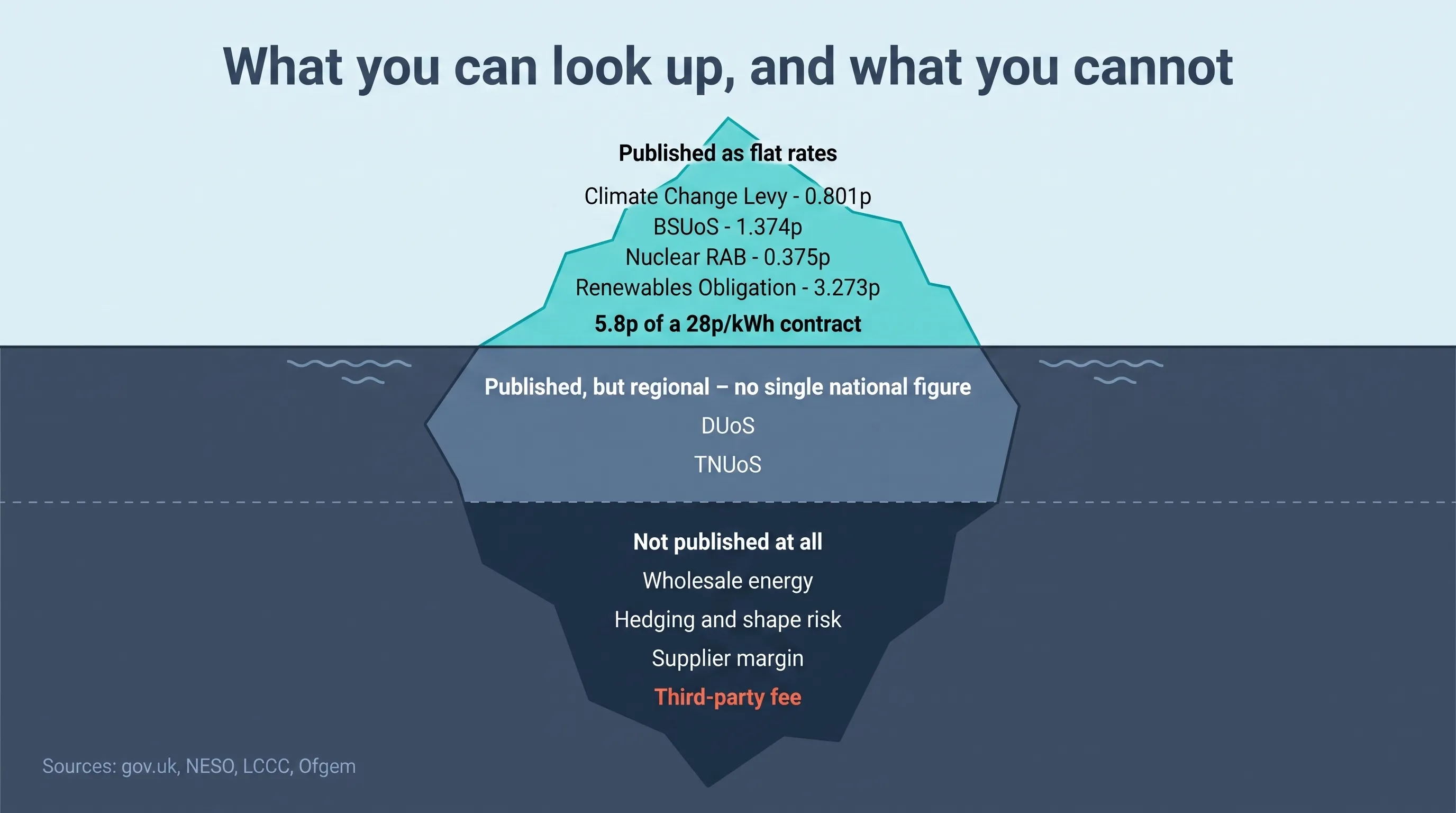
So treat any “X% of your business bill is network charges” claim as an estimate, usually a domestic figure carried across. Your contract is the authoritative source, and a business on deemed rates has no cap protecting it.
Why does the business next door pay a different rate?
Five things, and the one that dwarfs the rest is how much electricity you buy in a year.
The big one: how much you use
The evidence is the DESNZ series on prices of fuels purchased by non-domestic consumers (opens in new tab), fully delivered UK averages including the Climate Change Levy and excluding VAT:
| Consumption band (electricity) | Annual use | Average price |
|---|---|---|
| Very Small | up to 20 MWh | 35.02p/kWh |
| Small | 20 - 499 MWh | 28.76p/kWh |
| Small/Medium | 500 - 1,999 MWh | 28.08p/kWh |
| Medium | 2,000 - 19,999 MWh | 25.00p/kWh |
| Large | 20,000 - 69,999 MWh | 23.93p/kWh |
| Very Large | 70,000 - 150,000 MWh | 21.93p/kWh |
| Extra Large | over 150,000 MWh | 21.42p/kWh |
Source: DESNZ table 3.4.2 (including the Climate Change Levy), Q1 2026 data published 30 June 2026. Two caveats: DESNZ has revised the Very Small series from Q4 2024 onwards, with further revision possible, and these are survey averages, not quotes available today.
A very small consumer - under 20,000 kWh a year, which is most independent shops, salons, cafes and small offices - paid 13.60p/kWh more than the largest: a 63.5% premium on the same commodity, arithmetic we have done from those two rows, not a figure DESNZ publishes.
You will see bigger premiums quoted. The most-cited is 77%, which reads off a chart in Ofgem’s January 2026 State of the Market retail highlights (opens in new tab) plotting DESNZ data for Q2 2025: 37.95p Very Small against 21.41p Very Large, and 37.95 divided by 21.41 is 1.77.
Three things separate it from our 63.5%: an earlier quarter, Very Large rather than Extra Large, and - doing most of the work - a revision. DESNZ has since revised that Very Small figure down to 36.39p, and the same Q2 2025 comparison now reads 36.39p against 21.40p: a 70.0% premium, not 77%. Move both to the including-CCL basis our table uses and it is 69.6%. The revision moves the number seven points; the levy basis moves it under half a point.
The bands are reporting categories, not tariff tiers: there is no cliff edge at 20 MWh. They reflect fixed costs spread over fewer units and less credit certainty.
The other four
The rest is your contract and your meter. A negotiated fixed deal, a rolled-over contract, an out-of-contract rate and a deemed rate are four prices for the same electricity. DUoS is regional and TNUoS zonal, so neither follows you when you switch. Your load shape stops being an estimate as half-hourly settlement rolls out. And an intermediary’s fee is the layer nobody publishes.
How do I work out what is driving my own rate?
Five steps, no phone call needed.
- Find your all-in unit rate.
- Benchmark it against your consumption band in the DESNZ table.
- Check your contract status and start date.
- Read your Principal Terms for the third-party fee.
- Separate what is negotiable from what is not - compare on total annual cost, not headline unit rate.
The one cost that never appears on your bill
The third-party fee is the exception to everything above: negotiated privately, varying customer to customer for identical service.
In its Non-Domestic Market Review decision (opens in new tab), Ofgem extended to every non-domestic customer, from 1 October 2024, a rule that had covered only microbusinesses: suppliers must provide “a cost per unit presentation of TPI service fees in their Principal Terms and upon request”. Paragraph 6.12 settles the rest:
“For the avoidance of doubt, we note that the existing licence SLC 7A.10C only requires fees to be disclosed on the Principal Terms and upon request, and as we expand this to all Non-Domestic Customers, this same rule applies. There is no licence requirement for TPI service fees to be presented on bills as a result of this policy.”
So the fee sits inside the p/kWh you pay every month, disclosed once at signing and never again. On 4 June 2026 Ofgem opened a call for input on a third-party intermediaries market review (opens in new tab), citing “mis-selling, pressure selling, low transparency with consumers, and misaligned incentives”. Until it reports, the only number you can trust is the one in your own Principal Terms, and how uplift works explains how it gets into your rate.
Where Meet George fits
Meet George is a self-service switching platform built for the four layers that actually move: you see what the market will do for your meter and you decide, with no sales calls and no letter of authority before you have seen a number. Our fee is 1p/kWh, itemised on every quote, never buried in the unit rate. The platform is in private beta now, granted one business at a time. Whether or not you ask for access, dig out your Principal Terms and find your own fee per unit.
Sources:
- DESNZ, Prices of fuels purchased by non-domestic consumers in the UK, tables 3.4.1 and 3.4.2 (opens in new tab) - Q1 2026 data, published 30 June 2026
- Ofgem, State of the Market: energy retail market highlights (opens in new tab) - 27 January 2026
- Ofgem, Supplier obligations for environmental and social schemes (opens in new tab) - accessed August 2026
- Ofgem, Feed-in Tariff scheme (opens in new tab) - accessed August 2026
- Ofgem, Renewables Obligation buy-out price and mutualisation thresholds 2026/27 (opens in new tab) - 2026/27 scheme year
- DESNZ, Calculating the level of the Renewables Obligation for 2026 to 2027 (opens in new tab) - 2026/27 obligation level
- DESNZ, Electricity Market Reform: CfD Supplier Obligation (opens in new tab) - accessed August 2026
- The Electricity Capacity (Supplier Payment etc.) Regulations 2014, regulation 6 (opens in new tab) - as made
- DESNZ, British Industrial Competitiveness Scheme: consultation on regulatory changes and scheme delivery (opens in new tab) - 16 April 2026
- Low Carbon Contracts Company, Nuclear RAB Interim Levy Rate for Q4 2026 (opens in new tab) - 21 July 2026
- NESO, BSUoS final 2026/27 fixed tariffs (opens in new tab) - 15 January 2026
- NESO, TNUoS charges (opens in new tab) - accessed August 2026
- HMRC, Climate Change Levy rates (opens in new tab) - rates from 1 April 2026 and 1 April 2027
- HM Government, What the Autumn Budget means for your energy bills (opens in new tab) - Autumn Budget 2025
- DESNZ, RO to Exchequer and ECO costs schemes: guidance for suppliers (opens in new tab) - domestic energy tariff reductions 2026
- HM Government, Breathing space on your energy bill (opens in new tab) - 26 August 2026
- HMRC, Excise Notice CCL1/3: reliefs and special treatments for taxable commodities (opens in new tab) - para 2.5, small-quantity domestic-use thresholds
- Ofgem, Energy price cap: default tariff levels (opens in new tab)
- Ofgem, Energy price cap and default tariff levels (opens in new tab) - accessed August 2026
- Ofgem, Non-Domestic Market Review decision (opens in new tab) - April 2024
- Ofgem, Third-Party Intermediaries Market Review call for input (opens in new tab) - 4 June 2026


