
Business energy for dental practices Sort your practice's next energy contract without the broker calls.
Upload your latest electricity bill. George reads it in seconds and tells you whether you're in your switching window and what to do next.
- Result in seconds
- No account needed
- No sales calls
Bill check
Read by George in seconds
- Unit rate
- 28.4p/kWh
- Standing charge
- 62.0p/day
- Contract ends
- 28 Mar 2027
Result
In your switching window
You're ready to continue with Meet George.
Too early? Ask George to remind you when it's time.
Updated
How much electricity does a dental practice use?
- Estimated use, 140 m² practice
- 9,800 kWh a year
- Estimated annual cost
- £3,760
That's an estimate for a 140 m² practice, the median size of health centres, the group DESNZ puts dental practices in with GP surgeries. Don't know how much yours uses? You don't need to work it out - upload your bill and George reads it for you.
- 70 m² 4,900 kWh £1,880 a year
- 100 m² 7,000 kWh £2,690 a year
- 140 m² (Median in the DESNZ survey) 9,800 kWh £3,760 a year
- 200 m² 14,000 kWh £5,370 a year
- 280 m² 19,600 kWh £7,520 a year
DESNZ doesn't publish figures for dental practices alone. It groups them with GP surgeries as health centres, so these are a rough guide, not a dental average.
How we calculated this
These estimates are floor area multiplied by the median electricity use per m² that DESNZ's Building Energy Efficiency Survey found for health centres in England and Wales in 2014-15: 70 kWh per m² a year. DESNZ groups dental practices with GP surgeries as health centres, so the figures aren't a dental-practice average: of the 62 health centre records the survey collected, 10 came from dentists, and 52 records were used in its results, though DESNZ doesn't say how many of those were dental. The median health centre was 140 m². DESNZ publishes both medians rounded to the nearest 10, so 70 kWh per m² could be anything from 65 to 75, and the estimates assume the same use per m² at every size, so treat them as a rough guide. DESNZ's newer statistics (ND-NEED) don't separate practices either: the 2024 median for all health buildings in England and Wales, hospitals included, was 13,900 kWh of electricity. Costs use the provisional Q2 2026 average paid by businesses using up to 20,000 kWh a year (38.36p per kWh, every charge except VAT). That price includes Climate Change Levy, which practices averaging up to 1,000 kWh a month (about 170 m² or smaller at the median use per m²) don't pay, so for them it runs slightly high. Practices bigger than about 290 m² would pass 20,000 kWh a year, where a different price band applies, so they aren't shown.
Sources: DESNZ (formerly BEIS), Building Energy Efficiency Survey 2014-15, health report, tables and appendices; DESNZ, ND-NEED 2026 (2024 data), table 14A; VOA, Rating Manual, hospitals and healthcare (description codes); DESNZ, non-domestic energy prices, table 3.4.2 (Q2 2026)
How switching works with Meet George
A quick bill check first, so you only sign up when switching makes sense. Then you switch yourself, on the platform we built.
Step 1 · The bill check
See if you can switch in seconds
- Upload a recent electricity bill. No account needed.
- George reads it in seconds and tells you whether you're in your switching window and what to do next.
- Too early? Ask George to remind you when it's time.
No sales call, and no waiting for a reply.
Step 2 · Switch on Meet George
Do the whole switch yourself, online
- 01
Create your account
Sign up on Meet George. Nobody needs to call you.
- 02
Compare the contracts available to your business
Our 1p/kWh fee is shown separately on every quote.
- 03
Sign online
Your new supplier takes over from the agreed start date.
The whole switch happens on Meet George, not over the phone.
Where the electricity goes in health centres
DESNZ doesn't split out dental practices: it groups them with GP surgeries as health centres. Lighting is the biggest use, and DESNZ's 2014-15 building survey found that consulting rooms and small offices in health centres tended to be over-lit, which pushed their lighting use per m² up despite shorter opening hours. Computers and office equipment come next, at about a quarter. Heating is a small share here because most of it runs on gas: across all fuels, it's almost two thirds of a health centre's energy. Using less helps, but what you pay for each kWh comes down to your contract.
-
33% Lighting
-
24% Computers and office equipment
-
11% Cooling and fans
-
9% Heating Heating by gas or oil isn't counted here
-
3% Hot water Water heated by gas or oil isn't counted here
-
20% Everything else Includes fridges, catering and other equipment
Shares of health centres' electricity across the UK in 2025. DESNZ bases the split on its 2014-15 Building Energy Efficiency Survey, which groups dental practices with GP surgeries. DESNZ doesn't measure compressors, suction or sterilisers separately: its survey made a low-confidence estimate for medical equipment in consulting rooms, about 5% of health centres' electricity.
Four things worth checking before your practice's next contract
Most of the answers are on your latest bills or in your lease.
Can your practice reclaim the VAT on its energy?
Dental care is VAT-exempt, so a practice usually can't reclaim all the VAT on its energy. That makes the VAT rate on each bill worth checking.
Look for: The VAT rate and kWh on each bill. If a bill averages 33 kWh a day or less but charges 20% VAT, ask your supplier to correct it.
Read more Show less
The exemption covers private and NHS work alike, while purely cosmetic work and separate sales such as toothbrushes are usually standard-rated. HMRC gives utility charges as an example of an overhead where you can normally reclaim only the VAT linked to your taxable supplies, and if all your supplies are exempt you can't register for VAT at all, so your accountant can confirm your recovery rate. Separately, HMRC treats electricity averaging no more than 33 kWh a day as domestic use, with a lower VAT rate and no Climate Change Levy. It judges the limit over each bill, counting all the electricity one supplier provides at your premises: at the median use per m² DESNZ found for health centres (GP and dental surgeries), a 140 m² practice would average about 27 kWh a day, under the limit, and one bigger than about 170 m² would average over it, so a practice near that size can fall either side from one bill to the next.
Sources: HMRC, VAT Notice 701/57, sections 8.1 and 10.1; HMRC, VAT Notice 700/1, section 2.6; HMRC, VAT Notice 701/19, section 5.2; HMRC, VAT Fuel and Power Manual, VFUP2310; HMRC, Excise Notice CCL1/3, paragraph 2.5; HMRC, VAT Notice 700/45, section 5.2; DESNZ (formerly BEIS), Building Energy Efficiency Survey 2014-15, health report, tables and appendices
Is your heating on a separate gas contract?
Heating is almost two thirds of the energy in DESNZ's figures for health centres (GP and dental surgeries), mostly from gas: a second contract with its own end date.
Look for: A gas bill or gas meter number (MPRN) as well as your electricity MPAN, its end date, and the VAT rate on your winter gas bills.
Read more Show less
In those figures gas supplies about 60% of all their energy, against about 32% from electricity. A gas contract has its own standing charge and its own VAT limit of 145 kWh a day, judged bill by bill, so a winter bill can go over it even when your yearly average doesn't. Gas isn't on the online platform yet, so for now our team arranges gas contracts directly.
Sources: DESNZ, Energy Consumption in the UK 2026, table U6; HMRC, VAT Fuel and Power Manual, VFUP2310
Is your practice in an NHS Property Services building?
If so, NHS Property Services recovers utilities through the service charge, as can any landlord who pays the supplier, so the energy contract may not be yours to switch.
Look for: Whether you get an energy bill in your practice's name at all, and what your lease says about utilities and the service charge.
Read more Show less
NHS Property Services recovers them for the space you occupy exclusively, as "additional sums" that don't normally appear as their own line on your service charge bill. A landlord can also include energy in your rent. If paying the supplier is your responsibility, Ofgem's 2022 business energy advice says you can still choose your supplier, even if the lease names a default one. Check for clauses saying you must tell your landlord before you switch, or hand the supply back to a particular supplier when you leave.
Sources: NHS Property Services, Property billing FAQ; Ofgem and partners, non-domestic energy advice (2022), p.31 'If you are a tenant'
Did you buy the practice, or has your contract ended?
If the energy is still in the seller's name, tell the supplier as soon as you can. Without your own contract you're on deemed rates, which Ofgem says usually cost more.
Look for: The name, tariff and end date on the bill. "Deemed" or "out of contract" usually indicates default rates; a missing end date may just not be printed.
Read more Show less
Ofgem says both the business moving in and the one moving out should tell the supplier, and the supplier can ask for evidence such as your lease or property sale documents. You're responsible for any energy you use before your own contract starts. And if you already have a contract, when a fixed deal ends with nothing new agreed some suppliers move you onto out-of-contract rates, which Ofgem also says usually cost more than a fixed-term contract.
Sources: Ofgem, Change of tenancy for businesses; Ofgem, Switch your business energy supplier; Ofgem, Get a business energy contract
Not sure what contract you're on?
Upload your latest bill. George reads it in seconds and tells you where you stand.
Worth reading next

How we're paid
Our 1p/kWh fee on gas or electricity, who pays it and how it shows on every quote.
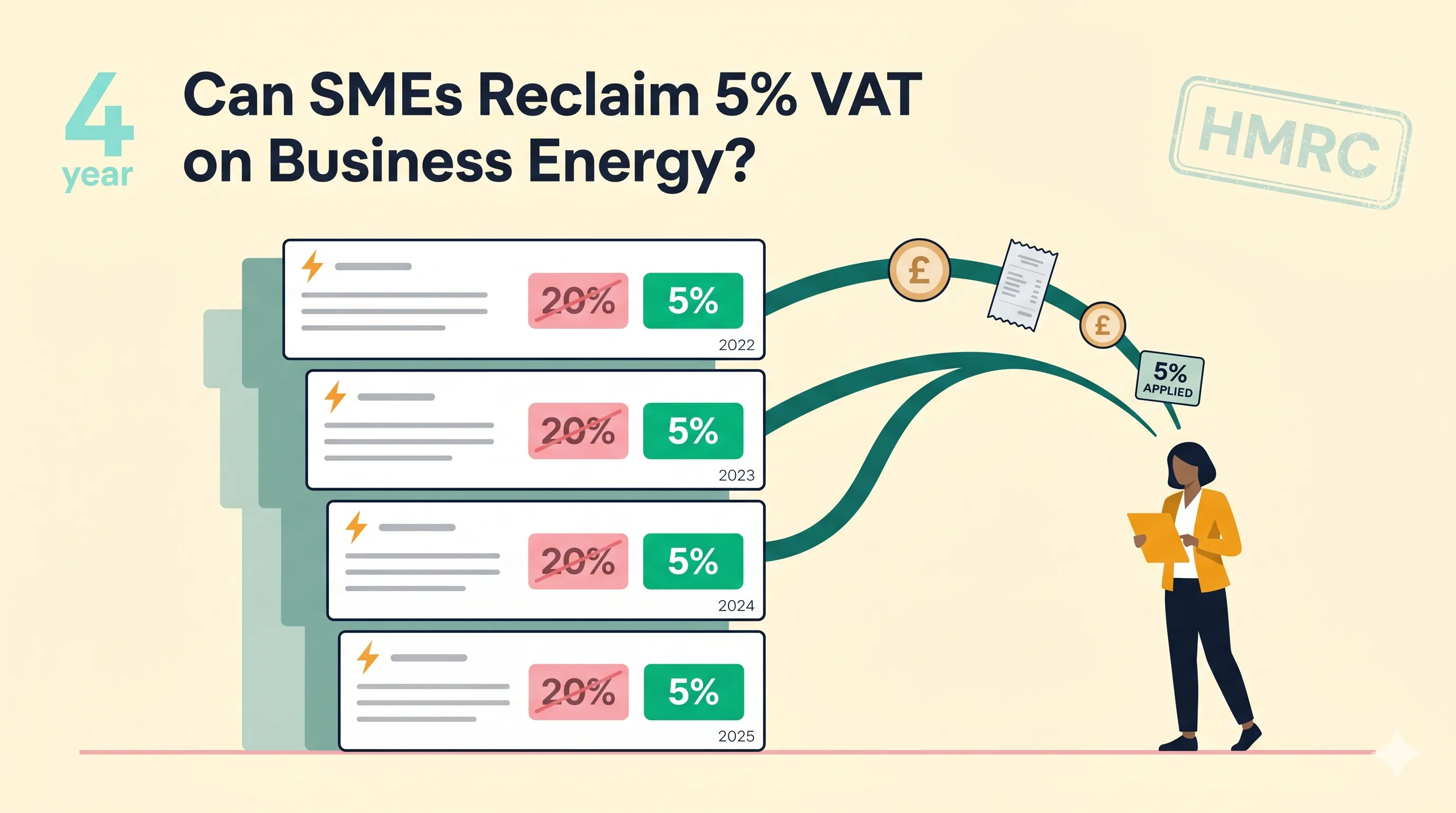
Charged the wrong VAT rate?
How to get your supplier to refund VAT charged at 20% on bills that qualified for a lower rate.

How to read your bill
Find your unit rate, standing charge, VAT and contract end date.

Microbusiness energy protections
Who counts as a microbusiness, and what changes for a business above the limits.
Questions dental practice owners ask
How much electricity does a dental practice use?
DESNZ doesn't publish a figure for dental practices alone. Its Building Energy Efficiency Survey groups them with GP surgeries as health centres, which used a median of about 70 kWh of electricity per square metre a year in England and Wales in 2014-15, with a median size of 140 m². That gives an estimated 9,800 kWh a year for a 140 m² practice. DESNZ publishes both medians rounded to the nearest 10, so treat it as a rough guide. Your bill shows what your practice actually uses.
Why are these figures for GP and dental practices together?
Because DESNZ doesn't publish energy figures for dental practices alone. Its Building Energy Efficiency Survey, which our estimates and electricity split are based on, groups dental practices with GP surgeries as health centres. The survey collected 62 health centre records, 10 of them from dentists, and used 52 in its results without saying how many of those were dental. DESNZ's newer statistics (ND-NEED) don't separate them either: they only go as far as all health buildings, hospitals included. So treat the figures as a rough benchmark rather than a dental-practice average. Your bill shows what your practice actually uses.
What's the average electricity bill for a dental practice?
There's no official figure for dental practices, but at an estimated 9,800 kWh a year, a 140 m² practice would pay about £3,760 a year before VAT, or £310 a month, at the provisional Q2 2026 average paid by businesses using up to 20,000 kWh a year (38.36p per kWh, including every charge except VAT). Because a practice usually can't reclaim all of its VAT, the VAT is part of the cost too. If your practice is heated by gas, that's a separate bill on top.
Can my dental practice reclaim the VAT on its energy bills?
Usually not all of it. HMRC says dental care and treatment is exempt from VAT whether you provide it privately or on the NHS, and that you can't normally reclaim VAT that relates to exempt supplies. Purely cosmetic work and separate sales such as toothbrushes are usually standard-rated, and overheads such as utility charges often relate to both taxable and exempt supplies: for those you can normally reclaim only the share linked to your taxable supplies. If all your supplies are exempt, you can't register for VAT at all. Your accountant can confirm your recovery rate. That's why the VAT rate on each energy bill is worth checking: for a practice, VAT charged at too high a rate usually can't come back through a VAT return, so ask the supplier to correct it.
Should my dental practice pay 20% VAT on electricity?
It depends on each bill. HMRC treats electricity averaging no more than 33 kWh a day (1,000 kWh a month) as domestic use, so there's no Climate Change Levy, no certificate needed and a lower VAT rate instead of 20%: 0% in Great Britain from 1 October 2026 to 31 March 2027, then 5% again, and 5% in Northern Ireland. At the median use per square metre DESNZ found for health centres (GP and dental surgeries), a 140 m² practice would average about 27 kWh a day, under the limit, and one bigger than about 170 m² would average over it, so a practice near that size can fall either side from one bill to the next. If a bill averages 33 kWh a day or less and still shows 20%, ask your supplier to correct it: a practice usually can't recover that VAT through a VAT return. Gas has its own limit, 145 kWh a day, and stays at 5% within it.
Our practice is in an NHS Property Services building. Can we switch energy supplier?
Possibly not. NHS Property Services says it recovers utilities costs for the space you occupy exclusively through the service charge, so the energy contract is likely to be the landlord's rather than yours. Check your lease. If it makes paying the energy supplier your responsibility, the 2022 business energy advice Ofgem wrote with Citizens Advice and Energy UK says you can still switch, even if the lease ties you to a default supplier. Check it for clauses saying you must tell your landlord before you switch, or return the supply to a particular supplier when you leave.
I've bought a dental practice. What happens to the energy?
If the energy is still in the seller's name, tell the current supplier as soon as you can, with a meter reading if you can take one: Ofgem says both the business moving in and the one moving out should. The supplier can ask for evidence such as your lease, property sale documents or title deeds, and reviews it within 10 working days. You're responsible for any energy you use before your own contract starts, and moving in without arranging one puts you on a deemed contract, at rates Ofgem says are usually higher than negotiated ones.
Does a dental practice count as a microbusiness for energy?
It can, even with 10 or more staff. Ofgem says you qualify as a microbusiness with fewer than 10 employees and an annual turnover or balance sheet total of no more than £2 million, and that you can also qualify if you use up to 100,000 kWh of electricity or up to 293,000 kWh of gas a year. At an estimated 9,800 kWh a year, a 140 m² practice is well under the electricity limit. Microbusinesses get extra protections, such as clear information about their contract and renewal prices before it ends. Ofgem notes that some suppliers use either your business size or your annual consumption when deciding which contract or protections apply, so check with yours.
What uses the most energy in a dental practice?
There's no official figure for dental practices alone. DESNZ's figures for health centres, which group dental practices with GP surgeries, put heating first, at almost two thirds of all their energy, most of it from gas. On the electricity bill, lighting comes first at about a third, then computers and office equipment at about a quarter, and DESNZ's survey found consulting rooms and small offices tended to be over-lit. DESNZ doesn't measure compressors, suction or sterilisers separately, so there's no official figure for what dental equipment adds. Your bills show what your whole practice uses.
What does Meet George cost a dental practice?
A flat 1p per kWh, and you only pay it if you switch through Meet George. For a practice using an estimated 9,800 kWh a year, that's £98 a year. The same 1p per kWh applies to gas. Electricity switches happen online; gas isn't on the platform yet, so for now our team arranges gas contracts with you directly. You pay the fee through your energy supplier, and it's itemised on every quote, never buried.
Sources (16)
DESNZ (formerly BEIS), Building Energy Efficiency Survey 2014-15, health report, tables and appendices; DESNZ, ND-NEED 2026 (2024 data), table 14A; DESNZ, Energy Consumption in the UK 2026, table U6; DESNZ, non-domestic energy prices, table 3.4.2 (Q2 2026); HMRC, VAT Notice 701/57, sections 8.1 and 10.1; HMRC, VAT Notice 700/1, section 2.6; HMRC, VAT Notice 701/19, section 5.2; HMRC, VAT Fuel and Power Manual, VFUP2310; HMRC, Revenue and Customs Brief 10 (2026); HMRC, Excise Notice CCL1/3, paragraph 2.5; HMRC, VAT Notice 700/45, section 5.2; NHS Property Services, Property billing FAQ; Ofgem and partners, non-domestic energy advice (2022), p.31 'If you are a tenant'; Ofgem, Change of tenancy for businesses; Ofgem, Switch your business energy supplier; Ofgem, Get a business energy contract
Your practice's next energy contract, sorted without the broker calls.
Upload your latest bill. George reads it in seconds and tells you what to do next. If you're ready to switch online, you can continue with Meet George.
- Result in seconds
- No account needed
- No sales calls


