


Quick answer: Between June 2026 and 2028, a series of separate reforms reshape UK energy. They cover settlement, supplier enforcement, smart meters, digital consent, tariff transparency, and primary legislation. Most UK businesses do not yet know these changes are coming. By the time they land, the rules governing how you contract for, switch, and pay for electricity will look different from how they have looked for the last decade.
This piece walks through each of the seven, in order of effective date. For every one it explains what it does, who it affects, when it bites - and, because a lot of this is written in industry jargon, what it actually means in plain English.
There is a lot of shorthand in this field. The first time we use an acronym we spell it out, then use the short form after that. Where a term has its own definition, we link to our energy glossary.
TL;DR: Key Takeaways
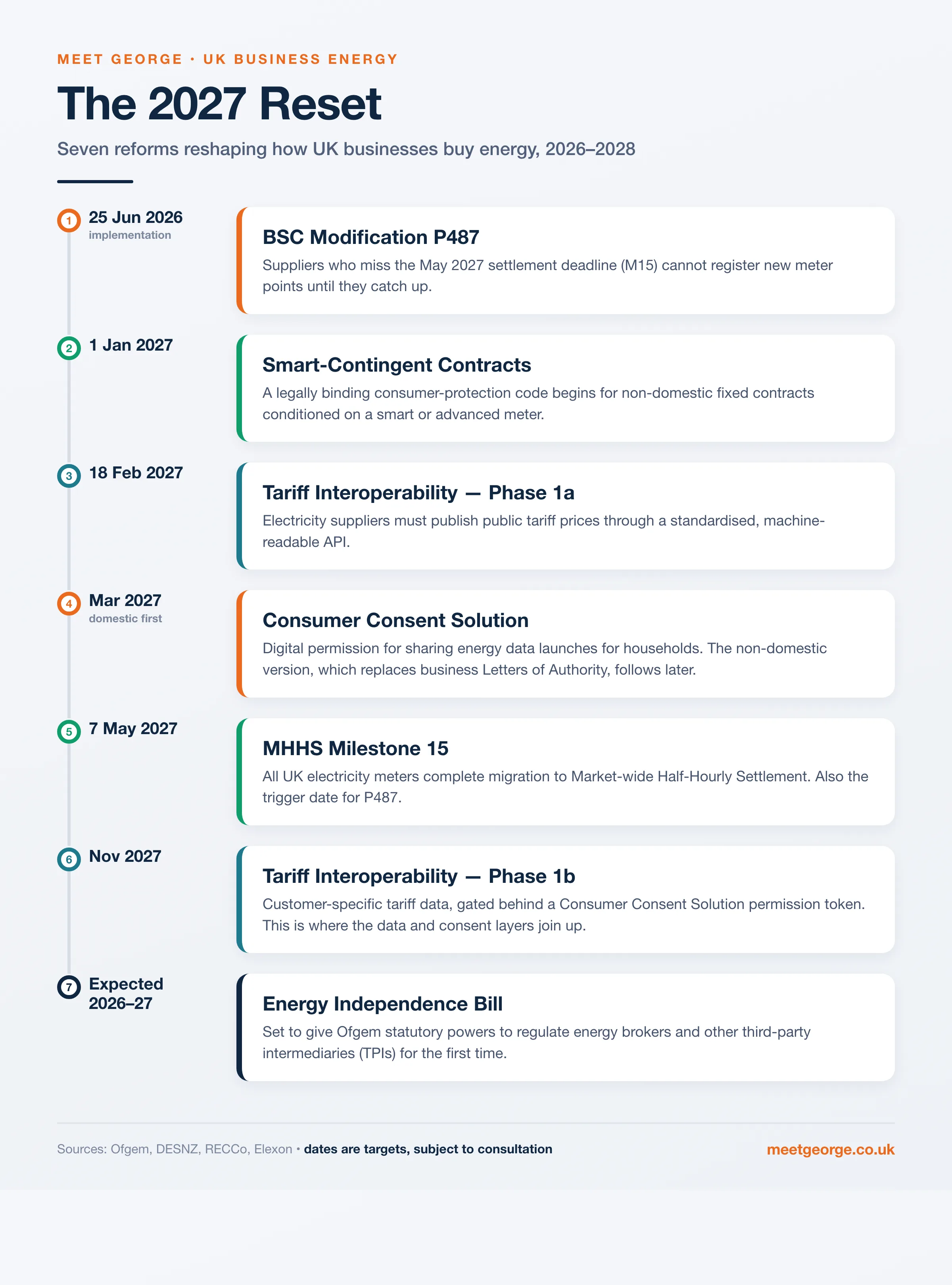
The seven landings, in order:
- BSC Modification P487 - Implementation 25 June 2026, trigger 7 May 2027. Suppliers who do not finish migrating to half-hourly settlement by Milestone 15 (M15) cannot take on new meter points until they catch up.
- Smart-Contingent Contracts (SCC) - 1 January 2027. A legally binding consumer protection code begins for non-domestic fixed-term contracts that are conditional on a smart or advanced meter.
- Tariff Interoperability (TI) Phase 1a - planned 18 February 2027. Electricity suppliers must publish public tariff pricing data via a standardised API.
- Consumer Consent Solution (CCS) - domestic launch - March 2027. A token-based digital permission framework for sharing energy data goes live for households. The non-domestic version - the one that actually replaces business Letters of Authority - follows later, expected to align with Tariff Interoperability Phase 1b and potentially landing in late 2027/early 2028.
- MHHS Milestone 15 - 7 May 2027. All UK electricity meters complete migration to Market-wide Half-Hourly Settlement.
- Tariff Interoperability Phase 1b - planned November 2027. Standardised access to consumer-specific tariff data, gated behind a CCS digital permission token. This is the point where Tariff Interoperability and the Consumer Consent Solution join up.
- Energy Independence Bill - introduction expected 2026 to 2027. Set to give Ofgem statutory powers to regulate energy brokers and other third-party intermediaries for the first time.
In plain English: the plumbing behind a UK electricity switch is being rebuilt all at once - how your usage is measured, who is allowed to see your data, how prices are published, and what brokers are allowed to do. Individually each change is technical. Together they reset the rules of the market you buy energy in.
Why This Matters Now
Three things are happening at the same time:
- The infrastructure that processes a UK electricity switch is being rebuilt. Market-wide Half-Hourly Settlement (MHHS) is one of the largest reforms of the electricity settlement system since privatisation.
- The consent and data-access layer is being rebuilt. The Consumer Consent Solution (opens in new tab) and Tariff Interoperability (opens in new tab) together standardise how customer permission and supplier pricing data flow across the market.
- The legal framework that governs broker conduct is being rewritten. The Energy Independence Bill is set to expand Ofgem’s remit to regulate third-party intermediaries (TPIs) - the brokers and intermediaries who sell energy contracts to businesses.
Each layer has its own dedicated programme and delivery body, which is why these reforms look like separate items in the trade press. But the dates cluster, and the cumulative effect lands across 2027 and into 2028.
In plain English: if your business signs a fixed-term energy contract in 2026 or 2027, the rules under which you signed it, the data that priced it, and the broker conduct standards that applied to its sale are all changing inside the contract period.
1. BSC P487 - The Supplier Deadline With Teeth
Effective dates: Implementation 25 June 2026 (or earlier). Enforcement trigger 7 May 2027 (M15).
On 11 May 2026, Ofgem approved Balancing and Settlement Code (BSC) Modification P487 (opens in new tab) - the “Incentive of BSC Supplier Parties to meet the M15 MHHS Milestone.” The BSC Panel had recommended that Ofgem reject it. Ofgem approved it anyway.
In plain English: the BSC is the industry rulebook for measuring and settling electricity. P487 adds a penalty to it. Any UK electricity supplier that fails to finish moving its meters onto half-hourly settlement by 7 May 2027 will be barred from registering new meter points - in other words, blocked from taking on new customers - until it has caught up. The restriction is applied at supplier level, and the only way out is an exemption from the MHHS Senior Responsible Owner (SRO).
That role changed hands on 21 May 2026. Steve Page, Elexon’s Chief Financial Officer, took over from Helen Adey. The exemption gatekeeper now answers to a CFO, which is worth noting if you assume exemptions will be easy to come by.
This matters for two reasons:
- It puts real commercial stakes behind MHHS. Suppliers who fall behind cannot grow during the freeze. A supplier whose registration channel is locked for several months is a supplier under strain.
- It could add pressure on smaller, less-resourced suppliers. The wider supplier market has been consolidating since the 2021-2022 crisis, and a registration freeze is the kind of pressure that bears hardest on suppliers with the least slack. How much it accelerates consolidation remains to be seen - this is a risk, not a certainty.
What this means for you: when you sign a multi-year fixed-term contract in 2026 or early 2027, the supplier you are signing with may face a P487-triggered freeze inside your contract period. That does not necessarily change the unit rates you have agreed, but it can affect customer service, change-of-tenancy handling, and the supplier’s commercial flexibility. It is one extra question to ask your supplier or broker at renewal.
2. Smart-Contingent Contracts - The 1 January 2027 Date
Effective date: 1 January 2027.
From 1 January 2027, UK non-domestic electricity suppliers must follow a legally binding consumer protection code for Smart-Contingent Contracts (SCC). These are fixed-term contracts where the supplier requires the customer to have - or agree to install - a smart or advanced meter as a condition of the deal.
This emerged from the DESNZ Non-Domestic Smart Meter Rollout Post-2025 consultation (opens in new tab), which closed for further engagement in April 2026. A government response and next steps are expected later in 2026.
In plain English: from 2027, if a supplier wants to tie its best fixed-price deal to you having a smart meter, it has to follow a rulebook that protects you - covering what it must tell you up front, how delays to your meter install are handled, and what counts as you having done your bit.
What changes for SMEs:
- Ahead of 2027, suppliers must tell non-domestic customers that fixed-term contracts entered into or renewed after 1 January 2027 will require a smart or advanced meter.
- From 1 January 2027, the consumer protection code defines what suppliers must do before, during, and after the installation process.
- The code introduces “all reasonable steps” tests for both suppliers and customers, with case studies that distinguish between circumstances outside the customer’s control (signal constraints, landlord refusal, remedial works) and matters where the customer is reasonably expected to act (granting access, identifying the right site contact).
- Compliance assessment and enforcement sit with Ofgem. Factual monitoring sits with RECCo (opens in new tab) (the Retail Energy Code Company) and a new Smart-Contingent Contract (SCC) Monitoring Body. Existing microbusiness protections under the Consolidated Metering Code of Practice (CoMCoP) continue in parallel.
It is worth being precise about two things:
- Smart-contingent does not mean smart-only. Suppliers can still offer non-fixed-term contracts to customers without smart meters. The smart-contingent rules apply specifically to fixed-term offers that the supplier has conditioned on smart data.
- Smart or advanced both count. An Automated Meter Reading (AMR) meter that delivers reliable consumption data is not automatically disqualified. The detail will sit in the supplier’s own product rules and the Ofgem-enforced code.
What this means for you: from 2027 onwards, the easiest route to a competitive fixed-term contract runs through a working smart meter. If your premises has known smart-meter blockers - signal issues, landlord disputes, restricted access - raise them with your current supplier now, not in January.
3. Tariff Interoperability Phase 1a - 18 February 2027
Effective date: planned 18 February 2027.
On 18 May 2026, two regulatory pieces went live with very little public attention: REC Schedule 35 and a new Supplier Licence Condition called SLC11C. Together they form the foundation of the Tariff Interoperability (TI) programme, part of the wider Smart Secure Electricity Systems (SSES) programme run by the Department for Energy Security and Net Zero (DESNZ) (opens in new tab).
In plain English: every electricity supplier in the UK will have to publish its tariff prices in one standard, computer-readable format through an Application Programming Interface (API) - a structured “data socket” that software can plug into. Today, prices live in PDFs, web pages, supplier price books (often huge Excel files), and broker quotes that machines cannot reliably read. Phase 1a is planned to go live on 18 February 2027. The technical specification has been baselined, a consultation on the API specification opens in July 2026, and supplier testing runs through to early 2027.
The Government’s stated purpose is to let Energy Smart Appliances (EV chargers, heat pumps, batteries) respond to time-of-use price signals. The deeper consequence is structural: for the first time, UK electricity tariff data has a mandatory, hosted, standardised specification, governed by RECCo and enforced through a Supplier Licence Condition.
A few caveats:
- Phase 1a covers public tariff pricing data - the published, headline pricing. It does not yet include customer-specific quotes tied to a particular consumption profile or contract term.
- There are updated exemption criteria for non-domestic suppliers in Phase 1a. The specific scope sits inside REC Schedule 35; public summaries flag that exemptions exist without listing them in full. Many SME-focused suppliers may not be obliged to publish under Phase 1a.
- The customer-specific data - the bit that lets a switching platform produce an accurate per-customer quote - sits in Phase 1b in November 2027.
In plain English: Phase 1a builds the infrastructure. The data format, the API model, and the licence-condition enforcement pattern all go live. Extending the obligation more widely across the non-domestic market then becomes a matter of policy, not engineering - a quiet but significant precedent.
4. Consumer Consent Solution - March 2027 (domestic)
Effective date: March 2027 (domestic Minimum Marketable Product). The non-domestic version - the one that replaces business Letters of Authority - is still to be confirmed.
Today, business energy switching depends on the Letter of Authority (LOA) - a paper or PDF document a customer signs, or a script verbally agreed over the phone, to authorise a broker to act on their behalf. The same authority is used to access data from existing suppliers, sign contracts, and in some cases agree to multi-year arrangements bundled with auto-renewal clauses. (Worth noting: LOAs are a non-domestic mechanism - households do not sign them, which is why the domestic and non-domestic sides of this reform are not the same thing.)
The Consumer Consent Solution (CCS) is set to replace that model with a token-based digital permission framework. RECCo has appointed Raidiam (the firm behind much of the UK Open Banking trust framework) and PayPoint to build the underlying infrastructure.
In plain English: instead of signing a piece of paper that hands a broker broad authority, you would grant a digital permission - a “token” - that you can see, renew and switch off yourself, through one interface. You hold the key to your own data, not the broker.
For domestic customers, the Minimum Marketable Product (MMP) launches in March 2027 with four core consent journeys: Grant, Review, Renew, Revoke. The non-domestic version - the one that actually replaces business LOAs - will be built on the same Trust Framework. Its timing has not been confirmed and is expected to align with the later, consumer-specific stage of Tariff Interoperability (Phase 1b), potentially landing in late 2027/early 2028.
Important caveat: until the non-domestic Phase of the Consumer Consent Solution is formally specified, much of what follows is informed inference, not confirmed policy. The direction looks clear, but the detail - scope, timing, and exactly how it interacts with brokers - is still to be set. Treat the points below as the likely shape of things, not settled fact.
What it could mean for SMEs:
- Paper LOAs look set to be phased out at the structural level. The expected replacement is a digital permission token the customer authenticates and grants, then reviews and revokes through a single interface - so the customer, not the broker, holds the access key.
- Accreditation is likely to apply to anyone wanting access. RECCo’s working assumption (subject to further consultation) is that organisations accessing CCS-permissioned data will need recognised security certifications such as Cyber Essentials Plus (opens in new tab) or ISO 27001. The exact bar has not been codified, but the direction is clear.
- Phone-based broker scripts could run into a token problem. A customer cannot easily authenticate to a digital permission portal mid-call. The verbal-LOA close that has been standard practice for parts of the broker industry may become harder to make work in its current form. How brokers adapt is one of the open questions of the 2027 reset - and one we will only be able to answer once the non-domestic rules are published.
What this means for you: for the customer, the visible change is small - you grant a digital permission instead of signing paper. The bigger, less visible change is who holds the master key to your data and contracts. If the reform lands as expected, that shifts from the broker to you.
5. MHHS Milestone 15 - 7 May 2027
Effective date: 7 May 2027.
Market-wide Half-Hourly Settlement is the long-running programme to move every UK electricity meter from estimated profile-based settlement onto actual half-hourly consumption data. It is run by Elexon (opens in new tab) and overseen by RECCo (opens in new tab) for the retail code components.
In plain English: “settlement” is the back-office process that works out how much electricity each supplier’s customers actually used, so the money can be squared up across the market. Today, most smaller meters are settled on estimates (a typical usage profile). MHHS moves everyone onto actual half-hourly readings.
The headline milestones:
- Milestone 14 (October 2026): All UK electricity suppliers must be qualified under the new MHHS arrangements. Around 80% of meters expected to be migrated.
- Milestone 15 (7 May 2027): Full migration complete. Every electricity meter settled half-hourly.
- Milestone 16 (July 2027): The settlement timetable shortens. In plain English: after a billing period, the industry runs a series of “reconciliation” runs - re-checking estimated against actual usage and re-settling the money between suppliers and the system. Today that final true-up can happen up to 14 months later. Milestone 16 begins moving that final reconciliation down towards a target of around 4 months over time, so the market settles up faster and more accurately, and there is less estimating to correct after the fact.
As of mid-May 2026, over a quarter of Britain’s roughly 33 million electricity meters - more than 8.4 million - had migrated (figures published by Elexon). The mass-migration phase is underway, with the bulk of the work scheduled across 2026 into early 2027.
For most SMEs, the technical mechanics of half-hourly settlement happen behind the scenes. Two practical effects are worth knowing:
- The estimated bill goes away. Once your meter is settled half-hourly, the supplier knows what you actually used and when. The era of “estimated read, adjust later” is ending for the SME market.
- Time-of-use pricing becomes commercially viable - and that opens up a new world of tariff products. With actual half-hourly data, suppliers can offer cheaper rates for off-peak consumption, with the savings reflecting your real usage rather than profile assumptions. This is the data that makes time-of-use tariffs possible, and it is the same data layer that underpins demand-side response (DSR) and flexibility - where a business can be paid to turn its energy use into income by shifting or reducing load at peak times. As the half-hourly data becomes universal, expect the range of flexibility and load-control products to widen. Put simply: when the data exists, new pricing and earning models become possible. (For more on the mechanics, see our guides to half-hourly meter charges and the end of the average bill.)
The M15 date is also the trigger that activates P487 enforcement. The two reforms are designed to land together.
6. Tariff Interoperability Phase 1b - November 2027
Effective date: planned November 2027.
If Phase 1a is the public tariff data, Phase 1b is the customer-specific tariff data. The consultation on Phase 1b opens later in 2026 and the design is explicitly described as CCS-aligned.
In plain English: this is the point where Tariff Interoperability and the Consumer Consent Solution join up. Your specific tariff information would sit behind a CCS permission token, so a third party (a switching platform or a flexibility service) could only retrieve it once you have granted permission.
This is the bit that unlocks proper machine-readable switching for the non-domestic market. With Phase 1b live and a CCS permission token in hand, a switching service could:
- Retrieve your current contract details directly from your supplier in a standard format
- Retrieve your half-hourly consumption from the smart data infrastructure
- Compare against published tariffs from other suppliers
- Produce a like-for-like quote without you having to upload bills, dig out MPANs, or chase your old supplier for data
Today, those four steps involve paper, phone calls, broker LOAs, manual data entry, and a long round of email chasing. After November 2027, the pieces to do them properly via API are intended to be in place.
What is not yet known: the exact obligations on non-domestic suppliers in Phase 1b. As with Phase 1a, exemption criteria are likely to apply. The detail will emerge through the consultation later in 2026.
7. The Energy Independence Bill - The Legislative Complement
Introduction: Announced in the May 2026 King’s Speech. Bill to be introduced. Passage and Royal Assent timing to be confirmed.
In the King’s Speech in May 2026, the Government committed to introducing the Energy Independence Bill. The headline provision for the non-domestic energy market: an expansion of Ofgem’s remit to regulate third-party intermediaries (TPIs) - the brokers, comparison sites, and procurement consultants who sell energy contracts to UK businesses on behalf of suppliers.
In plain English: at present, no regulator directly oversees energy brokers. The current arrangement is a voluntary code plus supplier licence conditions; Ofgem cannot itself authorise, fine, or ban a broker. The Bill is set to change that, giving Ofgem statutory powers over the broker market for the first time. (The Government confirmed its intention to make Ofgem the dedicated TPI regulator (opens in new tab) in October 2025.)
The TNT Charter (the Trust and Transparency in Business Energy Charter), led by Sarah Edwards MP (opens in new tab) (Tamworth) and convened by Startup Coalition (opens in new tab), is pressing for the Bill to include:
- A statutory authorisation regime for TPIs, administered by Ofgem
- Conduct rules covering commission disclosure, sales practice, and renewals
- Meaningful enforcement powers, including the ability to suspend or revoke authorisation
- An outcomes-based regulation model favouring customer outcomes over supplier and broker preferences
The campaign grew out of a real case: a café in Tamworth hit with a roughly £10,000 back-bill, where an independent review later found thousands of pounds of overcharging. It is now backed by a range of small-business bodies.
The Bill text is not yet published. Specific provisions, exemptions, and the parliamentary timetable will become clear when the Bill is laid. What the King’s Speech confirmed is that the policy direction is set: TPI conduct in the non-domestic energy market is on track to be brought inside the regulator’s remit.
Why this is the legislative complement, not just another reform:
- The other six reforms operate inside the existing legal framework. They are code modifications, licence conditions, and operational programmes.
- The Energy Independence Bill changes the legal framework itself. It rewrites the rules under which broker conduct is enforceable.
The bridge between this Bill and the operational reforms is the Smart-Contingent Contract framework. RECCo’s response to the DESNZ consultation explicitly names TPIs in the SCC contracting route, which would give the new TPI conduct rules something concrete to bite on from day one of authorisation.
What This Means Together
Read individually, each of the seven reforms is a technical change with a small number of stakeholders. Read together, they reset the operating environment for UK business energy.
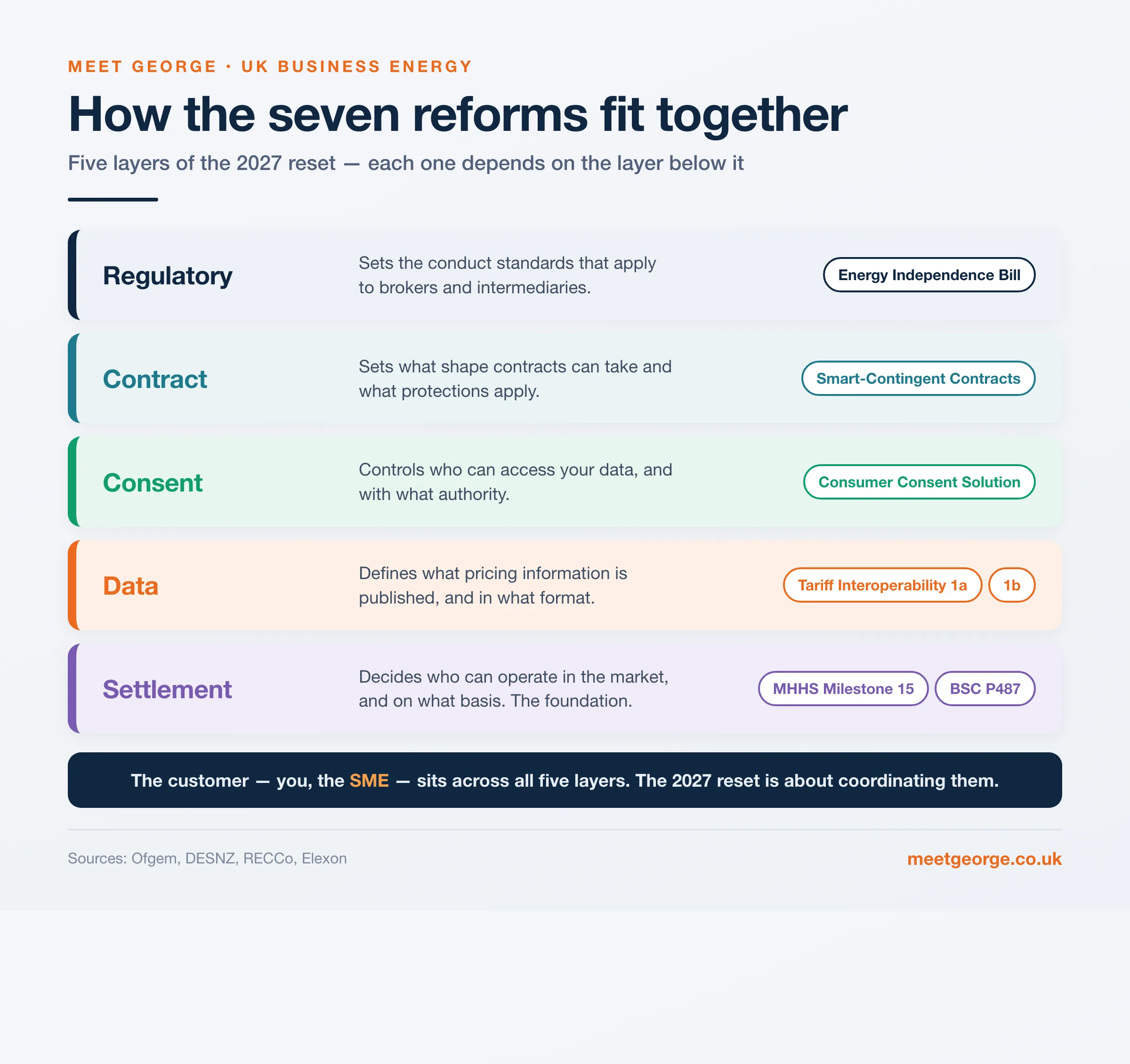
A useful way to think about it - five layers, each handled by a different reform:
- The settlement layer (MHHS, P487) decides who can play in the market and on what basis.
- The data layer (Tariff Interoperability Phase 1a and 1b) decides what information is available and in what format.
- The consent layer (Consumer Consent Solution) decides who can access what data and with what authority.
- The contract layer (Smart-Contingent Contracts) decides what shape contracts can take and what protections apply.
- The regulatory layer (Energy Independence Bill) decides what conduct standards apply to intermediaries.
Today, those five layers are inconsistent, fragmented, and uneven. By the end of 2027 and into 2028, they are scheduled to be coordinated, standardised, and enforced.
None of this is guaranteed to land exactly as planned. Each reform still has consultation rounds to come and exemption scopes to finalise, and several of the dates above are targets rather than fixed law. But the direction of travel is clear, and the dates are real enough to plan around.
What SMEs Should Do Now
This is not a list of urgent actions for January 2027. It is a list of things worth knowing before you sign your next energy contract.
- Find out whether your premises has a working smart or advanced meter. Check your supplier portal or your latest bill. If you have no smart meter and your renewal is in 2027 or beyond, you will be brought into smart-contingent contract territory at the next renewal.
- Identify any known installation blockers. Signal issues, landlord disputes, restricted meter-cupboard access, building-fabric issues, out-of-hours sites. These are the things that delay smart-meter installation. RECCo’s response to the SCC consultation sets out which blockers will count as “outside the customer’s control” - get ahead of them now.
- Review your current Letters of Authority. If you have signed a Level 2 LOA with a broker (the kind that gives them signing authority and rolls into auto-renewal), now is a good time to know exactly what you have authorised and how to revoke it.
- Ask harder questions at renewal. If you are renewing a fixed-term contract in 2026 that runs into 2027, the rules under which your contract operates may change inside the contract period. Ask your supplier or broker how they plan to handle MHHS migration, smart-contingent rules, and the new consent framework.
- Watch the Bill. When the Energy Independence Bill is introduced, the published text will tell us what the broker conduct rules actually look like in practice. The campaign letter signatories - Meet George among them - are advocating for substantive provisions; the published Bill is what matters.
The aim here is not to panic anyone. It is to make sure that you, as the customer, know the rules of the market you are buying in. Most of the brokers selling business energy contracts in 2026 will not be the people telling you about MHHS, P487, CCS, or the Energy Independence Bill. Those reforms reset the rules they have been operating under - and not always in their favour.


