

TL;DR: Key Takeaways
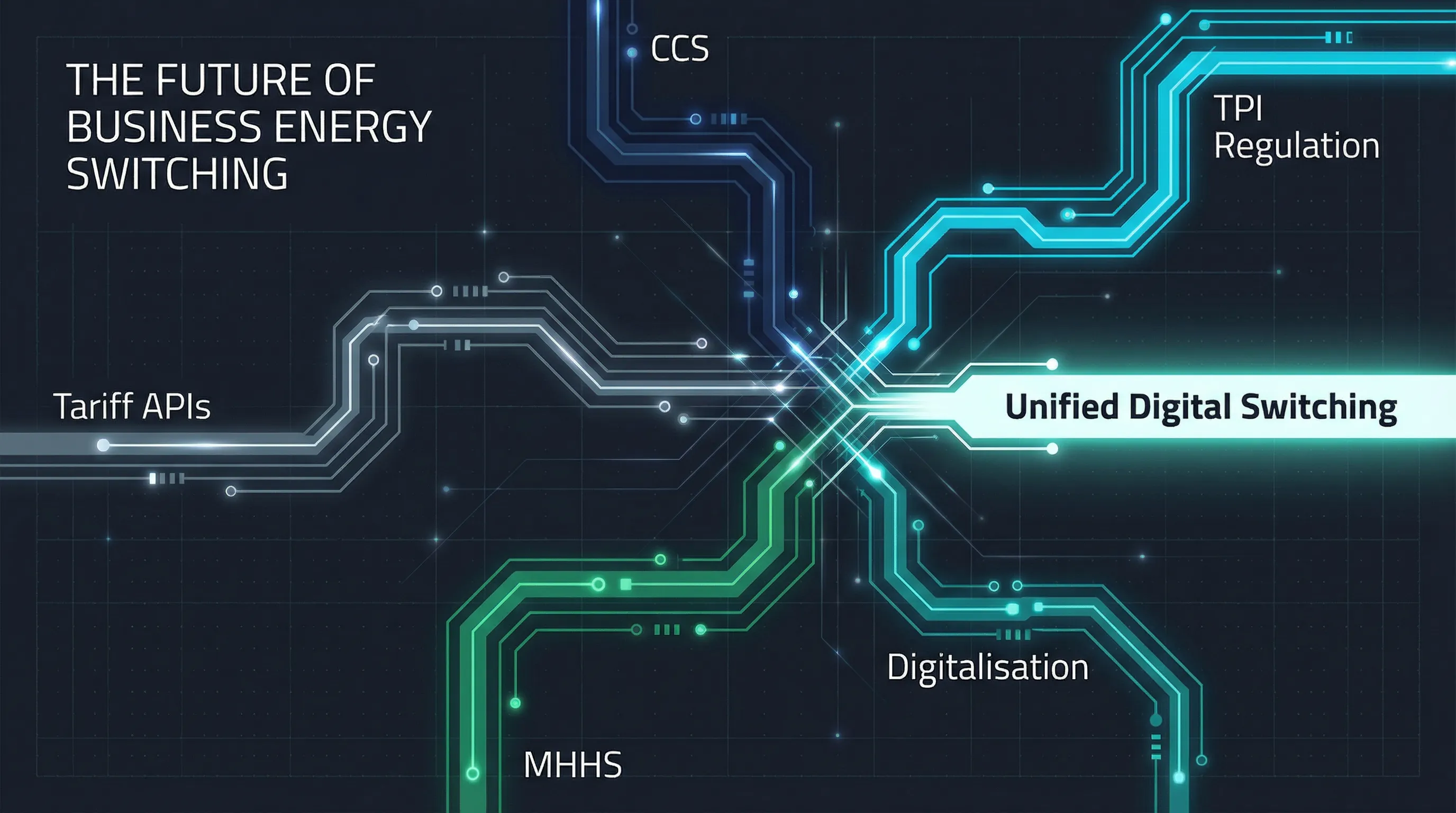
Five government and regulatory programmes are converging to rebuild how UK businesses switch energy. The direction of travel is clear - and it favours transparent, digital, self-service switching.
- Consumer Consent Solution (CCS) - digital consent tokens replace paper Letters of Authority. You control who sees your data and revoke access with one click. Launches March 2027 (domestic first, businesses next).
- Tariff Interoperability - suppliers will be legally required to publish pricing via standardised APIs, replacing proprietary price books. Government response confirming scope expected May 2026.
- Market-wide Half-Hourly Settlement (MHHS) - your actual half-hourly usage data replaces annual estimates, enabling more accurate quotes and time-of-use tariffs. Migration completing through 2026.
- Energy Digitalisation Framework - DESNZ and Ofgem mandate that all of the above work together under common standards and interoperable architecture. Published March 2026.
- Ofgem broker regulation - mandatory registration, commission disclosure, and Energy Ombudsman oversight. Expected 2026-2029.
The result: digital infrastructure that reduces the cost to serve each customer, which should drive down the intermediary fees businesses pay to switch. We submitted our response to the CCS consultation last week. Here is what is coming and why we think it matters.
How does business energy switching work today?
If you are an SME that has switched energy in the last few years, the process probably looked something like this: a broker called you (or you called a comparison site), you signed a Letter of Authority giving them permission to act on your behalf, they accessed pricing through an intermediary platform, and they came back with quotes that included their commission embedded in your unit rate - often without you knowing the exact amount unless you read through your contract to find the number.
This model was built for a world of landlines, fax machines, and annual meter readings. It works, but it relies on opacity, manual processes, and information asymmetry between the broker and the business.
The infrastructure being built now assumes a different world entirely. Five programmes - led by government, Ofgem, and the market’s own regulatory bodies - are redesigning the foundations of how energy data is shared, how consent is managed, and how prices reach the market. None of them were designed specifically to disrupt brokers. But taken together, they describe a future where the current model becomes structurally difficult to sustain.
A note on scope: these five programmes are primarily focused on the electricity market. Gas switching is not directly affected by MHHS, CCS, or Tariff Interoperability in their current form. The gas market may follow with its own digitalisation initiatives, but for now, the structural changes described here apply to electricity.
Five programmes, one direction
1. Consumer Consent Solution - digital consent replaces paper authority
The Consumer Consent Solution (opens in new tab) (CCS) is a centralised framework being built by RECCo that standardises how consumers grant, manage, and revoke permission to share their energy data.
Instead of signing a paper or electronic Letter of Authority and hoping the broker uses it responsibly, you will go through a digital consent flow - similar to 3D Secure when you buy something online, or logging in with Google. You verify your identity once, see exactly what data is being requested and for how long, and grant consent with a single click. That consent is recorded centrally, has a defined expiry date, and can be revoked instantly through a central portal or through the platform you are using.
The first version (the “Minimum Marketable Product”) launches March 2027 for domestic consumers. Business support is expected in the next phase, though no firm date has been published. We submitted our consultation response on 25 March 2026, pushing for a committed timeline on non-domestic support.
What changes for businesses: You will know exactly who has access to your energy data, what they are doing with it, and for how long. You will be able to revoke that access with one click. The days of signing a Level 2 LOA and discovering eighteen months later that a broker has been auto-renewing your contract without your active involvement are numbered.
2. Tariff Interoperability - standardised pricing APIs
The Department for Energy Security and Net Zero (DESNZ) is mandating that electricity suppliers publish pricing data in a standardised API format (opens in new tab), enforced through a new licence condition (SLC 11C).
Currently, supplier pricing lives in proprietary spreadsheet files called “price books.” Only a handful of intermediary platforms can ingest and parse these files. If you want to compare supplier rates programmatically, you need access to one of these platforms - and they charge for the privilege.
Standardised APIs change this. Any accredited platform with the right agreements could call supplier pricing directly, in a common format, without needing a proprietary intermediary to translate spreadsheets into data.
The government response confirming scope and timeline is expected May 2026. RECCo categorises the delivery work as “Think and Plan” for 2027-2028 - meaning preparatory work is happening now, but the mandated APIs will not be live until then.
What changes for businesses: More platforms will be able to offer genuine price comparison. Competition increases. The structural advantage that certain intermediary platforms have today - being the only ones who can read the price books - erodes.
3. Market-wide Half-Hourly Settlement - actual data replaces estimates
Market-wide Half-Hourly Settlement (opens in new tab) (MHHS) is the largest change to how the electricity market works in a generation. Instead of settling your consumption based on estimated annual profiles, every meter in the country is being migrated to half-hourly data.
Migration is well underway - over 6 million meters have completed the process, predominantly domestic so far. The non-domestic rollout accelerates from April 2026, with the full programme completing through 2026 and into early 2027.
What changes for businesses: Switching decisions based on your actual usage pattern rather than industry averages. Time-of-use tariffs that reward you for shifting consumption to cheaper periods. More accurate quotes, because suppliers can see when you actually use energy rather than guessing from a profile class. We wrote about the implications in detail in our MHHS guide.
4. Energy Digitalisation Framework - the overarching mandate
In March 2026, DESNZ and Ofgem jointly published the Energy Digitalisation Framework (opens in new tab) - a strategic document that mandates all of the above programmes work together under common standards and interoperable architecture.
This is the document that ties the individual programmes into a coherent vision. It establishes four data domains (core energy system, behind-the-meter assets, consumer data, and metering data), assigns a coordinator to each, and mandates “full interoperability” between the Data Sharing Infrastructure and Consumer Consent Solution. It explicitly states that digitalisation must “enable new and existing firms to develop new products, services and business models” and be “innovative and competition driven.”
What changes for businesses: One accreditation process rather than navigating multiple systems. Common standards that mean your data works the same way regardless of which platform you use to switch. A coordinated infrastructure that is designed to be open to new entrants - not locked behind incumbent gatekeepers.
5. Ofgem TPI regulation - formal oversight for brokers
The government confirmed in October 2025 that Ofgem will become the direct regulator of energy brokers (Third Party Intermediaries). This means mandatory registration, conduct standards, commission disclosure requirements, and Energy Ombudsman jurisdiction for dispute resolution.
Currently, the voluntary TPI Code of Practice had been signed by fewer than 4% of brokers on the Energy Ombudsman’s register as of October 2026. Formal regulation replaces voluntary compliance with enforceable standards.
What changes for businesses: You will know your broker is registered, regulated, and accountable. Commission disclosure has been mandatory since October 2024, but formal regulation adds registration, conduct standards, and enforcement behind it. If something goes wrong, you will have a clear route to the Energy Ombudsman. We covered this in depth in our Ofgem regulation analysis.
What will business energy switching look like in the future?
Each of these programmes is significant on its own. But they are not happening in isolation. They are being coordinated - the Energy Digitalisation Framework exists precisely to ensure they work together.
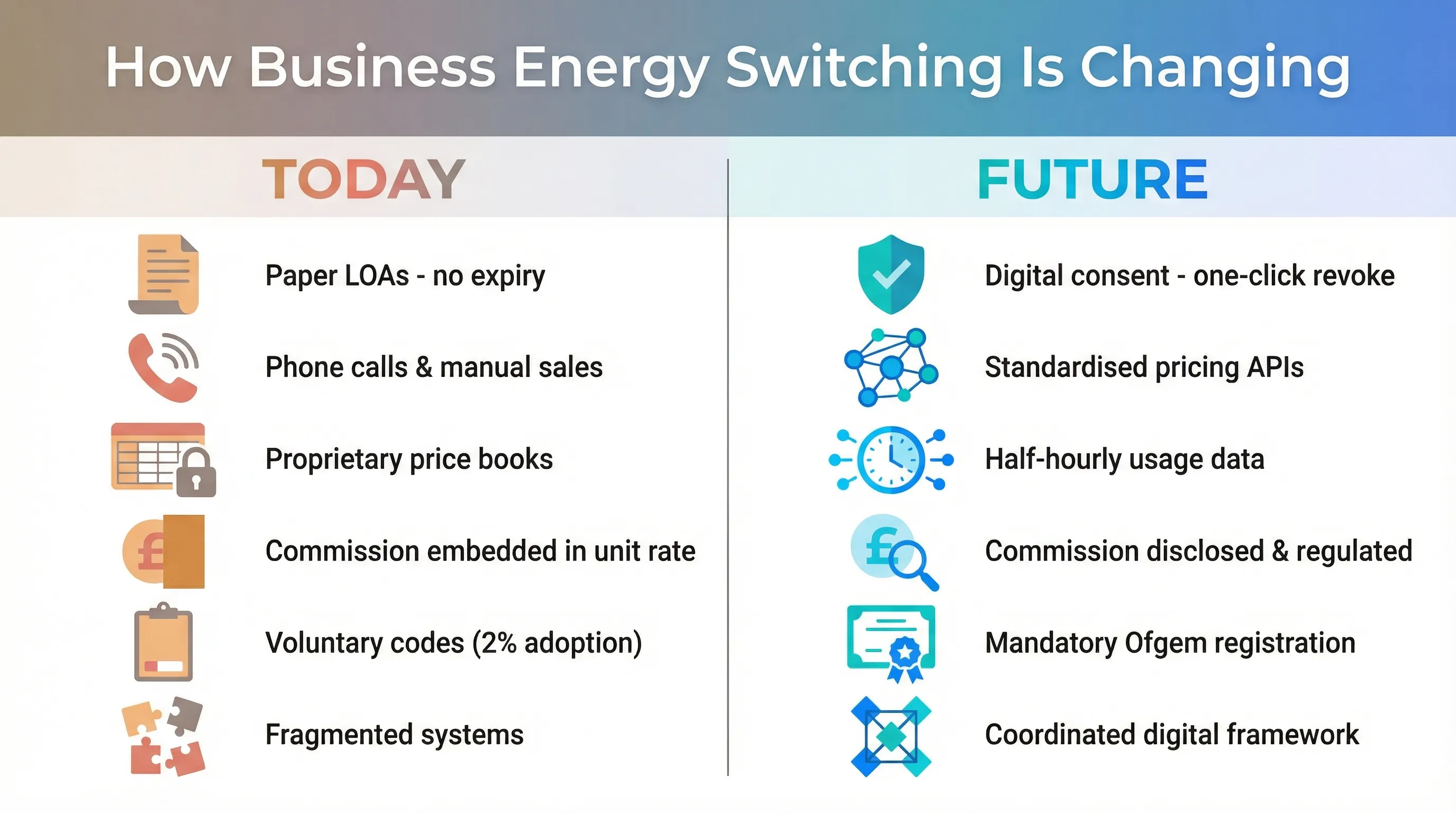
When they converge, the business energy switching experience looks fundamentally different:
| Today | Future |
|---|---|
| Paper or electronic LOA with no expiry | Digital consent with defined duration and one-click revoke |
| Pricing locked in proprietary price books | Standardised APIs accessible to any accredited platform |
| Consumption estimated from annual profiles | Half-hourly actual usage data |
| Broker commission embedded in unit rate | Commission disclosed in contract (since Oct 2024) and formally regulated |
| Voluntary compliance codes (<4% adoption, Oct 2026) | Mandatory Ofgem registration and oversight |
| Fragmented, initiative-led digitalisation | Coordinated framework with common standards |
This is not a five-year aspiration. The MHHS migration is happening now. The CCS launches March 2027. Broker regulation is expected 2026-2029. The infrastructure is being built.
Our hypothesis: this validates self-service switching
We should be transparent about our position here. We built Meet George because we believe the future of business energy switching is self-service, transparent, and digital. So when we look at these five programmes, we see validation of that hypothesis - and we are aware of our own bias.
But consider what these programmes are structurally designed for:
-
CCS requires digital identity verification that cannot be completed mid-phone-call. A phone-based broker would need to pause the sales conversation and send the customer a link - breaking the flow that traditional sales models depend on.
-
Standardised pricing APIs remove the structural advantage of intermediaries who built their business on being the only ones who can read proprietary price books.
-
Half-hourly data rewards platforms that can analyse granular consumption patterns programmatically - not brokers who input an annual consumption figure into a quoting tool.
-
Mandatory commission disclosure removes the information asymmetry that made hidden uplift possible.
None of this means brokers disappear. Specialist advisors who provide genuine expertise for complex portfolios will continue to add value. But the basic procurement function - “give me your bill, I’ll get you quotes, sign here” - is being automated by the infrastructure itself.
Our view is that the businesses and platforms built for this world will have a structural advantage. We may be wrong about the timeline. But the direction seems clear.
Will business energy switching get cheaper?
Here is why all of this matters to your bottom line.
The saving is not on the unit rate from the supplier - that is driven by wholesale markets, network charges, and government levies. The saving is on the intermediary layer that sits between you and the supplier.
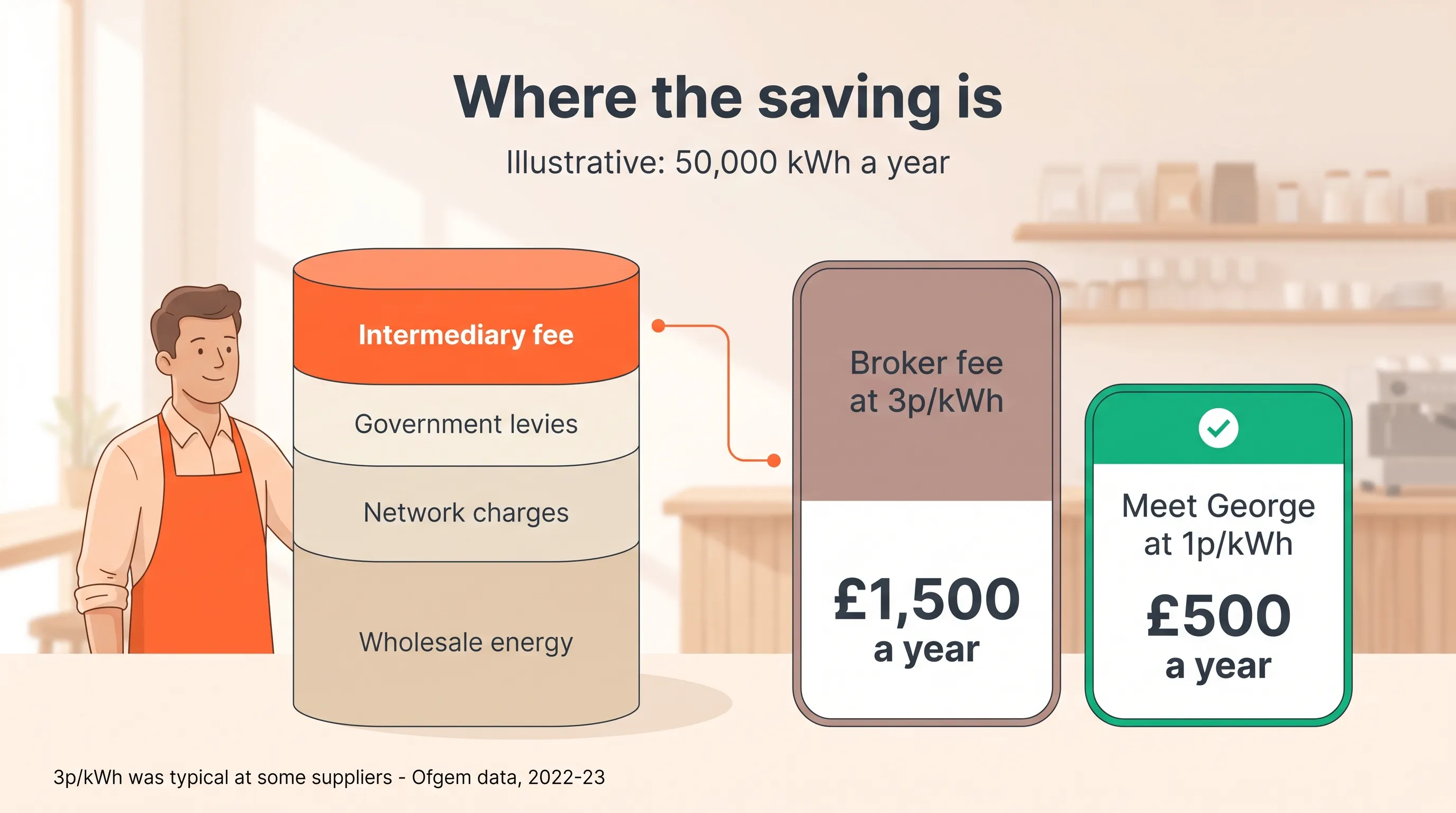
A traditional broker usually builds its commission into your unit rate, and how much varies from broker to broker. At 3p/kWh - typical at some suppliers in 2022-23, according to Ofgem’s data - a 50,000 kWh contract carries £1,500 a year in fees (our illustration). Since October 2024, this must be disclosed in your contract - but you need to read the contract carefully to find the number. That cost reflects, in part, the cost to serve: the phone call, the manual quoting process, the paper LOA, the relationship management, the office, the sales team.
Digital infrastructure reduces the cost to serve dramatically. When consent is handled through a standardised API rather than a phone call and a paper form, when pricing is retrieved from a supplier’s API rather than manually parsed from a spreadsheet, and when comparison is done programmatically rather than by a human entering data into a quoting tool - the cost of delivering a switch drops significantly.
We charge a flat 1p/kWh - Ofgem’s data (opens in new tab) shows broker fees of about 3p/kWh were typical at some suppliers in 2022-23, three times ours - because our cost to serve is lower. We are not the only platform that will figure this out. As this digital infrastructure matures and more self-service platforms enter the market, competition will drive fees down further. The intermediary cost that businesses pay to switch energy should fall over time, not because brokers become more generous, but because the infrastructure makes it cheaper to deliver the service.
Why business energy has been slower to digitalise
Domestic energy switching consolidated around a small number of price comparison websites years ago. Uswitch, MoneySuperMarket, Compare the Market - they dominate because domestic switching is relatively simple. Every household has the same meter types, the same tariff structures, and the same regulatory protections. The product is largely commoditised. That simplicity made automation straightforward and the cost to serve very low.
Business energy is genuinely more complex. Suppliers run credit checks on business customers. They have sector preferences - some will not quote for takeaways, some will not quote for businesses under two years old. Contract structures vary enormously. Standing charges, unit rates, pass-through charges, and volume tolerances all need to be understood and compared. This complexity is why the broker market has persisted - there has been genuine value in having someone navigate it for you.
But the five programmes described in this article are reducing that complexity at the infrastructure level. Standardised pricing APIs mean platforms can retrieve and compare supplier rates without needing a human to interpret a spreadsheet. Half-hourly data means quotes can be generated from actual consumption rather than estimates. Digital consent means the LOA process becomes a single API call rather than a phone conversation and a PDF.
The complexity does not disappear entirely - but the parts of it that required expensive human labour are increasingly automatable. The brokers who will struggle are those who cannot compete with digitalisation and do not have the skills or capital to build self-service capability in-house. The brokers who will thrive are the ones who offer genuine specialist value - complex multi-site portfolio management, demand-side response advice, regulatory expertise - things that genuinely require human judgement.
For the basic procurement function that most SMEs need - “compare my options, show me the fees, let me decide” - self-service platforms are likely to become the default. And that should mean cheaper switching for everyone.
When will business energy switching change?
Three dates matter in the near term:
-
May 2026 - Government response on Tariff Interoperability. This confirms scope (critically, whether non-domestic tariffs are included in Phase 1) and implementation approach.
-
March 2027 - CCS Minimum Marketable Product goes live. Domestic consumers first, but the architecture is being designed to extend to businesses.
-
2026-2029 - Ofgem broker regulation rolls out. Mandatory registration, conduct standards, and enforcement.
The infrastructure is being built. The question for businesses is not whether switching will change - it is whether you will be ready when it does.
Sources cited in this article:


