


A microbusiness signs a 3-year energy contract through a broker. Seven months in, the business outgrows its premises and moves to a bigger unit. The energy supply contract no longer applies - the meter point has changed. A few weeks later, an invoice arrives. Not from the energy supplier. From the broker. The amount is significant. The reason: the broker’s lost commission for the remaining 29 months of a contract that no longer exists.
This is happening. The Energy Ombudsman flagged it as a recurring concern in its Year 3 Broker Report (2025) (opens in new tab). And once you understand where the clause sits and how it gets agreed to, the practice is harder to defend.
TL;DR: Key Takeaways
- Some brokers invoice SMEs for their own lost commission when an energy supply contract ends early - including when the business simply moves premises. The clause is not a regulatory requirement. It is a commercial term the broker has chosen to add.
- The clause does not sit in the energy supply contract. It sits in the broker’s own T&Cs, linked from the Letter of Authority the SME signed at the start. A lot of SMEs unknowingly agree to this before they have even seen a quote.
- The Energy Ombudsman flagged this practice in its Year 3 Broker Report (2025) (opens in new tab), particularly because moves are often involuntary or at short notice.
- The numbers can be significant. An SME with a 50,000 kWh / 3-year contract at a 3p/kWh broker uplift represents £4,500 of broker commission. Exiting after 6 months can leave around £3,750 of unearned commission that the broker’s clause may allow them to invoice the SME for.
- The Consumer Consent Solution should curb this. When CCS (opens in new tab) extends to non-domestic, it replaces the open-ended LOA with scoped, time-bound, customer-revocable consent. That removes the mechanism brokers use to bind SMEs to their T&Cs before they have seen a quote.
- Meet George’s LOA does not include this clause. Our Letter of Authority contains no provision making you liable for our lost commission if your supply contract ends early.
What Is a Broker Termination Fee?
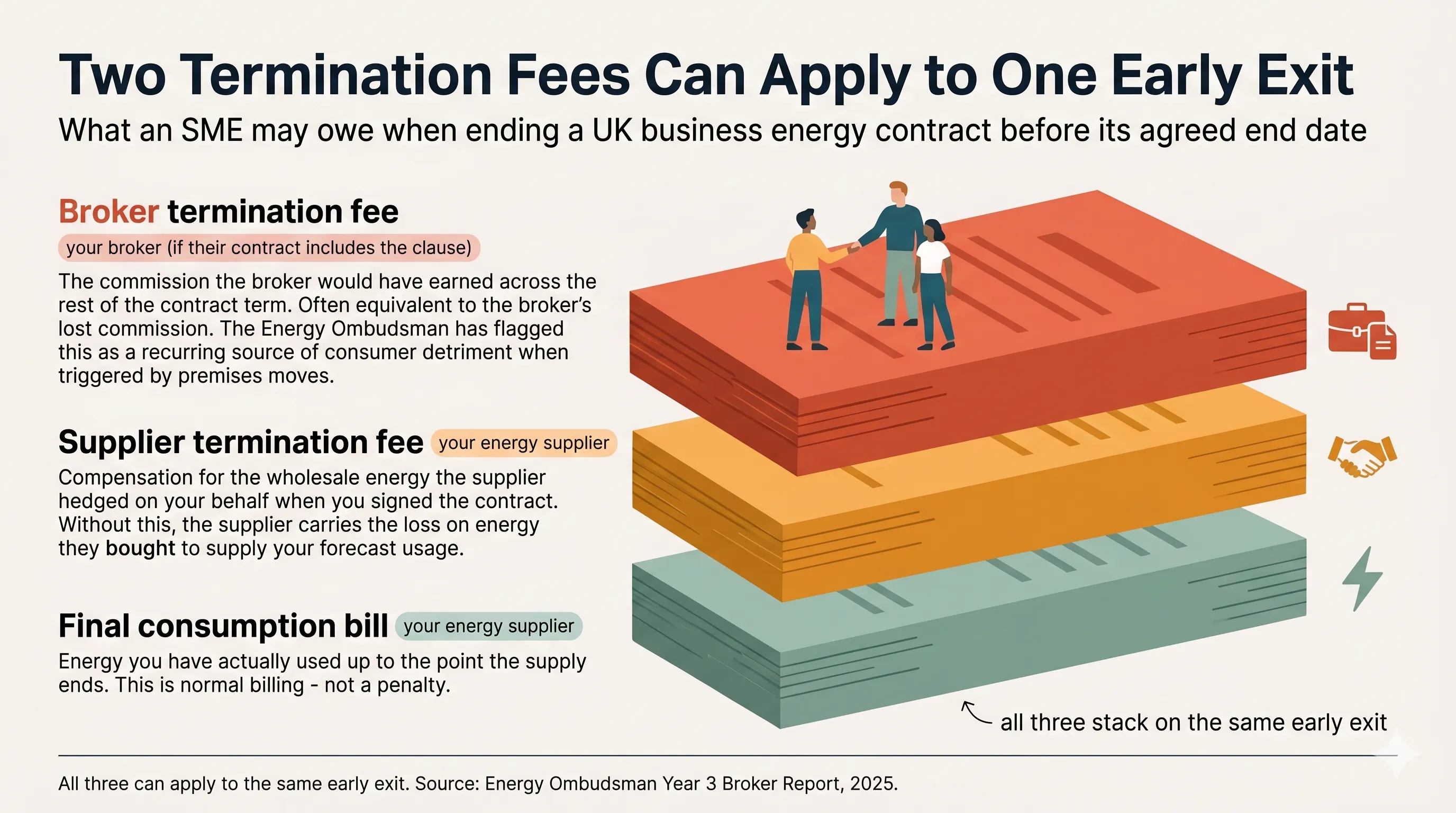
A broker termination fee is a charge a broker can levy on your business if your energy supply contract ends before its agreed end date. The fee is typically equivalent to the commission the broker would have earned across the remaining contract term.
It is separate from - and in addition to - any termination or exit fee the energy supplier itself charges.
| Fee | Who charges it | What it covers |
|---|---|---|
| Supplier termination fee | Your energy supplier | The wholesale energy the supplier hedged for your forecast usage |
| Broker termination fee | Your broker | The commission the broker would have earned across the rest of the term |
Both fees can sit on top of any final consumption bill. An SME exiting a 3-year contract one year early may face two separate termination fees on the same exit - the supplier’s and the broker’s - on top of paying for energy actually consumed.
The broker fee only exists if the broker added the clause to their T&Cs. It is not a regulatory requirement. It is a commercial choice.
Where the Clause Hides (And How SMEs End Up Bound to It)
This is the part that matters most, and it is the part most SMEs do not understand until they are looking at an invoice they did not expect.
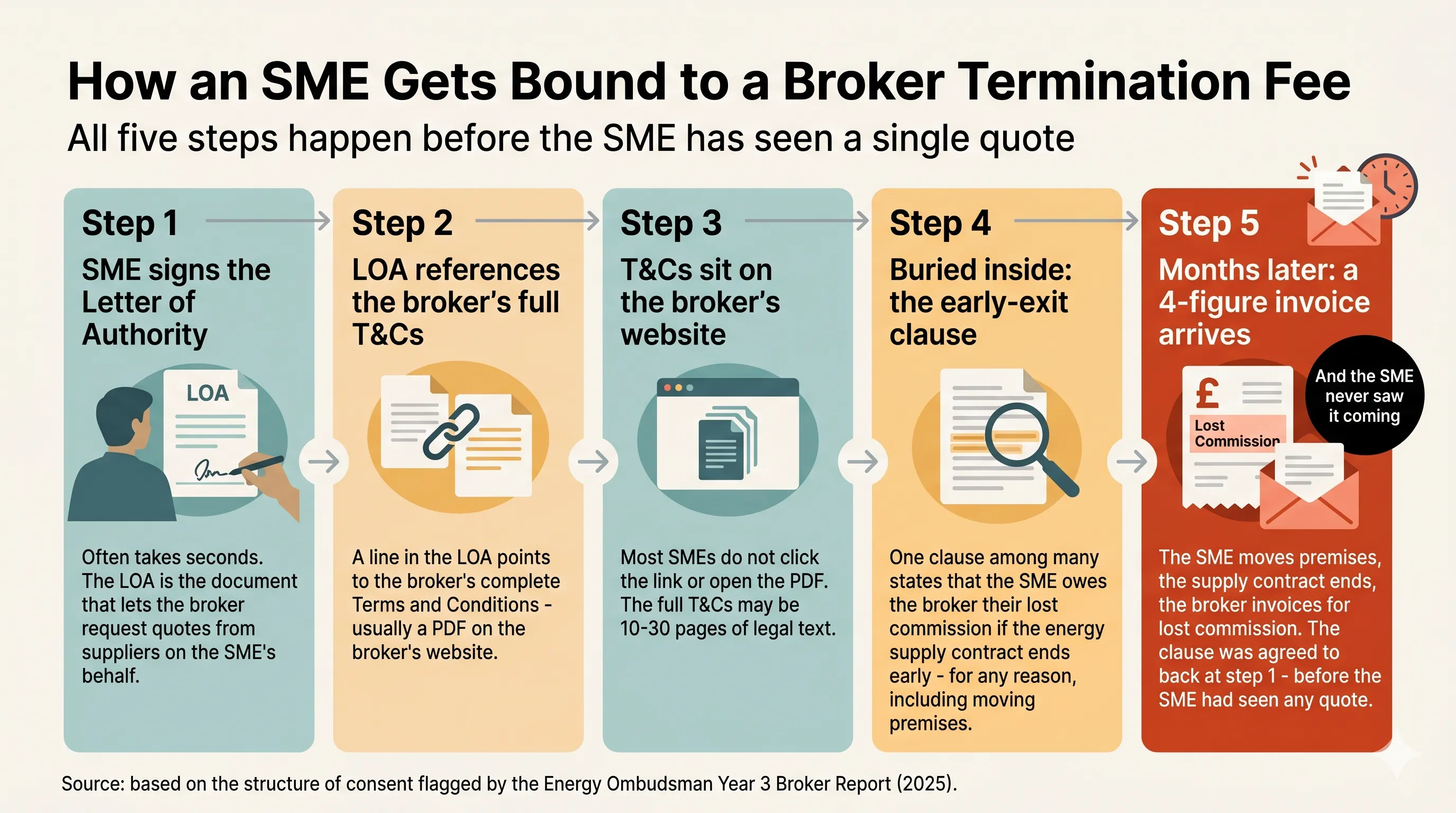
The clause does not sit in the energy supply contract. It sits in the broker’s own Terms and Conditions - a document hosted on the broker’s website. The SME agrees to those T&Cs when signing the Letter of Authority at the start of the engagement.
The chain of consent typically looks like this:
- The broker sends an LOA - the document that authorises them to obtain quotes from suppliers on the SME’s behalf.
- The LOA contains a line referencing the broker’s full T&Cs, usually linked to the full terms on a broker’s website.
- The SME signs the LOA - often in seconds, often without opening the linked T&Cs.
- By signing, the SME has agreed to every clause in the broker’s T&Cs - including the early-exit clause.
- Crucially, all of this happens before the SME has seen a single quote.
This is the structurally important bit. The SME has not been mis-sold a contract at this point. They have not been pressure-sold a tariff. They have simply granted permission for the broker to go and look at the market on their behalf. And in doing so, they may have agreed to underwrite the broker’s commission for any contract that subsequently gets signed - including reimbursing the broker if that contract ends early for any reason at all.
A clause that triggers a four-figure invoice should not be agreed to by reference, behind a hyperlink, before the customer has seen what they are buying.
What the Energy Ombudsman Said
From the Year 3 Broker Dispute Resolution Scheme Annual Review (2025) (opens in new tab):
“Some brokers have a term in their contracts which permit them to charge the business a fee if they end their supply contract before the end of the contract term. We’ve seen a number of cases where the business has incurred a fee equivalent to the commission the broker has lost - when they’ve moved business premises.”
And:
“We’re concerned about how well known these terms are to businesses and how clear the broker is making these at the point the contract is entered into, as well as how fair it is to expect a business to reimburse a broker for lost commission due to leaving a business location, sometimes involuntary and at short notice.”
The Ombudsman’s framing matters. They are raising two distinct problems: how the term is disclosed (badly), and whether the term is fair (questionable, especially for involuntary moves).
The trigger the Ombudsman has explicitly named is moving premises. The report does not list other triggers.
What This Can Actually Cost - A Worked Example
To make the scale concrete, here is a worked example using realistic numbers.
The set-up:
- An SME signs a 3-year fixed energy contract through a broker
- Annual consumption: 50,000 kWh
- Broker uplift baked into the unit rate: 3p/kWh
- Total broker commission across the full 3-year term: 50,000 × £0.03 × 3 = £4,500
The exit:
- The SME moves premises 6 months in
- Energy actually consumed before exit: ~25,000 kWh
- Commission already earned through actual energy use: 25,000 × £0.03 = £750
- Commission unearned (the “lost commission” the broker may seek to recover): £4,500 - £750 = £3,750
If the broker’s T&Cs include the early-exit clause and they choose to invoice this, that £3,750 lands as a separate invoice on a business that has just paid for moving costs, deposits, fit-out, and probably a supplier termination fee on the same exit.
By contrast, the same scenario with Meet George:
- Same 50,000 kWh, same 3-year contract length
- Meet George fee: 1p/kWh, paid by you and collected through your supplier as energy is consumed
- Total fee you would pay across the full term (if it had run): 50,000 × £0.01 × 3 = £1,500
- Fee paid before the 6-month exit: 25,000 × £0.01 = £250
- Fee Meet George would invoice the SME on exit: £0
The reason is not just the rate. It is that our LOA does not include a clause making the customer liable for our income if their supply contract abruptly ends. If the contract ends, our payments from the supplier simply stop. Nothing follows the customer.
| Typical broker model | Meet George | |
|---|---|---|
| Headline commission rate | 3p/kWh (illustrative) | 1p/kWh (flat, transparent) |
| Total commission on a 50,000 kWh / 3-year contract | £4,500 | £1,500 |
| Amount potentially invoiced to the SME if they exit at month 6 | Up to £3,750 | £0 |
| Where the early-exit clause lives | Broker T&Cs, linked from the LOA | Not in our LOA |
The Change-of-Tenancy Paradox
Now consider what is meant to happen on a legitimate change of tenancy.
When an SME moves out of a premises, the energy supply contract for that meter point ends. Depending on the supplier’s terms, the supplier may charge a termination fee, or may simply close the account and write off the wholesale position. Either way, the supplier is the party that originally took on the wholesale risk for the SME’s forecast usage. They are the party with the actual exposure.
The broker has no exposure to wholesale energy. They were paid for sourcing the contract. The contract was sourced. The work was done.
What the early-exit clause does is treat the broker’s expected future income as if it were a guaranteed receivable from the SME - to be paid even when the underlying supply relationship has ended for reasons unrelated to the SME’s commercial decisions. The broker, in effect, treats the SME as the source of repayment for the broker’s own income loss.
This is the practice the Energy Ombudsman is questioning the fairness of. We share the concern.
What the Consumer Consent Solution Will Change
The reason this clause works at all is the Letter of Authority - a single, often open-ended document that binds the SME to the broker’s T&Cs at the start of the engagement, before any contract has been seen.
The Consumer Consent Solution (CCS) (opens in new tab), being built by RECCo on Ofgem’s direction, replaces the LOA with a token-based consent model:
- Scoped to specific actions (data access, quote retrieval, contract execution)
- Time-bound by default
- Revocable by the customer at any time, through a central portal
- Standardised across the market
When CCS extends to non-domestic - planned for the “Next” phase after the March 2027 domestic launch - it should remove the mechanism that currently binds SMEs to a broker’s T&Cs by reference to a PDF on the broker’s website. Brokers may still try to introduce equivalent terms at the point of contract signing, but they will need to do it visibly, at the moment the customer is making the decision, rather than four steps removed at the LOA stage.
That is a meaningful structural shift, and one of the reasons we are advocating for non-domestic to be brought into CCS scope as early as possible. We’ve written more about this in The Future of Business Energy Switching - covering how CCS, MHHS, tariff interoperability, and TPI regulation are converging into a coordinated digital transformation of the SME energy market.
How to Spot the Clause Before You Sign
Some practical checks before you sign anything with a broker:
- Open the broker’s T&Cs. The link will be in or alongside the Letter of Authority. The full document usually lives on the broker’s website. Open it.
- Search for early-exit language. Use Ctrl-F for “termination”, “cancellation”, “lost commission”, “compensation”, “liquidated damages”, “reimbursement”, or “broker fee”.
- Ask the broker for written explanation of any clause you find. When does it trigger? How is it calculated? What is the maximum amount? Get answers in writing.
- Specifically ask: “If I move premises, do you charge me anything?” Many brokers will not volunteer this. Asking directly forces an on-the-record answer.
- Refuse to sign anything you do not understand. A broker unwilling to explain their own T&Cs in plain English is a broker you should not be signing with.
What to Do If You Have Already Been Charged
If you have moved premises - or otherwise exited an energy supply contract early - and received an invoice from your broker for lost commission:
Ask for the contract clause, the calculation, and the disclosure record. Write to the broker requesting: (a) the specific clause they are relying on, (b) the calculation showing how the fee was derived, and (c) evidence that the term was brought to your attention before you signed the Letter of Authority. The Energy Ombudsman has ruled in past cases that material terms should have been brought to a microbusiness customer’s attention before signing - and the Year 3 report explicitly raises the disclosure concern.
Raise a formal complaint with the broker. Set out what you were told, what is in the T&Cs, and why you do not consider the charge fair. Give the broker eight weeks to resolve.
Escalate to the Energy Ombudsman. From 19 December 2024, businesses with fewer than 50 employees can use the service - a significant expansion. The service is free, the average decision time is around 28 days, and the Ombudsman can require the broker to credit you, reduce the fee, or remove it entirely if it finds the term was not properly disclosed.
How to complain about your energy broker walks through the formal process in more detail.
How Meet George Handles This
We have written our LOA to deliberately not include this clause.
If you sign an energy supply contract through Meet George and you later move premises, sell the business, close down, or switch supplier mid-term, our payments from the supplier simply stop. We do not invoice you for income we expected to earn but won’t. We do not treat our future commission as a debt you owe us.
We charge a flat 1p/kWh on energy you actually consume. You pay it, collected through your supplier. If you stop consuming through the supply contract we sourced, the fee stops with it, and that is the end of the commercial relationship. Nothing follows you to your next premises.
That is a choice on our part - exactly the same kind of choice the brokers using the early-exit clause have made in the opposite direction. The clause is not in our LOA, and we believe it does not belong in anyone else’s either.
Sources & further reading:
- Energy Ombudsman - Year 3 Broker Dispute Resolution Scheme Annual Review (PDF) (opens in new tab) - the source for the quotes in this article
- Energy Ombudsman (opens in new tab) - publisher of the Broker Dispute Resolution Scheme Annual Review
- DESNZ consultation on regulating Third-Party Intermediaries (opens in new tab) - the basis on which Ofgem will regulate brokers from 2026 onwards
- Energy UK (opens in new tab) - energy industry trade body
- Citizens Advice - consumer energy (opens in new tab) - free advice on energy disputes


