

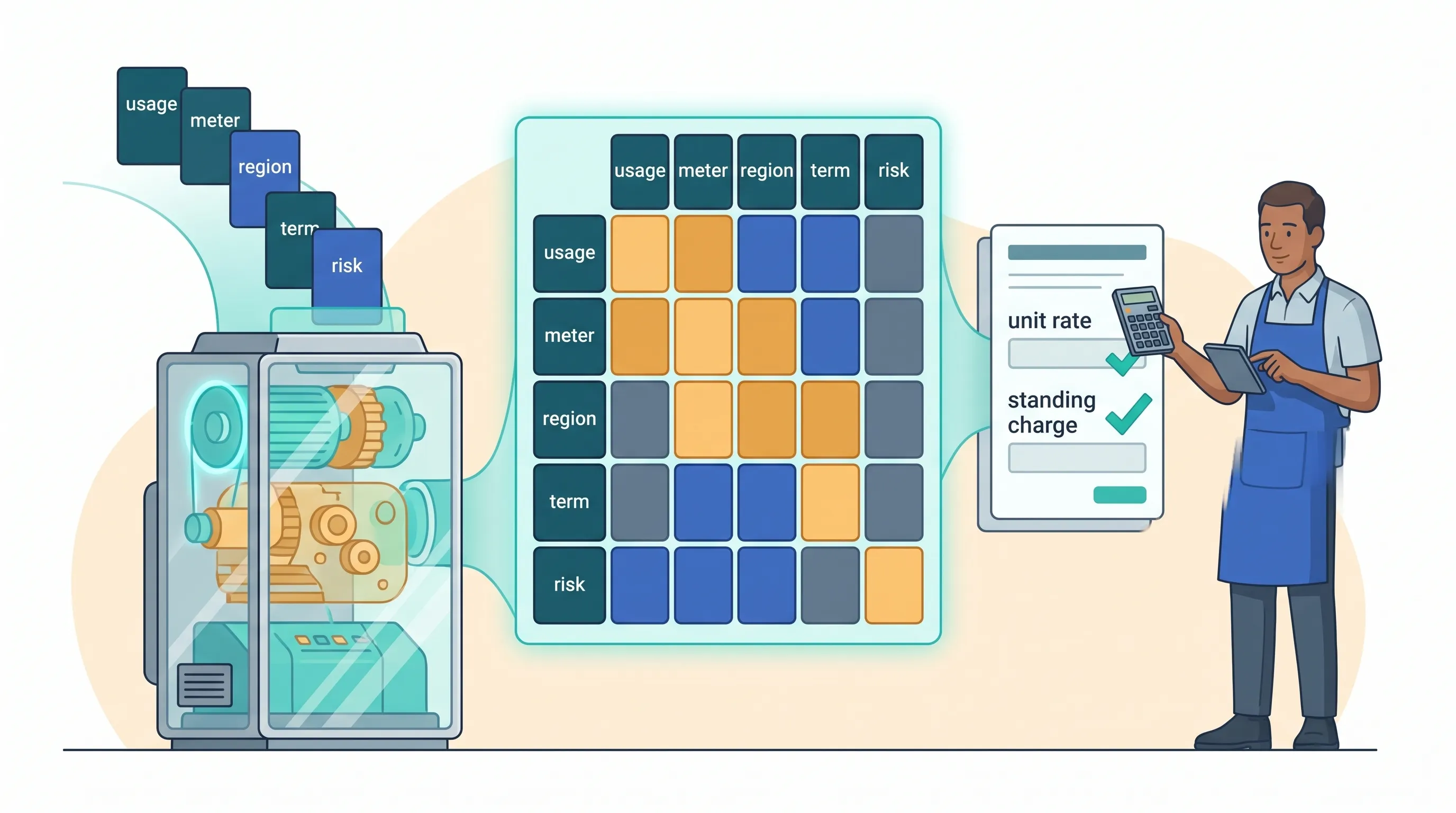
How business energy quotes work: a supplier takes your site data, runs it through a pricing model, then returns two main numbers - your unit rate and standing charge. The unit rate is the price you pay per kWh of energy you use; the standing charge is a fixed daily fee for your connection, whatever you use. For many straightforward SME contracts, that pricing model is a matrix.
In business energy, matrix pricing (no, not the film) is market shorthand for a supplier’s pre-set price table. It turns inputs like kWh usage, meter type, region, contract start date and contract length into the rate you see on the quote.
The useful question is not “is this the cheapest unit rate?”
It is: “what assumptions created this quote, and what is included in the number?”
TL;DR
- What matrix pricing is: a pre-set price table suppliers use to generate quick business energy quotes for standard SME sites.
- How business energy quotes work: the supplier combines site data, contract timing, risk and cost assumptions into a unit rate and standing charge.
- What decides your rate: usage, meter type, region, start date, contract length, credit risk, payment method and any broker or platform fee.
- Why quotes move: business energy quotes price future supply, so the assumptions can change with market conditions, supplier appetite and quote timing.
- What to compare: total annual cost, not the lowest unit rate. A lower unit rate can still lose once standing charges and fees are included.
- What to ask: “What is the full annual cost, what fees are included in the rate, and how long is the quote valid for?”
What is matrix pricing in business energy?
Matrix pricing in business energy is a supplier price table used to generate quotes quickly for standard sites. It is not an official Ofgem tariff category; it is a practical market term for “the pre-built grid of rates behind the quote”.
Think of it like a menu.
The supplier is not inventing a new dish every time a café asks for a quote. It already has a menu of prices based on the kind of site, the amount of energy used, the region, the meter setup and the length of the contract. Your quote is the menu item that matches your site.
For a simple business electricity quote, the matrix may vary by:
| Matrix input | Plain-English meaning | Why it changes the quote |
|---|---|---|
| Annual usage | How many kWh you normally use in a year | Higher usage changes supplier risk and buying power |
| Meter type | Whether the site is non-half-hourly, smart, advanced or half-hourly | More detailed usage data can change how risk is priced |
| Region | Which network area your site sits in | Network charges differ by region |
| Contract start date | When the new contract begins | A contract starting next month is priced differently from one starting next year |
| Contract length | One, two, three or more years | Suppliers price the risk of future costs into the term |
| Fuel | Electricity or gas | Separate markets, costs and settlement rules |
| Payment method | Direct Debit, card, invoice or other terms | Payment risk affects supplier appetite |
That is the first bit many owners miss. A business energy quote is not just a supplier saying “electricity costs 24p today”.
It is a rate for your site, under those assumptions, for that contract window.
How business energy quotes work in practice
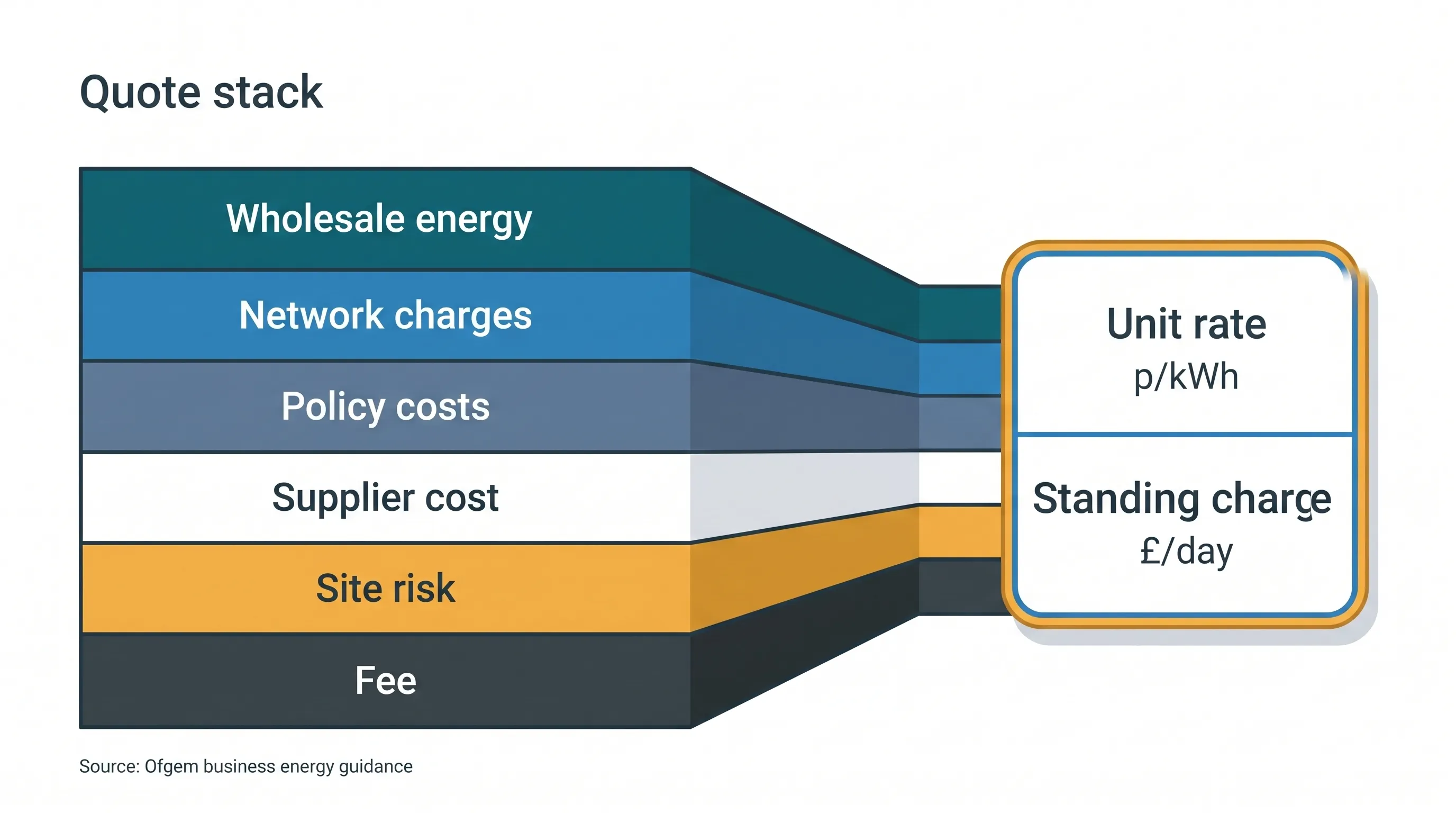
Business energy quotes work in practice by stacking several cost and risk layers into the price you see. A business energy quote normally includes a unit rate, a standing charge and the contract terms that explain when and how those prices apply.
Ofgem says business energy contract costs make up the unit rate charged per kWh and may also include a standing charge depending on the contract type (Ofgem: Get energy for your business (opens in new tab)).
In plain English, the quote stack looks like this:
| Quote layer | Where it shows up | What it means |
|---|---|---|
| Wholesale energy | Mostly in the unit rate | The supplier’s cost of buying electricity or gas for your contract period |
| Network charges | Unit rate and/or standing charge | The cost of moving energy through wires and pipes |
| Policy and market charges | Usually bundled into the unit rate | Industry charges such as balancing, capacity and environmental scheme costs |
| Supplier operating cost | Unit rate and/or standing charge | Billing, service, risk, admin and margin |
| Site risk | Built into the final rate | Credit risk, bad-debt risk, uncertain usage or unusual load shape |
| Broker or platform fee | Either embedded or shown separately | The cost of arranging the contract if you use an intermediary |
| VAT and CCL | Usually shown on the bill, not always inside the headline quote | Tax treatment depends on the business and usage |
Ofgem also lists third-party services, including sales commissions and brokerage, among the costs that can be included in business energy bills (Ofgem: Get energy for your business (opens in new tab)).
That is why two quotes with the same supplier name can still be different. One may include a broker uplift inside the unit rate. Another may show a transparent platform fee separately.
Same supplier.
Different wrapper.
Why do business energy quotes expire?
Business energy quotes expire because the supplier is pricing a future contract with assumptions that can change. If the start date, wholesale market, risk view or supplier appetite changes, the quote may no longer represent the deal the supplier is willing to honour.
That sounds slippery. It is not always sinister.
Ofgem’s deemed-rate guidance explicitly recognises that non-domestic pricing can differ across consumption, meter classification and location, and that suppliers may review rates more frequently during significant market volatility (Ofgem deemed contracts guidance (opens in new tab)). That guidance is about deemed contracts, not matrix quotes, but the pricing logic matters: business energy pricing is tied to customer class, cost assumptions and timing.
DESNZ also publishes quarterly and annual non-domestic gas and electricity price data split into consumption size bands, last updated on 30 June 2026 (GOV.UK non-domestic prices (opens in new tab)). Size bands exist because a very small shop and a large industrial site do not buy energy on the same terms.
So when a quote says “valid until 5pm”, the supplier is usually protecting a live pricing assumption.
Annoying? Yes. Completely made up? No.
What is the difference between matrix and bespoke pricing?
Matrix pricing is fast, standardised pricing for simpler SME contracts. Bespoke pricing is manual pricing for sites where the supplier needs a closer look before it can offer a rate.
Here is the practical difference:
| Pricing type | Best fit | How it works | What to watch |
|---|---|---|---|
| Matrix pricing | Standard SME sites with predictable usage | Supplier price table returns a quote from standard inputs | Fast does not mean automatically cheapest |
| Bespoke pricing | Larger, complex, half-hourly, multi-site or unusual sites | Supplier manually reviews data, usage shape, risk and contract terms | Manual does not mean automatically better |
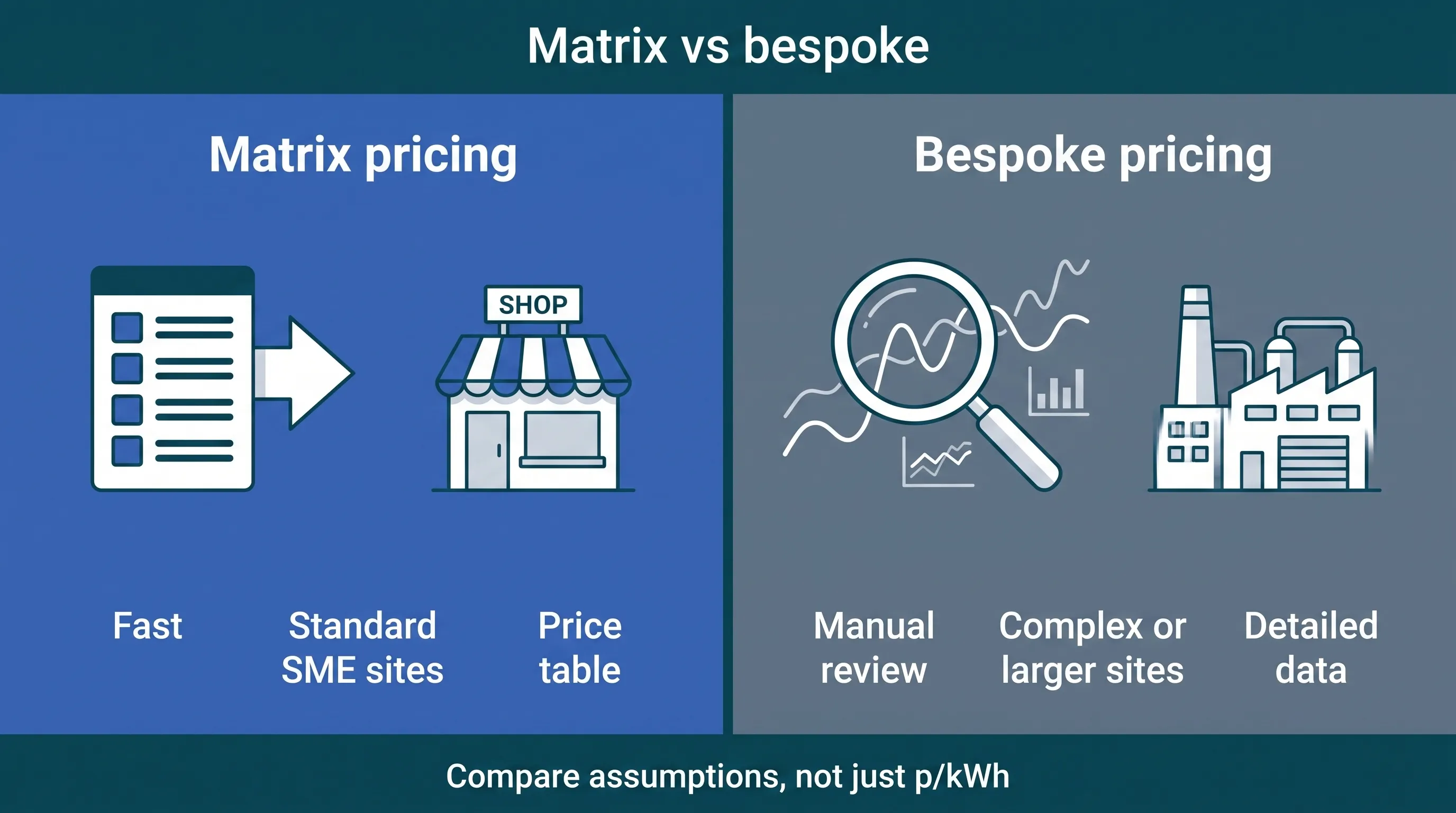
A bakery using 35,000 kWh a year on a standard meter may be fine on matrix pricing. A 24-hour factory with half-hourly data, high peak demand and multiple meters may need bespoke pricing.
The line is not about prestige. It is about risk.
If a supplier can price the site confidently from standard data, matrix pricing is efficient. If the site could expose the supplier to unusual cost, volume or timing risk, it may need a trader or underwriter to look at it.
How should you compare two business energy quotes?
Compare business energy quotes by total annual cost, not unit rate alone. The unit rate is only one part of the price; the standing charge, contract length, fees and assumptions can change the real answer.
Here is a simple example for a business using 25,000 kWh of electricity a year.
| Quote | Unit rate | Standing charge | Unit-rate cost | Standing-charge cost | Annual total |
|---|---|---|---|---|---|
| A | 24.2p/kWh | 70p/day | £6,050.00 | £255.50 | £6,305.50 |
| B | 23.9p/kWh | £1.20/day | £5,975.00 | £438.00 | £6,413.00 |
Quote B has the cheaper unit rate.
It still costs £107.50 more per year.
That is why “lowest p/kWh” is a bad shortcut. A good comparison needs this formula:
annual kWh x unit rate + 365 days x standing charge + visible fees = annual cost
If you want the broader switching checklist around that maths, use the business energy comparison guide alongside the quote itself.
And the cheapest annual cost is not automatically the best deal. Volume tolerance bands, pass-through clauses and uncapped exit fees can all cost you more than a few pence on the unit rate - the red flags to check in a business energy contract cover the terms that matter beyond the headline price.
Now add the intermediary question. If a quote includes a 2p/kWh broker fee inside the unit rate, the cost is:
25,000 kWh x £0.02 = £500 per year
Over a three-year contract, that is £1,500. That might be fair if the service is worth it and the fee is disclosed. The problem is when the fee is hidden inside the rate and the customer thinks the comparison was free.
Free is doing a lot of work there.
What data do suppliers need to price a quote?
Suppliers need accurate site and usage data to price a business energy quote properly. Bad data creates bad quotes, and bad quotes create messy switches.
Have these ready:
- MPAN or MPRN. Your MPAN identifies the electricity supply point; your MPRN identifies the gas supply point.
- Annual kWh usage. Your expected annual consumption is the main pricing input.
- Current unit rate and standing charge. These show what you are comparing against.
- Contract end date. Ofgem says “most suppliers will not let you switch before the end of your contract unless you have already agreed a termination clause or pay an exit fee” (Ofgem: Switch your business energy supplier (opens in new tab)).
- Meter type and profile. Half-hourly, non-half-hourly and smart-metered sites can price differently.
- Supply address and region. Network costs vary by location.
- Payment terms. Direct Debit can price differently from invoice terms because payment risk changes.
Ofgem says fixed-rate contracts “fix the price of unit rates and standing charges for the length of the contract”, and tells businesses to check “if there are any fees involved, for example those agreed in special clauses in your contract” (Ofgem: Get a business energy contract (opens in new tab)).
Those special clauses matter. “Fixed” usually means the unit rate is fixed. It does not mean every possible charge, clause or pass-through risk has disappeared.
Read the terms.
If the timing piece is the bit you are trying to solve, start with the step-by-step guide to switching business energy suppliers.
What is EAC data, and how does it affect a business energy quote?
EAC (Estimated Annual Consumption) is the electricity industry’s estimate of how many kWh your meter uses in a year, and it is often the usage figure a business energy quote is priced on. If the EAC is wrong, the annual cost on the quote is wrong too, even when the unit rate is fair.
Elexon, which runs electricity settlement, defines EAC as “an estimated rate of consumption, nominally expressed in kWh/Year” (Elexon BSC glossary (opens in new tab)). Gas has its own version, the Annual Quantity (AQ). Xoserve, which runs the gas industry’s central data, describes it as “an estimate of the amount of gas that it will use in a year under seasonal normal weather conditions” (Xoserve (opens in new tab)).
Usage is one of the first things a quote needs: Ofgem says you will need to give a new supplier “your annual consumption and details of your meter” before signing (Ofgem (opens in new tab)). When you sign a Letter of Authority, the broker or platform can pull your meter’s EAC or AQ from industry data, so you don’t have to work out your usage yourself. That is quicker. It also means the quote is only as good as the estimate.
Both figures are worked out from past meter readings, so they can drift from what your business actually uses:
- Few actual readings. The fewer real reads behind the figure, the more it rests on estimates.
- The business has changed. New equipment, longer opening hours or a quieter site don’t show up until new readings come in.
- You recently moved in. The meter’s history may be the previous occupant’s usage, not yours.
Take Quote A from the comparison above: 24.2p/kWh and 70p/day, priced on 25,000 kWh. That comes to £6,305.50 a year. If your bills show you actually use 30,000 kWh, the real cost is 30,000 x 24.2p + £255.50 = £7,515.50. That is £1,210 more than the quote suggested, with the same unit rate. And if two quotes assume different usage, comparing their annual totals tells you nothing.
What to do:
- Ask what annual usage the quote assumed, and whether it came from the EAC or AQ or from your bills.
- Check it against your last 12 months of bills. If they differ a lot, ask for a requote on your actual usage.
- Send real meter readings to your current supplier. Xoserve recalculates a gas AQ monthly when it receives a new reading, so regular readings keep the figure current.
Your bill is the cross-check. Upload your latest bill and Meet George’s free bill check lists your MPAN, unit rates and standing charge line by line, so you know the numbers a quote should start from.
Where do brokers and switching platforms fit into the quote?
Brokers and switching platforms sit between the business and the supplier, helping find or arrange energy contracts. Ofgem says energy brokers can help you find a suitable contract, and that “brokers charge you for their services” - most through a commission paid by the supplier you choose (Ofgem: Get a business energy contract (opens in new tab)).
There are good reasons to use an intermediary. Energy is fiddly, suppliers reject some sites, and most owners do not want to spend a week chasing quotes.
The transparency question is how the intermediary is paid.
| Model | How the cost usually appears | What the customer should ask |
|---|---|---|
| Direct supplier | Supplier quote only | Am I seeing enough suppliers to compare properly? |
| Traditional broker model | Often included in the quoted unit rate or supplier bill | What is the broker fee in p/kWh and total pounds? |
| Transparent platform model | Shown separately before you decide | What is the platform fee and what does it include? |
The government has consulted on regulating Third-Party Intermediaries, or TPIs, and noted that TPIs include brokers, consultants, price comparison websites and other services that help consumers secure energy services (GOV.UK TPI consultation (opens in new tab)). Ofgem is also reviewing the TPI market and describes TPIs as businesses that act on behalf of customers to find and arrange energy contracts between customers and suppliers (Ofgem TPI market review (opens in new tab)).
For the fee side of that model, the energy broker commission rate guide shows how p/kWh charges turn into pounds over a contract.
Our position is simple: a quote should show the supplier price and the arranging fee clearly enough that you can compare the deal. That is why Meet George charges a flat 1p/kWh fee, shown separately and never buried in the unit rate - here is exactly how we are paid.
That should not be radical.
What should you ask before accepting a quote?
Before accepting a business energy quote, ask questions that expose the assumptions behind the price. You do not need to become an energy trader. You just need to stop treating the quote as a magic number.
Use this checklist:
- What is the full annual cost, not just the unit rate? Ask for the unit rate, the standing charge and any visible fee in pounds, then compare the yearly total.
- What annual usage has been assumed? If the quote used the wrong kWh, the annual cost comparison is wrong.
- What fees are included in the unit rate? This is especially important if a broker arranged the quote.
- How long is the quote valid for? Do not assume it will be there tomorrow.
- When does the contract start? A quote for an immediate start and a quote for a start in six months are not the same.
- What happens if usage is higher or lower than expected? Larger contracts may include volume tolerance or take-or-pay terms.
- Are there pass-through charges or change clauses? A fixed contract can still contain conditions worth reading.
For microbusinesses, Ofgem says suppliers must include current prices, new prices and annual consumption on renewal letters for fixed-term contracts, making comparisons easier (Ofgem microbusiness renewal factsheet (opens in new tab)).
That is the right instinct for every quote, not just renewals.
Show the old price. Show the new price. Show the usage. Show the fee.
Then the owner can decide.
The bottom line
Matrix pricing is not mysterious. It is a supplier price table that turns your business data into a quote. The rate you see depends on usage, meter type, region, timing, contract length, risk and the way any intermediary fee is handled.
That is why two quotes can look similar and cost very different amounts.
If you only remember one thing, remember the formula: compare annual cost, not the headline unit rate. The matrix is not the enemy. The blind comparison is.
If any other term on that quote is still a mystery, the glossary is the place to start.
Sources
- Ofgem: Get energy for your business (opens in new tab)
- Ofgem: Get a business energy contract (opens in new tab)
- Ofgem: Switch your business energy supplier (opens in new tab)
- Ofgem: Guidance on Deemed Contracts (opens in new tab)
- GOV.UK: Gas and electricity prices in the non-domestic sector (opens in new tab)
- GOV.UK: Regulating Third-Party Intermediaries consultation (opens in new tab)
- Ofgem: Third-party intermediaries market review (opens in new tab)
- Elexon: Estimated Annual Consumption (BSC glossary) (opens in new tab)
- Xoserve: Annual Quantity (AQ) (opens in new tab)
- Ofgem: Microbusiness renewal factsheet (opens in new tab)


