


For years, business energy switching has started with the same slightly ridiculous request: “Can you send over a bill?”
That one PDF decides almost everything.
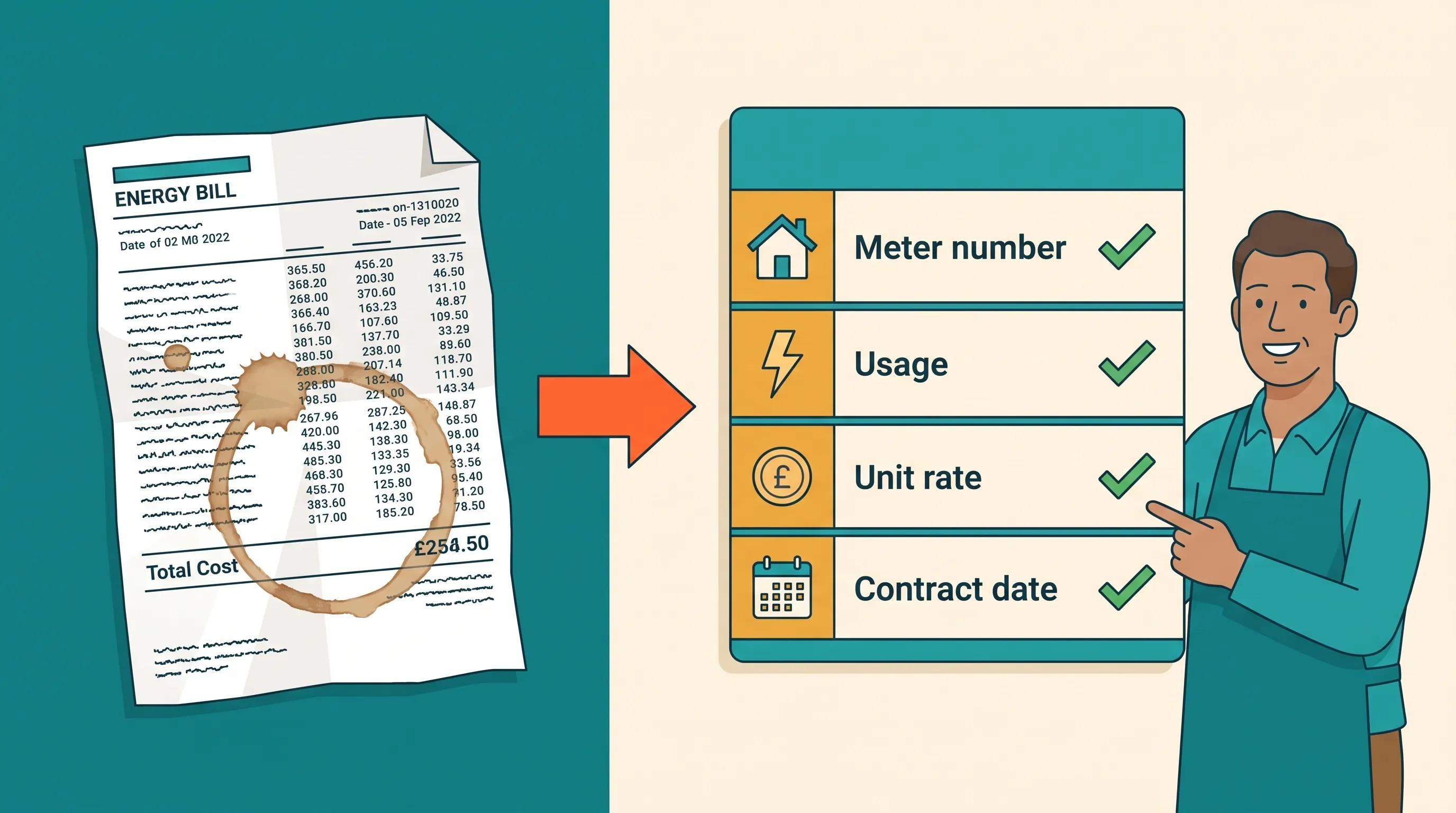
AI energy bill analysis tools for business read that bill and turn it into the figures you actually need to switch. For a UK SME, that usually means your MPAN, MPRN, kWh usage, unit rate, standing charge, VAT rate, supplier, billing period and contract dates.
At Meet George, that is not a side feature. It is the front door. George reads the bill, shows you what it found, and then takes you through the rest of the switch yourself - comparison, contract review and confirmation - designed to take about 20 minutes for a straightforward SME switch. We charge a flat 1p/kWh fee for it, not hidden commission.
No sales call.
No “we’ll get back to you”.
Just the bill, decoded.
TL;DR
- What it does: AI energy bill analysis tools for business turn a messy energy bill PDF into the figures a switch needs: meter IDs, usage, rates, dates and charges.
- Why it matters: business energy switching fails or gets delayed when the wrong bill data is used. The bill is the starting point, not an admin afterthought.
- Where Meet George fits: George uses bill analysis to kick off a self-service switch, so you can go from uploaded bill to reviewed deal without a broker-led phone process.
- What good looks like: the tool shows you the figures, flags what it is unsure about, and leaves the final check to you. Not “the AI said so”.
- Where it helps most: MPAN and MPRN checks, annual usage, contract end dates, rate comparison, VAT checks and quote preparation.
- What to watch: AI can misread poor scans or unusual bill layouts, so the final check should stay with you before anything is submitted.
What does AI energy bill analysis actually do?
AI energy bill analysis turns a supplier’s PDF into the figures you need to switch. In plain English: it reads the messy bill so you do not have to, and hands you back the numbers that matter - meter numbers, usage, rates, VAT, contract dates and supplier - as something you can actually check and act on.
The point is not the reading. Plenty of tools can pull text off a page.
The point is what happens next.
Bad AI does a magic trick and asks you to trust it.
Useful AI shows its working. It says: “Here are the figures I found. This one is clear. This one is worth a second look.” Then it leaves the final call to you.
That is the difference between a black box and a tool you can rely on to start a switch.
How does Meet George use AI bill analysis?
Meet George uses AI bill analysis as the first step in switching yourself. George does not just read your bill and leave you with a spreadsheet. It uses the checked figures to guide the next decision.
The flow is deliberately boring:
- Upload your latest bill. George reads off the key figures - supply numbers, usage, rates, supplier and contract dates - and shows them to you.
- Review what George found. You see the important fields before they are used for quotes.
- Compare supplier options. The quote inputs come from the checked bill data, not a rushed phone call.
- Read the terms in plain English. George explains the bits that usually get skipped, including dates, rates, standing charges and contract conditions.
- Choose whether to switch. You stay in control. George assists; you decide.
For a straightforward SME switch, that whole thing is designed to take about 20 minutes.
That is the product point. The AI is not there to sound clever. It is there to remove the admin that makes owners avoid switching in the first place.
What should AI energy bill analysis tools for business extract?
AI energy bill analysis tools for business should extract every field needed to understand the current bill and request a reliable quote. If the tool only grabs the supplier name and monthly spend, it is not doing enough.
| Field | What it tells you | Why it matters |
|---|---|---|
| MPAN | The electricity supply point | Suppliers need it to identify the exact meter and price the site |
| MPRN | The gas supply point | The gas equivalent of an MPAN |
| Meter serial number | The physical meter | Useful for checking the bill matches the meter on the wall |
| Billing period | The dates covered by the invoice | Stops monthly, quarterly and catch-up bills being compared as if they were the same |
| kWh usage | The energy used | The main input for quotes and annual cost estimates |
| Unit rate | The price per kWh | The biggest variable cost on most bills |
| Standing charge | The fixed daily charge | Important for low-usage sites where fixed charges bite harder |
| VAT rate | Usually 20%, sometimes 5% (0% on qualifying electricity in Great Britain, 1 October 2026 to 31 March 2027) | A wrong VAT rate can materially overstate the bill |
| Contract end date | When the current deal ends | Decides whether you can switch now or need to wait |
| Estimated or actual reading | Whether the usage is real or guessed | Estimated bills can distort quote comparisons |
An MPAN is not just “a number on your bill”. Elexon explains that the MPAN Core is the 13-digit reference used throughout systems and processes as the key to a particular metering point (Elexon MSID and MPAN guidance (opens in new tab)).
If that number is wrong, everything downstream wobbles.
Why does the final check still matter?
Reading the bill is the easy part. Knowing whether a figure is right is the part that saves you money - and it is why a good tool asks you to confirm the numbers before anything is submitted.
Here is why “close enough” is not good enough.
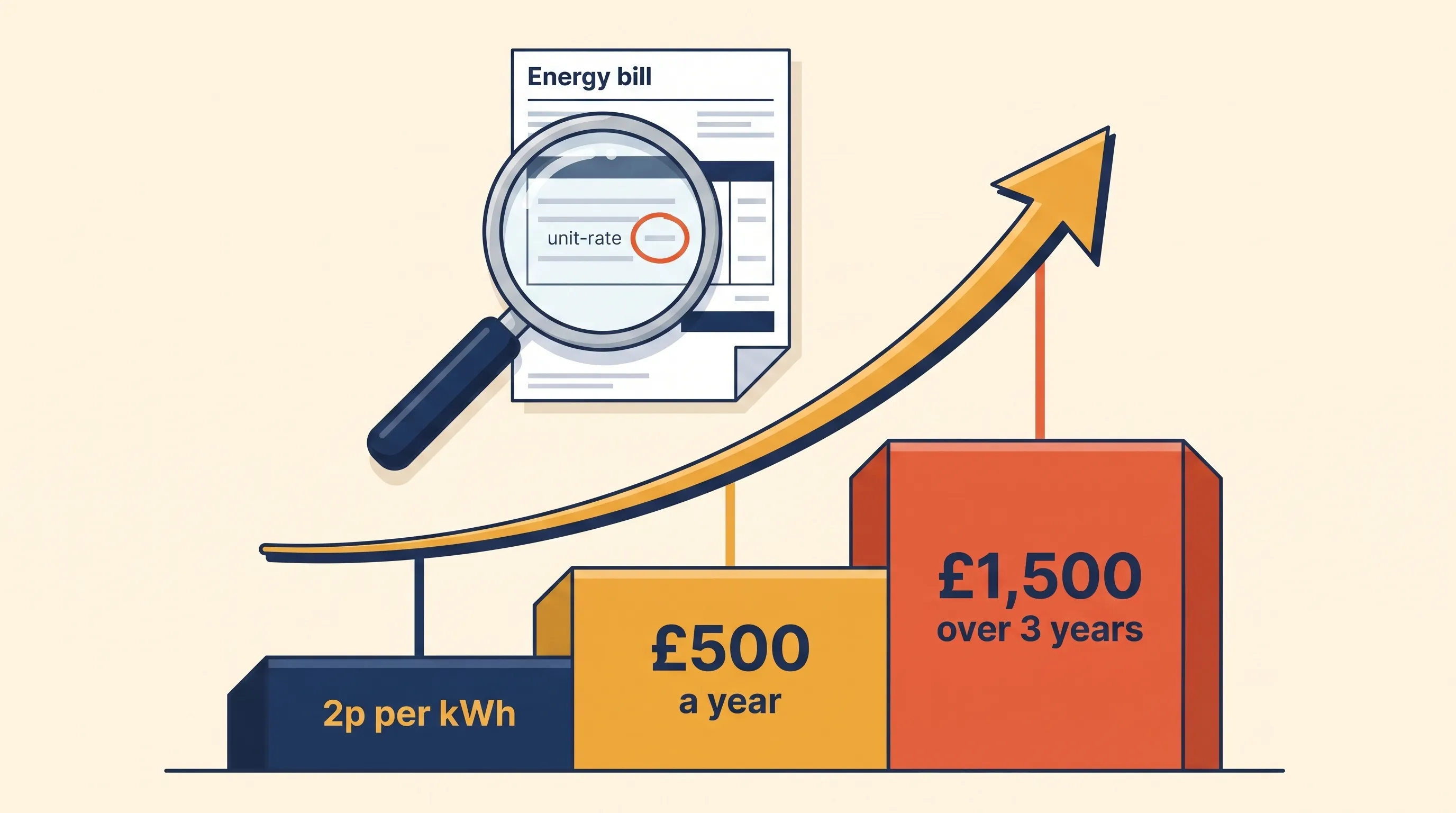
If a 25,000 kWh-a-year business has a unit rate misread by 2p/kWh, the annual difference is:
25,000 kWh x £0.02 = £500 per year
Over a three-year contract, that is £1,500 before VAT. That is an illustrative calculation, not a promise of savings - but it shows how a single wrong figure compounds.
The same applies to standing charges. A 40p-a-day difference looks tiny until you annualise it:
£0.40 x 365 days = £146 per year
Energy bills are full of numbers that look too small to care about. Then time gets involved.
That is exactly why George flags anything that looks off or uncertain and asks you to check it. A misread number should never slip through to a quote unseen.
Why does AI bill analysis matter for small businesses?
AI bill analysis matters because business energy is already painful enough without manual data entry making it worse. Ofgem’s 2024 non-domestic consumer research found that 27% of surveyed businesses were struggling to keep up with energy bills, down from 39% in 2023, and that among businesses that contacted their supplier in the previous 12 months, 23% had made a complaint, with notable increases in billing and overcharging complaints (Ofgem non-domestic 2024 research (opens in new tab)).
That is the context.
The bill is where the pain shows up, but it is also where the useful data lives. If you can read it properly, you can answer questions that usually require a call:
- Are you on the rate you think you are on?
- Is the bill based on actual or estimated usage?
- Is the VAT rate correct?
- Is your contract already out of date?
- Does the meter number match your premises?
- Is your annual usage high enough to change which suppliers will quote?
Ofgem has also published a non-domestic billing transparency guide, saying clearer bills help customers understand what they are paying for and where additional information may help (Ofgem billing transparency guide (opens in new tab)).
That is the whole point of AI bill analysis. It is not about making the bill look clever. It is about making the bill usable enough that you can act on it yourself.
Is AI bill analysis more accurate than manual entry?
AI bill analysis can be more consistent than manual entry, but it is not automatically more accurate. It depends on the document quality, the tool doing the reading, the checks it runs and whether the user is asked to review the result.
Manual entry has obvious failure modes:
- transposed digits in an MPAN or MPRN
- a decimal point typed in the wrong place
- a contract end date copied from an old bill
- estimated usage treated as actual usage
- one site in a multi-site portfolio copied into the wrong row
AI has different failure modes:
- poor scan quality
- missing pages
- supplier layouts it has not seen before
- overlapping invoices and credit notes
- fields inferred from context rather than clearly labelled
So the right comparison is not “AI versus humans”. It is AI plus checks plus human review versus rushed manual admin and another call you did not ask for.
That is much more interesting. And much more honest.
What about privacy and security when you upload a bill?
A business energy bill can contain personal data, especially for sole traders, small landlords and family-run companies. AI bill analysis should therefore follow the same discipline you would expect from any serious business software: data minimisation, access control, clear retention rules and explainable outputs.
The ICO’s AI guidance says organisations using AI need to apply UK GDPR principles and assess risks to people’s rights and freedoms (ICO artificial intelligence guidance (opens in new tab)). That matters because a bill is not just a number. It can include a named contact, business address, meter identifiers, account details and usage patterns.
At Meet George, the operating principle is simple: AI assists, you decide. Our AI Transparency page explains that AI helps with document extraction, Q&A and recommendations, but that you must review and confirm any switch. We do not make solely automated decisions that have legal or similarly significant effects on you.
That is not a footnote. It is the product design.
How does bill analysis make business energy self-service?
Bill analysis makes self-service switching possible because the bill is the bottleneck. Once the bill has been turned into checked data, the rest of the workflow can happen online: eligibility checks, quote inputs, supplier comparison, explanations and contract review.
The old workflow looks like this:
| Step | Manual broker-style workflow | Meet George self-service workflow |
|---|---|---|
| Find bill data | Customer reads it out on a call | Upload the bill |
| Get the figures | Human re-types details | George reads them off the bill |
| Check errors | Often found later | Flagged before quote submission |
| Compare offers | Explained verbally | Shown on-screen with the inputs visible |
| Decide | Sales-led moment | Customer-controlled review |
This is where the article comes back to Meet George.
We are not building AI bill analysis because every product now needs an AI sticker on the box. We are building it because a small business owner should be able to switch energy the way they do everything else online: see the inputs, understand the options, choose the deal, and move on with their day.
The future is likely to move beyond uploaded PDFs. In April 2025, Ofgem selected the Retail Energy Code Company as the delivery body for the Consumer Consent Solution, a standardised way for consumers to grant and manage consent to share energy data (Ofgem Consumer Consent Decision (opens in new tab)). Ofgem said the solution would start with smart meter consumption data and expand to other datasets as priorities allow.
That is not the same thing as a live non-domestic API for every SME bill today. It is the direction of travel: less paperwork, more consented data, fewer phone calls.
About time.
What should you check after an AI reads your bill?
After an AI reads your bill, check the fields that can break a quote or change the cost. Do not review every comma. Review the data that moves money.
- MPAN and MPRN. Make sure the supply identifiers match the meter or premises you want to switch.
- Billing period. Check whether the bill covers one month, a quarter or a catch-up period.
- Usage. Confirm whether the kWh figure is actual, estimated or annualised.
- Unit rate. Check the decimal point. 24.5p/kWh and 2.45p/kWh are not cousins.
- Standing charge. Multiply the daily rate by the number of days in the bill.
- VAT. Confirm whether 20% or 5% has been applied - or 0% on qualifying electricity in Great Britain from 1 October 2026 to 31 March 2027 - and whether your supply qualifies for the reduced rate.
- Contract end date. A great quote is not useful if you cannot leave yet without a termination fee.
- Supplier and account details. Useful for switch paperwork and dispute handling.
If you want the manual version of this, start with our guide to reading a business energy bill. If you just want the key identifiers decoded, read the guide to MPAN and MPRN numbers.
Or, if you are using Meet George, let George read the bill first - then check the fields it gives back to you.
The bottom line
AI-powered energy bill analysis matters because business energy switching starts with a document most owners do not have time to decode. If George can read the bill, flag what is worth a second look and let you review the result, switching can move from phone-led admin to self-service.
That does not mean handing control to a machine. It means taking the boring work away from you, then handing the decision back.
That is the bit the broker model was never built to do. And because Meet George charges a flat 1p/kWh fee instead of hidden commission, there is no incentive to bury the numbers in a phone call - here is exactly how we are paid.
And that is why the bill is the front door.
Sources
- Ofgem: Non-domestic 2024 research report (opens in new tab)
- Ofgem: Non-domestic best practice guide on billing transparency (opens in new tab)
- Elexon: MSID and MPAN Guidance (opens in new tab)
- ICO: Artificial intelligence guidance (opens in new tab)
- Ofgem: Consumer Consent Decision (opens in new tab)


